ATLANTA – With Georgia’s finances in better shape than last year at this time, the General Assembly is expected to consider tax relief this winter aimed at low- and middle-income Georgia families.
House Bill 510, which was introduced last February, would provide a state-level Earned Income Tax Credit (EITC) modeled after a federal tax credit that has been around since 1975.
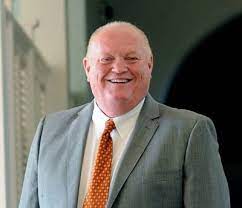
A state EITC would help prop up the bottom lines of working Georgians whose livelihoods were disrupted by the coronavirus pandemic, said Georgia Rep. Ron Stephens, one of the bill’s cosponsors.
“The other side believes cutting government checks is the answer,” said Stephens, R-Savannah. “We believe in incentivizing those people who will go out and work to continue to work.”
Democrats as well as Republicans back the legislation. Rep. Scott Holcomb, D-Atlanta, is also among its cosponsors.
The measure also enjoys public support. A statewide poll released last month by the Georgia Budget and Policy Institute found nearly 70% approval for using some of Georgia’s share of federal COVID-19 relief funds to create a state-level Earned Income Tax Credit.
Danny Kanso, a senior policy analyst with the institute, said President Joe Biden’s $1.2 trillion infrastructure bill making its way through Congress will provide plenty of money for water and sewer improvements and expanding broadband in Georgia.
That means the $4.8 billion the state will be receiving from the American Rescue Plan Congress passed last March should be available for the proposed tax credit, he said. The credit would cost the state about $130 million a year, according to the institute’s calculations.
“It would benefit over a million kids in Georgia and their families,” Kanso said. “In some rural counties, above 50% of the families are eligible. That’s a strong motivator for rural lawmakers.”
Under House Bill 510, Georgians would qualify for the state-level EITC if they are eligible to receive the federal tax credit. The state-level credit would equal 10% of what qualified taxpayers receive from the federal credit.
Kanso said nearly 30 states already have a state-level Earned Income Tax Credit, including South Carolina and other heavily Republican states.
Kyle Wingfield, president and CEO of the Georgia Public Policy Foundation, said the budget surplus the state has built up despite the economic ravages of the pandemic means the General Assembly can afford a state-level EITC.
“Georgia’s good fiscal stewardship, especially during the pandemic, has put it in a good position to provide relief to Georgia taxpayers,” Wingfield said. “We expect a variety of strong proposals to do just that.”
Stephens said he expects legislative Republicans to push several tax-relief proposals during the 2022 legislative session, including a further rollback of Georgia’s income tax rate. Lawmakers reduced the rate from 6% in 2018 to 5.75% but have yet to deliver a promised second round of tax cutting, citing the effects of the pandemic on the state’s finances.
Stephens said he’d like to see the state income tax rate reduced to 5.5% or less.
“We need to cut back our income tax to compete with surrounding states, particularly North Carolina,” he said.
Besides cutting Georgia’s income tax rate and providing a state-level Earned Income Tax Credit, Stephens said lawmakers also may consider exempting retired veterans from state income taxes.
This story available through a news partnership with Capitol Beat News Service, a project of the Georgia Press Educational Foundation.
ATLANTA – Former President Donald Trump has endorsed University of Georgia football great Herschel Walker for the U.S. Senate and state Sen. Burt Jones for lieutenant governor.
Trump’s friendship with Walker goes back to 1984, when Walker signed with the United States Football League’s New Jersey Generals, a team Trump owned.
Trump urged Walker to seek the Republican nomination for the Senate seat now held by Democrat Raphael Warnock for weeks before Walker entered the race last week.
“Herschel Walker is a friend, a patriot and an outstanding American who is going to be a great United States senator,” Trump wrote in his endorsement statement. “Herschel is tough on crime and borders, and he will always stand in support of law enforcement, military and our vets. He will fight hard for our Second Amendment and voter integrity.”
“Thank you to my friend President Trump for your support and encouragement!” Walker said. “Together, we will win back the U.S. Senate for Georgia!”
The Republican field in the 2022 Senate race also includes Georgia Agriculture Commissioner Gary Black; Latham Saddler, an Atlanta banking executive and former Navy SEAL officer; and Kelvin King, a small business owner and Air Force veteran also from Atlanta.
Jones, R-Jackson, was the first elected official in Georgia to support Trump for president back in 2016 and served as Trump campaign co-chairman in Georgia in 2016 and 2020.
Jones also was among a group of Senate Republicans who asked Gov. Brian Kemp to call a special session of the General Assembly shortly after last November’s elections to consider changes to Georgia’s election laws.
The group conducted hearings inside the state Capitol in December that lent ammunition to Trump’s claims of election fraud, which were subsequently dismissed in the courts.
“I am the only person in my race who has had the president’s back from day one, and it’s an honor to have his full support,” Jones said. “As lieutenant governor, I will work to advance the president’s America First agenda and continue to grow our economy, improve our schools, secure our elections, and keep Georgia safe.”
Also vying for the next year’s Republican nomination for lieutenant governor are state Senate President Pro Tempore Butch Miller of Gainesville and GOP activist Jeanne Seaver of Savannah.
Two Democratic state representatives, Erick Allen of Smyrna and Derrick Jackson of Tyrone, also are looking to step up to lieutenant governor.
The current lieutenant governor, Republican Geoff Duncan, is not seeking reelection.
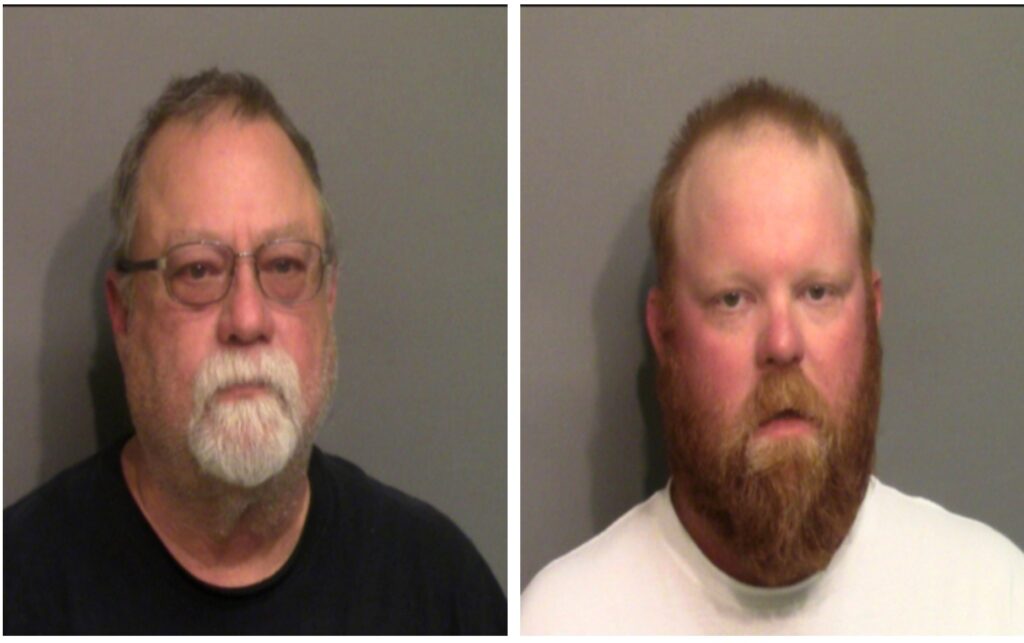
Greg McMichael (left) and Travis McMichael (right) are charged in the fatal shooting of Ahmaud Arbery. (Glynn County Sheriff’s Office)
ATLANTA – A Glynn County grand jury indicted former Brunswick District Attorney Jackie Johnson Thursday for misconduct in the investigation of the shooting death of Ahmaud Arbery last year.
Johnson is charged with violating her oath as a public official and obstructing a police officer. The first charge is a felony punishable by one to five years in prison, while the second is a misdemeanor.
Specifically, Johnson is accused of showing favoritism in the investigation toward suspect Greg McMichael, who had worked as an investigator in her office, and “failing to treat Ahmaud Arbery and his family fairly and with dignity,” the indictment stated.
The obstruction charge results from Johnson telling two Glynn County police officers not to arrest McMichael’s son Travis, according to the indictment.
“Our office is committed to ensuring those who are entrusted to serve are carrying out their duties ethically and honestly,” said Georgia Attorney General Chris Carr. “While an indictment was returned today, our file is not closed, and we will continue to investigate in order to pursue justice.”
Arbery, a 25-year-old Black man, was gunned down in February of last year. He was jogging in the Satilla Shores neighborhood when the two McMichaels allegedly armed themselves, got into a pickup truck and chased him. They were able to use their truck to cut off his route.
A third suspect, William “Roddie” Bryan, is accused of joining the chase in a second truck.
All three face state charges of malice murder, felony murder, aggravated assault, false imprisonment and criminal attempt to commit a felony. They also were indicted by a federal grand jury for hate crimes.
Johnson was widely criticized over her handling of the case and lost her bid for reelection last November.
This story available through a news partnership with Capitol Beat News Service, a project of the Georgia Press Educational Foundation.
ATLANTA – The Democratic Party of Georgia wrapped up a five-city tour in Atlanta Thursday, urging the state’s Republican congressional delegation to pass a bipartisan infrastructure bill.
President Joe Biden’s $1.2 trillion infrastructure spending package is expected to include $8.9 billion for Georgia highways over five years, $1.4 billion to improve public transit, $913 million for water and sewer projects, $225 million for bridge repairs and replacements, $135 million for electric-vehicle charging stations and at least $100 million to expand the deployment of broadband.
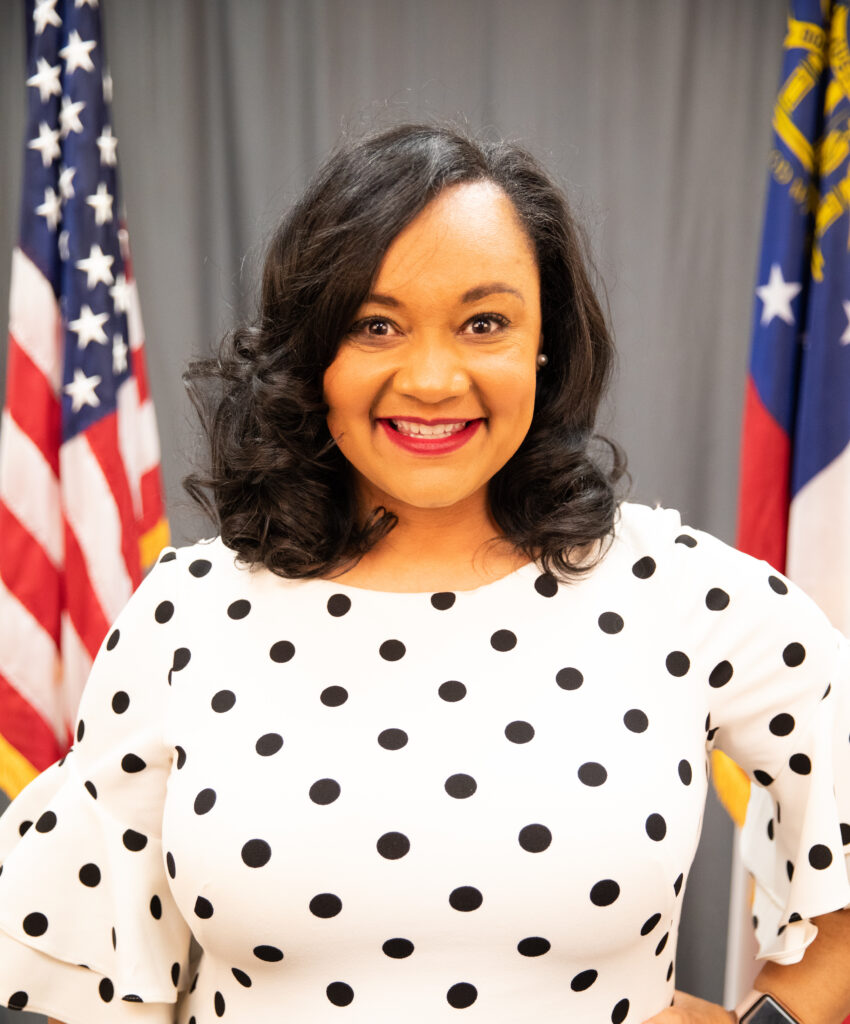
“This is why elections matter,” U.S. Rep. Nikema Williams, D-Atlanta, Georgia’s Democratic chairman, said during a news conference in Liberty Plaza across from the state Capitol. “Real people’s lives are being made better.”
“This bill represents the largest long-term investment in our infrastructure in nearly a century without raising taxes on anybody making less than $400,000 a year,” added state Rep. Billy Mitchell, D-Stone Mountain, chairman of the Georgia House Democratic Caucus.
The U.S. Senate passed the infrastructure bill 69-30 last month, with 19 Republicans joining Democrats in support of the measure. The House of Representatives followed with a 220-212 procedural vote along party lines to move the infrastructure package forward, with a final vote expected later this month.
Williams criticized Georgia’s Republican House members for opposing the procedural motion, which also included a vote to move ahead with Biden’s much larger $3.5 trillion spending bill aimed at “human” infrastructure including child care, health care and climate change measures.
“Republicans have refused time and time again to set aside partisanship and help working families,” Williams said.
Republicans countered that the “Democrats Deliver” statewide tour ignored the state of the U.S. economy, immigration and America’s ugly exit from Afghanistan.
“Georgia Democrats [are] celebrating crushing inflation, rising crime, an out-of-control southern border and the worst foreign policy disaster in decades,” said Garrison Douglas, Georgia spokesman for the Republican National Committee. “Democrats should focus on ending the multitude of crises they’ve created.”
Besides Atlanta, the Democrats’ tour included stops in Augusta, Savannah, Macon and Columbus.
ATLANTA – Rural Georgia is suffering from failing schools, inadequate health care and lack of economic opportunity, conditions that make politicians’ boasts the state is No. 1 for doing business ring hollow.
That’s the message Georgia lawmakers heard this week from experts who have been studying the plight of the Peach State’s rural communities for years.
“With the exception of 11 or 12 counties, much of Georgia is in a very distressed situation,” David Bridges, interim director of the Georgia Center for Rural Prosperity and Innovation, told members of the House Rural Development Council Wednesday. “If we’re going to be the No.-1 state for business, we must define the state as 159 counties, not 11 or 12.”
It’s a message lawmakers have been hearing since 2017, when House Speaker David Ralston, R-Blue Ridge, created the council to look for ways to improve rural Georgia’s economy. Wednesday’s meeting marked a reboot of the council after a period of inactivity with new co-chairmen and many new members.
“We want to do things to make rural Georgia stronger, to make people want to live there,” said Rep. Rick Jasperse, R-Jasper, one of those new co-chairs.
The 2020 Census highlighted the heart of rural Georgia’s dilemma: a loss in population. It showed that 68 of the state’s 159 counties have suffered population declines since 2010.
The populations of three counties – Dooly, Telfair and McIntosh – have fallen by more than 20% during the last decade. Numerically, Dougherty County led the way, with a population decline of 8,775.
Rural Georgia’s population also is aging. Georgians ages 65 and older now make up 19% of the population in rural counties, a figure that is projected to increase to 22% by 2030.
With that older population comes greater demand for government services, said David Tanner, associate director for state services and decision support at the University of Georgia’s Carl Vinson Institute of Government.
“Older people retiring in North Georgia is putting more pressure on health programs,” he said.
However, the greatest disparity between rural Georgia and the urban counties surrounding Atlanta, Augusta, Savannah and other Georgia cities is educational attainment, said Charlie Hayslett, a retired public relations consultant who writes a blog titled “Trouble in God’s Country.”
“It may be the single biggest problem affecting the dynamics of rural Georgia,” he said.
If metro Atlanta were a state, Hayslett said, it would rank second to Massachusetts in the percentage of the adult population with at least a four-year college degree. Georgia’s other 147 counties would rank second from the bottom in that category, behind only Mississippi, he said.
The 12 counties in metro Atlanta also have outstripped the other 147 in enrollment in University System of Georgia colleges and universities, he said.
Bridges, who also serves as president of Abraham Baldwin Agricultural College in Tifton, said the coronavirus pandemic is worsening rural Georgia’s plight in some ways, including putting more stress on the region’s workforce.
But Tanner said there is a silver lining to COVID-19. He said the movement of Georgians out of rural areas appears to have slowed since the pandemic struck, with the increase of working from home.
He said improving broadband connectivity in rural communities would go a long way toward encouraging that trend.
“If [rural areas] have great broadband they can attract the remote worker,” Tanner said.
Bridges said reducing government regulation and bureaucracy also would help speed help to rural Georgia. While he praised Gov. Brian Kemp’s creation this year of a Rural Innovation Fund to help local elected officials and economic development leaders create jobs, he said the $40 million initiative appears to be tied up in red tape.
“We have no idea how to get our hands on that money or what the process and rules are,” he said.
Bridges conceded that solving the challenges facing rural Georgia will be difficult.
“The problems are deeply rooted. They can’t be fixed overnight,” he said. “But that doesn’t mean we shouldn’t acknowledge them and address them.”