STONE MOUNTAIN – A new company owned by a veteran executive at Stone Mountain was named Monday as the finalist to take over management of the park next summer.
The Stone Mountain Memorial Association’s board voted unanimously to enter into negotiations with Thrive Attraction Management. The new firm’s owner, Michael Dombrowski, has served as the park’s vice president and general manager since 2014.
“We are honored to have been selected to continue the great work of managing Stone Mountain Park for the past several years and to keep in place an experienced group of senior managers and engaged employees,” Dombrowski said Monday.
“We’ll build on our success by … ensuring Stone Mountain Park is a welcoming and inclusive environment for all visitors from Atlanta, the nation and the world.”
The Stone Mountain board has been under pressure since nationwide civil rights protests erupted during the summer of last year to deemphasize Confederate imagery at the park, dominated by a giant mountainside sculpture of Confederate leaders Jefferson Davis, Robert E. Lee and Stonewall Jackson.
The board responded last May by passing resolutions to add historic context to the sculpture with a museum exhibit to be located at the park’s Memorial Hall and move the Confederate flags lining the park’s main walkup trail to the base of the mountain.
Then in August, board members adopted a new logo for the association that leaves out the Confederate symbols contained in the former logo.
While critics of the Confederate imagery at Stone Mountain have called for the carving and other symbols of the Confederacy to be removed altogether, a law the General Assembly passed in 2019 prohibits removing historic monuments from public property.
Subject to a final agreement, Thrive Attractions Management would take over at Stone Mountain next July 31, when the park’s current lease with Herschend Family Entertainment expires.
The new company will partner with Crescent Hotels and Resorts to oversee operations at the Evergreen Resort and Conference Center and the Stone Mountain Inn.
“Crescent has consistently ranked as one of the top five hotel management companies in America,” said Bill Stephens, the association’s CEO.
In other news Monday, the board announced it is releasing a request for proposals for a company with experience in museum exhibition design to develop an interpretive plan for the exhibit at Memorial Hall.
“We want to provide an expanded interpretation of the sculpture as art, the technological achievement it reflects and its relationship to local history,” the RFP states.
“The new exhibit should be thought-provoking and engaging and should entice new visitors to the museum as well as encourage and excite Georgians to revisit it.”
Proposals are due next April, and the board is scheduled to award a contract in June.
This story is available through a news partnership with Capitol Beat News Service, a project of the Georgia Press Educational Foundation.
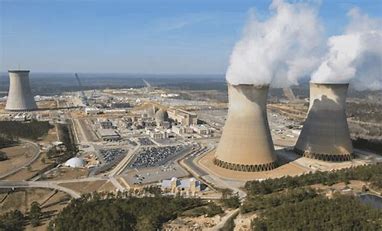
The Unit 3 tower under construction at Plant Vogtle (left). Units 1 and 2, built more than 30 years ago, are on the right.
ATLANTA – Georgia Power has announced another delay in the completion of the nuclear expansion at Plant Vogtle.
The first of two new reactors being built at the plant south of Augusta won’t be ready to go into commercial service until the third quarter of next year, the Atlanta-based utility announced Thursday. Under the revised schedule, the second unit will be delayed until the second quarter of 2023.
In both cases, that marks an additional delay of three months for two reactors that originally were due to be completed in 2016 and 2017.
Georgia Power blamed the delay on the need for additional time to deal with ongoing construction challenges and allow for the comprehensive testing necessary to ensure quality and safety standards are met.
“As we’ve said from the beginning of this project, we are going to build these units the right way, without compromising safety and quality to achieve a schedule deadline,” said Chris Womack, chairman, president and CEO of Georgia Power.
“We have endured and overcome some extraordinary circumstances building the first new nuclear units in the U.S. in more than 30 years. Despite these challenges, progress at the site has been steady and evident.”
The project was originally expected to cost $14 billion but has nearly doubled after years of delays and cost overruns. A key factor driving up the cost was the bankruptcy of prime contractor Westinghouse and its replacement by Southern Nuclear, like Georgia Power, a subsidiary of Atlanta-based Southern Co.
The most recent delay Georgia Power announced back in July drove up the capital cost of the project by $460 million.
The state Public Service Commission is scheduled to vote early next month on how much of the mounting costs for the first of the new reactors the utility will be allowed to pass on to customers.
A tentative agreement announced last week would let Georgia Power pass on an additional $2.1 billion. However, the utility would not be permitted to start recovering those costs until one month after that first reactor goes into commercial operation.
Between them, the two reactors once in service will power more than 500,000 Georgia homes and businesses. With more than 7,000 workers on the site, the Plant Vogtle expansion is the largest construction project in the state.
This story is available through a news partnership with Capitol Beat News Service, a project of the Georgia Press Educational Foundation.
ATLANTA – In 2011, majority Republicans in the General Assembly drew such heavily partisan legislative maps that the GOP captured a “supermajority” – 38 of 56 seats – in the state Senate the following year.
In the Georgia House of Representatives, Republicans fell just one seat short of that two-thirds majority in 2012, winning 119 of 180 seats.
But the Georgia Democratic Party of 2021 is stronger than it was a decade ago. In the last two election cycles, Democrat Stacey Abrams lost an open gubernatorial race to Republican Brian Kemp by just 1.4 percentage points, while Democrats flipped two GOP-held congressional seats in Atlanta’s northern suburbs.
Democrat Joe Biden carried Georgia by 11,779 votes last November on his way to turning Republican President Donald Trump out of office. And two months later, Democrats Jon Ossoff and Raphael Warnock defeated Republican incumbents to win Georgia’s two U.S. Senate seats.
Republicans will still be in charge of drawing new maps based on the 2020 Census results during a special legislative session starting Nov. 3. But Georgia political observers aren’t looking for a repeat of 2011’s GOP successes.
“This is not 2011,” said Brian Robinson, a top aide to former Gov. Nathan Deal and a Republican political commentator. “Republicans can’t go in trying to run the table. They have to pick what they’re willing to give up to shore up other areas.”
The reason behind the Democratic gains in Georgia lies in demographic changes.
The Peach State’s Black population has grown by 15.8% during the last decade. The state’s Hispanic population is up by 31.6%, and Asian Americans in Georgia have soared by 54.8%. All three minority groups tend to vote for Democrats.
Advocates for minority groups called on legislative Republicans to incorporate those demographic changes into the new maps during public hearings held across the state over the summer.
“If the lines are drawn fairly, they will accurately reflect racial diversity,” said Glory Kilanko, founder and CEO of Women Watch Afrika Inc., an Atlanta-based social justice nonprofit. “If our communities are divided up, we’ll be inadequately represented.”
Another trend that could play in Democrats’ favor in the upcoming redistricting process is a loss of population during the last decade in rural South Georgia, where voters tend to favor Republicans. By law, redrawn legislative districts cannot vary in population by more than 10%.
“[Republicans] are going to have to move some seats out of South Georgia to North Georgia,” said Charles Bullock, a political science professor at the University of Georgia. “It may take some creative cartography.”
Georgia Republicans do have some advantages they didn’t enjoy during the 2011 redistricting. The U.S. Supreme Court in a 2013 ruling did away with the “preclearance” provision of the federal Voting Rights Act, which required states with a history of racial discrimination to submit their congressional and legislative maps to the Justice Department.
“This is a potential obstacle that’s been removed,” said Kerwin Swint, a political science professor at Kennesaw State University.
But state Sen. Elena Parent, D-Atlanta, said parties that might object to maps the Republicans draw still have recourse to the courts despite the loss of the preclearance requirement.
“The provisions of Section 2 of the Voting Rights Act are in place,” she said. “There are legal protections for historically disenfranchised communities.”
Bullock said a further motive for Republicans not to take advantage of the lack of preclearance is that drawing districts designed to elect Black legislators helps Republicans politically by allowing them to “pack” surrounding districts with white voters likely to support GOP candidates.
“The idea that without preclearance, these Black districts are going to be carved up and split up is not going to happen,” he said.
Another advantage legislative mapmakers will have is that next month’s special session won’t take place until after the Nov. 2 municipal elections across Georgia. Under the law, incumbent state lawmakers who don’t like how their district has been drawn can’t move elsewhere to run within a year of the next election.
The ability to “freeze” lawmakers in their districts will allow Republicans to sabotage Democrats by drawing two or more Democratic incumbents into the same district and forcing them to run against each other.
But Swint said the loss of population in heavily Republican rural counties means GOP incumbents could also end up inside the same districts in order to make the population numbers work.
“It can be a real challenge to do that to Democrats and not Republicans as well,” he said.
Bullock predicted the demographic trends going against the Republicans are going to be too much to overcome despite GOP leaders’ control over redistricting.
“My guess is the Democrats won’t get what they like, but they’re probably going to get more seats than they have now,” he said. “Republicans are going to have to figure out how to strategically cut their potential losses.”
But Robinson said Republicans should be able to do better than mitigate an inevitable loss of seats. He said the key to GOP success will lie in drawing maps that pack Democrats – who tend to live closer together – while spreading out Republicans who already live in less dense communities.
“If Democrats win districts by 80%, and Republicans win by 50% to 60%, that’s how you do it,” he said.
Edward Lindsey, a former Georgia House majority whip, said he doesn’t believe redistricting will result in any dramatic shifts in the makeup of the General Assembly.
“Republicans should expect to lose three to five [House] seats south of Interstate 20,” he said. “[But] Republicans have a chance to regain three to five seats in suburban Atlanta by focusing on Republican principles.”
This story is available through a news partnership with Capitol Beat News Service, a project of the Georgia Press Educational Foundation.
ATLANTA – Georgia posted the strongest employment numbers last month since the coronavirus pandemic began more than a year and a half ago, the state Department of Labor reported Thursday.
Unemployment fell to a record low of 3.2% in September, dipping below the 3.3% jobless rate posted in January of last year, shortly before COVID-19 struck Georgia.
The number of employed Georgians rose above 5 million for the first time since the pandemic began, and the 161,786 listed as unemployed was at its lowest level since June 2001.
“This is excellent progress for Georgia,” state Commissioner of Labor Mark Butler said Thursday. “It shows that the state’s economy is rapidly recovering, and [the labor department’s] programs, along with other state policies, are working to get people back to work.”
The number of jobs statewide rose 14,300 last month compared to August. As a result, the state has regained 521,000 of the 609,500 jobs lost during the early stages of the pandemic in March and April of last year.
The job sector posting the most over-the-month job gains were retail trade, which gained 5,900 jobs in September. The number of wholesale trade jobs in Georgia was up by 2,100, and jobs in the transportation and warehousing sector increased by 1,800.
At the same time, accommodation and food services – the job sector hardest hit by the pandemic – is still down by 52,000 jobs.
“Our teams are proactively reaching out to unemployed jobseekers around the state to offer support services with finding a job, along with staff doing specialized recruitments,” Butler said.
First-time unemployment claims dropped substantially last month by 19,037 to 28,835. For the year, initial jobless claims are down 172,955, or 86%.
The labor department has 193,739 job openings posted on the Employ Georgia website, with a minimum of 308,106 unfilled positions.
“This is almost twice the number of available jobs than we have people currently looking for employment,” Butler said. “This is the main factor affecting job growth as employers across the state continue to struggle to fill vacant positions.”
This story is available through a news partnership with Capitol Beat News Service, a project of the Georgia Press Educational Foundation.
State School Superintendent Richard Woods (Photo by Beau Evans)
ATLANTA – Georgia’s high-school graduation rate remained steady this year despite the impacts of the coronavirus pandemic.
The Peach State posted a graduation rate of 83.7% for the 2020-2021 school term, down slightly from the 83.8% rate achieved during the previous term, the Georgia Department of Education reported Thursday.
COVID-19 forced school districts to make a series of adjustments during the last school year, with some resorting to virtual instruction for long periods but others able to get students back into their classrooms by exercising safety precautions included mask wearing and social distancing.
“Given the impacts of the COVID-19 pandemic, I am pleased to see Georgia’s graduation rate holding steady,” State School Superintendent Richard Woods said.
“Combined with the class of 2021’s increases in ACT and SAT scores, this is an encouraging indicator about the work being done in public schools. Teachers and students have continued to succeed in the face of challenging circumstances.”
High-school graduation rates have risen steadily during the past decade. This year’s rate marked an increase of 14% over the class of 2012.
Meanwhile, two Georgia high schools – Berrien Academy Performance Learning Center and Clarkston High School – have been taken off a federal list of schools targeted for low graduation rates.
“An exit from CSI (Comprehensive Support and Improvement) status means a school has done hard work that produced measurable improvements for their students,” Woods said.
This story is available through a news partnership with Capitol Beat News Service, a project of the Georgia Press Educational Foundation.