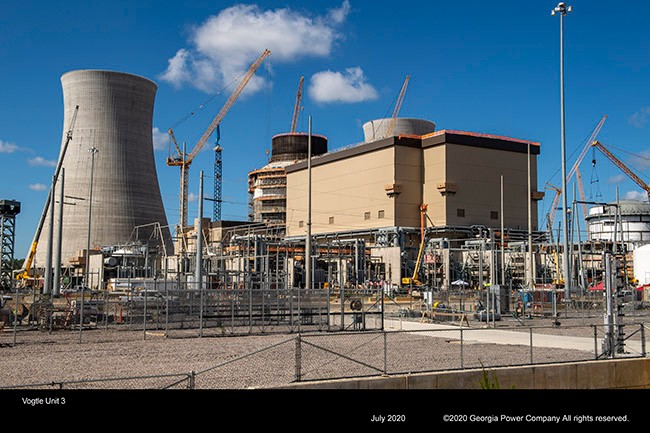
ATLANTA – Georgia’s utility-regulating agency voted unanimously Tuesday to let Georgia Power pass on to customers $2.1 billion of the costs of completing the first of two new nuclear reactors at Plant Vogtle.
That figure, which will boost average residential customer bills by $3.78 a month, was set in an agreement the Atlanta-based utility and the state Public Service Commission’s (PSC) Public Interest Advocacy Staff reached last month.
Under the agreement, Georgia Power will not be allowed to start recovering the $2.1 billion until one month after the reactor unit goes into commercial operation. The latest delay in the project Georgia Power announced late last month means that first reactor won’t be ready until the third quarter of next year.
The PSC voted in August to stop approving incremental cost increases incurred at the long-delayed, over-budget nuclear expansion at the plant south of Augusta. Instead, the commission postponed deciding how much of the cost overruns Georgia Power customers will ultimately have to bear until after Unit 3, the first of the two new reactors, is completed.
The Plant Vogtle nuclear expansion, originally projected to cost about $14 billion when the PSC approved the project a dozen years ago, has soared to at least $26 billion.
The cost overruns are the result of numerous delays in the project schedule, from an original completion timetable of 2016 for the first reactor and 2017 for the second to the latest estimate of 2022 and 2023.
In their defense, Georgia Power officials have argued they are building the first new nuclear reactors in the United States in 30 years. The project has been beset by the bankruptcy of Westinghouse Electric, the original prime contractor, and by delays associated with the coronavirus pandemic’s impact on the construction workforce.
This story is available through a news partnership with Capitol Beat News Service, a project of the Georgia Press Educational Foundation.
ATLANTA – The University System of Georgia (USG) experienced a slight decline in enrollment this fall after seven straight years of growth.
Total enrollment at the university system’s 26 colleges and universities stands at 340,638 students, system officials reported Monday.
The enrollment decline resulted from a 3.7% decrease in students at the system’s state universities and a 6.7% drop-off at state colleges.
The number of students at the system’s research and comprehensive universities actually grew, helping offset the losses at the state colleges and universities. At the four research universities, enrollment increased by a healthy 2.6%, while the comprehensive universities saw a slight increase of 0.5%.
Overall, the enrollment decline was just 0.2% – or 851 students – which system officials blamed on the disruptions brought about by the coronavirus pandemic.
“I appreciate all the challenges our students have overcome as they have persisted on their journey toward their degree from a USG institution,” said Teresa MacCartney, the system’s acting chancellor.
Undergraduate enrollment at the system’s four-year institutions fell by 2.1%, while graduate student enrollment grew by 7.9%. In both cases, the USG numbers were stronger than the national average for four-year institutions.
Enrollment increased at five system institutions: the University of Georgia, Georgia Tech, Kennesaw State University, Augusta University and Georgia Southern University. Georgia Tech posted the largest jump at 10.3%.
Twenty institutions experienced declines in enrollment. The largest drop came at East Georgia State College, where enrollment fell by 16.2%.
Enrollment at Georgia Southwestern State University was flat.
The demographic numbers showed growth among Hispanic and Asian students, which increased their enrollments by 3.4% and 10.3%, respectively. Enrollment by Black students was down 2.4%, while white student enrollment dropped 2.2%.
This story is available through a news partnership with Capitol Beat News Service, a project of the Georgia Press Educational Foundation.
ATLANTA – Several dozen of former Georgia Rep. Meagan Hanson’s former colleagues in the state House of Representatives are endorsing her bid for Congress.
The Sandy Springs Republican announced Monday she has picked up endorsements from 35 current and 10 former state House members for the GOP nomination in Georgia’s 6th Congressional District.
“These Republican officials are men and women I served with in the state legislature and who have seen firsthand that I have the work ethic, vision, and grit necessary to defeat [U.S. Rep.] Lucy McBath and restore conservative leadership to Washington,” Hanson said Monday. “I am tremendously grateful for the confidence they have placed in me.”
Current state lawmakers endorsing Hanson include Rep. Bruce Williamson, R-Monroe, secretary of the House Republican Caucus, and several committee chairmen: Reps. Terry England, R-Auburn; of the House Appropriations Committee; Alan Powell, R-Hartwell, who chairs the Regulated Industries Committee; Richard Smith, R-Columbus, the Rules Committee chairman; and Don Parsons, who chairs the Energy, Utilities & Telecommunications Committee.
Former GOP House members supporting Hanson include Wendell Willard of Sandy Springs and Brett Harrell of Snellville.
Two members of the state Public Service Commission – Republicans Tricia Pridemore and Jason Shaw – also are backing Hanson.
Hanson is among several Republicans vying to challenge McBath, D-Marietta, who won the seat in 2018 after the GOP had held it for decades. The list includes Jake Evans, former chairman of the Georgia Government Transparency & Campaign Finance Commission; U.S. Army veteran Harold Earls and activist Suzi Voyles.
The 6th Congressional District covers East Cobb, North Fulton and North DeKalb counties. However, Republicans in control of the General Assembly are likely to redraw the district during the special legislative session that starts on Wednesday to give the GOP a better chance of winning it back.
This story is available through a news partnership with Capitol Beat News Service, a project of the Georgia Press Educational Foundation.
ATLANTA – The Georgia Court of Appeals has upheld a lower court decision allowing Georgia Power to collect from customers $525 million in coal ash pond closure costs.
Monday’s ruling came in an appeal filed by the state chapter of the Sierra Club.
Georgia Power has committed to spending nearly $9 billion in the coming decades on a plan to close all 29 of its ash ponds located at 11 coal-burning power plants across the state, a cost estimate that has been revised upward at least twice from the $7.6 billion the Atlanta-based utility proposed during its 2019 rate case.
The state Public Service Commission voted to allow Georgia Power to recover a portion of those costs from ratepayers after lawyers for the utility argued the closure plan complies with federal regulations for ash ponds as well as the more stringent requirements of the Georgia Environmental Protection Division (EPD).
“We continue to strongly disagree with any claims to the contrary,” Georgia Power wrote Tuesday in a prepared response to Monday’s ruling.
“Additionally, the issue of cost recovery was thoroughly discussed and evaluated through Georgia’s open and transparent regulatory process with the Georgia Public Service Commission (PSC), with the PSC’s decision affirmed by the Superior Court of Fulton County and, with Monday’s decision, by the Court of Appeals of Georgia.”
Coal ash contains contaminants including mercury, cadmium and arsenic that can pollute groundwater and drinking water as well as air.
Georgia Power plans to excavate and remove the ash from 19 ponds and close the other 10 ponds in place.
Thus far, the EPD has held public hearings on closure plans for ash ponds at Plant Hammond near Rome and Plant Bowen near Cartersville. The state agency has yet to act on proposed permits requested by Georgia Power.
Nearly all of those who spoke during the public hearings urged the EPD to reject the permits and require Georgia Power to excavate all of the ponds and remove the ash rather than close them in place. They argued that storing toxic coal ash in unlined pits could lead to contamination of nearby streams and groundwater supplies.
David Rogers, Southeast deputy regional director for the Sierra Club’s Beyond Coal Campaign, expressed disappointment with the court ruling.
“This decision will raise power bills for communities whose utility costs are already too high,” Rogers said Tuesday. “Georgia Power knowingly stored coal ash unsafely, and should be responsible for paying for that bad decision.”
The EPD’s permitting program for ash ponds due to be closed in place requires post-closure care for 30 years, including ongoing maintenance of the cover and groundwater monitoring. Results from monitoring must be reported at least twice a year and posted on Georgia Power’s website.
The Republican-controlled General Assembly declined to consider legislation introduced by minority Democrats during this year’s legislative session requiring coal ash to be stored in lined landfills.
A bill tightening monitoring requirements for coal ash made it through the state House of Representatives but died in the Georgia Senate.
This story is available through a news partnership with Capitol Beat News Service, a project of the Georgia Press Educational Foundation.
ATLANTA – The Georgia Board of Natural Resources voted unanimously Tuesday to impose limits on comments posted on its third-party social media websites that critics say violate free-speech rights.
The new Department of Natural Resources (DNR) social media rule allows the agency to remove comments not related to the topic of the posting or that contain profanity.
Court rulings have held that such “limited public forums” do not violate freedom-of-speech protections under the U.S. Constitution’s First Amendment, Kate Iannuzzi, the DNR’s deputy executive counsel, told board members before Tuesday’s vote.
“This isn’t really silencing,” she said. “It’s just effectively communicating with the public. … We’re just keeping up with the time and how folks communicate.”
In other business Tuesday, the board approved the purchase of 909 acres in Paulding County that will be added to the 4,850-acre Paulding/Sheffield Wildlife Management Area (WMA).
The area offers opportunities for hunting, fishing, hiking and camping much closer to Atlanta than most of Georgia’s WMAs.
“This is one of the places I go to because I can get there in 40 minutes,” DNR Commissioner Mark Williams said.
The price tag for the property is $2.6 million. The largest chunk of the funding – $1.5 million comes from the U.S. Fish and Wildlife Service.
Other contributors include the DNR, the Knobloch Family Foundation, The Nature Conservancy and the National Wild Turkey Federation.
This story is available through a news partnership with Capitol Beat News Service, a project of the Georgia Press Educational Foundation.