ATLANTA – Georgians turning back their clocks by an hour this weekend to begin observing standard time might be excused for thinking they don’t have to make the time change this year.
But legislation the General Assembly passed last March adopting year-round daylight saving time won’t take effect unless and until Congress makes the change at the national level.
Georgia lawmakers approved the permanent daylight saving time bill on the final day of this year’s legislative session following a session-long debate that included consideration of a second measure calling for the Peach State to observe standard time all year long.
The state Senate showed a preference for standard time in February by passing a bill putting Georgia on standard time permanently.
The Georgia House of Representatives sided with daylight saving time, passing its bill during the waning days of the 2021 session. The Senate then went with that version on final passage.
While the House and Senate initially disagreed over standard versus daylight time, lawmakers in both chambers were united in their desire to stop forcing Georgians to switch back and forth twice a year.
Switching to daylight time every spring and back to standard time every fall has been shown to be unhealthy, said Sen. Ben Watson, R-Savannah, who sponsored the standard time bill in the Senate.
“If you look at the scientific and medical journals, the sleep studies, you see an increased hazard to us changing back and forth,” he said.
Rep. Wes Cantrell, R-Woodstock, who sponsored the House measure, used the same argument in favor of sticking with daylight time all year.
But Cantrell cited an additional argument in favor of daylight saving time, citing polls showing Americans prefer daylight time over standard time by a wide margin.
Watson also noted that Georgia’s neighboring states of South Carolina, Tennessee, Alabama and Florida are among 19 that have passed laws establishing daylight saving time permanently.
One advantage to year-round standard time is that states have the legal authority to make that switch unilaterally, while Congress must act before states can switch to daylight time all year.
But help for daylight time advocates may be on the way. U.S. Sen. Marco Rubio, R-Fla., has introduced legislation making daylight time permanent.
While the bill hasn’t gained significant support, Rubio said recently he may try to attach it to other legislation that is moving through the Senate by the end of this year.
This story available through a news partnership with Capitol Beat News Service, a project of the Georgia Press Educational Foundation.
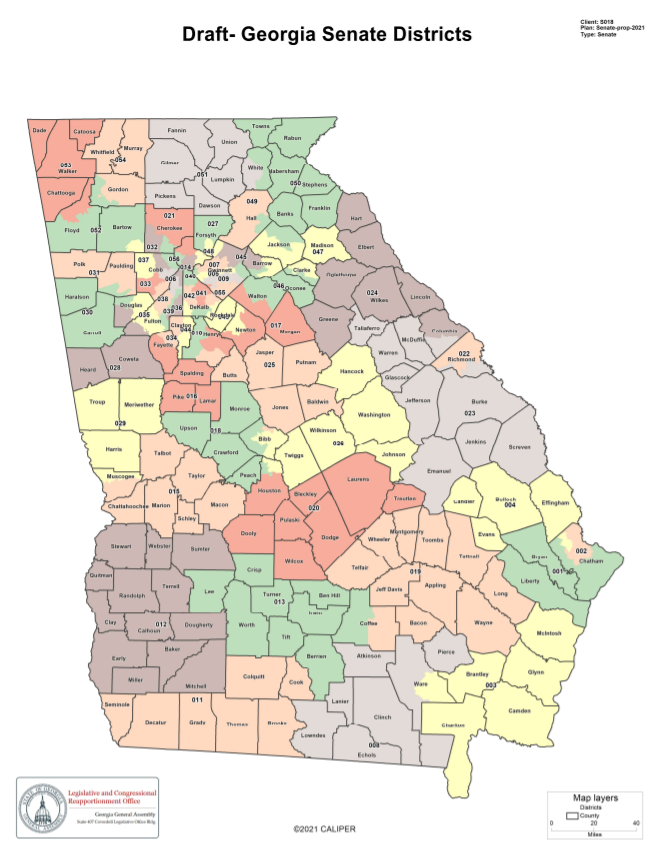
ATLANTA – It looks like a new state Senate map will be the first order of business for the General Assembly special redistricting session that convened Wednesday.
The Georgia Senate Reapportionment and Redistricting Committee will hear testimony Thursday on a proposed map Senate Republican leaders released late Tuesday.
The committee could vote on new Senate district boundaries as early as Friday, Sen. John Kennedy, R-Macon, the panel’s chairman, said during a brief committee meeting Wednesday.
Republicans currently hold 34 of the Senate’s 56 seats, to 22 for Democrats.
Under the proposed map, the Democrats could gain up to three seats, reflecting the growth of Georgia’s minority populations, voters who historically have supported Democratic candidates.
During a series of public hearings held across the state during the summer, civil rights and voting rights advocates urged majority Republicans to take minority growth into account when drawing new legislative and congressional district maps.
“The draft map … has been diligently crafted to represent our growing state,” said GOP Lt. Gov. Geoff Duncan, the Senate’s presiding officer. “As we continue to prioritize transparency and fairness throughout the redistricting process, listening to concerns expressed by members and the communities they represent will remain a top priority.”
The Republicans’ task of creating “minority opportunity” districts in the new Senate map was made easier when two GOP incumbents opted to run for statewide office rather than seek reelection.
The new map moves the 7th Senate District now served by Sen. Tyler Harper, R-Ocilla, from rural South Georgia – where counties are losing population – to Gwinnett County, increasing the number of Senate districts in that rapidly growing area of the state. Harper is running for agriculture commissioner.
Likewise, the 14th Senate District seat now occupied by Sen. Bruce Thompson, R-White, would be relocated to fast-growing North Fulton County. Thompson is running for commissioner of labor.
Democrats would have a shot at capturing both seats, based on the 7th District’s white voting-age population of only 35% and the 14th District’s minority voting-age population of just more than 40%. Districts where Black, Hispanic and Asian American voters make up more than 40% of the population are generally considered competitive for Democrats.
Another potential Democratic pickup can be found in Gwinnett County’s 45th Senate district, which has a minority voting-age population of 42.47%.
At Wednesday’s committee meeting, Senate Minority Leader Gloria Butler, D-Stone Mountain, urged majority Republicans to adopt maps based on concerns Georgia citizens expressed during the public hearings.
“They asked for fair maps and transparency,” Butler said. “I hope we’re really listening and will act according to their requests.”
Kennedy said members of the public provided “a lot of good valuable input” during the hearings and pledged the committee would consider that feedback.
After the committee completes its work on the Senate map, it will turn to the proposed congressional map Senate Republicans released last month.
This story is available through a news partnership with Capitol Beat News Service, a project of the Georgia Press Educational Foundation.
ATLANTA – Atlanta City Council President Felicia Moore was headed toward a first-place finish Tuesday night in the city’s mayoral contest.
But with 16 candidates in the race, it was clear she would not be able to amass the 50%-plus-one margin needed to avoid a Nov. 30 runoff.
With nearly 96% of the precincts reporting as of 11 p.m., Moore led with 40% of the vote.
But Moore’s runoff opponent remained uncertain late Tuesday night. Former Atlanta Mayor Kasim Reed was running second with 23.7% of the vote, and Councilman Andre Dickens was a close third at 22.6%.
Earlier Tuesday night, Moore thanked her supporters for their hard work during the campaign.
“These people have put their heart and soul and time and money toward a new Atlanta where everyone’s going to feel safe and where, when you spend your money for taxes and services, you’re going to get them,” Moore told WXIA-TV.
Moore was elected council president four years ago after serving on the city council representing a district in northwestern Atlanta.
Reed was elected mayor in 2009 and served two terms. Before that, he served as a state senator representing an Atlanta district.
Dickens gave up his council seat to run for mayor. He was elected to an at-large seat on the council in 2013 and is completing his second term.
Current Atlanta Mayor Keisha Lance Bottoms surprised political observers earlier this year when she announced she would not seek a second term at the helm of the city.
As Moore indicated with her remarks, rising crime was the key issue throughout this year’s mayoral campaign. The candidates proposed various approaches to stemming violence in a city that has seen a huge increase in homicides this year along with increases in assaults and auto thefts.
This story is available through a news partnership with Capitol Beat News Service, a project of the Georgia Press Educational Foundation.
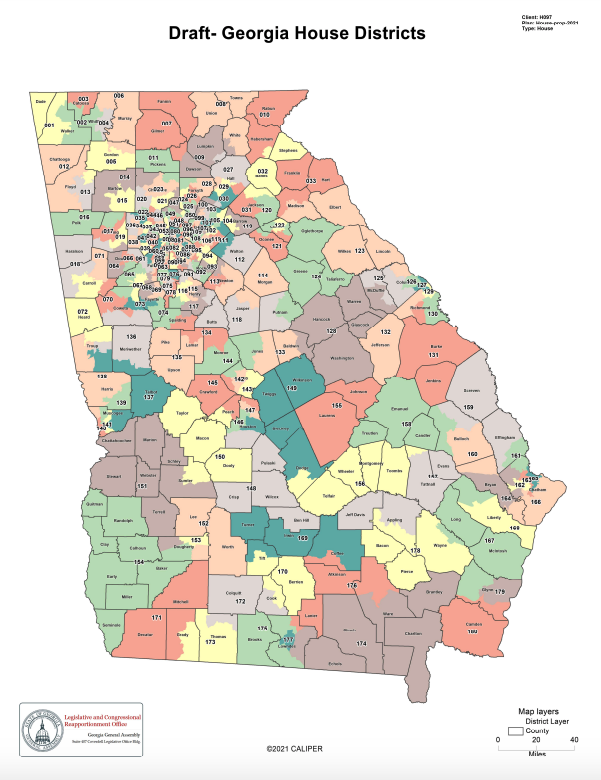
Georgia House Republican leaders released a proposed state House map late Tuesday.
ATLANTA – Georgia House Republican leaders released a proposed map of state House districts late Tuesday less than 12 hours before the General Assembly kicks off its once-a-decade redrawing of legislative and congressional districts.
The map meets many of the criteria set down in guidelines adopted by the state House and Senate committees in charge of redistricting.
It has a population deviation of less than plus-or-minus 1.5%, meaning the 180 House districts vary by fewer than 1,800 people. By law, legislative district may vary in population by up to plus-or-minus 5%.
The Republican map also reduces the number of counties split between House districts from 73 to 68, preserving more “communities of interest,” another goal of the redistricting guidelines.
And it creates a number of new “minority opportunity” districts to let minority voters elect candidates of their choice, according to a news release put out by House Republican leaders.
“We have produced a fair and equitable map representative of Georgia’s changing demographics and shifting population centers that is in full compliance with the spirit and letter of the law,” said House Speaker David Ralston, R-Blue Ridge.
Indeed, minority population growth in North Georgia and metro Atlanta could play to Democrats’ advantage.
A preliminary look at the proposed House map shows Democrats may have a chance to pick up seats now held by Republicans in Gwinnett, Cobb and Forsyth counties. Hispanic growth in the Gainesville and Dalton areas also could result in Democratic gains.
Democrats also could threaten a couple of GOP-held seats in Southwest Georgia, where House districts will have to become larger because of population losses in the region during the last decade.
Ralston also praised the map as the result of an inclusive process that featured 11 joint House-Senate committee hearings held last summer both online and in cities around the state with 22 hours of public testimony.
Lawmakers also received more than 700 written comments from interested citizens through an online portal.
The General Assembly redraws Georgia’s congressional and legislative district maps every 10 years to account for population shifts reflected in the U.S. Census.
This story is available through a news partnership with Capitol Beat News Service, a project of the Georgia Press Educational Foundation.
ATLANTA – The 2020 U.S. Census undercounted Georgia’s population by an estimated 124,438, the Washington, D.C.-based nonprofit think tank Urban Institute reported Tuesday.
Only four more populous states – Texas, California, New York and Florida – experienced higher undercounts than Georgia.
While census figures compiled every 10 years are never completely accurate, the Urban Institute found the 2020 Census likely was less accurate than the 2010 population count for a variety of reasons.
The report cited the impacts of the coronavirus pandemic on getting accurate counts as well as the politicization of the process.
Then-President Donald Trump attempted to add a citizenship question to the census long sought by opponents of illegal immigration. Although the effort failed, the proposal likely acted as a disincentive for some immigrants to fill out census forms.
As has occurred in the past, minorities including Blacks and Hispanics were disproportionately undercounted, the report found. What was different in 2020 was the growth in those minority populations since 2010.
“Traditionally hard-to-count groups increased as a share of the population,” the report stated. “Pre-census funding shortfalls at key times limited the testing of new census procedures, and late disputes over census content exacerbated uncertainty.
“Then the pandemic affected living arrangements, complicated in-person follow-up counts, and delayed post-enumeration data cleaning and other processes.”
Overall, the U.S. population of 331.4 million reported in the 2020 Census was undercounted by nearly 1.7 million, or 0.51%, the Urban Institute found.
The 10.7 million Georgians listed in the census represented an undercount of 1.15%, according to the report.
Of the 50 states and the District of Columbia, only 14 states were overcounted. The largest overcounts occurred in three states in the upper Midwest: Minnesota, Wisconsin and Michigan.
The census is used not only to apportion congressional representation among the 50 states and to redraw the boundaries of state legislative districts, a process Georgia’s General Assembly will begin during a special session starting Wednesday.
Census numbers also affect the allocation of federal funding across the states.
This story is available through a news partnership with Capitol Beat News Service, a project of the Georgia Press Educational Foundation.