ATLANTA – The Georgia Senate unanimously passed legislation Thursday temporarily suspending the state sales tax on gasoline, but not before a lengthy debate over who is to blame for record-high pump prices.
The bill, which the state House of Representatives passed last week, now heads to Gov. Brian Kemp’s desk for his signature.
The governor and lawmakers acted after gas prices surged following the Russian invasion of Ukraine.
Suspension of the tax will save Georgians 29.1 cents per gallon of gasoline, Senate Finance Committee Chairman Chuck Hufstetler, R-Rome, said before Thursday’s vote.
“The 29 cents is not going to completely solve the problem,” he said. “But it’s a start and a statement.”
Hufstetler went on to accuse the Biden administration of contributing to higher gas prices through the Democratic president’s decision to cancel the Keystone XL project last year and ban drilling for oil and gas in the eastern Gulf of Mexico and on federal lands in Alaska.
Sen. Greg Dolezal, R-Cumming, said gas prices started rising well before Russian troops entered Ukraine three weeks ago.
“Gas prices were up last year by $1 a gallon,” he said.
But Senate Democrats said the oil industry is to blame for holding down oil production in the U.S., not the Biden administration. Energy Secretary Jennifer Granholm called on the industry last week to step up production of oil and gas.
“The administration only has control over drilling on federal lands,” said Sen. Nan Orrock, D-Atlanta. “It’s the fossil-fuel industry’s decision not to drill. … There are permits oil companies have that they’re not accessing … because it’s not cost-effective. They’re making decisions on the expectation that demand for fossil fuels will decrease.”
Hufstetler said temporarily suspending the gas tax will cost the state an estimated $300 million to $400 million in lost revenue. That gap will be covered by reserve funds, he said.
The suspension will expire May 31. Kemp could extend it after that by executive order if he deems it necessary.
This story is available through a news partnership with Capitol Beat News Service, a project of the Georgia Press Educational Foundation.
ATLANTA – Members of the Georgia Supreme Court have unanimously elected Michael Boggs to become the state’s next chief justice.
Boggs, who now serves in the leadership position of presiding justice, will succeed David Nahmias as chief justice in July. Nahmias announced last month he would be leaving the court to spend more time with his family.
Boggs was appointed to the high court in 2016 by then-Gov. Nathan Deal. He was elected to a six-year term two years later.
Before joining the state Supreme Court, Boggs served on the Georgia Court of Appeals – the state’s intermediate appellate court – and as a Superior Court judge in the Waycross Judicial Circuit.
Prior to his judicial service, Boggs served two terms in the state House of Representatives representing a district in southeastern Georgia.
The Supreme Court also unanimously elected Nels S.D. Peterson to take over as presiding justice when Boggs moves up to chief justice.
This story is available through a news partnership with Capitol Beat News Service, a project of the Georgia Press Educational Foundation.
ATLANTA – Gov. Brian Kemp signed a $30.3 billion mid-year budget Wednesday that includes pay raises and bonuses for state employees and school workers.
The General Assembly increased state spending through June 30 by nearly $450 million above the mid-year budget Kemp recommended in January. Rising state tax collections gave lawmakers the added leeway.
Kemp cited his decision to keep the state’s economy open during the coronavirus pandemic for the strong revenue numbers.
“Georgia is in a unique position as we lead the nation in the great economic recovery,” the governor said during a signing ceremony at the state Capitol. “We chose to protect both lives and livelihoods during the pandemic.”
The mid-budget is highlighted by a $1.6 billion refund to Georgia taxpayers.
It also restores spending cuts to K-12 education imposed during the early months of the pandemic, and provides $2,000 one-time supplements to school nurses, custodians, cafeteria workers and school bus drivers.
State employees will see their annual pay increased by $5,000, with an additional $2,000 going to correctional officers in the juvenile and adult prison systems to reduce high turnover rates.
“These investments are all possible because of strong conservative leadership over the last few years,” said Lt. Gov. Geoff Duncan. “The legislature and governor have worked together to understand how we shepherd through some of the toughest moments in our state’s history.”
The state House and Senate passed the mid-year budget last week.
This story is available through a news partnership with Capitol Beat News Service, a project of the Georgia Press Educational Foundation.
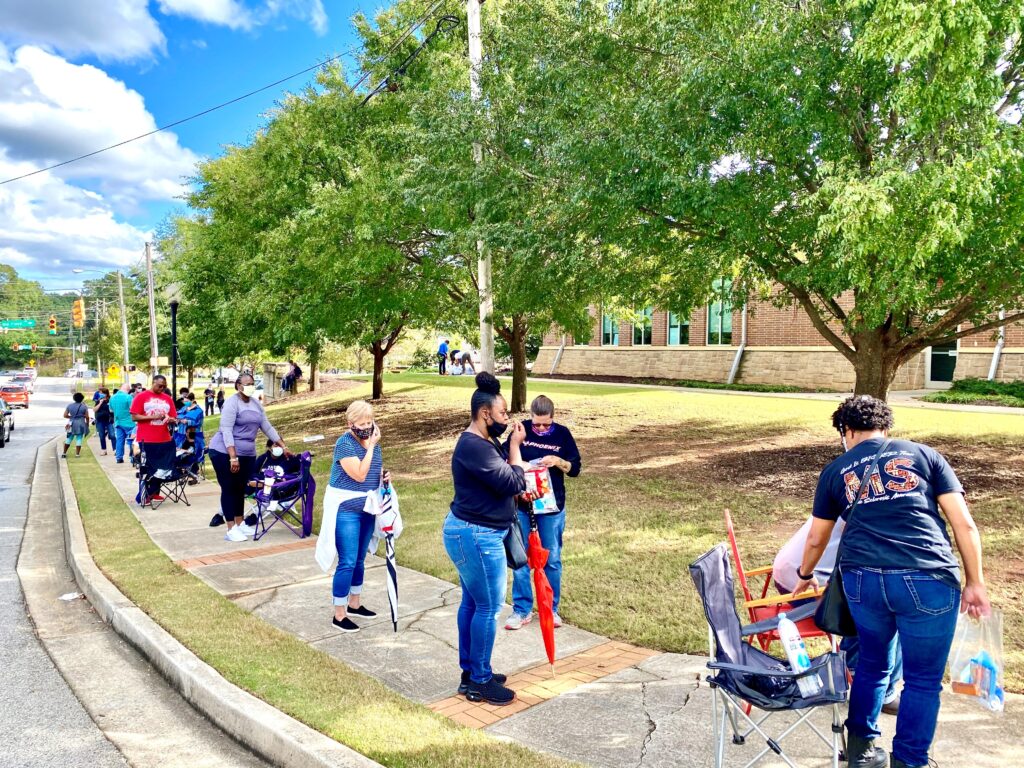
An early voting line outside the South Cobb Regional Library in Mableton (Photo by Beau Evans)
ATLANTA – Republicans and Democrats in the General Assembly are refighting the war over election laws sparked by the controversy that continues to swirl around the 2020 presidential results.
The GOP-controlled Georgia House of Representatives passed legislation Tuesday night Republicans said provides ballot security measures aimed at restoring trust in elections but Democrats criticized as more voter suppression on top of an election law overhaul lawmakers passed last year.
House Bill 1464 passed 98-73 along party lines shortly before 11 p.m. Tuesday. It was the last vote on Crossover Day, the deadline for bills to pass at least one legislative chamber to stay alive for the year.
The 37-page bill includes provisions aimed at securing the chain of custody of ballots.
“Chain of custody is important,” said Rep. David Knight, R-Griffin. “This is about the integrity of elections [so] everybody knows the procedures and rules are followed.”
The bill also requires employers to make time for their workers to vote, not just on Election Day but also during the early voting period.
House Democrats’ strongest objections were over a provision giving the Georgia Bureau of Investigation “original jurisdiction” to investigate complaints of election fraud, meaning the agency wouldn’t have to wait to be called into a case by the State Election Board or attorney general’s office.
“The GBI conducting voter fraud investigations … will be used to intimidate Georgia voters and election workers,” said Rep. Derek Mallow, D-Savannah. “This is another attack on the right to vote.”
Rep. Bee Nguyen, D-Atlanta, who is running for secretary of state, reminded lawmakers that Gov. Brian Kemp promised not to push further changes to Georgia’s election laws this year after the legislature passed Senate Bill 202 last year.
Among other things, that bill added a voter ID requirement for absentee ballots and restricted the location of absentee ballot drop boxes.
Nguyen said the new bill is full of unfunded mandates on local elections agencies that increase the burden on election workers.
“This time, we’re targeting our election boards and our election administrators,” she said.
But Rep. James Burchett, R-Waycross, the bill’s chief sponsor, said Democrats’ arguments exaggerate the legislation’s potential impacts.
“This bill does nothing more than add administrative provisions,” he said. “Voter suppression is not in the bill.”
The legislation now moves to the Georgia Senate, where Republicans also hold the majority.
This story is available through a news partnership with Capitol Beat News Service, a project of the Georgia Press Educational Foundation.
ATLANTA – Georgians playing coin-operated amusement machines (COAM) could receive non-cash redemption gift cards under legislation the state House of Representatives passed Tuesday.
Gift cards would help the Georgia Lottery Corp., which oversees the COAM machines, keep better track of an industry that has been plagued by illegal cash payments to winners, Rep. Alan Powell, R-Hartwell, the bill’s chief sponsor, told House lawmakers.
“It will stop any illegal trade,” he said.
House Bill 1424, which passed 100-67 Tuesday evening, also would increase the value of prizes awarded by so-called “kiddie” games from $5 to $50.
And it would exempt fraternal and veterans organizations from having to comply with a requirement that retail businesses installing COAM machines derive no more than 50% of their income from the machines. The 50/50 rule applies to convenience stores, restaurants and other retailers.
While often considered a stepchild of the lottery, COAM machines brought in $4.5 billion in Georgia last year, with the state getting 10% of the proceeds to support the HOPE Scholarship and pre-kindergarten programs.
Rep. Stacey Evans, D-Atlanta, who voted against the bill, argued that’s not enough.
“This is serious money, and our kids need it,” she said.
Rep. Mary Margaret Oliver, D-Decatur, suggested a higher take for the state could be negotiated into the COAM bill as it moves over to the Georgia Senate.
Indeed, a different version of COAM reform the Senate Regulated Industries Committee approved last week called for the lottery to receive 30% of COAM revenue.
However, that legislation failed to reach the Senate floor on Tuesday, the Crossover Day deadline for bills to pass at least one legislative chamber to remain alive for the year.
This story is available through a news partnership with Capitol Beat News Service, a project of the Georgia Press Educational Foundation.