ATLANTA – A minority utility partner in the nuclear expansion at Plant Vogtle is freezing its capital costs on the long-delayed, overbudget project.
Oglethorpe Power is one of three minority partners on the construction of two additional nuclear reactors at the plant south of Augusta, along with the Municipal Electric Authority of Georgia (MEAG) and Dalton Utilities. Georgia Power, which owns the largest share, is overseeing the project.
In freezing its costs, Oglethorpe is exercising an option agreed to by all four project co-owners in 2018. Under the agreement, Oglethorpe will reduce its share of ownership of the project from 30% to 28% in exchange for Georgia Power paying 100% of Oglethorpe’s remaining share of construction costs.
Freezing its share of the project will cap Oglethorpe’s costs at $8.1 billion.
“Oglethorpe Power and our member cooperatives are deeply invested in the success of these nuclear units that will provide emission-free energy for Georgians for the next 60 to 80 years,” said Michael L. Smith, Oglethorpe Power’s president and chief executive officer.
“At the same time, we feel responsible for protecting our not-for-profit member cooperatives and their consumers. … Our decision to freeze protects EMC (electric membership cooperative) energy consumers who can least afford increases in their electricity rates, especially in today’s economy.”
Plant Vogtle has suffered multiple delays and cost overruns since the Georgia Public Service Commission approved the expansion in 2009. Originally expected to be completed in 2016 and 2017 at a cost of $14 billion, the project’s price tag has more than doubled.
Since September 2018, the project budget has increased five times, totaling an increase of $3.4 billion since the co-owners jointly negotiated the new cost-sharing agreement.
Under the latest projected schedule, the first of the two reactors is due to go into service by the first quarter of next year. The second reactor is scheduled to follow by the fourth quarter of 2023.
Georgia Power spokesman Jacob Hawkins said the Atlanta-based utility doesn’t believe Oglethorpe has the legal right to freeze its capital costs for the Plant Vogtle expansion.
“Georgia Power and Oglethorpe have a difference of opinion over the dollar amount at which this tender option is triggered,” Hawkins said.
“Our focus continues to be bringing the Vogtle units online safely. We will continue to engage with our co-owners productively as we achieve that goal.”
Oglethorpe Power’s decision to freeze its capital costs does not stop the project. According to Georgia Power, as of the end of March, the total project was 96.3% complete.
“Oglethorpe Power is committed to ensuring our member cooperatives’ power supply needs are met with affordable, reliable, safe and environmentally responsible generation,” Smith said. “By exercising the freeze option, we are ensuring that the 4.4 million Georgians served by our member cooperatives will not absorb future capital cost increases, if they occur.”
The Plant Vogtle expansion is the first advanced nuclear project in the United States in three decades. The two new units are the only nuclear reactors currently under construction in America.
This story is available through a news partnership with Capitol Beat News Service, a project of the Georgia Press Educational Foundation.
ATLANTA – Georgia is home to three of the nation’s 100 dirtiest power plants, the Atlanta-based Environment Georgia Research & Policy Center reported Monday.
Georgia Power’s Plant Bowen near Cartersville topped the Georgia list for carbon emissions and is ranked 23rd in the country.
Two of Plant Bowen’s four coal-burning units were due to be retired by 2028 under a proposal the Atlanta-based utility filed with the Georgia Public Service Commission (PSC) last January.
But a 14-page agreement Georgia Power and the PSC’s Public Interest Advocacy Staff reached last week would leave that decision up to the commission, contingent upon the “completion of necessary transmission system improvements.”
Environment Georgia’s new report ranks power plants across the U.S. by their contribution to climate change based on the U.S. Environmental Protection Agency’s (EPA) latest eGRID data.
The dirtiest power plants have an outsized impact: In 2020, the 10 most climate-polluting plants in Georgia were responsible for 91.5% of global warming emissions from the power sector despite only generating 56.5% of total electricity, according to the report.
“Our changing climate affects every aspect of our lives, from the air we breathe in our neighborhoods to the food we grow in Georgia,” said Jennette Gayer, Environment Georgia’s state director.
“Dirty power plants threaten our health and the climate, yet these super-polluters have filled the skies with pollution for decades without consequence. We need to hold the worst power plants accountable for damaging our climate.”
While Plant Bowen burns coal, eight of Georgia’s 10 dirtiest power plants are fired by methane gas. New research on methane leaks finds that the emissions associated with extracting and transporting methane are a serious climate problem.
Although burning methane gas releases less carbon dioxide than burning coal, the report ranked Plant McDonough, a gas-fired plant near Smryna, as the state’s second dirtiest.
Coal-burning Plant Scherer, near Macon, was third on Georgia’s dirtiest-plants list.
To get power plant pollution under control, the report recommends limiting emissions from power plants and accelerating Georgia’s transition from fossil fuels to renewable energy sources. Georgia Power is proposing to expand its renewable energy portfolio by 2,300 megawatts by 2029.
Environmental advocates are worried a U.S. Supreme Court ruling expected this month in a West Virginia case could hamstring the EPA’s ability to set limits on carbon emissions from power plants.
“We can repower our state more cleanly and safely with renewable energy,” Gayer said. “We hope the Public Service Commission will take steps to shut down Plant Bowen, our state’s dirtiest power plant.”
Georgia Power spokesman John Kraft responded to the Environment Georgia report by noting the utility has reduced its carbon emissions by 60% since 2007 and now relies on coal for only 15% of its energy generating capacity.
“We are committed to making smart investments today so that our customers can continue to have clean, safe, reliable and affordable energy for decades to come,” he said.
“Our long-term planning process, the Integrated Resource Plan (IRP), has allowed us to work with the Georgia Public Service Commission to make significant, cost-effective and reliable resource planning decisions that have resulted in a mix of lower-carbon energy resources that benefit all customers.”
Top 10 dirtiest power plants in Georgia, 2020
Plant County Fuel Carbon dioxide equivalent emissions*
Bowen Bartow Coal 7.93
McDonough Cobb Gas 6.89
Scherer Monroe Coal 6.86
McIntosh Effingham Gas 3.28
Wansley (55965) Heard Gas 3.14
Smith Energy Facility Murray Gas 2.84
Yates Coweta Gas 1.35
Chattahoochee Energy Facility Heard Gas 1.28
Wansley (7946) Heard Gas 1.21
Effingham Energy Facility Gas 1.12
*million metric tons
Source: U.S. Environmental Protection Agency
This story is available through a news partnership with Capitol Beat News Service, a project of the Georgia Press Educational Foundation.
A Georgia State University study shows racial segregation housing in metro Atlanta has eased since 1970.
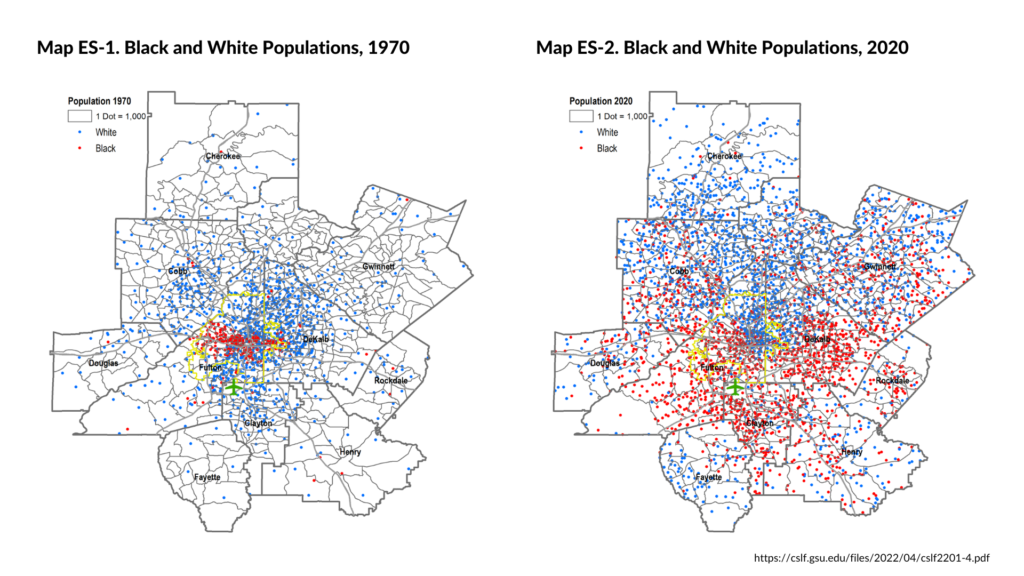
ATLANTA – Racial segregation in housing in the 10-county Atlanta area has eased during the last 50 years, according to a new study from Georgia State University.
Research by economists at the school in downtown Atlanta shows a combination of population growth and federal legislation have resulted in substantial changes in Black residential patterns – particularly in the last 20 years – in a metro region that had been deeply segregated.
Black residents were largely concentrated in a few in-town Atlanta neighborhoods east and west of Atlanta’s Central Business District in 1970. But over the next two decades, Black families and individuals began expanding into south Fulton, southeast DeKalb and northern Clayton counties.
The Georgia State study attributes those changes in part to the impacts associated with congressional passage of the Fair Housing Act of 1968.
By 2000, the Black population had expanded into other areas of the region, particularly in the north, and by 2020 substantial numbers of Blacks could be found throughout the entire region.
“When Blacks began locating in white neighborhoods, many whites moved out, many outside the I-285 perimeter,” said Lakshmi Pandey, a senior research associate at Georgia State’s Fiscal Research Center.
“However, whites recently have increased their share in many census tracts that were predominately Black in 1970. Although there were no large increases of white residents in any of these tracts, their presence in many areas of Atlanta is significant in the last decade compared to trends prior to 2010.”
The study also concluded that immigration of Asians to the U.S. – and therefore, Atlanta – increased significantly after passage of the 1965 Immigration and Naturalization Act. With “other races” comprising just 0.2% of the region’s total population in 1970, the share of the Asian population rose to nearly 7.2% in 2020.
Pandey and Georgia State economics professor David Sjoquist also explored four factors that might explain the observed changes in where Atlantans live — Black population density, Black living preferences, white avoidance and income differences — with mixed results.
“Our findings offer encouraging evidence of a positive change in racial residential segregation and the underlying dynamics,” Sjoquist said. “[But] a positive conclusion must be tempered by the fact that racial residential segregation is still high, particularly in Fulton and DeKalb, and that in the past decade the white population in the 10-county region decreased.”
This story is available through a news partnership with Capitol Beat News Service, a project of the Georgia Press Educational Foundation.
ATLANTA – Car traffic in Georgia is at an all-time high despite rising prices at the pump, state Commissioner of Transportation Russell McMurry said Thursday.
The cost of gasoline has soared across the state to an average of $4.48 per gallon, up from $2.87 a gallon in June of last year, McMurry told members of the State Transportation Board.
Gas prices were as low as $1.84 a gallon in Georgia as recently as June 2020, during the early months of the pandemic, down from $2.40 a gallon in June 2019.
Normally, rising gas prices tend to drive commuters toward using public transit as an alternative, McMurry said. But that’s not the case now, he said.
“About two weeks ago, there was more car traffic on Georgia’s roadways than there’s ever been despite gas being as high as it’s ever been,” he said. “It’s not playing out the way it traditionally has in the past.”
Despite the amount of driving Georgians are doing, state gasoline tax revenues through May were about $71 million below the first 11 months of the last fiscal year, McMurry reported to the board.
McMurry cited the suspension of the state gas tax as the reason for the decrease in tax receipts.
The General Assembly passed legislation in March temporarily suspending collection of the tax through May 31. Lawmakers acted as prices at the pump jumped past the $4-per-gallon mark and continued climbing.
Gov. Brian Kemp issued an executive order last month extending the suspension through July 14.
This story is available through a news partnership with Capitol Beat News Service, a project of the Georgia Press Educational Foundation.
ATLANTA – Gov. Brian Kemp endorsed trucking executive Mike Collins Thursday in next week’s Republican runoff for Georgia’s open 10th Congressional District seat over Donald Trump ally Vernon Jones.
Collins, son of the late GOP Congressman Mac Collins, finished first in last month’s crowded Republican primary, winning 25.6% of the vote in a district that stretches from Butts County and a portion of Henry County north and east through Athens and Elbert County to the South Carolina line.
Jones, a former state representative, came in second with 21.5% of the vote, qualifying him for Tuesday’s runoff to decide the GOP nominee in the heavily Republican district.
Kemp, who maintains a residence in Athens while occupying the Governor’s Mansion, said Thursday he will cast his ballot for Collins next week.
“As a conservative small businessman, Mike knows firsthand how the disastrous policies of the Biden administration are hurting hardworking Georgians and communities all across our state,” the governor said. “Mike is strongly pro-life, pro-2nd Amendment, and will fight hard to put Georgians first in Congress.”
Jones, a former Democrat who once served as DeKalb County CEO, was running for governor against Kemp until last February, when he dropped out of the race and threw his support behind former U.S. Sen. David Perdue. Jones then entered the race in the 10th Congressional District, a seat being vacated by U.S. Rep. Jody Hice, R-Greensboro, who was defeated in last month’s Republican primary for secretary of state.
Trump remains angry with Kemp for refusing to go along with the then-president’s attempts to overturn the 2020 presidential election in Georgia. Trump, who endorsed Perdue in last month’s unsuccessful effort to wrest the GOP gubernatorial nomination away from Kemp, is endorsing Jones in the congressional runoff.
The former president released a recorded robocall Wednesday accusing Collins of attacking Jones with “vicious political ads that aren’t true.”
For his part, Jones responded to Kemp’s endorsement of his opponent by positioning himself as a political maverick.
“Throughout my political career, I have never been the Establishment’s favorite,” Jones said. “That’s something to be proud of – not ashamed of – and is exactly why President Trump endorsed me. I’m not running for Congress to join the Establishment. I’m running for Congress to destroy it.”
Collins said he’s honored to have Kemp’s trust and endorsement.
“Governor Kemp has led the fight to create jobs, lower taxes, support our rural communities, defend our 2nd Amendment, protect the unborn, and stand up to champion our conservative values and deliver results for Georgia families,” Collins said Thursday. “That’s exactly what I plan to do as the next congressman from the 10th District.”
This story is available through a news partnership with Capitol Beat News Service, a project of the Georgia Press Educational Foundation.