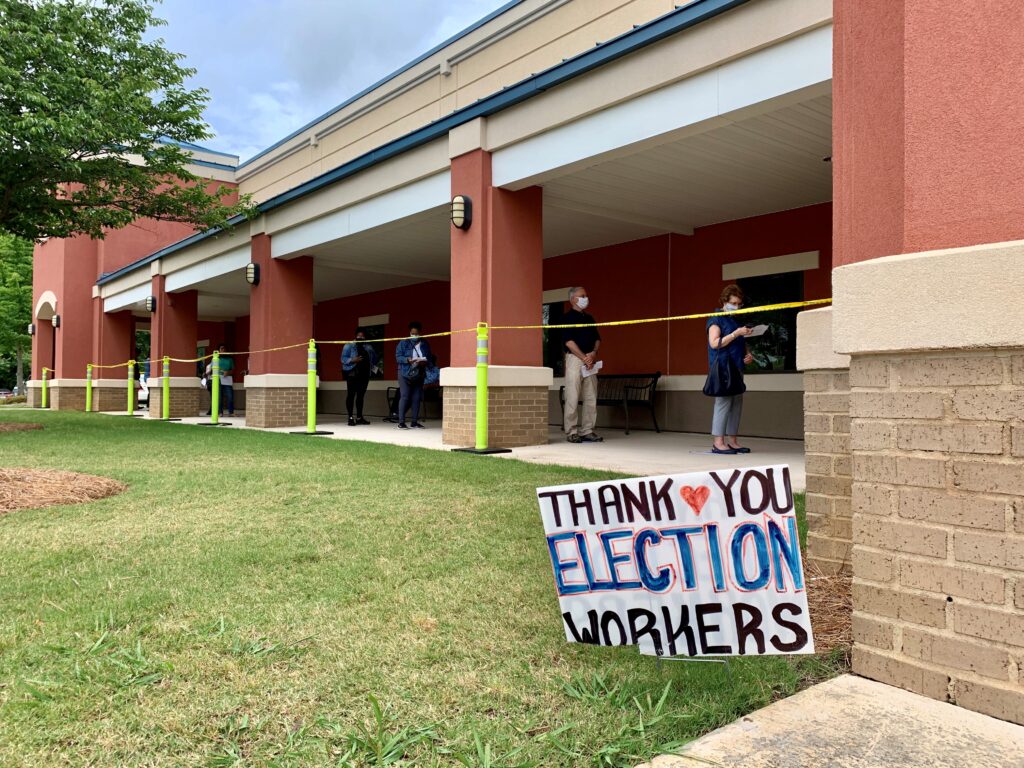
Early voters wait in line at a precinct in Cobb County. (Photo by Beau Evans)
ATLANTA – More than 1.7 million Georgia voters cast ballots last week ahead of the U.S. Senate runoff, a sure sign that interest is high in the contest between incumbent Democratic Sen. Raphael Warnock and Republican challenger Herschel Walker.
The 352,953 ballots cast on Friday, the final day for early voting, shattered the previous one-day record for early voting in Georgia set ahead of the 2016 presidential election.
Counting absentee and military voters, the total turnout reached 1.85 million, 26.4% of active Georgia voters.
Warnock received more votes than Walker in the Nov. 8 general election, capturing 49.4% of the vote to 48.5% for the Republican. But since neither candidate won more than 50% of the vote, state law requires a runoff to decide the victor.
Democrats have expressed concern about the relatively low number of absentee ballots turned in ahead of the runoff, citing legislation the Republican-controlled General Assembly passed last year requiring voters to show a photo ID to vote absentee and significantly limiting the number of absentee ballot drop boxes.
But Republican Secretary of State Brad Raffensperger said the strong early voting turnout shows the new law works.
“Georgia has struck the perfect balance between accessibility and security,” Raffensperger said. “These historic turnout levels emphasize that any lawful voter who wants to cast a ballot can do so easily.”
Tuesday is Election Day. Polling locations across the state will be open from 7 a.m. until 7p.m.
This story is available through a news partnership with Capitol Beat News Service, a project of the Georgia Press Educational Foundation.
ATLANTA – The Democratic National Committee’s Rules and Bylaws Committee voted Friday to recommend shuffling the 2024 presidential primary schedule to give Georgia and several other states earlier primaries.
Under the proposed schedule, Iowa and New Hampshire – historically the first Democratic caucus and primary states – would give way to South Carolina, Georgia, Nevada, and Michigan. The proposal came from President Joe Biden.
The move would add to the diversity of early Democratic primary voters, since both Iowa and New Hampshire are majority white. While Republicans have dominated South Carolina for decades, Georgia, Nevada, and Michigan, have become key battleground states in recent presidential elections.
“Georgia Democrats have always said that our state will play a critical role in the national political landscape for years to come and must be prioritized as such,” U.S. Rep. Nikema Williams, D-Atlanta, who chairs the Democratic Party of Georgia, said Friday. “Today’s vote … to recommend Georgia as an early primary state reflects the Democratic Party’s commitment to diversity and inclusivity.”
Under the proposal, South Carolina would become the first state to hold a Democratic presidential primary in 2024, which would take place on Feb. 3. New Hampshire and Nevada would hold primaries on Feb. 6, followed by Georgia on Feb. 20 and Michigan on Feb. 27.
South Carolina essentially bailed out Biden’s presidential bid two years ago after he received a powerful endorsement from House Majority Whip Jim Clyburn, D-S.C. After losing in Iowa to Pete Buttigieg – now Biden’s transportation secretary – and to Sen. Bernie Sanders of Vermont in New Hampshire, Biden posted his first primary win in South Carolina.
He then went on to win the Georgia primary with 75% of the vote and coasted from there to the Democratic nomination.
The committee’s vote sends the proposal to the full Democratic National Committee, which will make a final decision on the primary schedule early next year.
This story is available through a news partnership with Capitol Beat News Service, a project of the Georgia Press Educational Foundation.
ATLANTA – Environmental advocates are calling into question Georgia Power’s plan for closing ash ponds adjacent to coal-burning power plants.
Jennette Gayer, director of Atlanta-based Environment Georgia, cited a recent decision by the U.S. Environmental Protection Agency (EPA) denying an Ohio utility’s request to leave coal ash at a closed pond in contact with groundwater.
As part of its ash-pond closure plan, Georgia Power is proposing to leave coal ash in contact with groundwater at plants Scherer, McDonough, Yates, and Hammond.
“When cleanup plans that don’t require liners to keep coal ash out of groundwater fail and groundwater testing continues to show contamination, or when the EPA requires cleanup that keeps coal ash out of ground water as they have in Ohio, will ratepayers be asked to contribute more funds?” Gayer asked members of the state Public Service Commission (PSC) Nov. 30 during a hearing on Georgia Power’s request for a rate increase of nearly 12%. “At a minimum, do not commit funds to cleanup that is not permitted.”
Georgia Power’s request to recover $400 million from ratepayers during the next three years for ash pond cleanup is part of a $9 billion multiyear plan. The utility intends to close all 29 of its ash ponds located at 11 coal plants across the state as it reduces its reliance on coal for power generation due to both tighter government regulation and market conditions.
Coal ash contains contaminants including mercury, cadmium and arsenic that can pollute groundwater and drinking water as well as air.
While Georgia Power plans to excavate and remove the ash from 19 ponds and close the other 10 ponds in place, environmental groups are calling for removing ash from all 29 ponds.
The EPA gave the environmentalists’ cause new ammunition last month when the federal agency denied a request from Gavin Power LLC to continue disposing of coal ash in an unlined ash pond at its plant in Cheshire, Ohio.
“For too long, communities already disproportionately impacted by high levels of pollution have been burdened by improper coal ash disposal,” EPA Administrator Michael Regan said Nov. 18.
“Today’s action reaffirms that surface impoundments or landfills cannot be closed with coal ash in contact with groundwater, ensuring safe water resources for these communities while protecting public health and ensuring a reliable supply of electricity.”
The EPA’s decision in the Ohio case followed an announcement the agency made back in January that it intended to enforce a 2015 rule prohibiting utilities from dumping coal ash from coal-burning power plants into unlined ponds.
Isabella Ariza, a lawyer for the Sierra Club, called attention to the Ohio case while questioning a panel of Georgia Power executives on Nov. 29, the first of two days of hearings before the PSC.
Ariza said the utility’s customers will suffer if Georgia Power moves ahead with its cleanup plan without considering the EPA’s decision in Ohio.
“EPA has stated that leaving coal ash in groundwater does not comply with federal rules,” she said. “Ratepayers will continue paying for ash pond closures that will continue to leave ash in groundwater.”
But Aaron Abramovitz, Georgia Power’s chief financial officer, said the Ohio case changes nothing for Georgia Power.
“I believe that was a specific case in Ohio,” Abramovitz told Ariza. “I don’t think that was … for a broader interpretation.”
“Our ash pond closure plans are, and have been, in compliance with federal and state rules and regulations,” Georgia Power spokesman John Kraft added.
Kraft said Georgia Power is continuing to review the EPA’s January pronouncement.
“While [that] review is ongoing, [Georgia Power] will continue to work with the Georgia [Environmental Protection Division] to ensure our closure plans remain in compliance with these rules,” he said.
The PSC is scheduled to vote on Georgia Power’s three-year rate hike request Dec. 20.
This story is available through a news partnership with Capitol Beat News Service, a project of the Georgia Press Educational Foundation.
ATLANTA – A former Georgia Vocational Rehabilitation Agency (GVRA) counselor has been sentenced to five years in prison for creating fake students with non-existent disabilities and illnesses in a scheme to steal more than $1.3 million.
Karen C. Lyke and ex-husband Kevin M. Gregory used the names of friends and relatives to create fake medical records to make it appear that 13 fake students qualified for tuition assistance from the GVRA. They claimed these fake students suffered from disabilities or illnesses including AIDS, cancer, psychosocial impairments, or muscular dystrophy.
Lyke and Gregory then used photo-editing software to alter authentic college transcripts, financial aid reports, and proofs of registration from actual GVRA clients to support claims that the fake students attended schools including Georgia Tech, Georgia State University, or the University of Georgia.
Based on the false documentation, Lyke and Gregory caused more than 230 checks to be mailed to the 13 friends and relatives for bogus educational expenses. In fact, none of the 13 attended any of the claimed colleges or universities.
Lyke and Gregory used the stolen GVRA funds to pay for various personal expenses including cars, jewelry, high-end guitars, and the down payment on a new home.
“The state of Georgia trusted Lyke to serve some of its most vulnerable citizens – Georgians with significant disabilities and illnesses,” U.S. Attorney Ryan K. Buchanan said Thursday. “Driven by greed more than integrity, Lyke betrayed that trust and masterminded a complex scheme to invent fake students with non-existent disabilities. … Based on her sophisticated conspiracy, Lyke cheated taxpayers out of more than $1.3 million.”
“Lyke abused her trusted counselor position to line her own pockets, and for that she will spend time in prison,” added Keri Farley, special agent in charge of the FBI’s Atlanta office. “This sentencing should serve as a message that the FBI and our partners will not tolerate anyone driven by personal greed to steal American taxpayer money that should be going to those who need it.”
Lyke served as a GVRA counselor in the agency’s Norcross office from 2015 until 2019. After she left the agency, she and Gregory continued to submit forged paperwork to the GVRA for non-existent educational expenses.
The pair also conspired to steal at least seven high-value computers worth about $32,000 from the GVRA. They kept one for personal use and sold at least five on eBay.
Lyke pleaded guilty in October to conspiring to commit federal program theft. Her five-year prison sentence will be followed by three years of supervised release. She also was ordered to pay the stolen money back to the U.S. Department of Education and the GVRA.
Gregory, who also pleaded guilty in October, is scheduled to face sentencing next month.
This story is available through a news partnership with Capitol Beat News Service, a project of the Georgia Press Educational Foundation.
ATLANTA – Atlanta’s Mercedes-Benz Stadium will host the first college football national championship game under an expanded playoff format in 2025, the College Football Playoff’s Board of Managers announced Thursday.
The two surviving teams in a 12-team field will play for the national title in downtown Atlanta on Jan. 20, 2025. The game will culminate the 2024-25 season.
Starting in 2024, college football’s playoffs will expand from the current four-term format to include the six highest-ranked conference champions and the next six highest-ranked teams.
“We’re delighted to be moving forward,” CFP Executive Director Bill Hancock said. “More teams and more access mean more excitement for fans, alumni, students, and student-athletes. … Everyone realized that this change is in the best interest of college football and pulled together to make it happen.”
The college football playoffs have pitted the four highest-ranked teams since 2014. The University of Georgia has played in the title game twice since then, losing to Alabama in 2018 but turning the tables on the Crimson Tide and winning the national championship last January.
Since moving to the four-team format, college football fans and the schools themselves have been pushing to expand the playoffs.
Under the new format, the four highest-ranked teams will receive first round byes. The other eight will play quarterfinal contests at the Fiesta, Rose, Sugar, and Peach bowls, with the Peach Bowl game also being played at Mercedes-Benz Stadium.
The two semifinal games will be played at the Cotton and Orange bowls. Dates for the quarterfinals and semifinals have yet to be determined.
Atlanta also will get one of the two semifinal games following the 2025 season.
This story is available through a news partnership with Capitol Beat News Service, a project of the Georgia Press Educational Foundation.