ATLANTA – Moving up Georgia’s presidential primaries to put the Peach State fourth in the primary calendar would reap huge economic benefits, according to a new study.
Early Democratic and Republican presidential primaries next year could generate nearly $220 million in economic impact and create more than 2,200 jobs, Emory University finance professor Thomas More Smith concluded in a study released last week.
The report accounted only for the effects of campaign spending by candidates, national and regional committees representing political parties, and political action committees. It did not include spending by media organizations that would flood Georgia to cover early primaries.
Smith also based his findings on a scenario that would include 11 Republican candidates but only one Democrat: President Joe Biden. An open election in 2028, when presumably neither party would have an incumbent running, would yield even greater economic impact, the study concludes.
Smith also predicted the economic effects of early primaries wouldn’t be limited to metro Atlanta.
“The most recent elections [2020 general election, 2021 U.S. Senate runoffs, and 2022 general election and runoff] proved the importance of exurban counties, smaller rural counties, and other metro areas (such as Columbus, Savannah, Augusta, Macon, Albany, Valdosta, Athens, Rome, and more),” the report states.
“In 2024 and beyond, candidates will have to secure votes across the state to run a competitive race. As such, the economic impact of the early primary will spread across the state.”
The prospects of early primaries in Georgia next year, however, are dubious at best. The Democratic National Committee voted last month to approve an early presidential primary calendar for 2024 that includes Georgia.
Georgia’s Republican secretary of state, Brad Raffensperger, also supports the idea of early presidential primaries. But Raffensperger said this month he wouldn’t want to change the primary calendar until 2028.
With Republicans not on board with moving up the GOP primary next year, it likely won’t happen because of the cost of holding presidential primaries on different dates.
This story is available through a news partnership with Capitol Beat News Service, a project of the Georgia Press Educational Foundation.
ATLANTA – Legislative supporters of legalizing sports betting in Georgia are trying something different this year.
To avoid amending the pesky state Constitution, which requires a two-thirds vote of the Georgia House and Senate, lawmakers in both chambers are pushing bills that would allow online sports betting by statute. Adding sports betting to Georgia law without a constitutional change would need only a simple majority vote in the House and Senate.
But skeptics are warning that doing an end run around the Georgia Constitution runs the risk of lawsuits tying up the state in court and needlessly delaying sports betting from taking effect.
Lawmakers backing the statute route are armed with a new legal opinion from former Georgia Chief Justice Harold Melton asserting that a constitutional amendment is unnecessary. In a 10-page memorandum requested by the Metro Atlanta Chamber – a key supporter of bringing sports betting to Georgia – Melton contends that sports betting can be classified as a form of lottery, already legal in Georgia under the 1992 constitutional amendment that created the Georgia Lottery.
Melton cites a Georgia Court of Appeals ruling that declared three ingredients – prize, chance, and consideration – are legally required to constitute a lottery.
“Bettors pay a fee (the consideration) to enter the betting scheme with the hope of winning money (the prize),” he wrote.
Melton continued that establishing the element of “chance” may be a “closer question” than the prize or consideration. Nonetheless, he concludes that chance is present in sports betting.
“Although a bettor may exercise some skill in picking a particular team or athlete as the winner, the actual determination of a winner is entirely dependent on the ultimate performance of the teams or player,” he wrote.
A bill before the state Senate goes further by calling for legalizing not only sports betting in Georgia by statute but also horse racing. It does so by allowing only “fixed-odds” betting on horses rather than pari-mutuel betting, which is specifically prohibited by the Georgia Constitution along with casino gambling.
“This bill has no pari-mutuel betting and no casinos,” said Sen. Billy Hickman, R-Statesboro, the chief sponsor of Senate Bill 57.
But former U.S. Rep. John Barrow of Athens, who is a lawyer, called attempts to justify legalizing sports betting in Georgia without a constitutional amendment “legalistic hocus-pocus.”
In an opinion piece published by the Atlanta Journal-Constitution, Barrow wrote that betting on sports cannot be classified as a form of “lottery” but does fit the definition of “pari-mutuel,” and thus would require a constitutional amendment.
” ‘Pari-mutuel’ is the word that has always been applied to gambling on the outcome of some other contest – a race, a fight, a game, whatever,” he wrote. “Unlike a lottery, it depends on such things as the skill or strength of the contestants, and on the skill of the gambler in evaluating the contestants. This is the very essence of sports betting.”
Beyond the legal dispute over whether sports betting can happen in Georgia without a constitutional change is the practical consideration that going the statute route would leave out casinos. Recent polling of likely Georgia voters found stronger support for bringing casino gambling to Georgia than sports betting.
A demographic breakdown of polling results also showed that while sports betting is popular among younger voters and Black men, casinos are more appealing to older voters and Black women.
“A bet’s a bet, but your grandma wants to enjoy some newfound freedom differently than your nephew,” said Dan McLagan, spokesman for All in Georgia, a casino industry group. “Let’s not throw grandma from the fun train.”
McLagan also argued that resort casinos would generate significantly more economic impact in Georgia than online sports betting, which lacks a brick-and-mortar presence and, thus, would create few jobs.
Georgia lawmakers will have plenty of options to pick from when it comes to legalizing gambling during this year’s legislative session. Thus far, two constitutional amendments have been introduced – one in the House and one in the Senate – while two more bills would bring gambling to the Peach State without a constitutional change.
ATLANTA – A state lawmaker is renewing a bipartisan push to reform Georgia’s coin-operated amusement machines (COAM) industry.
House Bill 353, sponsored by Georgia Rep. Alan Powell, would award non-cash redemption gift cards to winners that could be redeemed anywhere in the state for any legal product. Under current law, COAM winners can redeem their prizes only for merchandise sold in the store where the machine they played is located.
With taxes from the popular COAM machines already making up the Georgia Lottery Corp.’s fastest growing source of revenue for education, gift cards would generate even more tax funds for HOPE scholarships and the state’s pre-kindergarten program, Powell, R-Hartwell, told members of the House Higher Education Committee Thursday.
“You will see the proceeds explode,” he said. “It will bring in more money to the lottery.”
During an initial hearing on his bill, Powell recounted the “checkered” history of the COAM industry in Georgia, replete with retailers paying out cash to winners.
“These machines are for amusement … non-cash redemption,” he said. “They got absolutely out of control with video poker.”
After video poker was outlawed in the early 2000s, the Georgia Lottery Corp. took over regulation of the COAM business.
While the lottery has brought new technology to bear that is able to track what every COAM machine in the state does, Powell said the gift cards are needed both to boost revenue and dissuade retailers from making illegal cash payments to winners.
Powell said the lottery corporation has been experimenting with gift cards in portions of the state through a pilot project. Retailers who have participated in the project like the idea, he said.
A state Senate committee approved legislation last year that would have increased state taxes on COAM machine owners and retailers from 10% to 30%. But the bill didn’t reach the Senate floor for a vote.
Powell suggested the legislature keep the tax rate at 10% – divided evenly between machine owners and retailers – for now and only consider raising it later if awarding gift cards drives up revenue to the extent he is predicting.
After Thursday’s hearing, Powell’s bill was transferred from the Higher Education Committee to the House Regulated Industries Committee, which he chairs.
ATLANTA – The General Assembly will get a choice this year whether to legalize gambling in Georgia by statute or constitutional amendment.
Legislation introduced into the state House and Senate this week takes the constitutional amendment approach, which would put the issue to Georgia voters in a statewide referendum.
The Senate version is limited to legalizing sports betting, while the House measure would also allow casinos and pari-mutuel betting on horse racing.
Two bills introduced into the legislature earlier this year would legalize sports betting by statute. Avoiding the constitutional amendment route means they wouldn’t have to gain two-thirds majorities in the House and Senate to pass.
The constitutional amendment path would make better public policy because it would give voters the final say over whether to legalize a form of gambling that goes well beyond the Georgia Lottery, said Sen. Bill Cowsert, R-Athens, chief sponsor of Senate Resolution 140.
“If we’re going to make that big a cultural change in Georgia, let the people decide that,” said Cowsert, chairman of the Senate Regulated Industries Committee, which will take up the amendment next week.
Cowsert reminded members of the committee during a brief presentation of his legislation Thursday that the Senate mustered enough votes two years ago to pass a constitutional amendment on sports betting. The measure easily cleared the Senate 41-10 but died in the state House of Representatives.
“It is politically possible to do so,” Cowsert said. “I am not putting this up as a roadblock.”
The Senate constitutional amendment, if ratified by voters, would authorize online sports betting in Georgia. Twenty to 25% of the revenue raised through sports betting would go to the state for a variety of purposes.
Half of that money would go to need-based scholarships. Georgia’s HOPE Scholarships program began in the 1990s as need-based but was soon converted to a merit-based program.
“This will allow poorer Georgians to get an advanced education and become more productive,” Cowsert said.
The legislation would set aside 25% of the revenue for health care, mental health care, economic development, and initiatives to reduce poverty in low-income areas. Fifteen percent would be dedicated to public health programs, including the prevention and treatment of problem gambling.
The final 5% would be used to solicit, promote, sponsor, and host major sporting events in Georgia, including college football playoffs, the Olympics, and the NCAA Final Four basketball tournament.
Cowsert said his committee will hold a hearing on the legislation next Thursday.
Meanwhile, a House committee Thursday began airing one of the two bills aimed at legalizing sports betting by statute.
State Rep. Marcus Wiedower, R-Watkinsville, chief sponsor of House Bill 380, told the House Higher Education Committee the scope of the bill has been significantly reduced since it was first introduced. A proposal to allow in-person betting on sports at retail kiosks has been scrapped, and the bill now is limited to online sports betting, he said.
The House bill would require companies awarded sports betting licenses to pay 15% of their adjusted gross incomes to the state. Unlike Cowsert’s Senate legislation, the revenue would go strictly to the HOPE Scholarships and pre-kindergarten programs, the same beneficiaries of the lottery.
After a hearing on the bill Thursday, the measure was transferred from the Higher Education panel to the House Regulated Industries Committee, which likely will take it up next week.
This story is available through a news partnership with Capitol Beat News Service, a project of the Georgia Press Educational Foundation.
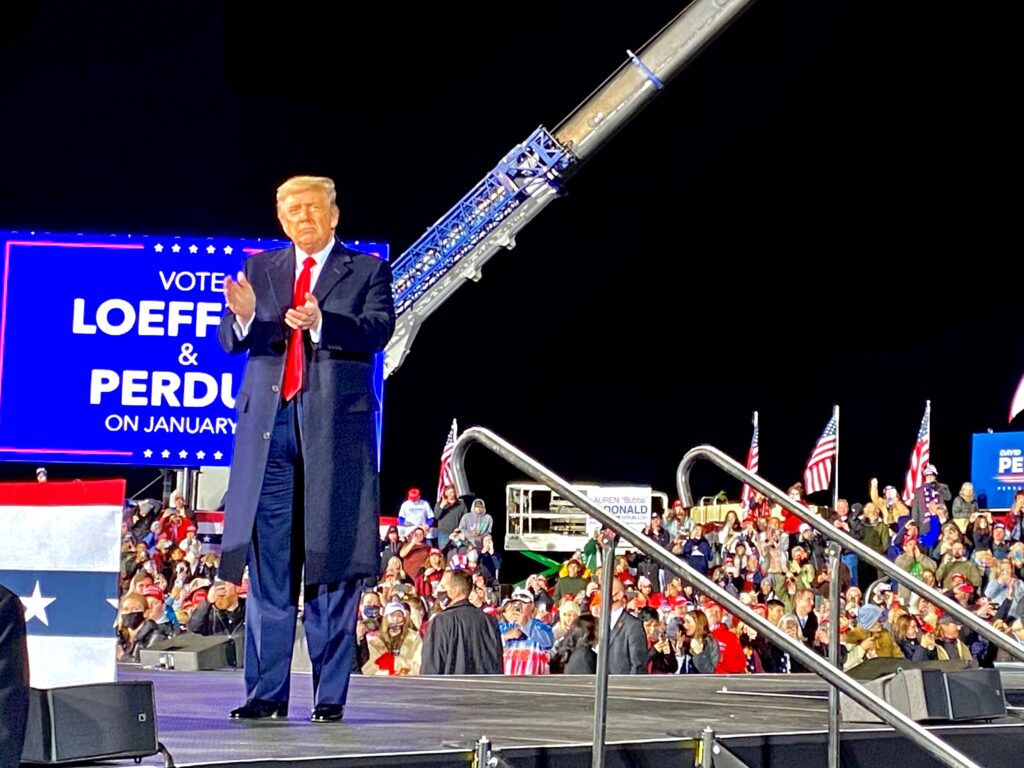
Then-President Donald Trump headlined a campaign rally in Dalton on Jan. 4, 2021. (Photo by Beau Evans)
ATLANTA – The Fulton County special purpose grand jury that investigated allegations of criminal interference in the 2020 presidential election in Georgia is recommending that one or more witnesses be indicted for perjury.
The recommendations were part of a report the panel issued when it completed its investigation in December. The report was not released to the public at that time, but Fulton Superior Court Judge Robert McBurney ruled earlier this week that parts of the jury’s findings could be released.
The sections of the report released Thursday did not name former President Donald Trump or any of his associates. It will be up to Fulton District Attorney Fani Willis to decide whether to use the special purpose grand jury’s findings as the basis to seek indictments.
“A majority of the grand jury believes that perjury may have been committed by one or more witnesses testifying before it,” the report stated. “The grand jury recommends that the district attorney seek appropriate indictments for such crimes where the evidence is compelling.”
Willis assembled the special purpose grand jury last May to investigate Trump’s alleged attempts to overturn the 2020 presidential election in Georgia, including a phone call he made urging Georgia Secretary of State Brad Raffensperger to “find” the 11,780 votes Trump would need to reverse Democrat Joe Biden’s victory in the Peach State.
The grand jury received evidence from 75 witnesses during its investigation, according to the portion of the report released Thursday. While the vast majority came from in-person testimony given under oath, the panel received some information through various forms of “digital and physical media,” the report stated.
The grand jury recommended releasing the entire report to the public, and a coalition of media outlets filed a motion arguing the public has a right to know the panel’s full findings.
But Willis argued in a hearing before McBurney last month that making the full report public – including the names of witnesses the grand jury believes should be indicted – would jeopardize the rights of potential future defendants to a fair trial.
Witnesses who appeared before the grand jury included former New York City Mayor Rudy Giuliani, Trump’s personal lawyer; U.S. Sen. Lindsey Graham, R-S.C.; and then-U.S. Rep. Jody Hice, R-Greensboro.
The panel also heard from Raffensperger, Gov. Brian Kemp, Georgia Attorney General Chris Carr, the late Georgia House Speaker David Ralston, and then-Lt. Gov. Geoff Duncan.
This story is available through a news partnership with Capitol Beat News Service, a project of the Georgia Press Educational Foundation.