ATLANTA – The University System of Georgia is pushing back on a $66 million cut to its fiscal 2024 budget the General Assembly approved on the last day of this year’s legislative session.
Lawmakers signed off on the reduction Wednesday after House and Senate budget conferees shrank the cut from a $113 million reduction from the system’s teaching formula in the version of the spending plan the Senate adopted last week.
“This is an incredibly disappointing outcome, given the work done over the years by our state leaders to elevate higher education and send Georgia on a path to ascension,” system Chancellor Sonny Perdue said Thursday. “It will have a significant impact on institutions and the services that students and families depend on to advance their prosperity and help Georgia succeed.”
Perdue said the cut comes on top of a reduction of about $230 million the system sustained at the beginning of the pandemic three years ago, funds that have never been restored. The system also was already due to receive a $71.6 million reduction for the coming fiscal year before the $66 million cut because of enrollment declines.
Senate Appropriations Committee Chairman Blake Tillery cited that declining enrollment as justification for the cut. Tillery, R-Vidalia, suggested the system could offset the reduction by dipping into carry-over funds not spent this year. The system had $504 million in carry over funds on its books, according to an audit released last fall.
Tillery said the system’s Board of Regents has the flexibility under the Georgia Constitution to make sure the reduction is allocated in a way that won’t disproportionately affect the system’s smaller institutions. The money comes to the system in the form of a block grant, which the regents can spread around as they see fit, he said.
But Perdue said carry-forward funds are earned and retained at the individual institution, so the system does not have the ability to move the money from one institution to another. Eighty-two percent of those funds are concentrated at only six schools – including the system’s four research institutions: Augusta University, Georgia State University, Georgia Tech and the University of Georgia, he said.
The University of Georgia would absorb the largest cut – $11.9 million – followed closely by an $11.3 million reduction at Georgia Tech, according to figures the university system released Thursday.
Gov. Brian Kemp has 40 calendar days from the end of the legislative session to sign the budget, giving him in this case until May 8.
Below is a list of the reductions each of the university system’s 26 institutions would sustain:
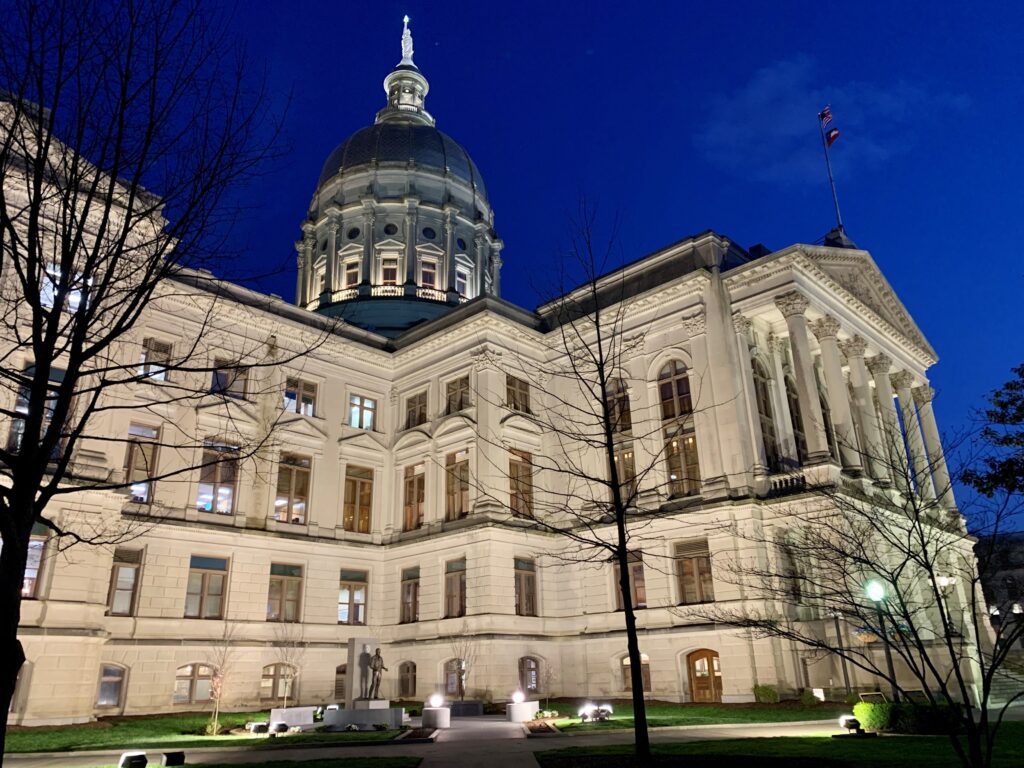
The Georgia Capitol building in Atlanta (Photo by Beau Evans)
ATLANTA – A $32.4 billion state budget with pay raises of $4,000 to $6,000 for state law enforcement officers and $2,000 increases for other state workers, teachers, and university system employees gained final passage in the General Assembly Wednesday.
The Georgia Senate passed the fiscal 2024 spending plan 54-1 late Wednesday afternoon. The state House of Representatives followed suit 170-3 shortly before midnight on the final day of this year’s legislative session.
The budget, which takes effect July 1, increases state spending by $2.2 billion, or 7.4%, over the budget the legislature adopted last spring.
The spending plan fully funds Georgia’s Quality Basic Education (QBE) k-12 student funding formula with a record $13.1 billion in state dollars.
House and Senate budget conferees also added $6.3 million to provide 17 million free meals to public school children from low-income families.
“Kids aren’t able to learn when they’re hungry,” said House Appropriations Committee Chairman Matt Hatchett, R-Dublin.
The budget also covers 100% of tuition for Georgia’s HOPE scholars for the first time since 2011.
However, House and Senate budget conferees agreed to a Senate proposal to redirect $66 million from the University System of Georgia’s teaching formula to shore up Georgia’s Medicaid program. The university system could make up the reduction by dipping into carry-over funds, said Senate Appropriations Committee Chairman Blake Tillery, R-Vidalia.
Several senators sought assurances from Tillery during the floor debate on the budget that the cut wouldn’t hurt Georgia’s public colleges and universities, particularly the smaller institutions with fewer resources.
“I think our university system provides the best educational opportunities in the country,” said Sen. Bill Cowsert, R-Athens.
Tillery said the university system has $504 million in carry-over funds, according to a report released in October. He said the formula cut doesn’t have to disproportionately affect the smaller schools.
“It’s essentially a block grant,” he said. “[The university system Board of Regents] can spend it any way they want.”
The final version of the budget also added $117 million for mental health services, $47 million above Gov. Brian Kemp’s request.
The spending plan includes $11.1 million for the staffing that will be needed in the coming weeks to redetermine assessments for Medicaid enrollees following the “unwinding” of additional federal benefits that were provided during the pandemic.
“Even with these increased funds … it’s going to be difficult,” Tillery said. “Sometimes, there’s just things dollars can’t do.”
The budget also funds construction, planning and/or design of 24 buildings, primarily projects on university campuses, money Tillery said might not be available next year.
“We will continue to keep a close eye on the financial clouds gathering on the horizon,” Kemp told House members early Wednesday evening during his annual address on the last day of the session.
The budget now moves now to the governor’s desk for signing.
ATLANTA – The Republican-controlled Georgia Senate gave final passage Wednesday to legislation prohibiting local elections offices from receiving private donations to help run their operations.
Senate Bill 222 cleared the Senate 32-21 along party lines. The House passed the bill on Monday in another primarily party-line vote.
The bill was sparked by complaints from Republicans in Georgia and elsewhere that private donations have flowed into elections offices in Democratic counties in recent elections, including a $350 million contribution by Facebook CEO Mark Zuckerberg to the nonprofit Center for Technology and Civic Life.
Those out-of-state private dollars were contributed in an effort to influence the outcome of those elections, Sen. Ed Setzler, R-Acworth, told his Senate colleagues Wednesday.
“This issue is one of basic fairness,” he said.
But Democrats argued Senate Bill 222 is an Republican effort to choke off financial assistance Georgia’s large Democratic counties need to make their elections run smoothly.
“Why are we removing a tool to help our elections officials run better elections?” asked Sen. Nabilah Islam, D-Lawrenceville.
But Sen. Max Burns, R-Sylvania, the bill’s chief sponsor, said private funds will still be available to local elections officials. The legislation centralizes the distribution of private donations to local elections offices by authorizing the State Election Board (SEB) to distribute the money.
“You can get all the third-party funding you choose from the SEB,” Burns said.
Senate Bill 222 now heads to Gov. Brian Kemp’s desk for his signature.
ATLANTA – Local elections offices in Georgia would not be allowed to accept donations from private sources to help run their operations under a Republican-backed bill that has passed the state House of Representatives.
Senate Bill 222 cleared the lower chamber along party lines 100-69 late Monday night, the last bill lawmakers took up in a marathon next-to-last day of this year’s legislative session.
The legislation stems from complaints from Republicans in Georgia and other states about private donations flowing into elections offices in Democratic counties, notably a $350 million contribution by Facebook CEO Mark Zuckerberg to the nonprofit Center for Technology and Civic Life during the 2020 election.
“It’s common sense for us to make sure we’re banning private money from public elections,” said Rep. Houston Gaines, R-Athens, who carried the bill in the House.
But House Democrats said cutting off local elections offices from access to grants from private nonprofits would leave already resource-poor county elections officials ill equipped to deal with thousands of challenges to voters’ qualifications out-of-state groups have been filing since the 2020 elections.
“The primary intent of these challenges is to gum up the works … to divert elections workers from their duties,” said Rep. Saira Draper, D-Atlanta. “Counties will be cut off from the funds they need to do their jobs.”
Draper said banning local governments from accepting private donations would leave the State Election Board in charge of allocating funds to all 159 Georgia counties, a blow to local control.
“Why do we presume the State Election Board knows what our counties need better than our counties?” she asked.
Because of changes the House made to the bill, it now heads back to the Senate, which must act on it before the General Assembly adjourns for the year on Wednesday night if it is to become law.
Georgia Sen. Carden Summers (Photo credit: Rebecca Grapevine)
ATLANTA – Georgia cities and counties must enforce local ordinances prohibiting homeless people from camping and sleeping in public arenas under legislation that has gained final passage in the General Assembly.
The Republican-controlled state Senate passed the bill Monday night, voting 32-24 primarily along party lines, and sent it on to Gov. Brian Kemp for his signature. The Senate vote came a few hours after the Georgia House of Representatives passed the bill 99-76.
“We know that street camps are dangerous for homeless people themselves,” Rep. Katie Dempsey, R-Rome, who carried Senate Bill 62 in the House, told her legislative colleagues. “The cities that have allowed it have seen an increase in the number of homeless deaths.”
Democrats spoke out against the bill, particularly a late addition the House inserted prohibiting local governments and hospitals from dumping homeless people in other counties.
“Bills like this criminalize homelessness,” said Rep. Jasmine Clark, D-Lilburn. “We need bills that address the root causes of homelessness.”
Democrats also accused Republicans of stomping on the concept of local control.
But Dempsey and other GOP lawmakers said the provision requiring local governments to enforce their ordinances against public camping and sleeping only applies if they have such ordinances.
“Local governments need to enforce the laws they have on their books. It’s that simple,” said Rep. Houston Gaines, R-Athens.
“We want to ensure that cities in this state don’t become more like Los Angeles and Austin, Texas,” added House Governmental Affairs Committee Chairman John LaHood, R-Valdosta, referring to those cities’ problems with homeless encampments.
When the bill got to the Senate side Monday night, Sen. Kim Jackson, D-Stone Mountain, complained that the original intent of the legislation was limited to requiring a state audit of the government funding available to address homelessness.
“Once we have a full audit, we can make some calculated decisions on how to use that money,” she said.
But Sen. Carden Summers, R-Cordele, Senate Bill 62’s chief sponsor, said the issue of homelessness can’t wait for an audit. Summers chaired a Senate study committee on homelessness last summer and fall.
“Every person we interviewed said homeless is getting worse and worse and worse,” he said. “Each county must deal with homeless. Each county has to have a plan to deal with homeless.