ATLANTA – Student enrollment is continuing to decline at the University System of Georgia.
Overall enrollment for the spring semester at the system’s 26 institutions fell to 311,484, down 0.9% from last spring, Angela Bell, the system’s vice chancellor of research and policy analysis, told members of the Board of Regents Tuesday.
The system’s enrollment grew steadily from 2014 through 2021, Bell said during the regents April meeting on the campus of the University of North Georgia in Dahlonega. But enrollment has declined during the last couple of years to the point where it stands only about 500 students above 2019, she said.
The enrollment drop in Georgia is part of a national trend researchers say reflects low unemployment, financial uncertainty, and the lingering effects of the pandemic.
But the declining numbers are not showing up uniformly in every category of student or every category of school within the university system.
For example, Bell said undergraduate enrollment has fallen by 5% during the last five years. However, the enrollment of graduate students has risen 24% during that same period.
Enrollment at the university system’s four research universities – the University of Georgia, Georgia Tech, Georgia State University, and Augusta University – was up 1% this spring over the spring semester of 2022. However, enrollment at the comprehensive universities – Kennesaw State University, Georgia Southern University, Valdosta State University, and the University of West Georgia – declined by 3% year over year, Bell said.
Demographically, enrollment of Hispanic and Asian students is on the rise. Asian students now make up 13% of the university system’s enrollment, while Hispanic students account for 11%.
The enrollment of white students has declined during the last five years to 45% of the overall student population. Black student enrollment is also down slightly, with Black students accounting for 25% of overall enrollment.
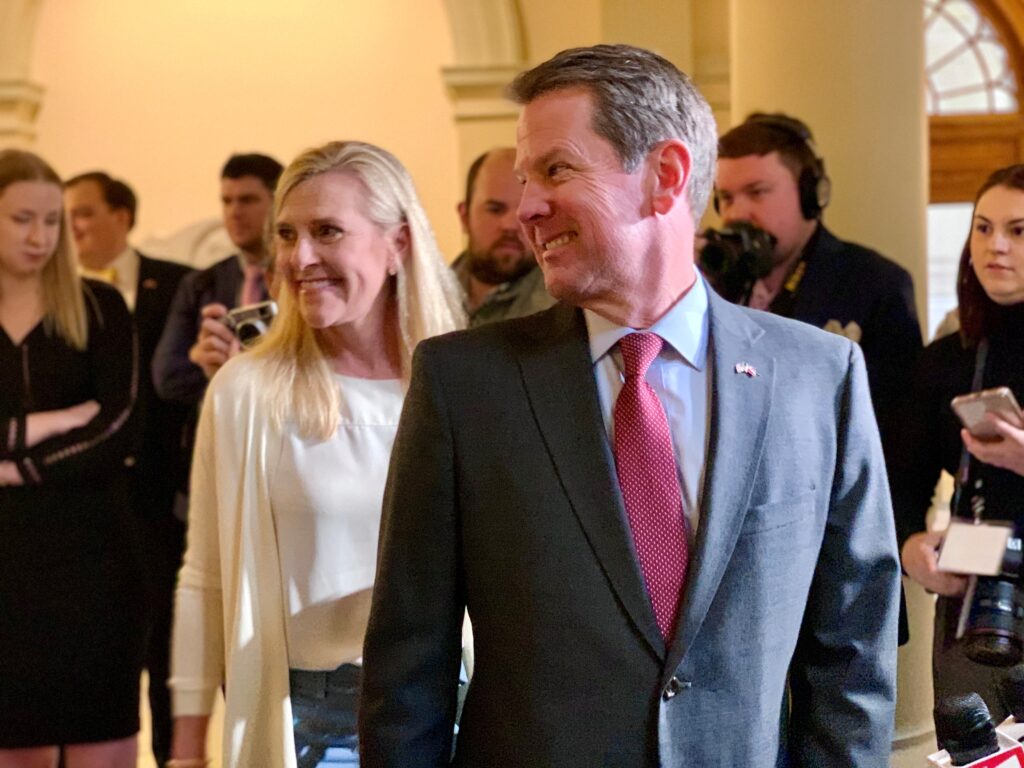
Gov. Brian Kemp and First Lady Marty Kemp (Photo by Beau Evans)
MARIETTA – A nonprofit that works with victims of human trafficking announced a partnership Tuesday with the Georgia Sheriffs’ Association and nonprofit health plan CareSource.
The two organizations will work with Rescuing Hope to raise awareness of human trafficking and how to avoid becoming a victim, train law enforcement officers and other first responders on how to handle cases of human trafficking, and provide health-care and other services victims need to get on the road to recovery,
“It will take all of us doing our part to eradicate human trafficking in Georgia,” Susan Norris, Rescuing Hope’s founder, said during a presentation at GracePointe Baptist Church in Marietta.
Gov. Brian Kemp has made combating human trafficking a major focus of his administration. In 2019, his first year in office, he created the GRACE Commission – a panel of law enforcement officials, advocates for human trafficking victims, and subject matter experts – and named First Lady Marty Kemp to chair the initiative. Both Kemps attended Tuesday’s event.
“This is one of those issues that the more you learn, the more you realize the needs that are out there,” Kemp said. “It’s heartbreaking. It’s brutal. The people doing these things need to be locked up for a long time.”
The governor signed legislation last week that increases the penalties for business owners who fail to post required notices about resources for human trafficking victims at their establishments.
Two years ago, Kemp formed a multi-agency Crime Suppression Unit including the attorney general’s office and Georgia Bureau of Investigation to concentrate in part on arresting and prosecuting human traffickers.
The GBI has brought 45 cases against alleged human traffickers this fiscal year, Marty Kemp said Tuesday, while Attorney General Chris Carr has rescued 116 victims and secured six convictions.
“They’re just doing amazing work,” First Lady Kemp said.
The new partnership is being funded with a $50,000 grant from CareSource to Rescuing Hope and a second $50,000 grant from CareSource to the sheriffs’ association.
Norris said Rescuing Hope will use its grant to hire a second caseworker, or “advocate” to work with victims of human trafficking.
The grant to the sheriffs’ association will go toward training law enforcement officers in how to handle human trafficking cases and to help raise awareness of human trafficking among the young people from dysfunctional homes housed at five Georgia Sheriffs’ Youth Homes.
ATLANTA – Georgia Power and the state Public Service Commission’s (PSC) Public Interest Advocacy Staff have reached an agreement resulting in a slight reduction in the utility’s request to recover $2.1 billion in higher fuel costs from customers.
If the commission approves the agreement next month, Georgia Power would trim $7 million off the recovery request. Still, the average customer who uses 1,000 kilowatt-hours of electricity per month would see an increase of at least $17 on their monthly bills.
“Just as Georgians paid higher prices at the gas pump in 2022, Georgia Power also paid more for the natural gas and other fuels we use to generate electricity, and the company does not earn any profit from these fuel costs,” Georgia Power spokesman John Kraft said late last week.
Georgia Power executives first announced the company would be seeking to recover its fuel costs for the last two years during testimony before the PSC at hearings last fall on the utility’s 2022 rate hike request.
The commission approved a $1.8 billion rate increase for Georgia Power in December, which raised the average residential customer’s monthly bill by $3.60 effective last Jan. 1. The utility then filed for the fuel costs recovery in February.
As part of the agreement filed last Thursday, Georgia Power agreed to file by next Monday a revised estimate of its under-recovered fuel costs through March 31. The utility also has agreed to increase its senior citizen discount from $6 to $8, bringing it to $32 per month.
The PSC will hold hearings on the proposed agreement early next month and vote on the plan May 16.
Besides the fuel costs recovery and the increase in base rates that took effect in January, Georgia Power also will be looking to recover the costs of bringing into service the two new nuclear reactors being built at Plant Vogtle. The first of the two reactors is scheduled to begin commercial operation by June.
ATLANTA – Georgians’ right to fish in navigable portions of the state’s rivers and streams was safeguarded in the final seconds of this year’s legislative session.
The General Assembly passed a bill on the last night of the 2023 session late last month that secures the public’s right to fish “even where private title … originates from a valid grant.”
No one was questioning what was thought to be a long-established public right in Georgia until a property owner along Yellow Jacket Shoals, a small portion of the Flint River, asserted its exclusive right to control fishing from the bank on its side of the river to the center of the stream and banned public fishing there.
After Four Chimneys LLLP sued the state alleging failure to enforce the ban, the Georgia Department of Natural Resources signed an agreement March 27 consenting to the ban.
By the time wildlife enthusiasts and environmental protection groups found out about the agreement the following day, they had just one day to bring it to the attention of Gov. Brian Kemp and legislative leaders. The General Assembly was due to adjourn for the year on March 29.
The issue needed to be addressed then and there because it had implications far beyond a short stretch of the Flint, said Mike Worley, president of the Georgia Wildlife Federation.
“Anyone in the state could assert a claim like that,” he said. “We could have seen this popping up all over the state. … To see 1.2 million anglers in the state potentially disenfranchised didn’t seem equitable.”
But supporters of guaranteeing public fishing rights in Georgia faced a logistical challenge. The annual Crossover Day deadline for bills to pass at least one legislative chamber, which fell on March 6, was weeks in the rearview mirror.
Typically, backers of bills that have failed to make Crossover Day find related legislation that has made the deadline and attach their bills to that measure.
The wildlife federation, the Southern Environmental Law Center, Flint Riverkeeper and other interested groups followed that strategy during the early hours of Sine Die, the last day of the annual General Assembly session, Worley said. But when the related bill they chose for their purposes was failing to move, they had to try something different, he said.
Without related legislation to fall back on, they chose to take an unrelated bill and substitute the fishing rights legislation, leaving only the original bill number intact. That was accomplished by the House Rules Committee as Sine Die moved from afternoon into evening, with the permission of Sen. Josh McLaurin, D-Sandy Springs, the original bill’s sponsor.
The final product – Senate Bill 115 – narrowly cleared the House 93-75, just two votes more than were required to constitute a majority in the 180-seat chamber. It then passed the Senate 50-4 literally in the last seconds before the adjournment gavel came down and started on its way to Kemp’s desk for his signature.
Worley said the convoluted process supporters had to go through to get the fishing rights legislation passed on such short notice cost it votes in the House, where some lawmakers objected to hijacking an unrelated bill.
“I understand and respect that position,” he said. “It’s not the way you want to see these things done. But it was an issue that had to be addressed.”
While the fishing rights bill should take care of the issue for now, the House also unanimously passed a resolution during the last day of the session forming a study committee to examine the extent of the public’s right to fish in Georgia’s freshwater rivers and streams, including inconsistencies or conflicts in state law between that public right and private property rights.
“I expect during the interim [between the 2023 and 2024 legislative sessions], we’ll be taking a deeper dive and seeing if this legislation needs to be fine-tuned,” Worley said. “[The bill] was a really good step. But more work needs to be done.”
ATLANTA – A combination of state senators, health-care executives, and an insurance industry representative were named Wednesday to a study committee that will look for ways to reform the state’s certificate of need (CON) process.
Lt. Gov. Burt Jones, who presides over the Senate, appointed the members of the Senate Study Committee on Certificate of Need Reform after efforts to address the issue during this year’s General Assembly session failed.
Legislation that gained the most traction before falling by the wayside was a bill that would have exempted most rural hospitals from Georgia’s CON law, which requires applicants looking to build new health-care facilities or provide new medical services to demonstrate a need for them in their communities. The Senate passed the measure in late February, but it died in the state House of Representatives.
A second Senate bill that would have repealed the CON law entirely except in connection with long-term care facilities cleared a Senate committee but failed to reach the floor for a vote.
“As a sixth-generation rural Georgian, I understand from personal experience what a lack of health-care access means to rural Georgia families,” Jones said Wednesday. “Expanding access to health care and reviewing how the current certificate of need laws are hindering this process will be a focus of this study committee.”
The 12-member study committee will be chaired by Sen. Greg Dolezal, R-Cumming, chief sponsor of the bill that made it through the Senate. Other senators who will serve on the panel include Matt Brass, R-Newnan; Bill Cowsert, R-Athens; Ed Harbison, D-Columbus; Kay Kirkpatrick, R-Marietta; Freddie Powell Sims, D-Dawson; and Ben Watson, R-Savannah.
Citizen appointees to the panel include Mark Baker, CEO of Hughston Clinic; Matt Hasbrouck, CEO at Memorial Meadows in Vidalia; Christine Macewen of Piedmont Health Care; Jesse Weathington, CEO of the Georgia Association of Health Plans; and Dr. Steven Wertheim, former co-president of Resurgens.
The study committee will hold meetings throughout the state in communities where proposed health-care projects were denied or limited due to CON regulations. Dates and locations will be announced at a later date.