ATLANTA – Who knew a kid in Georgia is supposed to have a permit to set up a lemonade stand at the end of their driveway?
That won’t be the case come July 1, however, thanks to the General Assembly.
Gov. Brian Kemp signed Senate Bill 55 on Wednesday, a bipartisan measure that will allow Georgians under age 18 to sell non-consumable goods, pre-packaged food items and non-alcoholic beverages on private property without requiring a permit or license or paying a tax. The one caveat is the business must earn no more than $5,000 in a calendar year.
“The Lemonade Stand Act represents a bipartisan effort to support youth education, empowerment and entrepreneurship,” said state Sen. Elena Parent, D-Atlanta, the bill’s chief sponsor.
“Further, the Lemonade Stand Act supports parents by ensuring they are not in a position of having to choose between the hassle and cost of permits, licenses and taxes, looking the other way, or just denying their children the opportunity to engage in this long-standing American tradition.”
An often divided General Assembly overwhelmingly approved such a feel-good measure. The bill’s cosponsors included Senate President Pro Tempore John Kennedy, R-Macon, and Senate Minority Leader Gloria Butler, D-Stone Mountain.
ATLANTA – A gunman accused of killing one woman and wounding four others in a mass shooting in Midtown Atlanta early Wednesday afternoon was arrested in Cobb County Wednesday night, the Marietta Daily Journal reported.
Deion Patterson, 24, was captured by officers with the Cobb County Police Department without incident at a condominium complex near Truist Park. A vehicle Patterson allegedly carjacked near the scene of the shootings was recovered earlier inside a parking garage at The Battery Atlanta adjacent to the stadium.
Patterson, who served five years in the U.S. Coast Guard before being discharged in January, is charged with pulling out a handgun and opening fire inside an 11th-floor waiting room at a Northside Hospital facility on West Peachtree Street. He had gone to the medical center for an appointment.
Patterson fled immediately after the shootings and carjacked a vehicle near the intersection of 14th and Williams streets, Atlanta police said. Atlanta police and other law enforcement agencies from the region, unaware that Patterson had left the Midtown area, cordoned off several blocks and enforced a shelter-in-place order for several hours that kept workers at office buildings in the area, guests and employees of nearby hotels and restaurants, and school students from leaving.
The woman who was killed was identified as 39-year-old Amy St. Pierre of Atlanta, an employee of the federal Centers for Disease Control and Prevention. The other four women was taken to Grady Memorial Hospital. Three underwent surgery and were listed in critical condition, Atlanta’s WANF-TV reported.
Patterson’s mother accompanied him to the appointment Wednesday and was not injured. She then cooperated with police to try to locate her son.
Patterson lived in Jonesboro until recently, according to police. He has an arrest record going back to 2015, when he was charged with possession of marijuana in Henry County.
He was arrested in Clayton in 2017 and charged with driving under the influence, leaving the scene of an accident, and improper lane change. Those charges were dropped later in the year.
ATLANTA – One person was killed and four wounded in Midtown Atlanta Wednesday afternoon when a gunman opened fire inside a medical facility waiting room.
The suspect, identified by police as Deion Patterson, 24, was at a medical center on West Peachtree Street operated by Northside Hospital with his mother when he pulled out a gun and began firing.
A 39-year-woman died at the scene, Atlanta Police Chief Darin Schierbaum told reporters at a news conference. The four wounded also were women, ages 71, 56, 39, and 25, Schierbaum said.
The wounded women were transported to Grady Memorial Hospital, where three are listed in critical condition, said Dr. Robert Jansen, chief medical officer for Grady Health System.
Jansen said Grady’s doctors and nurses routinely train to handle mass shootings.
“We were completely prepared for it,” he said. “We had all the staff we needed.”
Schierbaum said Patterson left the building immediately after the shootings, and police believed he carjacked a nearby vehicle. The vehicle was recovered in Cobb County. His mother was uninjured and has been cooperating with police, the chief said.
“Law enforcement agencies across this city are working together to bring this suspect in and make sure we are all safe,” Atlanta Mayor Andre Dickens said.
Police released a driver’s license photo of Patterson to help members of the public identify him. A $10,000 reward is being offered for information leading to the suspect’s capture.
“We’re dealing with someone who is armed and dangerous,” Dickens said. “If you see him, do not approach. Call 911.”
With police unsure of Patterson’s whereabouts after the shootings, workers in Midtown office buildings, nearby guests and employees of hotels and restaurants, and school students sheltered in place for several hours. Those sheltering included two young children of U.S. Sen Raphael Warnock, D-Ga.
Warnock took to the Senate floor after the shootings to plead for legislation to curb what has become an epidemic of gun violence in America.
“We act as if this is routine. We behave as if this is normal,” Warnock said. “It is not normal. It is not right for us to live in a nation where nobody is safe no matter where we are.”
Voters wait in line at a precinct in Cobb County (Photo by Beau Evans)
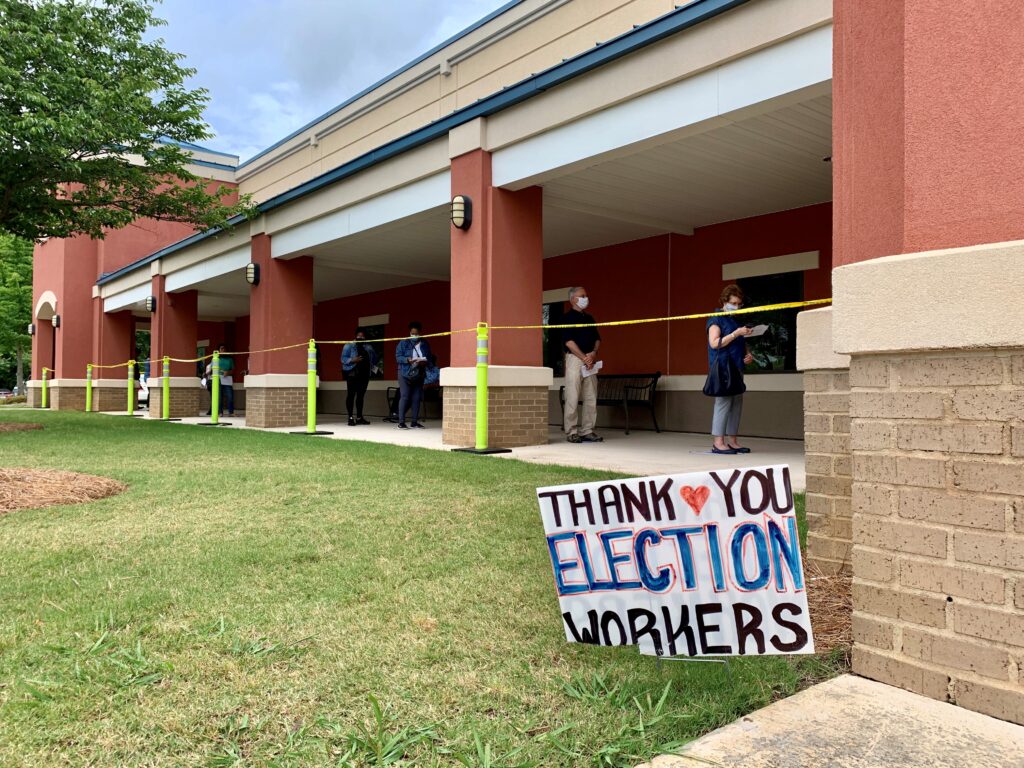
ATLANTA – Local elections offices in Georgia will not be allowed to receive private donations under controversial legislation Gov. Brian Kemp signed into law Wednesday.
Senate Bill 222, which the General Assembly’s Republican majorities passed along party lines, was prompted by complaints that out-of-state private funds have been flowing into elections offices in large Democratic counties across the country, including a $350 million contribution by Facebook CEO Mark Zuckerberg to the nonprofit Center for Technology and Civic Life.
Legislative Democrats charged the bill was aimed at denying the financial assistance already resource-poor elections offices need to run their elections smoothly. Without the ability to receive private donations themselves, the measure’s opponents argued, local elections offices will be forced to rely on the State Election Board to allocate private dollars.
Kemp signed 13 other bills into law Wednesday, including legislation to:
— require cities and counties to enforce local ordinances prohibiting homeless people from camping and sleeping in public areas. Democrats opposed the Republican-backed bill as a blow to local control.
— authorize financial advisors to delay transactions involving their elderly or disabled clients if they suspect fraud.
“Georgia law now grants financial institutions the ability to slow down and verify transactions involving the accounts of elderly and at-risk Georgians,” Georgia Secretary of State Brad Raffensperger said Wednesday. “This proactive measure against fraud was my key legislative priority of the past legislative session.”
ATLANTA – A parade of expert and citizen witnesses asked the Georgia Public Service Commission (PSC) this week not to let Georgia Power recover 100% of higher fuel costs incurred during the last couple of years from customers.
While the witnesses blamed the increased costs on the Atlanta-based utility’s overreliance on natural gas, a witness for Georgia Power cited factors beyond the company’s control as driving up the costs of the fuel it uses to generate electricity.
Tuesday’s daylong hearing was on a request by Georgia Power to increase the average residential customer’s monthly bill by $15.90 to allow the utility to recover $2.2 billion in higher fuel costs. That’s down from the $23 monthly hike the company originally sought, thanks to an agreement Georgia Power reached last month with PSC staff.
Citizen witnesses complained that Georgia Power is too dependent on natural gas, which has a track record of huge price swings, and isn’t being aggressive enough in pursuing alternatives include wind and solar energy.
“The sun is free,” said Wanda Mosley, an Atlanta-area voting rights activist. “We get a whole lot of sun.”
A significant portion of Tuesday’s discussion centered on how much authority the commission has over fuel costs. Commissioner Lauren “Bubba” McDonald said state law requires the PSC to grant the increase.
“Our staff has looked at this fuel case. Everything is in order,” he said. “We have the responsibility of making the proper adjustments that are necessary under the law.”
But Jeremy Kalin, a clean energy finance attorney and advisor, said the law does not require the PSC to let Georgia Power recover all of its higher fuel costs from customers. Without at least some skin in the game on the part of Georgia Power and its shareholders, the company has no incentive to manage fuel costs prudently, he said.
Kalin said the law does not require the commission to sit on the sidelines and simply act as a pass-through for Georgia Power’s higher costs.
“I believe the commission does have an obligation under the law to conduct greater scrutiny on whether Georgia Power has been sufficiently prudent in mitigating … increases in natural gas reliance and natural gas costs,” said Kalin, who testified on behalf of the Georgia chapter of the Sierra Club and the Southern Alliance for Clean Energy.
Sarah Adams, Georgia Power’s vice president and comptroller, said the agreement between the utility and commission staff represents a significant improvement for customers over the company’s original request.
The agreement not only reduced Georgia Power’s initial request by more $1 billion, Adams said. The company also agreed to increase its senior citizen discount from $6 to $8, bringing it to $32 per month, and extended the recovery period from two years to three, she said.
Adams attributed the higher fuel costs to a combination of geopolitical unrest, supply chain constraints, higher than expected domestic demand for natural gas, and an increase in U.S. exports of liquefied natural gas, all outside of Georgia Power’s control.
The commission is scheduled to vote on the proposed increase May 16.