ATLANTA – Georgia Attorney General Chris Carr is asking a federal judge to reconsider a preliminary injunction issued late last week blocking enforcement of legislation limiting medical care for transgender minors.
A motion filed Tuesday in U.S. District Court for the Northern District of Georgia cites a ruling the Atlanta-based U.S. Circuit Court of Appeals issued Monday lifting a preliminary injunction a federal court had imposed barring enforcement of similar legislation in Alabama.
“In its opinion, the Eleventh Circuit expressly addressed – and rejected – each of the core legal theories Plaintiffs here advanced in support of their motion for preliminary injunction,” Carr’s motion stated.
U.S. District Judge Sarah E. Geraghty ruled late Sunday that four Georgia families and a national organization of parents with transgender children likely would succeed on the merits of their challenge to a provision in Senate Bill 140 that bans hormone replacement therapy for the treatment of gender dysphoria in adolescents.
Geraghty declared that Georgia’s Senate Bill 140 violates transgender minors’ equal protection rights under the U.S. Constitution’s 14th Amendment. If it stands, the preliminary injunction would prohibit the law from being enforced while the lawsuit moves forward.
The General Assembly’s Republican majorities passed SB140 last March, voting along party lines, Gov. Brian Kemp signed it two days later, and the measure took effect July 1.
Kemp and other supporters argued the law would protect minors from making life-altering decisions at such a young age.
“SB140 was … a good-faith effort to protect children from the irreversible, lifelong effects of experimental treatments with unproven benefits but well-documented risks to health and fertility,” Carr’s motion stated.
During the debate on the bill, legislative Democrats said delaying hormone replacement therapy or surgery for transgender youths until after age 18 could pose mental health risks. They cited higher-than-average suicide rates among transgender teens.
ATLANTA – A veteran administrator with the Georgia Department of Natural Resources (DNR) is the agency’s new commissioner.
The state Board of Natural Resources voted Tuesday to promote Walter Rabon to the top post. Rabon has been serving as interim commissioner since the beginning of July, when Mark Williams left the DNR to become executive director of the Jekyll Island Authority.
Rabon began his career with the DNR in 1993 as a conservation ranger and worked his way up through the agency’s Law Enforcement Division. He served there as a major before being promoted to deputy commissioner.
“Throughout his many years of service … Walter Rabon has dedicated himself to the mission of protecting hardworking Georgians and their ability to enjoy our outdoor spaces,” Gov. Brian Kemp said Tuesday. “I look forward to DNR’s continued success ensuring our state is a good steward of its natural resources as he continues to lead the department.”
Rabon earned a bachelor’s degree in public administration from Brenau University and a master’s degree from Columbus State University.
ATLANTA – The Georgia Senate is working to come to grips with the ramifications of the growth in artificial intelligence (AI) technology for public policy.
Two Senate committees announced plans Monday to hold a joint hearing on AI this fall. The Public Safety and Science and Technology committees will take up the issue at the state Capitol on Nov. 1.
“Artificial intelligence is evolving rapidly, and it is important for us to analyze current and future AI practices” said Lt. Gov. Burt Jones, who presides over the state Senate. “We must look at the pros, cons and potential unintended consequences of AI, and I look forward to the work of this Senate joint committee.”
Artificial intelligence has caught the attention of government leaders at all levels. U.S. Sen. Jon Ossoff, D-Ga., called the growth of AI an “existential threat” on multiple fronts during a Senate subcommittee hearing in June.
Ossoff said AI can be used to invade Americans’ privacy, disrupt labor markets by replacing jobs now being done by humans, influence the future of warfare, destabilize politics, and threaten the nation’s cybersecurity. On the other hand, the technology promises to increase economic productivity, help diagnose cancer, and produce life-saving drugs, he said.
The use of AI in political ads has raised alarms over its ability to mislead voters into believing candidates said and did things they did not.
“AI may be one of the greatest disruptors in history, providing significant advancements and monumental risk,” said state Sen. Jon Albers, R-Roswell, chairman of the Senate Public Safety Committee. “We must address this head on to protect our citizens, businesses, and state.”
The joint committee will hear from industry experts in an effort to design policies for coping with the growth of AI technology across a multitude of platforms.
ATLANTA – A federal judge has granted a preliminary injunction prohibiting the state from enforcing a portion of a bill limiting medical care for transgender children.
Judge Sarah E. Geraghty ruled late Sunday that four Georgia families and a national organization of parents with transgender children likely would succeed in a permanent challenge to a provision in Senate Bill 140 that bans hormone replacement therapy for the treatment of gender dysphoria in adolescents. The legislation also prohibits Georgians under 18 from receiving gender-affirming surgery.
Sunday’s ruling will allow the lawsuit challenging the ban on hormone therapy for minors to move forward.
The Republican-controlled General Assembly passed SB140 last March, voting along party lines. The law took effect July 1.
Supporters characterized the law as a measure to protect children from irreversible physical changes. Opponents, including parents of transgender youth and major medical societies, argued that delaying hormone replacement therapy or surgery until after age 18 would harm vulnerable transgender youths’ mental health.
“This law unapologetically targets transgender minors and denies them essential health care,” civil rights groups representing the plaintiffs wrote in a statement. “The ruling restores parents’ rights to make medical decisions that are in their child’s best interest, including hormone therapy for their transgender children when needed for them to thrive and be healthy.”
The plaintiffs are represented in the case by the Southern Poverty Law Center, the Georgia chapter of the American Civil Liberties Union, the Human Rights Campaign Foundation and the law firm O’Melveny & Myers LLP.
The state will appeal the ruling, said Kara Richardson, spokesperson for Georgia Attorney General Chris Carr.
“We are disappointed in the judge’s decision and plan to immediately appeal to protect the health and well-being of Georgia’s children,” Richardson said.
The Georgia ruling was the seventh in federal court blocking a ban on gender-affirming care for transgender youth, joining courts in Alabama, Arkansas, Indiana, Tennessee, Kentucky, and Arkansas.
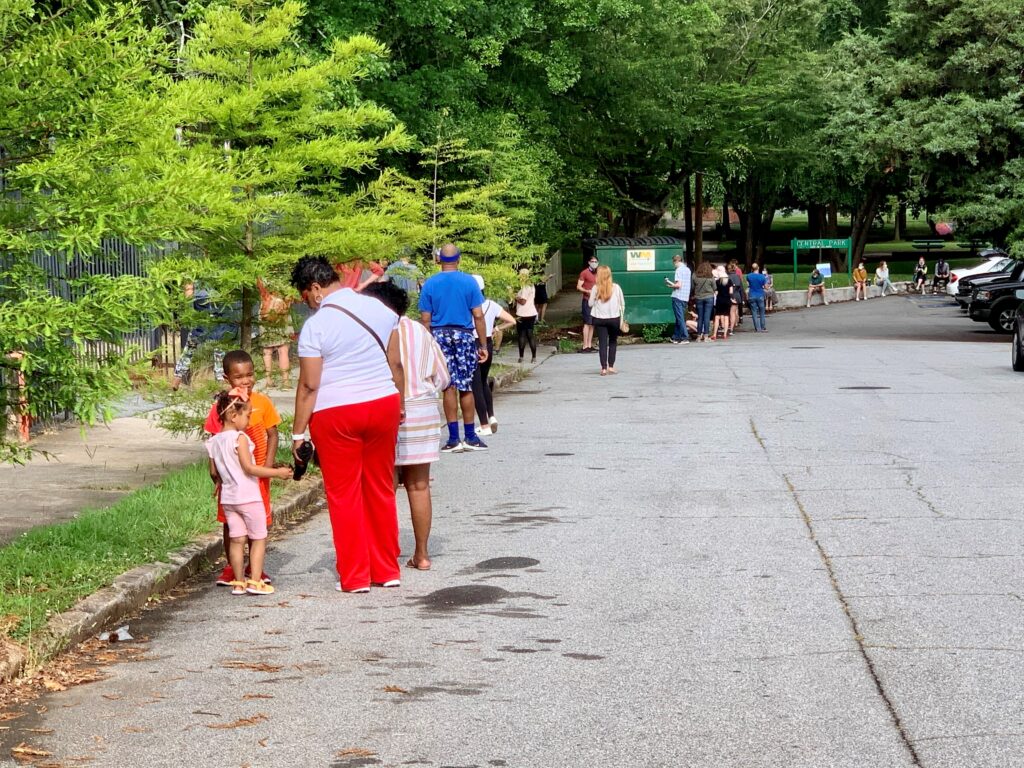
Voters wait in line outside a polling place in Atlanta during the primary election on June 9, 2020. (Photo by Beau Evans)
ATLANTA – A federal court judge has handed both sides in a lawsuit over a controversial election reform bill the General Assembly passed two years ago a partial victory and a partial defeat.
Judge J.P. Boulee granted a preliminary injunction Friday to civil rights and voting rights groups temporarily blocking portions of Senate Bill 202 that restricted volunteers from providing food and water to voters waiting in long lines at the polls. In a partial win for the plaintiffs, the judge declared the ban would apply only within 150 feet of a polling place.
Boulee also threw out a provision requiring voters to include their birthdate on absentee ballot envelopes.
“Today’s decisions remove some of SB202’s barriers to absentee and in-person voting in the 2024 election cycle,” said Rahul Garabadu, senior voting rights staff attorney at the American Civil Liberties Union’s Georgia chapter. “The court recognized that voters should not be disenfranchised for forgetting to write their birthdate on their absentee ballot envelope, or arrested for offering food or drink to voters in line outside the 150-foot zone around polling locations.”
But the judge also gave Georgia Secretary of State Brad Raffensperger reason to celebrate. Boulee upheld portions of the legislation banning ballot harvesting – the gathering and submitting of absentee ballots by third parties – and limiting the number of absentee ballot drop boxes.
“Georgia has one of the best absentee ballot systems in the country,” Raffensperger said. “We have no-excuse absentee ballots, with voters verified with photo ID and who are given an opportunity to cure any discrepancy prior to their ballot being rejected. It’s a system that works well.”
The plaintiffs had brought the lawsuit before last year’s elections. But the judge declined to issue a ruling last August, arguing that changing election laws close to an election would confuse voters.
The General Assembly’s Republican majorities passed SB202 in 2021 after Democrats had scored major gains in Georgia in the 2020 election cycle, including Joe Biden’s victory over incumbent GOP President Donald Trump and the capture of both of the Peach State’s U.S. Senate seats.
With the COVID-19 pandemic going strong, absentee voting played a major role in the 2020 elections, with drop boxes being used for the first time.