ATLANTA – Gov. Brian Kemp extended the temporary suspension of the state sales tax on gasoline and other motor fuels Wednesday, citing ongoing high prices and uncertain economic conditions.
Kemp signed an executive order extending the suspension through Nov. 29, which he said will help Georgians cope with high food and travel costs during the Thanksgiving holiday.
The state can easily afford going without the tax revenue the sales tax would have brought after ending the last fiscal year in June with $5 billion in “rainy-day” reserves and $11 billion in undesignated surplus funds, according to a report released last week by the Georgia Budget and Policy Institute.
“Thanks to our responsible approach in budgeting, we’re able to deliver relief to families fighting through the disastrous effects of Bidenomics,” Kemp said Wednesday, criticizing what he called “failed” economic policies coming out of the Biden administration.
“I’m proud this action has helped keep millions of dollars in hardworking Georgians’ pockets and look forward to continuing to see that impact with the Thanksgiving holiday approaching.”
Kemp suspended the gas tax for a second time in September. He suspended the tax for the first time in March of last year and lifted the suspension last January.
The governor is calling on the General Assembly to ratify the suspension when lawmakers gather under the Gold Dome late this month for a special session aimed primarily at redrawing Georgia’s legislative and congressional district lines following a federal court ruling that boundaries the legislature approved two years ago violated the Voting Rights Act.
ATLANTA – Georgia tax collections fell an adjusted 5.7% last month compared to October of last year, the state Department of Revenue reported Tuesday.
That decline does not take into account the revenues from Georgia’s sales tax on gasoline and other motor fuels the state collected last month. If that $70.5 million is included, the decreased tax revenue for October is lessened to a 3.1% drop compared October 2022.
The tax revenue outlook for the state is complicated by Gov. Brian Kemp having temporarily suspended the gas tax twice, making month-to-month comparisons difficult. Each time, the governor cited the impact of inflation on prices at the pump.
Kemp first suspended the tax in March of last year and continued it into last January. He then resumed the suspension two months ago.
Individual income tax and net sales tax collections last month reflect the red ink. Individual income taxes in October declined 11.8% compared to the same month last year, driven by a 30.2% increase in tax refunds the revenue department issued and a 32.6% decline in tax return payments.
Net sales tax receipts fell by a less precipitous 1.6%.
Corporate income tax revenues actually rose by 24.3% last month, with payments up by 18.7% compared to October 2022.
Gasoline prices in Georgia have dropped this week to a statewide average of $2.89 per gallon of regular, significantly above the national average, according to AAA. However, with the state sitting on a huge budget surplus, Kemp has the leeway to continue the suspension of the gas tax beyond the current Nov. 11 expiration date if he so chooses.
ATLANTA – Four Northwest Georgia counties have been declared natural disaster areas due to weeks of severe drought conditions.
The declaration will allow farmers in Catoosa, Chattooga, Dade, and Walker counties to receive emergency credit from the U.S. Department of Agriculture’s Farm Service Agency (FSA).
“As a seventh generation farmer, I know firsthand the impact drought conditions can have on our agriculture industry, especially those with dryland operations,” Georgia Commissioner of Agriculture Tyler Harper said.
“The lack of moisture in the soil impacts every aspect of an agricultural operation, from delaying winter grains to forcing farmers to purchase hay to feed their cattle. We’re grateful to (U.S. Agriculture) Secretary (Tom) Vilsack for recognizing the importance of providing essential assistance to our Northwest Georgia farmers.”
FSA loans can be used to meet various drought recovery requirements, including replacing such essential items as farm equipment or livestock, reorganizing a farming operation, or refinancing loans. The federal agency reviews all loans based on the extent of losses, available security, and repayment ability.
Georgia farmers and producers in the four disaster counties as well as the contiguous counties of Floyd, Gordon, and Whitfield may apply for assistance.
ATLANTA – Lt. Gov. Burt Jones unveiled a legislative push Tuesday aimed at reducing the size and scope of state government while making it easier for Georgians to get business licenses.
The Republican-backed multi-pronged “Red Tape Rollback” is being supported by the state’s leading business organizations, including the Georgia Chamber of Commerce and the Metro Atlanta Chamber.
“Georgia has built the nation’s best business environment, and we want to keep it that way,” Jones, the state Senate’s presiding officer, said Tuesday.
“A regulatory environment promoting competition, while encouraging the startup and expansion of new businesses, and taking the heavy hand of government out of the equation is a priority. The reforms the Senate will lead on this year will reduce costs and paperwork while minimizing uncertainty for those who want to start or grow a business in Georgia.”
State Senate Republicans plan to introduce legislation during the upcoming General Assembly session to:
improve the process of obtaining professional and occupational licenses while giving state licensing boards more flexibility.
empower Georgia lawmakers to obtain economic analyses of proposed legislation and agency regulations that would affect small businesses.
expand the legal definition of “small business” in Georgia from 100 to 300 employees.
eliminate defunct or duplicative state boards or commissions.
Efforts to reform state licensing boards aren’t limited to state Senate Republicans. GOP Secretary of State Brad Raffensperger formed a commission earlier this year that is looking for ways to reform Georgia’s business licensing process.
Chris Clark, president and CEO of the Georgia Chamber, praised the lieutenant governor Tuesday for championing the cause of easing business regulations.
“As Georgia has just been named the best state in which to do business for the 10th consecutive year, our statewide business community relies on thought leaders like Lt. Gov. Jones to ensure we expand Georgia’s global competitiveness to attract new investment and create opportunity,” Clark said.
The 2024 session of the General Assembly will begin Jan. 8.
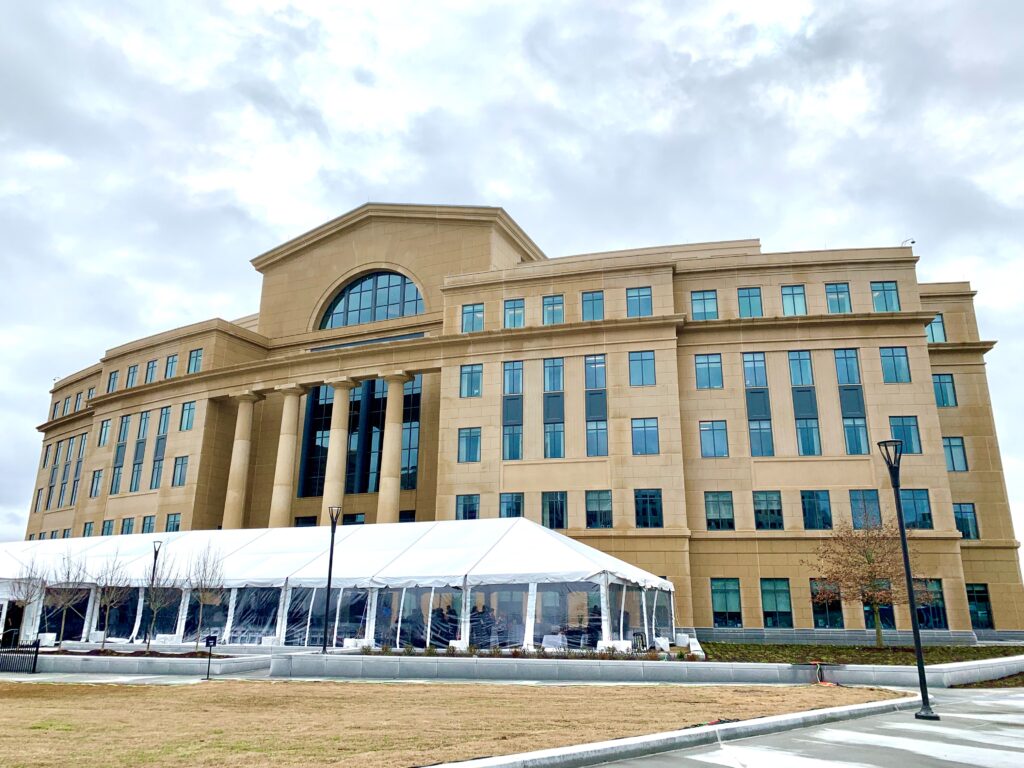
The Nathan Deal Judicial Center in downtown Atlanta (Photo by Beau Evans)
ATLANTA – The scope of the Georgia Department of Community Health’s (DCH) authority to overrule decisions on Certificate of Need (CON) applications rendered by hearing officers was at issue Tuesday before the state Supreme Court.
In a complicated case, multiple parties are challenging Northside Gwinnett Hospital’s application for a CON to establish a new radiation therapy service.
The case made its way to the state’s highest court after the Georgia Court of Appeals declared the DCH commissioner had the authority to approve Northside Gwinnett’s CON application.
The appellate court’s ruling overturned a lower court decision that the commissioner exceeded the limits of his statutory authority by rejecting and modifying findings of fact of the hearing officer without specifically declaring those findings “were not based upon competent substantial evidence.”
On Tuesday, a lawyer representing Northeast Georgia Medical Center in Gainesville told the justices the commissioner improperly rejected half of the 86 findings of fact in the hearing officer’s earlier decision to deny the CON application.
“There’s not a single place in the commissioner’s order where he addresses evidence at all,” David Darden said.
“A lot was done wrong in this case,” added Keith Blackwell, a former Georgia Supreme Court justice representing Dunwoody-based Vantage Cancer Centers of Georgia in this case.
Lawyers representing the DCH and Northside Gwinnett Hospital conceded some of the language in the commissioner’s order was imprecise.
But Robert Highsmith, representing Northside Gwinnett, argued the rules of evidence in administrative law proceedings are broad, giving the commissioner the leeway to render decisions based on competent substantial evidence, not just legally admissible evidence. In his order, the commissioner went beyond that by explaining his legal interpretations, he said.
“In every case, the commissioner said, ‘Here’s why I’m rejecting this evidence,’ ” Highsmith said.
Blackwell suggested the state Supreme Court could order the DCH commissioner to redo the review of the CON application or remand it back to a lower court to reassess the case.