ATLANTA — When Georgia lawmakers went home on Friday, they left the state on a collision course with their own self-imposed deadline to change the way residents vote.
In 2024, they banned the use of QR codes to tally election results starting July 1. Despite lengthy hearings on the problem before the legislative session last year and during it this winter, they walked away without establishing a replacement system.
Election officials are equipped to use hand-marked ballots instead, but they say that system is only for isolated emergencies and they question the reliability for statewide use during the Nov. 3 midterm elections.
“We shouldn’t plan to have an emergency in November,” said Joseph Kirk, the election supervisor in Bartow County and the president of the Georgia Association of Voter Registration & Election Officials.
Beyond the logistics, the use of the backup system outside of an emergency may not be legal.
State law says election officials must let voters use an electronic ballot-marking system like the one in use now unless conditions make that “impossible” or “impracticable.”
The Legislature has not defined those words, but election officials have been interpreting them to mean situations like a power outage or a computer bootup failure.
The State Election Board, which interprets election-related law, considered amending its rules in a way that would have effectively allowed the paper-based backup systems to be used in other kinds of emergencies, like a legal one.
Critics, including President Donald Trump, contend Georgia’s voting system violates federal and state law.
Reasons range from lack of required secrecy — the touchscreen kiosks voters use to enter their selections are barely private — to the inability of voters to confirm that their vote was accurately recorded by the “Quick Response” (QR) code on the ballot they turn in after making their selections.
The computer system spits out a record of the vote on paper, in human readable text as required by law. But the system relies on an included translation into a machine-readable data format — the QR code — to tabulate the official tally.
The state election board declined to write a definition of “impossible” or “impracticable” into its rules. During a vote in December, the members tied 2-2, with two Republicans in favor and a Democrat and a Republican opposed. The Republican who voted against the measure said it was the Legislature’s duty to define the words it had written into law.
With the legislative session over, it is too late for lawmakers to do that before this year’s midterm elections, unless Gov. Brian Kemp calls them back to the Capitol for a special session.
But lawmakers failed to address the issue during their legislative session last year and during the three months that they were in Atlanta this year.
“If they couldn’t do it in two years, how are they going to do it in a few weeks? I have no confidence left in the legislators that are trying to decide what to do with elections,” said Anne Dover, the election director in Cherokee County.
She said she is worried about the midterms like never before in her 18-year career.
The current computerized system automatically deals with a logistical headache in polling places where people converge from different neighborhoods represented by different combinations of districts for city council, county commission, school board, the Legislature and Congress.
There are 90 ballot “styles” in Cherokee alone, she said, with as many as five at one of her precincts.
Dover said her biggest fear is that a poll worker accidentally gives a voter the wrong paper ballot. She said the odds of that go up as her veteran poll workers, many in their mid-70s, throw up their hands and say they are done with the job due to the uncertainty and risk. She said some have expressed concern about prosecution by a State Election Board that has become more zealous about election integrity since Trump lost the presidency in 2020.
The prospect of November “is a little bit frightening,” Dover said.
Marilyn Marks, one of the many advocates for the use of hand-marked paper ballots, said such fears are overblown.
Marks is sympathetic with election officials’ concerns about being blamed for screwing up an election conducted with hand-marked paper ballots, but she said the bigger risk is that Trump uses questions about the legality of Georgia’s current system to seize voting machines after the November elections.
They would get blamed for issuing the wrong ballot, acknowledged Marks, executive director of the Coalition for Good Governance, adding that they think they would be held blameless if the computerized system they were directed to use were deemed to be illegal.
“That’s kind of looking at things a little too myopically,” she said.
Marks said poll workers are already trained to pivot to paper in an emergency, so it is not a stretch to imagine them pulling off an entire election without the computerized voting machines. Election directors would just have to pre-print ballots and get them organized, she said. Counties with more ballot styles could also use on-demand printers, she added.
About 4 million Georgians voted in the last midterm elections, in November 2022.
“I have a lot of concerns about how heavy this lift is going to be for us,” said Kirk, the leader of the association for elections officials.
He said he has implemented new voting systems many times in his career. It takes a year to do it right, he said, and he and his colleagues will have less than half a year after the primary runoff elections in June.
“That doesn’t mean we’re not going to do our absolute best to try and serve our communities,” he said.
Secretary of State Brad Raffensperger oversees elections in Georgia.
He told lawmakers it would cost about $66 million to swap out election systems with three years remaining under the contract with the current vendor.
Some lawmakers said that was an exaggerated amount, and the General Assembly did not put it in the budget.
Even so, a spokesman for the secretary of state’s office said Raffensperger, who will appear on May 19 Republican primary election ballots as a candidate for governor, is confident that the state is ready for November.
“Georgia’s election directors will be ready to run an election, period,” the spokesman said in a text message.
The spokesman did not elaborate on why the office was so sanguine, but in November Raffensperger wrote a letter to the two state representatives leading a Blue Ribbon study committee on election procedures.
Raffensperger wrote that his office had successfully conducted a pilot program authorized by the Legislature to use optical character recognition technology, or OCR, to tally votes. The “double blind” count of the human-readable ballot printouts from the electronic ballot-marking devices produced 100% accurate results, Raffensperger told them.
In other words, the OCR count had matched the QR count.
Raffensperger concluded that the General Assembly should authorize and fund this method as a way around the 2024 ban, since that law only made the use of QR codes illegal for tabulation of the official vote. He said it would only cost $300,000 “and would save taxpayers $60 million or more for the cost of new system components.”
So, the Legislature left a loophole in 2024, and if the state opts to use it, voters will not notice anything different when they go to the polls in November.
ATLANTA — Republican Clayton Fuller was cruising to victory in the special election runoff Tuesday night to select a successor for former U.S. Rep. Marjorie Taylor Greene, according to unofficial results.
Fuller, a former district attorney endorsed by President Donald Trump, held more than a 10 percentage point margin over Democrat Shawn Harris, a retired Army brigadier general, with most of the 10 counties in Congressional District 14 fully reporting.
“Tonight showed that GA-14 is committed to supporting President Trump and sending an America First fighter to Washington,” Fuller said in a statement. “This victory couldn’t have happened without President Trump’s endorsement and the amazing patriots of Northwest Georgia.”
A month ago, Fuller and Harris emerged as the leaders among a field of 17 candidates seeking to replace Greene, who left office a year early after falling out with Trump, mainly over the release of files related to deceased sex trafficker Jeffrey Epstein.
Democrats had hoped to make headway in the conservative northwest Georgia district after Harris led the field in the March 10 special election.
But there were only three Democrats vying for votes that night while Fuller had to split votes with 11 other Republicans.
Josh McKoon, chairman of the Georgia Republican Party, described Tuesday’s outcome as a Trump victory.
“Trump’s coattails are long, his movement is alive and well, and no amount of Hollywood cash or coastal elite endorsements could stop it,” McKoon said on social media, an apparent reference to the endorsement of Harris by actor Samuel L. Jackson.
Fuller said he would be “a strong vote for the President’s MAGA agenda in Washington and giving GA-14 a conservative voice again.”
Fuller will be back on the campaign trail soon: had Greene remained in office, she would have had to run for re-election, starting with the May 19 primary.
On that date, Fuller will face a rematch with nine of the 16 Republicans he vanquished last month.
Should he win against them, he will face a rematch with Harris on Nov. 3.
Harris was the only Democrat to qualify for the upcoming primary. It will be his third attempt to win the Congressional seat, having lost to Greene in 2024 when he secured 36% of the vote.
Among those Fuller defeated in March and will be facing again next month is former state Sen. Colton Moore, R-Trenton, a Trump devotee who resigned early this year to contest the Congressional race.
Voters on Tuesday put another Republican in Moore’s former seat: Lanny Thomas defeated Democrat John Bentley “Jack” Zibluk in the race to represent the 53rd state Senate district, which spans the northwest corner of Georgia, including Catoosa, Chattooga, Dade, Floyd and Walker counties.
In DeKalb and Gwinnett counties, Venola Mason defeated Kelly Kautz in the runoff to replace former state Rep. Karen Bennett, D-Stone Mountain, who resigned in January and pleaded guilty to charges that she fraudulently obtained $13,940 in unemployment supplements during the COVID-19 pandemic.
In a Richmond County state House runoff, Democrat Sheila Clark Nelson defeated Republican Thomas McAdams to take the seat previously held by state Rep. Lynn Heffner, D-Augusta, who resigned after moving out of the district because of damage to her house caused by Hurricane Helene.
ATLANTA — Homeowners will get relief from their fast-rising property tax bills and may even see tax cuts if Gov. Brian Kemp signs Senate Bill 33 into law.
But many other constituencies stand to lose, including one that cannot vote: children in public schools.
Local governments and schools collect the money they need to pay for operations using a simple formula: property values established by county assessors multiplied by tax rates set by each city council, county commission or school board.
SB 33 would arrest half of that formula by limiting increases in taxable home values to the rate of inflation.
Cities, counties and schools could simply bump the other variable in the formula, bringing in more revenue by raising the tax rate, also known as the millage rate.
That might not be politically popular, but it would keep the lights on.
There is a catch for schools, though: nearly all of Georgia’s 180 school districts are limited to a maximum rate of 20 mills under the state constitution.
So, the most that they can collect is $20 per $1,000 of assessed value.
Some districts would begin to see cost increases outpacing revenue increases in just a few years, said Justin Pauly, spokesman for the Georgia School Boards Association.
“It’s definitely going to squeeze things,” he said.
School districts are powerless to contain two big drivers of rising costs, he said. Teachers get two benefits that the locals must pay into at rates set by the state: a pension and health insurance.
Health insurance costs have risen 20% to 30% in the past half decade, said John Zauner, executive director of the Georgia School Superintendents Association.
If Kemp signs SB 33 into law, Zauner expects pockets of school districts around the state to begin laying off teachers in a few years.
Personnel costs account for 90% of a typical school budget, Zauner said. “How do you save money when 90% of your budget is personnel cost? You go to the personnel to reduce your costs.”
That, in turn, would mean more students per teacher, affecting teaching quality, he said.
SB 33 arrests costs for owner-occupied homes, so rural and primarily residential areas that lack industry would get hit first.
Also, most school systems are already near the maximum tax rate, with the state average at 15 mills.
At least five school districts already had tax rates set between 19 and 20 mills by 2024, including Clayton, Fayette and Gwinnett counties in metro Atlanta, according to Zauner’s count. Two others were Dublin City and Wilkinson County, both near Macon.
A handful of others had already reached or exceeded the 20-mill cap, but they are exempt owing to peculiarities in the constitution, Zauner said. Many of those are also in metro Atlanta, including the systems for DeKalb and Rockdale counties and for the cities of Atlanta and Decatur. Muscogee County, where Columbus is the county seat, is in that group, as well.
Many constituencies besides students would lose if SB 33 were to become law. The taxable value of properties that are not owner-occupied would be allowed to continue outpacing inflation, so apartments, factories, restaurants, stores and offices would see no benefit.
Also, SB 33 would allow a new penny sales tax to further offset the property tax burden for homeowners in counties that approve such a tax by referendum.
So, the burden of paying for parks, police, roads — and schools — could shift further from homeowners, while the overall economy carried the cost.
ATLANTA — Georgia House and Senate Republicans with competing agendas managed to push through income and property tax cuts as the curtain closed on the 2026 Georgia legislative session after midnight Friday.
The Senate did not get its elimination of income taxes. The House did not get its elimination of property taxes.
But both taxes would become smaller if Gov. Brian Kemp signs the two bills into law.
Owing to the late hour, Senate Republicans had to repurpose a hemp farming bill to send a property tax cut to the House.
The measure would basically shift money from homeowners’ right pocket to their left: the property taxes on their homes could be reduced by the income from a new penny sales tax.
It also would suppress the increase in valuations of owner-occupied homes, limiting the rise of those “homesteaded” properties for tax purposes to the rate of inflation.
Commercial properties — and renters — would not benefit from either provision.
The state House had had a similar idea, but it ran afoul of the state Constitution. A two-thirds vote was required for adoption, and Democrats opposed it, denying passage of House Bill 1116 in early March.
So the Senate came up with a legal workaround that would allow local legislative delegations to call for such changes, making it politically easier to get the necessary two-thirds vote for each of Georgia’s 159 counties. The new sales tax would then go to voters in a referendum.
The income from that sales tax revenue would bypass government and go straight to homeowners.
“We think there are about 110 counties and all the cities within those 110 counties that could pretty much eliminate their homestead property taxes for county and city with that one-time sales tax,” said Clint Mueller, deputy director of ACCG, the association for Georgia’s county commissioners.
Local governments would see revenue growth constrained by the inflation cap on home values. But when a property changes hands, or when there is new construction, the value would reset to the current market.
So fast-growing jurisdictions and those with a higher proportion of their tax base comprising properties that are not occupied by homeowners would be less affected.
Cities and counties could also raise their property tax rates. So could school districts, although, unlike cities and counties, nearly all of them are limited by law to a maximum rate of 20 mills, Mueller said. (A mill equals a dollar for every thousand dollars of assessed value.)
Sen. Blake Tillery, R-Vidalia, presented Senate Bill 33, formerly the hemp bill and now containing a mutation of HB 1116, on the Senate floor less than half an hour before midnight Thursday.
It passed despite firm opposition from Democrats, the minority party.
In the House, as the clock ticked toward 1 a.m., Rep. Shaw Blackmon, R-Bonaire, who’d been leading the charge on the House’s primary agenda of property tax reduction, acknowledged that the cut would pass by hitchhiking, allowing senators to take the credit.
He recounted a line from a favorite Marvel movie, involving the character Dr. Strange: “it’s not about you,” Blackmon said. “And we’re going to do what’s best for the taxpayer.”
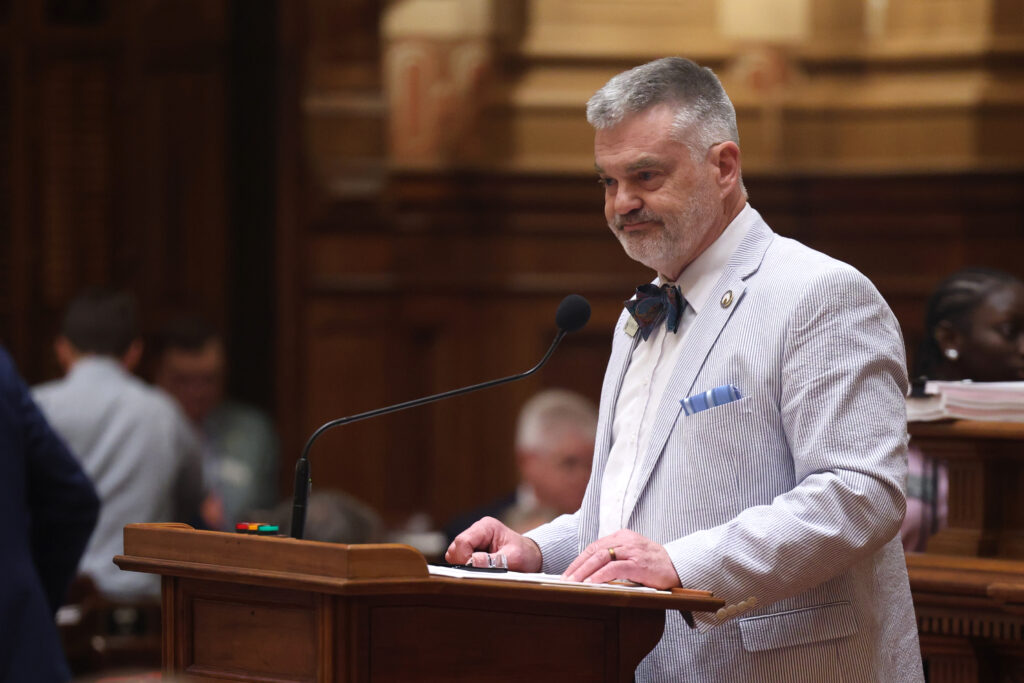
Rep. Shaw Blackmon, R-Bonaire, presented an amended version of House Bill 1116 on crossover day on Friday, March 6, 2026, at the Georgia State Capitol Building. The bill at that point was a pared back version of the one that had sought to eliminate homeowner property taxes in Georgia. The Senate chose to send back its own proposal for property tax cuts in Senate Bill 33 on Thursday, and the House approved it early Friday, as the legislative session ticked to an end. (Ashtin Barker/Capitol Beat)
House Republicans sent the bill to Kemp, overriding opposition from Democrats, also in the minority in that chamber.
Later, House Speaker Jon Burns, R-Newington, expressed mixed emotions about the outcome.
“The bill that came back to us was not strong enough,” he said. “There were several different initiatives we had in our property tax bill that would have been more meaningful for our property taxpayers.” But it was still a “robust” tax cut, he said, vowing to push further next year.
If Kemp signs House Bill 463 into law, Georgians will also pay less for income taxes.
The measure approved by lawmakers would drop the rate to 4.99% from the current 5.19%. It would continue falling over eight years to 3.99% if state revenues remain strong. Income tax deductions would rise, as well, over eight years, from the current $12,000 for single filers, to $18,000. The amounts would double for married couples. Dependent deductions also would rise by $1,000 over eight years from the current $4,000.
And the state income tax on overtime pay and cash tips would be waived on the first $1,750.
HB 463 would offset the cuts by eliminating a handful of tax breaks for items like electrical vehicle chargers and the manufacture of cigarettes for export.
Democrats complained that Georgia’s top earners would get the most back, and Blackmon responded that they put the most in.
He called it “real, meaningful tax relief.”
But Sen. Josh McLaurin, D-Sandy Springs, said the tax credits being eliminated to pay for the income tax cut would not come close to making up for the lost revenue.
“It’s a completely fiscally irresponsible bill,” he said, adding that the tax exemption for overtime pay and tips was “a handful of peanuts that we’re throwing back” at Georgians.
Sen. Harold Jones, II, D-Augusta, the Senate minority leader, called the income tax legislation, which passed the Senate around 10 p.m., a “cynical attempt at electoral politics,” in a year when affordability had become a central talking point.
Tillery, who, like McLaurin, is a candidate for lieutenant governor, admitted the income tax cut was not as big as what Senate Republicans had wanted. They had previously pushed a measure to eliminate state income taxes altogether.
ATLANTA — Georgia lawmakers set up the possibility of a swift conversion to hand-marked paper ballots this year when they failed to pass a bill early Friday morning that would have gradually replaced the state’s touchscreen voting system.
The Senate’s refusal to vote on the bipartisan elections bill leaves Georgia with computer-generated ballots that will soon be illegal, just months before the midterm elections.
The legislation, Senate Bill 214, would have delayed a state law passed two years ago that set a July 1, 2026, deadline to stop using the kind of ballots produced by Georgia’s touchscreen voting machines, which print computer QR codes on ballots to count votes.
Opponents of the current voting system say humans can’t read QR codes — which contain voters’ choices — to verify that their ballots are accurate.
Without a new law, the July 1 deadline to eliminate QR codes remains in effect.
Instead of those QR-coded ballots, voters would need to use Georgia’s backup voting system: pre-printed ballots with ovals that voters fill in with a pen. Existing ballot scanning machines can read hand-marked ballots.
Rep. Victor Anderson, R-Cornelia, speaks about Senate Bill 214 on the House floor during the final day of the 2026 Legislative Session, on Thursday, April 2, at the Georgia Capitol in Atlanta. This bill would have switched Georgia to hand-marked paper ballots by 2028. (Ashtin Barker/Capitol Beat)
County election directors have warned that an election-year transition to a new voting method, without a plan or funding, could lead to voter confusion and disruptions in polling places.
It’s unclear how they will handle the hurdles of pre-printing millions of ballots, training election workers, and educating voters if QR codes are banned two months from now.
“I think we’ve got a problem,” said Sen. Kim Jackson, D-Stone Mountain. “By not acting, we’ve actually chosen chaos.”
The House voted 132-39 hours earlier SB 214, which would have moved the deadline to eliminate QR codes to 2028.
But Lt. Gov. Burt Jones, who presides over the Senate, let the House’s competing solution die without a vote as the legislative session ended early Friday morning. The Senate passed a bill last week to require hand-marked paper ballots in this year’s elections, but the House didn’t consider it.
Senate Majority Leader Jason Anavitarte, R-Dallas, said he didn’t know what would happen next.
House Speaker Jon Burns, R-Newington, said needed to talk with Gov. Brian Kemp about what, if anything, lawmakers should do next.
Burns said the House bill was a “reasonable plan” to update Georgia’s voting technology gradually rather than immediately during a high-stakes election year.
“You can’t change horses in the middle of the stream,” Burns said. “Part of what we want to do is what’s tried and true, working with our locals with a good plan that we knew could work.”
Kemp could call a special session to bring legislators back to the Capitol to resolve the issue.
“There’s still some options. We’ve got to look. We’ve got to investigate. I’m hopeful we’ll get there,” said Sen. Max Burns, R-Sylvania. “Give us 24 to 48 hours to get a nap, and then we can talk about it.”
Under the bill approved by the House, Georgia would have bought a new election system that would count ballots without using QR codes before the 2028 presidential election year, recording votes directly from bubbled-in ovals or the text printed on ballots.
House Governmental Affairs Chair Victor Anderson, R-Cornelia, said county election officials need time to buy and test a new voting system before it’s rolled out to Georgia’s 8 million registered voters.
Georgia’s election equipment, purchased from Dominion Voting Systems for over $100 million in 2019, came under fire from Republicans after President Donald Trump lost the 2020 election. Election security experts have also criticized it, saying the technology is vulnerable to tampering.
County election directors from across Georgia supported the bill that passed the House, SB 214, over the Senate’s proposals that would have forced a rapid switch to hand-marked paper ballots before the November midterm elections.
They said such a quick transition would disrupt elections because there wouldn’t have been much time for training, testing, and implementation.
Without a new law, election directors will have to begin preparing for that possibility.