ATLANTA — Georgia House and Senate Republicans with competing agendas managed to push through income and property tax cuts as the curtain closed on the 2026 Georgia legislative session after midnight Friday.
The Senate did not get its elimination of income taxes. The House did not get its elimination of property taxes.
But both taxes would become smaller if Gov. Brian Kemp signs the two bills into law.
Owing to the late hour, Senate Republicans had to repurpose a hemp farming bill to send a property tax cut to the House.
The measure would basically shift money from homeowners’ right pocket to their left: the property taxes on their homes could be reduced by the income from a new penny sales tax.
It also would suppress the increase in valuations of owner-occupied homes, limiting the rise of those “homesteaded” properties for tax purposes to the rate of inflation.
Commercial properties — and renters — would not benefit from either provision.
The state House had had a similar idea, but it ran afoul of the state Constitution. A two-thirds vote was required for adoption, and Democrats opposed it, denying passage of House Bill 1116 in early March.
So the Senate came up with a legal workaround that would allow local legislative delegations to call for such changes, making it politically easier to get the necessary two-thirds vote for each of Georgia’s 159 counties. The new sales tax would then go to voters in a referendum.
The income from that sales tax revenue would bypass government and go straight to homeowners.
“We think there are about 110 counties and all the cities within those 110 counties that could pretty much eliminate their homestead property taxes for county and city with that one-time sales tax,” said Clint Mueller, deputy director of ACCG, the association for Georgia’s county commissioners.
Local governments would see revenue growth constrained by the inflation cap on home values. But when a property changes hands, or when there is new construction, the value would reset to the current market.
So fast-growing jurisdictions and those with a higher proportion of their tax base comprising properties that are not occupied by homeowners would be less affected.
Cities and counties could also raise their property tax rates. So could school districts, although, unlike cities and counties, nearly all of them are limited by law to a maximum rate of 20 mills, Mueller said. (A mill equals a dollar for every thousand dollars of assessed value.)
Sen. Blake Tillery, R-Vidalia, presented Senate Bill 33, formerly the hemp bill and now containing a mutation of HB 1116, on the Senate floor less than half an hour before midnight Thursday.
It passed despite firm opposition from Democrats, the minority party.
In the House, as the clock ticked toward 1 a.m., Rep. Shaw Blackmon, R-Bonaire, who’d been leading the charge on the House’s primary agenda of property tax reduction, acknowledged that the cut would pass by hitchhiking, allowing senators to take the credit.
He recounted a line from a favorite Marvel movie, involving the character Dr. Strange: “it’s not about you,” Blackmon said. “And we’re going to do what’s best for the taxpayer.”
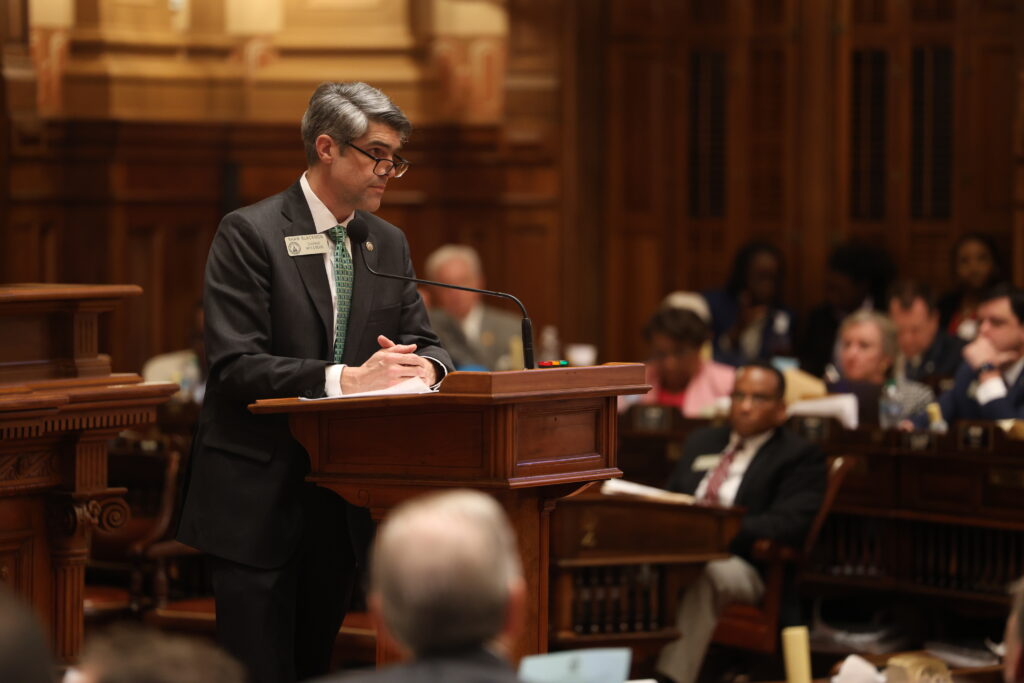
House Republicans sent the bill to Kemp, overriding opposition from Democrats, also in the minority in that chamber.
Later, House Speaker Jon Burns, R-Newington, expressed mixed emotions about the outcome.
“The bill that came back to us was not strong enough,” he said. “There were several different initiatives we had in our property tax bill that would have been more meaningful for our property taxpayers.” But it was still a “robust” tax cut, he said, vowing to push further next year.
If Kemp signs House Bill 463 into law, Georgians will also pay less for income taxes.
The measure approved by lawmakers would drop the rate to 4.99% from the current 5.19%. It would continue falling over eight years to 3.99% if state revenues remain strong. Income tax deductions would rise, as well, over eight years, from the current $12,000 for single filers, to $18,000. The amounts would double for married couples. Dependent deductions also would rise by $1,000 over eight years from the current $4,000.
And the state income tax on overtime pay and cash tips would be waived on the first $1,750.
HB 463 would offset the cuts by eliminating a handful of tax breaks for items like electrical vehicle chargers and the manufacture of cigarettes for export.
Democrats complained that Georgia’s top earners would get the most back, and Blackmon responded that they put the most in.
He called it “real, meaningful tax relief.”
But Sen. Josh McLaurin, D-Sandy Springs, said the tax credits being eliminated to pay for the income tax cut would not come close to making up for the lost revenue.
“It’s a completely fiscally irresponsible bill,” he said, adding that the tax exemption for overtime pay and tips was “a handful of peanuts that we’re throwing back” at Georgians.
Sen. Harold Jones, II, D-Augusta, the Senate minority leader, called the income tax legislation, which passed the Senate around 10 p.m., a “cynical attempt at electoral politics,” in a year when affordability had become a central talking point.
Tillery, who, like McLaurin, is a candidate for lieutenant governor, admitted the income tax cut was not as big as what Senate Republicans had wanted. They had previously pushed a measure to eliminate state income taxes altogether.
“But it moves the ball forward,” he said.