ATLANTA – The Georgia Senate unanimously passed a $29.9 billion mid-year state budget Thursday that includes raises for teachers and state employees.
With the state in sound financial shape coming out of the pandemic thanks to growing tax revenues, Gov. Brian Kemp and lawmakers are giving most state workers a $5,000 increase, with the Senate putting up an additional $4,000 raise for adult and juvenile corrections officers to address high turnover.
Teachers are due to get a $2,000 raise, the last installment of a $5,000 increase Kemp promised during the 2018 campaign.
“Georgia’s economy has remained resilient despite challenges on many fronts,” Senate Appropriations Committee Chairman Blake Tillery, R-Vidalia, said Thursday. “We continue to add jobs. We continue to add businesses. … It’s reflected in the revenue numbers.”
Besides the pay raises, the mid-year budget covering state spending through June 30 includes $93 million to reflect an increase in public school enrollment reported last fall, $388.2 million to fully fund the state’s K-12 student funding formula and $432.5 million to upgrade the prison system.
“Many of these facilities are very old,” Tillery said. “It’s a safety issue.”
Senators also supported Kemp’s proposal to take advantage of the influx of tax revenue by returning $1.6 billion in rebates to Georgia taxpayers.
Senate changes to the mid-year budget the state House of Representatives adopted last month include $4.1 million to give school nurses $2,000 raises, $20 million for rural downtown development grants and $14.9 million to match an equal amount the House put toward fixing wear and tear at state parks, which have gotten a lot of use during the pandemic.
The mid-year budget now returns to the House, which could either agree with the Senate changes or send the spending plan to a joint conference committee to work out the two chambers’ differences.
This story isavailable through a news partnership with Capitol Beat News Service, a project of the Georgia Press Educational Foundation.
ATLANTA – A new partnership between an electric membership cooperative (EMC) in Taylor County and a major internet service provider will deliver broadband service to 31,000 customers across a swath of Middle Georgia.
Flint Energies and Kansas City-based Conexon Connect will launch a 3,000-mile fiber network to homes and businesses in Crawford, Macon, Marion, Muscogee, Peach, Schley, Talbot, Taylor and south Houston counties.
The $90 million project is being funded through a federal American Rescue Plan grant of $25 million, $7.5 million from a fund overseen by the Federal Communications Commission and substantial investments by Flint Energies and Connect.
“Today is another milestone in the ongoing effort to bring broadband to unserved and underserved customers in rural Georgia,” Gov. Brian Kemp said.
The project is the latest in a series of broadband initiatives across Georgia since the General Assembly passed legislation in 2019 allowing EMCs to get into the broadband business.
Including Flint Energies, 20 EMCs in Georgia are currently providing high-speed internet or partnering with a provider to expand broadband service in rural communities across the state.
Collectively, these projects represent an investment of $770 million serving more than 282,000 Georgians in 89 counties.
Flint Energies CEO Jeremy Nelms said the new project will serve two goals.
“The system will deliver immediate benefits such as improved power outage response times, better load balancing, and more efficient power delivery,” Nelms said.
“Of equal importance, the fiber system provides an opportunity to help meet the critical need of high-speed broadband for rural Flint members who have been waiting for adequate service.”
This story isavailable through a news partnership with Capitol Beat News Service, a project of the Georgia Press Educational Foundation.
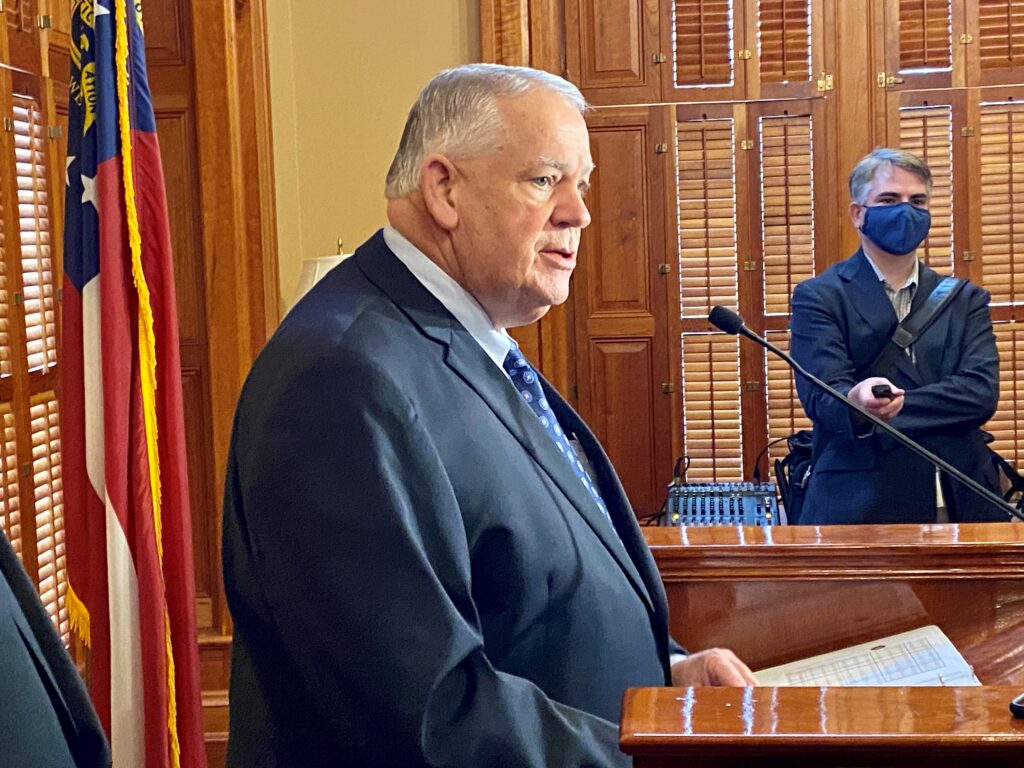
Georgia House Speaker David Ralston (Photo by Beau Evans)
ATLANTA – A bipartisan overhaul of Georgia’s mental health system took a first step toward passage Wednesday when it cleared a state House committee.
The House Health and Human Services Committee approved the comprehensive legislation and sent it on to the House Rules Committee to schedule a floor vote.
Wednesday’s vote came after House Speaker David Ralston, the bill’s chief sponsor, urged the panel to act on what he said is the most important issue lawmakers are facing this year.
“This discussion impacts most every family in Georgia in one way or another,” said Ralston, R-Blue Ridge. “Many Georgians are suffering with mental health issues. Their families are suffering.
“They’re looking for help and either don’t know where to turn or may not have a viable option for mental-health services.”
Georgia ranks 48th in the nation in access to mental health and substance abuse services.
The Mental Health Parity Act would require health insurance companies to treat mental illness in the same way they treat physical illness. The parity provision also would apply to Georgia’s Medicaid and PeachCare for Kids programs and to the State Health Benefit Plan for Georgia teachers and state employees.
The legislation also would require care management organizations (CMOs) participating in Georgia Medicaid to dedicate at least 85% of their revenues to patient care.
To address the shortage of mental health and substance abuse workers, the bill would create a service-cancelable loan program, an initiative expected to cost $8 million to $10 million.
“Whoever can be part of growing and expanding the workforce is paramount to what we do,” said Rep. Katie Dempsey, R-Rome.
The lengthy bill underwent a series of changes as it made its way through the committee aimed at concerns mental health and substance abuse treatment advocates raised.
For one thing, it removed a proposed registry of children who have required the intervention of the state’s crisis services after complaints it would amount to an invasion of privacy.
Advocates also complained the legislation would make it too easy to involuntarily commit Georgians to mental health care.
Another sticking point has been over who should provide “subsequent transport” of patients brought to hospitals by law enforcement or emergency medical services personnel and how to pay for it.
Rep. Mary Margaret Oliver, D-Decatur, one of the bill’s cosponsors, said the state’s mental health system serves most mentally ill Georgians well but is broken when it comes to those in the most distress.
“The money we’re trying to spend in an effective way is about the folks who are not being managed well,” she said. “They end up in jails, as homeless or in our emergency room system.”
Oliver said financial help is on the way. Georgia expects to receive $600 million from a recent national opioid settlement, including $88 million that will be available in next year’s state budget, she said.
Committee Chairman Sharon Cooper, R-Marietta, said the extension work the panel has put in on Ralston’s bill has helped identify gaps in Georgia’s mental health services delivery system.
“It will help us see how we need to change the system to make it more efficient,” she said.
This story is available through a news partnership with Capitol Beat News Service, a project of the Georgia Press Educational Foundation.
ATLANTA – A constitutional amendment asking Georgia voters whether to legalize pari-mutuel betting on horse racing cleared a state Senate committee Wednesday.
But some lawmakers worried the horse racing industry could be set up for failure in the Peach State if racetracks are limited to live or simulcast horse racing.
The constitutional amendment would prohibit casinos from setting up slot machines and table games at racetracks. Other tracks around the nation have come to rely on income from casino operations for a major portion of their businesses.
“I’m very fearful they would not generate enough income without the other forms of gambling,” said Sen. Bill Cowsert, R-Athens, chairman of the Senate Regulated Industries and Utilities Committee.
An “enabling” bill accompanying the constitutional amendment calls for the construction of up to five horse racing tracks in Georgia, to be overseen by a five-member state commission whose members would be appointed by the governor.
Applicants for licenses to operate a racetrack would pay a $500,000 non-refundable fee and a $250,000 renewal fee each year.
If Georgia voters approve horse racing in a statewide referendum, local city councils or county commissions would have to vote by ordinance to allow a racetrack to be built in their community.
A portion of the revenue generated by racetracks would go to education, health care and rural economic development.
Bringing horse racing to Georgia – including the breeding and racing of thoroughbreds – would generate $1.28 billion in annual economic impact and create 15,800 jobs in its first decade, according to a recent study by Georgia Southern University.
“This is a huge industry that’s already here but not at the level it could be,” Sen. Billy Hickman, R-Statesboro, told members of the committee. Unlike Georgia’s heavily subsidized film industry, horse racing would not involve taxpayer-funded incentives to attract interest, he said.
But Mike Griffin, public affairs director for the Georgia Baptist Mission Board, said racetracks wouldn’t be able to stick with horse racing and turn a profit without adding casinos.
“Forty tracks have closed since 2000,” he said. “[They] can’t make it without machines.”
Cowsert said Senate leadership will not support horse racing without making sure the constitutional amendment prohibits tracks from adding casinos.
The committee is expected to vote Thursday on the underlying enabling bill specifying how the horse racing industry would operate in Georgia.
This story is available through a news partnership with Capitol Beat News Service, a project of the Georgia Press Educational Foundation.
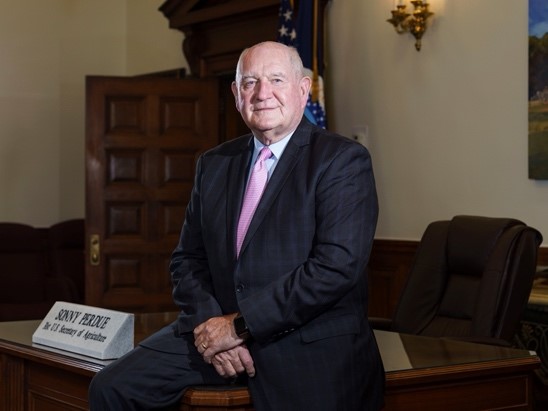
ATLANTA – Former Gov. Sonny Perdue will become the 14th chancellor of the University System of Georgia.
The system’s Board of Regents voted unanimously Tuesday to hire Perdue to lead the state’s 26 public colleges and universities, their more than 300,000 students and more than 40,000 faculty and staff.
Perdue, 75, of Houston County, was selected sole finalist for the post two weeks ago after a nationwide search following the retirement of former Chancellor Steve Wrigley last summer.
The Republican served two terms as governor in the 2000s, then was secretary of agriculture in former President Donald Trump’s administration from 2017 until early last year.
Before being elected statewide, Perdue served in the state Senate, where he chaired the chamber’s Higher Education Committee.
Student and faculty groups criticized Perdue’s appointment because of his lack of experience in education administration.
But Regent Don Waters of Savannah said management and leadership are more important to the chancellor’s role than an academic pedigree.
“Sonny Perdue is extraordinarily well equipped to lead the University System of Georgia,” he said. “His skills make him the right person at the right time.”
Regent Barbara Rivera-Holmes of Albany said Perdue will take on his new role with the university system at an important time for higher education in Georgia.
“We’re facing a national and global labor crisis … a workforce challenge,” she said. “Our institutions are our biggest economic development drivers. … Sonny will do a phenomenal job.”
Perdue’s appointment is effective April 1.
“I appreciate the board’s confidence in me and look forward to working together with them, our campus leadership and faculties, our elected representatives and most importantly, our students, to provide opportunities for students, faculty and staff to be successful and to produce even more outstanding results,” Perdue, who did not attend Tuesday’s board meeting, said in a statement.
“This may be the most important job yet. I can’t think of a better way to make a difference than to help prepare the next generation – educating them for prosperity, themselves, their families and ultimately our state. I’m excited to get started.”
Teresa MacCartney, who has served as acting chancellor since Wrigley left, will remain with the university system as executive vice chancellor of administration.
“She’s been an incredible leader,” Regent Harold Reynolds, the board’s chairman, said before Tuesday’s vote. “We’re grateful for her steady hand.”
This story is available through a news partnership with Capitol Beat News Service, a project of the Georgia Press Educational Foundation.