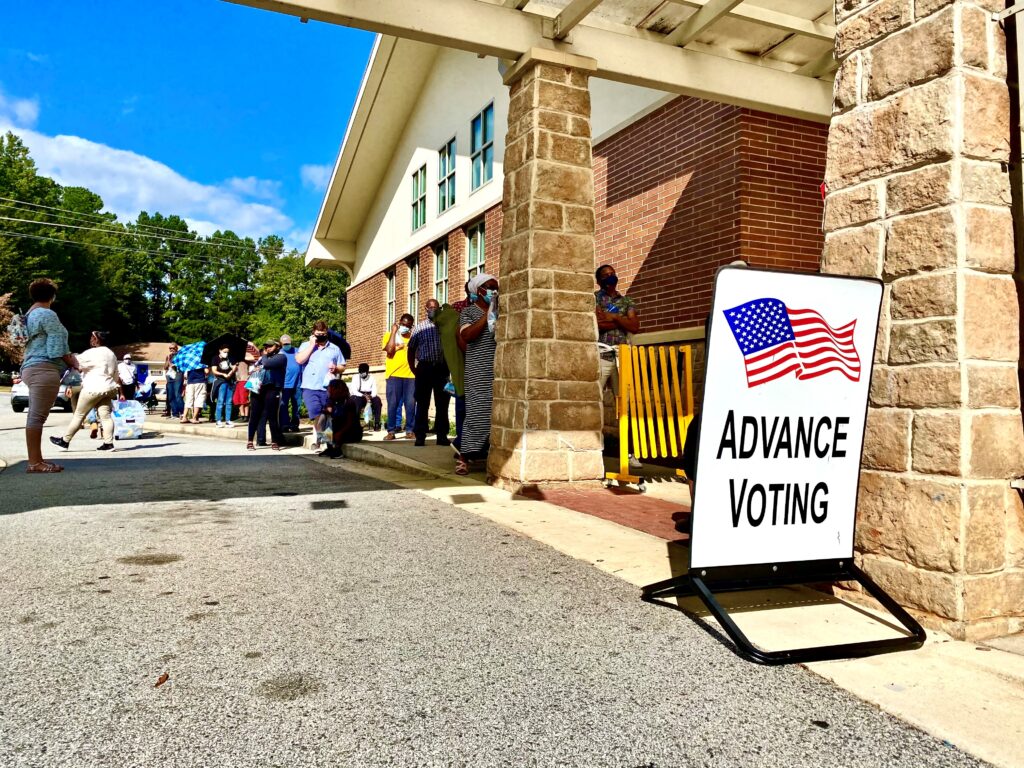
The line stretched around the block at South Cobb Regional Library in Mableton where voters waited in line for hours to cast ballots on the first day of early voting in the Nov. 3 general election on Oct. 12, 2020. (Photo by Beau Evans)
With the Nov. 3 elections just around the corner, Georgians are already heading to the polls in record-breaking numbers amid the dual challenges of the COVID-19 pandemic and the biggest test of the state’s new voting machines.
More than 2.4 million ballots had been cast by mail and in person during the early-voting period as of noon Friday, marking around one-third of Georgia’s roughly 7.5 million registered voters.
Georgians are facing one of the most consequential elections in their lifetimes with a presidential contest, both of Georgia’s U.S. Senate seats, congressional, state and local offices all on the ballot, while state Democratic leaders are vying to flip the Georgia House for the first time since 2005.
Concerns over the virus, recent instances of long lines and doubts over the election’s integrity have driven unprecedented numbers of voters to cast absentee ballots and take advantage of the three-week early-voting period that started last week and ends next Friday.
Nearly 900,000 absentee ballots had been cast by noon Friday, vastly more than the roughly 109,000 ballots cast at this point in the 2016 election. Add those numbers to the roughly 1.5 million in-person early votes logged so far and Georgia’s ballot count to date has exceeded this point in the 2016 election by 121%.
“We are working to make Georgia’s election system fair, voter-centric, smooth and uniform,” Georgia Secretary of State Brad Raffensperger said at a recent news conference. “So far with the numbers, we are succeeding.”
Even so, thousands of voters in metro Atlanta and elsewhere in the state have endured hours-long waits in line at local polling places to vote early, echoing the lengthy queues Georgia saw in the June 9 primary elections and prompting worries over how voting for Election Day on Nov. 3 will fare.
And election officials have met with some technical issues involving the new machines including an overwhelmed check-in system that contributed to delays and a software glitch that wiped some candidates’ names from the ballot. Officials have said both issues were fixed.
County officials who manage the nuts-and-bolts of elections at the local level have pushed to staff up poll workers with adequate training in the new machines and implement sanitization practices amid the pandemic that aim to keep voters safe but have prolonged wait times.
In particular, delays have come as voters who requested absentee ballots but show up to vote in person must formally cancel their mail-in ballots before they can vote. That extra step has extended wait times in precincts across the state, according to local officials.
“That’s slowing things down a bit,” said Janine Eveler, director of the Cobb County Board of Elections and Registration.
Eveler, like other county election chiefs, will have help from a temporary rule allowing election officials to start opening and processing absentee ballots as of this week. Those ballots can’t be tabulated yet, but officials agree the head start should relieve some counting pressure on Election Day.
Raffensperger and other officials are also expecting the three weeks of early voting with such large turnout will give poll workers ample preparation in how to run the new machines before Nov. 3. Lack of know-how at some polling places was a major factor in long lines seen during the June 9 primaries, according to officials.
Installed statewide earlier this year, the new $104 million voting machines from Dominion Voting Systems drew intense scrutiny well before the COVID-19 pandemic set in, largely from voting-rights groups pushing for Georgia to adopt an all-paper ballot system instead of touchscreens.
A lawsuit brought to halt use of the new machines for the 2020 elections prompted a federal judge to require paper backups of voter registration information at polling places to be available if the check-in equipment experiences glitches.
Marilyn Marks, executive director of the Coalition for Good Governance that filed suit, is seeking the court’s intervention to require that certain precincts allow observers inside polling places so they can more closely monitor the machines’ performance for the rest of early voting and on Election Day.
“We think that in this next week, it’s going to be really important to try and gather evidence of what’s wrong,” Marks said in a recent interview. “We’re trying very hard to get in.”
Raffensperger has sought to assure quick technical assistance will be on hand for Election Day from the vendor Dominion as well as with backing from local companies that are helping provide tech support, donate plexiglass screens at polling places and purchase more absentee ballot drop-off boxes for counties.
With turnout expected to top 5 million voters, Raffensperger has called for more Georgians to cast ballots by mail or during early voting to help ease the bottleneck that could strain polling places on Election Day. So far, the state appears on track to have enough votes collected before Nov. 3 to make the upcoming election more manageable, Raffensperger said.
“That will be a manageable election,” Raffensperger said. “The more they vote early, the less there will be left on the playing field to show up on Election Day.”
The line stretched around the block at South Cobb Regional Library in Mableton where voters waited in line for hours to cast ballots on the first day of early voting in the Nov. 3 general election on Oct. 12, 2020. (Photo by Beau Evans)
Georgians are turning out to vote in record-breaking numbers both by mail and at local polling places during the early voting period less than two weeks before the Nov. 3 election.
As of noon Wednesday, nearly 2 million people had voted in the hotly anticipated election that features a presidential contest, both of Georgia’s U.S. Senate seats, congressional, state and local offices all on the ballot.
Of those, more than 1.2 million had cast ballots in person during the three-week early voting period that started last Monday, marking a roughly 60% increase in the number of early voters compared to the same point in the 2016 election.
And to date, around 783,000 voters have cast absentee ballots amid the COVID-19 pandemic that has prompted many Georgians to avoid the lines and virus transmission risks involved in heading to the polls. By this time in the 2016 election, roughly 103,000 mail-in ballots had been cast.
“Notwithstanding the pandemic, voters in the Peach State can take advantage of no-excuse absentee ballot voting by mail or through a secure drop box, three weeks of early in-person voting or Election Day voting,” said Georgia Secretary of State Brad Raffensperger.
With turnout still climbing, state and county election officials expect even more people to cast ballots next week in the days leading up to the election. Raffensperger said earlier this week turnout could top 2.5 million for early voting, with another 2 million voting on Election Day.
Georgia voters have already contended with hours-long waits in line outside many polling places since early voting began last week. Officials have urged voters to take advantage of an online portal to request absentee ballots and to mail them back as soon as possible.
As of Monday, Raffensperger said more than 1.6 million absentee ballots had been requested.
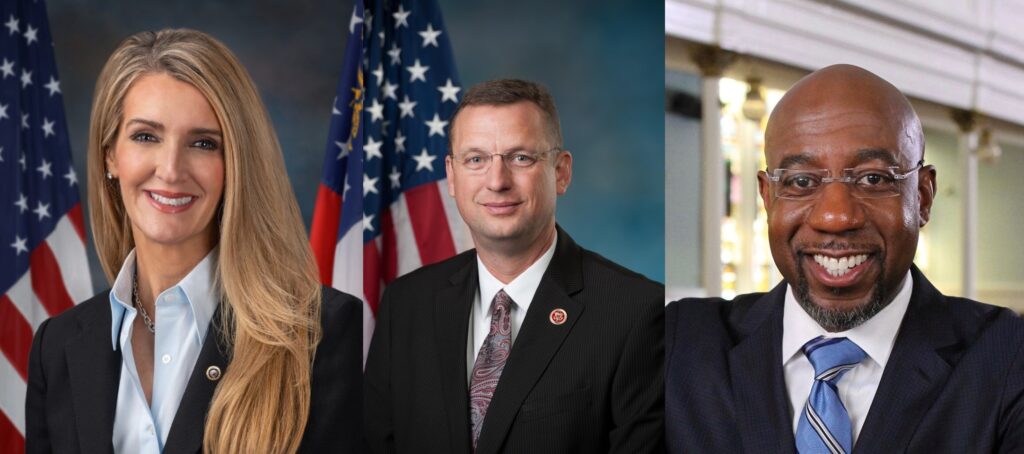
U.S. Sen. Kelly Loeffler (left), U.S. Rep. Doug Collins (center) and Rev. Raphael Warnock (right) are competing in the Nov. 3 special election.
Candidates vying for U.S. Sen. Kelly Loeffler’s seat from Georgia squared off for the first time in a debate Monday that touched on the coronavirus response, criminal justice reforms and concerns that not all challengers are getting a fair shake in the crowded free-for-all race.
Sixteen candidates including Loeffler took the stage in two separate debates hosted back-to-back by the Atlanta Press Club, marking a split format that several candidates said did not give them a real shot at taking on the incumbent senator.
Loeffler, an Atlanta businesswoman and Republican who was appointed to replace retired U.S. Sen. Johnny Isakson in January, continued her war of words with GOP rival U.S. Rep. Doug Collins in the marquee debate.
Their clash surfaced many of the talking points they have employed in the campaign for months heading toward next month’s election, in which both Republicans have sought to cast their opponent as less conservative and more aligned with left-leaning causes and policies.
The two Republicans also stepped up attacks during the debate against the race’s Democratic frontrunner, Rev. Raphael Warnock, the senior pastor of Atlanta’s Ebenezer Baptist Church, who is poised for a runoff in January against either Loeffler or Collins.
And candidates from a range of parties pecked at the three leading candidates during both debates, as well as the Republican and Democratic parties and local media outlets, which they claimed have shut them out of the political process by devoting less press coverage to their candidacies.
The special election, which by law must host all candidates on the same ballot to fill the remaining two years of Isakson’s Senate term, is set for Nov. 3. If none of the roughly 20 candidates in the ballot win more than 50% of the vote, a runoff will be held in January between the top two finishers.
The issues
Echoing the overall tone of this Senate race, much of the back-and-forth featured in Monday’s frontrunners’ debate centered on Collins and Loeffler, who each punched the other on their records in office, their personal backgrounds and which candidate is a bigger supporter of President Donald Trump.
Collins, a U.S. Air Force Reserve chaplain who has served four terms in Congress as well as a stint in the General Assembly, posed his experience as a contrast to the appointed Loeffler and argued certain attacks she has made on him reveal misunderstandings with how the legislative process works.
In particular, Collins raised the issue of Loeffler’s use of wealth in the campaign, to which she has devoted $20 million so far of her own money as a former executive in the company run by her billionaire husband, Intercontinental Exchange CEO Jeffrey Sprecher.
“She doesn’t want people to know about her past,” Collins said. “That’s the reason she’s spending money.”
Loeffler, who has long touted her rural roots growing up on a family farm in Illinois, has batted back criticism of her wealth and sought to cast herself as a largely self-funded candidate like Trump who is spending her money for the cause of public service.
“Doug Collins doesn’t know me,” Loeffler said Monday. “I don’t need advice from a failed career politician who has built his campaign on lies about someone who is a true conservative.”
The spat continued into Loeffler and Collins’ records and past political activities, with Loeffler accusing Collins of voting often with Democratic favorite Stacey Abrams while in the state legislature and Collins pressing Loeffler to delist Chinese companies from the New York Stock Exchange, which is owned by her husband’s company.
Meanwhile, Warnock fended off an attack from Loeffler over past comments he made criticizing police officers from the pulpit, which were featured on a Fox News segment that both Republican candidates have highlighted.
Warnock, who hails from Savannah, stressed he does not support calls from many Democratic leaders and groups to defund police agencies and noted he believes “it’s possible to appreciate the work that law enforcement members do and at the same time hold them accountable.”
“I do think it’s lamentable that the senator would use her power to politicize an issue where people are literally dying on the streets,” Warnock said Monday.
Warnock also raised the recent controversial endorsement of Loeffler by Marjorie Taylor Greene, a Republican in line to win the 14th Congressional District seat who has made past comments echoing views expressed in the QAnon conspiracy theory.
Loeffler, who has embraced the firebrand Greene, said she does not “know anything about QAnon” but denounces all hate crimes. Collins outright condemned QAnon, while simultaneously challenging Warnock to disavow the so-called Antifa movement on the left.
“I condemn violence no matter where it shows up,” Warnock said.
On the issue of the COVID-19 pandemic, Loeffler reiterated her stance that China played a direct role in allowing the virus to spread to the U.S. and should be punished, both for that health crisis as well as for cavalier trade practices that Trump has also made a hallmark of his administration.
“I will not be an apologist or a shill for China,” Loeffler said. “China brought this disease to our country.”
Collins backed the president’s often-criticized response to the pandemic, noting Trump was quick to close travel between China and the U.S. He urged Georgia businesses and schools to continue reopening with social distancing and sanitization practices.
“Georgia is living proof that you can actually get the economy going and get our state going at the same time and actually make sure the virus is kept in check,” Collins said.
And Warnock stuck with a solidly Democratic position that Trump and state leaders have botched the pandemic response by not enforcing rules like mask-wearing more strictly.
“I wish that the folks who are serving in Washington would pay attention to the science instead of politicizing something as basic and obvious as wearing a mask,” Warnock said.
‘It hurts our republic’
Meanwhile, several candidates criticized the debate process and party leadership on both sides for putting too much emphasis on Loeffler, Collins and Warnock in the race.
Most notably, educator and health-care consultant Matt Lieberman urged Georgians to not “vote for one of these three stooges,” arguing he represented the best chance for voters to pick a candidate who would not be beholden to major party figures and agendas.
“The establishment Republican and establishment Democratic candidates in this race are like party drones,” said Lieberman, the son of former U.S. Sen. Joe Lieberman of Connecticut. “What’s the good for us in Georgia to have a senator who’s just going to be about agreeing with Donald Trump or [U.S. Senate Majority Leader] Mitch McConnell or [U.S. Senate Minority Leader] Chuck Schumer or anyone like that?”
Former U.S. Attorney Ed Tarver, who like Lieberman has faced calls to drop out of the race and make way for Warnock, touted his experience as a lawyer, U.S. Army veteran and former state senator to argue why he should keep campaigning.
“I think we’ve gotten a chance to see why many believe that our government in Washington is as polarized as many have ever seen, why many think it’s broken and divided and that people have forgotten about the simple commitment to represent Georgians and not represent political parties,” Tarver said.
Others like Libertarian candidate Brian Slowinski also took jabs at party leadership and media outlets that they feel have shut them out of the process with little news coverage and the split debate format, in which candidates who have not polled higher than 3% shared a different stage from those who have polled higher.
“I also want to talk about candidate suppression as well,” Slowinski said. “It hurts our republic when not everybody is being covered.”
The 10 candidates who shared the second-tier stage expressed similar points while articulating a variety of policy proposals ranging from universal basic income and the Green New Deal to terms limits in Congress and a flat fair tax.
They included Al Bartell, Alan Buckley, John Fortuin, Derrick Grayson, Annette Davis Jackson, Deborah Jackson, Tamara Johnson-Shealey, Valencia Stovall, Kandiss Taylor and Richard Dien Winfield.
U.S. Sen. Kelly Loeffler (left), U.S. Rep. Doug Collins (center) and Rev. Raphael Warnock (right) are competing in the Nov. 3 special election.
Candidates vying for U.S. Sen. Kelly Loeffler’s seat from Georgia hauled in big fundraising dollars down the home stretch ahead of the Nov. 3 special election.
Rev. Raphael Warnock, the Democratic frontrunner who is the senior pastor of Atlanta’s Ebenezer Baptist Church, continued his impressive fundraising run with nearly $13 million between July and September, leaving his campaign with roughly $6.5 million on hand for the race’s final weeks.
The large influx of cash for Warnock came as Loeffler and her Republican challenger, U.S. Rep. Doug Collins, have duked it out for a larger share of Georgia conservative voters in a crowded race.
Loeffler, a wealthy Atlanta businesswoman who formerly worked for and whose husband owns the company that owns the New York Stock Exchange, pumped another $5 million of her own money into her campaign war chest during the July-September fundraising period.
That most recent boost upped her personal loans in the campaign to $20 million, marking a huge amount that has allowed her to launch searing ads against Collins. Loeffler also raised around $2 million in donations, leaving her campaign with nearly $7.2 million.
Loeffler’s campaign has also benefitted from ads launched by a political action committee with ties to Georgia Gov. Brian Kemp, who appointed Loeffler last December to hold retired U.S. Sen. Johnny Isakson’s seat until the special election.
That group, called Georgia United Victory, raised nearly $10 million dollars in the July-September cycle with more than half of that amount donated by Loeffler’s husband, Intercontinental Exchange Inc. CEO Jeffrey Sprecher.
Collins, the U.S. Air Force Reserve chaplain who has attacked Loeffler for her use of wealth in the campaign, raised nearly $2.3 million this fundraising quarter. That leaves him with about $2.4 million to battle Loeffler for enough votes to reach a likely runoff against Warnock in January.
Meanwhile, educator and health-care consultant Matt Lieberman raised nearly $2.6 million since July to stock his campaign with roughly $2.3 million down the home stretch. Lieberman has faced routine calls to drop out of the race as Warnock steams ahead in endorsements, fundraising and polling.
The special election format required by Isakson’s retirement has prompted around 20 candidates including Loeffler to compete on the same ballot on Nov. 3. If no candidate gains more than 50% of the vote, a runoff will be held in January between the top two finishers.
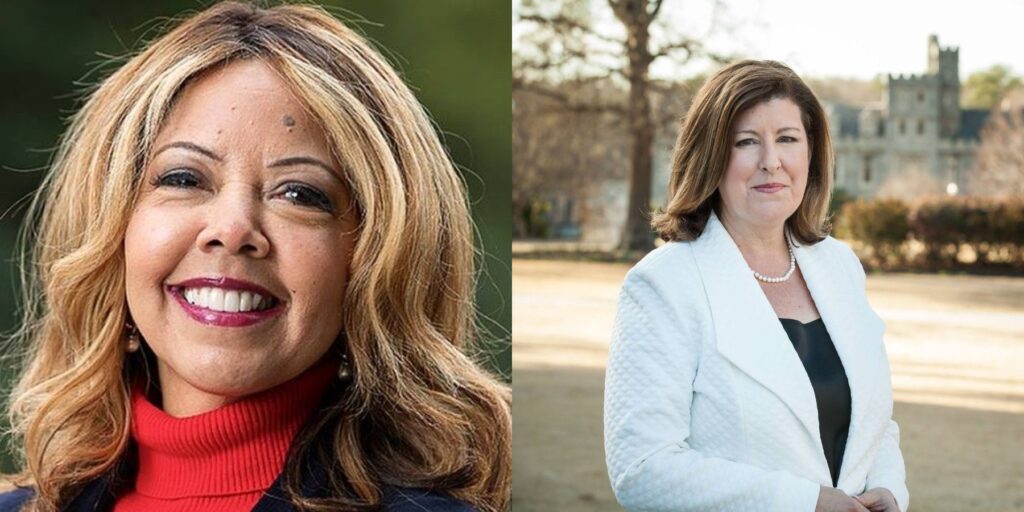
Carolyn Bourdeaux and Dr. Rich McCormick are vying for Georgia’s 7th Congressional District seat in the Nov. 3 general election. (Photos by candidate campaigns)
Health care, immigration and COVID-19 took center stage at a debate Tuesday between candidates running for Georgia’s hotly contested 7th Congressional District seat ahead of the Nov. 3 election.
Dr. Rich McCormick, an emergency room doctor and the Republican nominee, focused on his experience treating COVID-19 patients since March as proof he knows how to combat the disease in hospitals and in the economy.
But his Democratic opponent, Georgia State University professor Carolyn Bourdeaux, slammed McCormick for several statements in recent months in which he appeared to echo President Donald Trump in downplaying the virus, arguing the Republican doctor should know better.
Disputes between the two congressional hopefuls similar to how to handle the COVID-19 crisis going forward played out over several issues in Tuesday’s debate hosted by the Atlanta Press Club, including whether to abandon the controversial 287(g) immigration enforcement program and how to improve health care for district residents.
“I got into this race because our elected officials have lost their line of sight to the people of this district, and my opponent represents the positions and policies that have failed us and that have gotten us into this mess now,” Bourdeaux said.
“[Bourdeaux] stands for larger government, more government solutions, more ideas that are based on a centralization of those solutions,” McCormick said. “I stand for believing in people. I believe in business owners more than bureaucrats.”
Covering most of Gwinnett County and part of Forsyth County, the 7th District race is expected to be close. Current seat-holder U.S. Rep. Rob Woodall, a Republican who is not seeking re-election, narrowly defeated Bourdeaux in 2018 by fewer than 500 votes to win a fourth term.
Bourdeaux, a former state budget advisor who is making her second run at the seat, has mirrored state and federal Democratic candidates in pushing health-care issues to the front of the race, arguing Republican leaders botched the COVID-19 response while trying to tear down the Affordable Care Act.
“It is morally wrong, it is fiscally irresponsible, and I am here to make sure the people of this district have the health care that they need,” Bourdeaux said Tuesday.
McCormick has leaned on bedrock Republican stances for his campaign, evidenced by his support for changing the extra weekly unemployment checks for laid-off workers during the pandemic from a flat $600 to an amount calculated based on an employee’s pre-pandemic wages. He has also accused U.S. House Democratic leaders of blocking another round of COVID-19 relief.
“We need to have autonomy and we need to push this down to medical professionals,” McCormick said. “Stop having the bureaucracies get in the way of progress.”
Bourdeaux punched back Tuesday, noting 120 doctors and infectious disease experts have urged the Medical Association of Georgia to abandon its endorsement of McCormick over his calls to quickly reopen sections of the economy amid the virus.
“One of the reasons it is so shocking to me that you continue to downplay the virus is you see the front-line impact of it,” Bourdeaux said.
McCormick countered that because he has “been on the front lines intubating patients,” he has seen how only certain segments of the population are at serious risk from the virus such as the elderly and those with pre-existing conditions.
His campaign has also accused the 120 doctors calling for his endorsement to be dropped of being partisan in favor of Democratic leaders and candidates via campaign and cause donations.
“I’m just telling you what I’m seeing first-hand,” McCormick said. “And I think we can get back to work safely.”
Immigration reform is also a key issue for the 7th District, which has seen a growing immigrant population in recent years and has adopted the 287(g) information-sharing program between the Gwinnett County Sheriff’s Office and U.S. Immigration and Customs Enforcement (ICE).
Bourdeaux said she would abolish the program if elected, calling it a tool to harass local Latino communities. She also slammed McCormick for seeking to woo immigrant voters while simultaneously supporting more hardline policies like reducing overall entry and no longer granting citizenship to those born in the U.S.
“Rich McCormick talks a good game about immigrants,” Bourdeaux said. “But he is supported by NumbersUSA, an extreme anti-immigrant group.”
McCormick dismissed Bourdeaux’s attack, calling it “a bunch of lies” while arguing many immigrants in the district support the 287(g) program because it helps weed out undocumented persons who may have criminal histories.
“To say that it’s better and safer to not put violent criminals out of the United States who are from another country is certainly not safe,” McCormick said. “I think that’s double-speak and typical hypocrisy from the left.”
Early voting for the Nov. 3 general election started Monday and runs through Oct. 30.
This story has been updated to clarify Dr. McCormick’s position on the $600 in extra unemployment checks during the pandemic and to note his campaign’s stance on doctors opposed to his endorsement by the Medical Association of Georgia.
U.S. Rep. Lucy McBath (left) is battling to keep her seat against a challenge from its former occupant, Karen Handel (right), in the Nov. 3 general election. (Photos by candidate campaigns)
It was a dogfight from the start in a debate Tuesday between U.S. Rep. Lucy McBath, a Democrat, and Republican challenger Karen Handel ahead of the Nov. 3 general election.
McBath, who beat Handel in 2018 to win the once-heavily conservative district in the suburbs north of Atlanta, led off with a quick jab at Handel for moving to cut funding for cancer screenings to the pro-abortion rights group Planned Parenthood.
Handel later jabbed back, arguing she is a supporter of standalone legislation to protect health care for people with pre-existing conditions and has made no secret of her staunch opposition to abortion.
The back-and-forth between McBath and Handel highlighted abortion as a wedge issue in the race for the 6th Congressional District, which has trended blue in recent years following a long history as a Republican stronghold.
“Voters cannot trust you to stand up for a woman’s right to choose, Ms. Handel,” McBath said during the debate Tuesday hosted by the Atlanta Press Club.
Handel, who served one term as Georgia’s secretary of state and one term in Congress before being ousted by McBath, sought to tie McBath to U.S. House Democratic leaders like Nancy Pelosi who figure as routine punching bags for Republican candidates.
In particular, she pressed McBath on why congressional Democrats have balked at working with U.S. Senate Republicans on passing a second round of COVID-19 relief, arguing the higher-price package favored by Democrats includes unnecessary spending items compared to the Republican proposal.
“It is just an absolute shame that Democrats like Lucy McBath are playing political games with the package,” Handel said.
Both campaigns have poured millions into television ads and mailers in recent months to gain an edge in what could be a close race similar to 2018, when McBath won by a roughly 1% margin – about 4,000 votes – over Handel.
Handel has eyed a rematch ever since, routinely pouncing on McBath in social-media messaging and in public speeches. She also fended off Republican competitors in the June 9 primary who cast Handel as a damaged candidate incapable of beating McBath after losing once already.
Meanwhile, the tight race appeared to force the incumbent McBath to go on the offensive during Tuesday’s debate, which saw her accusing Handel of obstructing voter rights while secretary of state and trying to hide income from the Georgia Life Alliance on her federal campaign disclosure forms.
In response, Handel sought to draw McBath into revealing whether she would support moves to “pack” the U.S. Supreme Court, or add additional seats to the bench, if Democratic presidential nominee Joe Biden is elected next month. McBath, like Biden, did not answer in the affirmative or negative.
“The only ones who are trying to pack the court are Mitch McConnell and President Trump,” McBath said.
“She is a one-issue activist who will not speak up or stand up for you,” Handel said of her opponent.
Early voting in the Nov. 3 general election began on Monday and runs through Oct. 30.
This story originally described Planned Parenthood as a “pro-life” group. It has been revised to describe this group as “anti-abortion rights.”