ATLANTA — Bills to restrain public protests have advanced in Georgia’s House and Senate in the wake of shooting deaths in Minneapolis that shocked the nation.
One would expose people charged with blocking roads to stiffer financial penalties. Another would make it a felony to use a vehicle, whether moving or stationary, to block local, state or federal officers.
During a hearing Monday, Rep. Ginny Ehrhart, R-Powder Springs, cited statistics about recent increases in law enforcement deaths due to motor vehicle incidents as a reason to pass her legislation, House Bill 1076.
Though she later acknowledged that her numbers reflected all manner of vehicular incidents, including collisions while officers were driving their own vehicles, she said cars in the hands of protesters posed a danger to police and that protesters should face stiff penalties for using even stopped vehicles.
“It is dangerous conduct and should be taken seriously,” she said, before a Republican-led committee of the House passed her bill over objections by Democrats. “The danger is real,” she said. “A motor vehicle in the hands of an ill-intentioned person is a lethal weapon.”
HB 1076 would make it a felony punishable by one to five years in prison and a $100,000 fine for anyone using a vehicle who “knowingly obstructs, hinders, blocks, or otherwise interferes” with officers enforcing the law.
Ehrhart said groups representing Georgia police and sheriffs told her they supported her bill and that prosecutors were neutral about it.
Critics said the legislation was unnecessary because Georgia already had a law against harming an officer with a vehicle. Aggravated assault, a felony, could be applied in such a case, said Mazie Lynn Guertin, executive director of the Georgia Association of Criminal Defense Lawyers.
At a another hearing in early February, a representative with a civil liberties organization offered a similar critique and suggested a motive for the legislation.
“Recent occurrences that we’ve seen in Minneapolis seem to be at least an origin or intention of this bill,” said Sarah Hunt-Blackwell, senior policy council with the ACLU of Georgia.
This was less than a month after Renee Nicole Good was shot dead in her vehicle during an encounter with Immigration and Customs Enforcement agents amid a protest in Minneapolis.
Then, Alex Pretti was shot dead as Customs and Border Protection agents forced him to the ground.
Ehrhart’s bill is at least the second to seek enhanced penalties for protesters.
Police can already charge anyone with a misdemeanor who “recklessly obstructs” a road, a violation punishable by up to a year in jail and a fine of up to $1,000.
But last week, a Senate committee advanced Senate Bill 443, which would elevate the charge to a high and aggravated misdemeanor punishable by the same amount of jail time but a fine of up to $5,000.
The bill initially would have allowed felony charges in road-blocking protests that led to injury or property damage.
The chief co-sponsor, Sen. Carden Summers, R-Cordele, then reduced the stakes by deleting the felony provision and by offering to strike language in current law prohibiting the reckless blocking of sidewalks or other public passages.
But he kept the high and aggravated misdemeanor charge and his bill would also allow lawsuits against protesters who block roads.
“Protest all you want to,” Summers said. “Just don’t act the fool.”
ATLANTA — Taxpayers, rural drivers and the mentally ill were among the winners in the mid-year budget adopted by the Georgia Senate on Friday.
Financially distressed college students and metro Atlanta drivers were not exactly the losers, but they would get less than initially proposed in the Senate’s version of the $42.3 billion amended budget for the fiscal year through June.
The state House started the budget based on a blueprint from Gov. Brian Kemp. On Friday, it was the Senate’s turn to make some edits.
Both the House and Senate kept Kemp’s $1.2 billion rebate to taxpayers that would break down to $250 per single filer, $375 for heads of household and $500 for couples filing jointly.
But the House added more gravy with an $850 million property tax grant for homeowners, and the Senate liked that line item.
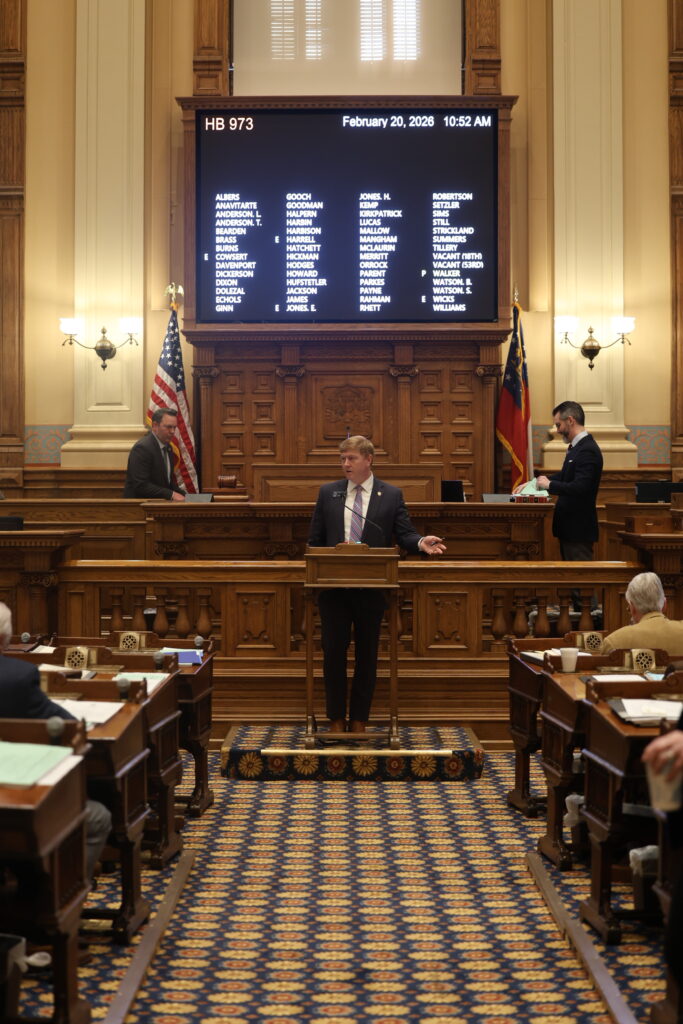
Sen. Blake Tillery, R-Vidalia, discusses House Bill 973 on the Senate Floor at the Georgia Capitol on Friday, Feb. 20. This legislation is the amended fiscal year 2026 state budget (Ashtin Barker/Capitol Beat)
Several senators are running for higher office, and voters tend to appreciate tax breaks, especially in an election year when affordability is key.
The property tax rebate would work out to about $500 per homeowner in urban areas and $300 in rural areas, said Sen. Blake Tillery, R-Vidalia.
“We are laser focused on affordability,” said Tillery, who is running for lieutenant governor and, as chairman of the Senate Appropriations Committee, helped craft the Senate’s budget.
What the Senate gives, the Senate can take away. Under its proposal, state employees would get a smaller bonus than Kemp wanted. He had put a $2,000 one-time pay supplement in the budget at a cost of over $600 million, but the Senate saved a couple hundred million by knocking the payment down to $1,250.
The Senate also kneecapped a new program for college students that Kemp had touted. Georgia is still on a path to give taxpayer dollars to a need-based scholarship fund called Georgia DREAMS.
But instead of the $325 million endowment allotted by Kemp, the Senate kept only $100 million.
The Senate also slashed Kemp’s idea for a $50 million grant to communities to address homelessness, trimming it to $10 million.
Senators needed the money for other priorities. They shifted $15 million to the Department of Veterans Service and put a whopping $409 million toward construction of a regional hospital for the mentally ill who often wind up housed in local jails by default.
The House had introduced money into the budget for the same project, but it was only $27 million to get it started.
Lt. Gov. Burt Jones, a Republican running for governor, said all could agree that mental health services in Georgia were lacking.
“This is not a partisan issue,” he said. Judging by the 49-1 vote to pass the budget, or House Bill 973, he was right.
The Senate made several changes Kemp might appreciate. The governor had proposed $88 million for an aerospace building at Georgia Tech, but the House had pared that back to $15 million. The Senate’s budget restored the funding.
But there were some bumps in the road.
The Senate cut nearly $100 million from Kemp’s $2 billion in improvements to I-75 south of Atlanta and to state Route 316, from Gwinnett County to Athens.
Yet the Senate added back $15 million that the House had trimmed from Kemp’s $100 million to fix rural bridges, some dating to the 1940s, according to Tillery.
Senators also added $30 million for rural infrastructure projects, and they expanded the $35 million improvement program for natural gas infrastructure that had been pitched by Kemp and endorsed by the House.
In the Senate’s budget there is now $55 million to deliver methane to customers as a means of spurring economic development.
“There are areas across our state where gas capacity is so weak that we can’t even put another Burger King on the line,” Tillery said.
The House said later Friday that it did not like the Senate’s changes. So, the budget will now go to a conference committee where a handful of lawmakers will negotiate the finer details.
After they pass the mid-year amendments, they will look to the full budget for the fiscal year that starts in July.
ATLANTA — A fixture in the leadership of Georgia’s House of Representatives will step down when her term ends this year, declining to run for re-election after nearly a quarter century in office.
Rep. Jan Jones, R-Milton was first elected to the House in 2002. In 2010, her fellow representatives voted to make her the speaker pro-tempore then re-elected her to that post every term after. It made her second in command and the most powerful woman in a legislative body that has 180 members when all seats are occupied.
House Speaker Jon Burns, R-Newington, said he and his wife count Jones as a friend, and he described her as an accomplished leader.
“Jan’s 16-year tenure in House leadership reflects the abiding faith and admiration her colleagues have for her,” Burns said in a statement Thursday. “She will close her career in the General Assembly with a long record of accomplishments but also a long list of great friends, including me and Dayle.”
Jones served as speaker pro tem under both Burns and former Speaker David Ralston, R-Blue Ridge, who died in 2022. She served briefly as speaker after his death, until the House selected Burns for that role in 2023.
Jones developed a reputation as a detail-oriented tactician who could get key bills passed into law. She said in a statement that she will miss her colleagues and the work, adding that she was “incredibly proud” of educational policies enacted during her tenure.
Under Gov. Brian Kemp, the General Assembly restored recessionary cutbacks to public school funding and raised teacher pay. Jones also led on expanded access to pre-kindergarten, bolstering charter schools and putting more tax dollars into private school education.
Jones shepherded Senate Bill 233, The Georgia Promise Scholarship Act, through the House in 2024. It established $6,500 a year in direct state funding for each K-12 student who switches from a low-performing public school to a private school or home school.
The measure established what is commonly known as a voucher program. It faced concerted opposition from public school advocates who were concerned about the shift of state funding from public to private education.
It was so controversial that it failed on the House floor in 2023, when some Republicans allied with the vast majority of Democrats who opposed it. But Jones rallied and got the measured passed in a close vote the next year.
Jones was known as an advocate for “parent choice” in education, a position that she said had been good for the economy and would inform her legacy.
“Conservative leadership has given Georgia the best business climate in the country,” she said, “and these investments in our workforce will keep us at the top for years to come.”
ATLANTA — A Republican activist and former employee of a family-run financial firm accused of bilking mostly conservative investors out of millions of dollars could face criminal prosecution after the Georgia Secretary of State’s office referred his case to a local prosecutor Wednesday.
Edwin Brant Frost V, former chairman of the Coweta County Republican Party, was also fined $500,000 by the state agency in connection with his alleged actions at First Liberty Building & Loan.
Frost is the son of the firm’s founder, Edwin Brant Frost IV.
“First Liberty misappropriated investors’ funds by failing to use investor funds as it represented to investors,” said the order issued by an assistant commissioner for Secretary of State Brad Raffensperger.
The agency referred its investigative file for potential prosecution to the Coweta County district attorney and sent it to the Georgia Office of the Commissioner of Insurance and Safety Fire, where Frost V holds an insurance agent license, according to the order.
Frost V’s lawyer, Christopher J. Huber, said his client denies the allegations.
“The Secretary of State did not provide him an opportunity to address his baseless accusations before rushing to judgment and to the press,” Huber said by email.
The Coweta district attorney’s office had no immediate comment. The insurance commissioner’s office did not immediately respond to queries about the case.
Frost V is accused of interacting with investors without the required registrations as a broker dealer agent and as an investment adviser representative. The secretary of state’s order also said he failed to disclose risk to investors and made unsuitable recommendations while personally profiting by investing in loan agreements that he then solicited to investors.
The order said he received $47,000 in bonuses and $88,000 in commissions and was receiving $4,000 a month from First Liberty by November 2023.
The U.S. Securities and Exchange Commission accused First Liberty of operating a Ponzi scheme with investor funds, saying in a lawsuit last year that the company and Frost IV had raised at least $140 million from about 300 investors, funneling at least $5 million to the family and more than $570,000 to political contributions.
Raffensperger, who is seeking the Republican nomination for governor, last year called on recipients to return campaign contributions from First Liberty and the Frost family.
ATLANTA — Georgia lawmakers are again targeting corporate landlords in a bid to address housing costs during an election year when voters are concerned about affordability.
“I have a grave fear that we are becoming a nation of renters and not homeowners,” said Sen. Greg Dolezal, R-Cumming, who is running for lieutenant governor.
Regular home buyers do not have the deep pockets to compete with institutional investors when trying to buy a home, he said. His solution is Senate Bill 463, which would cap corporate ownership at 500 single-family rental homes.
A Senate committee passed his measure Tuesday despite industry opposition.
SB 463 would allow tenants and other aggrieved parties to sue if they found that a corporation was in violation of the ownership limit. Dolezal said that would skirt constitutional challenges against state overreach with direct enforcement.
But Austin Hackney, executive vice president of the Home Builders Association of Georgia, still questioned whether that would pass legal muster.
The use of lawsuits rather than state enforcement is “walking a constitutional tightrope” rarely seen in legislation, Hackney said, adding it “is a strong indicator that that the right to private property is on the chopping block here.”
A critic representing Realtors said they oppose the bill because it would affect “mom and pop” Georgia landlords who had amassed “generational wealth” through real estate.
Current owners of more than 500 homes would be held harmless by the legislation.
The bill also targets foreign owners because, Dolezal said, “we are trying to prevent foreign entities from buying American homes that we believe should be for American families to own.”
The measure now moves to the full Senate. The House already has similar legislation.
House Bill 555 sought to limit companies from having an ownership interest in more than 2,000 single-family residences or 10 multifamily residences in Georgia. A House committee approved it last March despite constitutional concerns. It has not had another hearing.
The issue has become bipartisan.
Lawmakers passed a more limited measure into law last year that was led by a Democrat. House Bill 399, by Rep. Mary Margaret Oliver, D-Decatur, required out-of-state investors, such as hedge funds, to have a local broker and property manager for their Georgia rental properties.
U.S. Sen. Jon Ossoff, a Democrat who is fending off a Republican challenge for his seat, launched a public inquiry last spring into the way corporate landlords treat tenants.