ATLANTA — Drivers will soon find gas to be a little cheaper in Georgia after Gov. Brian Kemp signed a law Friday that immediately suspended the state excise tax on motor fuel to address affordability concerns.
“Today is just the latest step we’re taking and it’s one that will help all Georgians as they work to make ends meet,” Kemp said at the Capitol before signing House Bill 1199 into law. The measure passed the House on Wednesday with broad bipartisan support and cleared the Senate unanimously on Thursday.
Kemp also signed House Bill 1000, giving Georgians a one-time rebate on income taxes paid last year or the year before. Individual filers will get $250 back, heads of household $375 and married couples filing jointly $500.
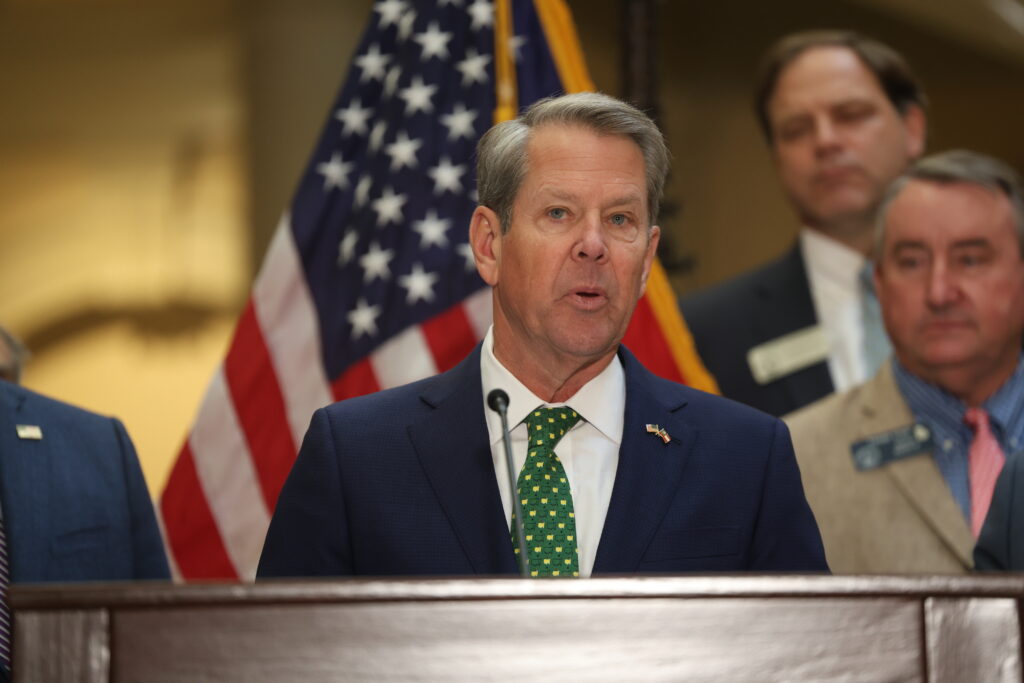
Gov. Brian Kemp speaks before signing Georgia House Bills 1199 and 1000 into law at the Georgia State Capitol on Friday, March 20, 2026. The laws suspend the state motor fuel tax for 60 days and implement one-time income tax rebates. (Ashtin Barker/Capitol Beat)
Kemp noted that lawmakers were working to help Georgians deal with affordability well ahead of the elections, when voters are expected to select candidates based on their feelings about the issue.
The fuel tax suspension, the fourth during Kemp’s tenure, will cost the state treasury an estimated $400 million during the 60 days it is in effect. The timing has the suspension in place up to the Georgia primary election on May 19.
Lt. Gov. Burt Jones, who is running for the GOP nomination for governor, applauded the collaboration between the Senate, the House and the governor’s office.
“We want to get income tax relief. We want to get property tax relief. So, we’re working together on getting this done,” Jones said.
Kemp’s signature on HB 1199 immediately suspends the state’s 33 cent per gallon excise tax on gasoline. It also suspends the 37 cent a gallon tax on diesel fuel, which affects the cost of food and other goods on store shelves.
Gas prices spiked after President Donald Trump ordered air strikes on Iran last month.
“We’re all feeling the pain at the pump as instability in the global oil markets causes the cost of fuel to rise across this country,” House Speaker Jon Burns, R-Newington said.
He said Georgia is among the first states to suspend the gas tax to suppress the recent run-up in prices. He said the state House met this week with representatives of the trucking industry, which faces a nearly $2 per gallon increase in diesel costs.
Burns said he anticipated “a quick and successful end to the conflict overseas that is causing these increases.” He also thanked American military members and their families, saying “we should all keep them in our prayers.”
Then, Kemp signed the bills that will leave more income tax money in Georgian’s pockets and reduce the cost of travel as families embark on spring break trips.
ATLANTA — Georgia drivers should soon see relief at the pump after the Georgia General Assembly sent a temporary gasoline tax suspension to Gov. Brian Kemp.
The 60-day suspension of the state excise tax would save drivers just over 33 cents a gallon for gasoline and 37 cents a gallon for diesel.
It would cost the state treasury an estimated $200 million a month.
The measure comes after the U.S. attack on Iran triggered a spike in fuel prices.
“Hopefully this will be resolved but in the meantime we’re going to do what we can to help our citizens of Georgia have the lowest cost possible,” said Sen. Chuck Hufstetler, R-Rome, who presented House Bill 1199 on the Senate floor Thursday.
The bill started out as a measure to conform Georgia law with changes in the federal tax code. It passed the House for the first time in mid-February, a week before the air strikes on Iran ordered by President Donald Trump.
The bill bounced back and forth between the House and Senate as each made changes, and then, on Wednesday, the House added the gas tax suspension and sent HB 1199 to the Senate again.
“We’re hopeful that the ongoing international conflict, which is temporarily driving up energy prices, comes to an expeditious and successful conclusion,” Hufstetler said.
He talked about affordability, noting that fuel prices ripple through the economy, driving up the price of fertilizer and food.
Democrats agreed.
“It’s a win for our constituents and hopefully will give them much needed relief while we get through this time,” said Sen. Nikki Merritt, D-Grayson, the minority caucus vice chair.
The bill then passed the Senate unanimously.
Kemp has used his authority to unilaterally order three gas tax suspensions in recent years in response to high prices, inflation and Hurricane Helene.
Kemp said Thursday on X that he applauded passage of the bill because it would provide immediate relief for families: “This is great news for all Georgians, and I look forward to signing this tomorrow!”
ATLANTA — Students in Georgia schools and colleges who face certain types of discrimination could soon have a path for redress that need not involve the federal government.
Both the state House and Senate have passed a measure that would establish a Georgia-based process for investigating complaints of discrimination involving race, ethnicity, national origin or religion.
The version of Senate Bill 523 that passed the House unanimously Wednesday had been stripped of language that would have required public schools to treat harassment or discrimination motivated by antisemitism the same as religious discrimination.
Even so, Rep. Esther Panitch, D-Sandy Springs, praised the measure, citing instances of Jewish parents who felt powerless when their children were subjected to harassment.
“These families had no real recourse short of going to the media or filing a federal complaint,” said Panitch, the only Jewish member of the Georgia General Assembly.
In its current form, the measure would require that the Georgia Department of Education employ a statewide coordinator of Title VI, the part of the federal Civil Rights Act that prohibits discrimination based on race, color or national origin.
Sen. Russ Goodman, R-Cogdell, said he was moved to introduce the bill because of a family trip to Israel. They happened to be there the day Hamas attacked in 2023.
“There are extremes on both ends of the political spectrum that in today’s climate condone antisemitism,” he said at a House committee hearing on his measure last week. “History has shown us what happens when we allow antisemitism to take root in our society.”
He referenced the slaughter of World War II unleashed by Nazi Germany and the Americans who died “before we got the genie back into the bottle.”
He left that hearing before Rep. Deborah Silcox, R-Sandy Springs, presented the measure, saying that the language targeting antisemitism had been deleted.
Several public commenters, include one representing a Muslim civil rights advocacy organization, then praised the deletion. They said the bill now treated all faiths equally.
SB 523 would require public schools and colleges to establish policies for handling discrimination complaints or risk the withholding of their state funds.
The measure returns to the Senate, which can choose to accept or reject the House changes.
Georgia lawmakers have nearly passed legislation that could lead to hefty fines against businesses, colleges and nonprofits when they accept contributions or donations funneled from countries deemed to be foreign adversaries.
The debate fell along party lines before Senate Bill 177 passed the House 98-65 Monday with only two Democrats in favor.
It returns to the Senate for agreement on a few changes.
“All this does is require transparency,” said Joseph Gullett, R-Dallas, who presented the bill on the House floor.
The measure requires recipients of support by agents from hostile nations to register with the state ethics commission.
Among the House amendments was language identifying those hostile nations. The Senate version targeted North Korea, Iran, China and Russia.
The House changed that to whichever countries were designated by the U.S. commerce secretary.
Rep. James Burchett, R-Waycross, the majority whip, said the current countries on that list are those four, plus Cuba and “and the Venezuelan politician Nicolas Maduro.”
Violations could lead to a $10,000 fine, or as much as $200,000 for “willful” or repeat violations.
The only Republican to raise concerns was Rep. Mike Cameron, R-Rossville, who went on to vote for the bill.
He said a company in his district asked questions because it is owned by a former subsidiary of General Electric that was sold to a Chinese conglomerate. He said another major company asked about constitutional issues.
Democrats said they agreed that the countries on Burchett’s list were a risk. But they also offered critiques that have become common with similar legislation in other states.
They said SB 177 could violate constitutional protections for speech, it could conflict with federal law containing similar requirements, and it would add bureaucracy, perhaps discouraging companies from locating in Georgia.
“It creates heavy compliance costs,” said Rep. Long Tran, D-Dunwoody.
Rep. Jasmine Clark, D-Lilburn, noted that House members were issued laptops by the Chinese company Lenovo, and she wondered if Amazon shoppers could be implicated.
Others said exemptions in the registration requirement seemed political.
SB 177 exempts TikTok per a September executive order by President Donald Trump. It also exempts trade associations and advocacy organizations founded before Jan. 2, 1950, leading one Democrat to note that the National Rifle Association, founded in the 19th century, would not have to comply.
Rep. Gabriel Sanchez, D-Smyrna, said the legislation was a distraction.
“If you want to talk about foreign influence, how about the fact that Israel, along with the military industrial complex, just dragged us into an unnecessary war that no one wants and no one voted for,” he said.
Several states have adopted legislation like SB 177 and at least a half dozen more are considering it this year, according to the International Center for Not-For-Profit-Law headquartered in Washington, D.C.
The group noted that such legislation had been rejected or allowed to die in more than a dozen states.
Some of the concerns raised in the past include lack of foreign policy expertise at the state level, and a patchwork of schemes among the states that could undermine U.S. foreign policy and complicate compliance for organizations.
“It is still unclear how states will enforce these types of laws,” the organization said in an analysis last summer, “but for now they create a regulatory minefield for nonprofits and others.”
SB 177 now returns to the Senate for agreement to the House changes. Should the Senate agree, the bill would head to the desk of Gov. Brian Kemp for his signature. He vetoed a similar Senate bill in 2024 involving foreign adversary political contributions, noting they were already prohibited under federal law.
ATLANTA — Four words added to legislation that targets mugshot mills have free speech advocates worried the public could lose access to videos that hold police accountable for their conduct.
Legislation that started in Georgia’s Senate as a solution to the reputational harm caused when booking photographs circulate online after charges are dismissed has evolved into a much broader measure.
Senate Bill 482, supported by sheriffs across Georgia, pits personal privacy of the accused against the public’s right to examine government use of force.
Blake Feldman, senior policy counsel with the Southern Center for Human Rights, said it raises a red flag when “a law enforcement agency that wields incredible authority to stop and detain people and discharge firearms at people” seeks to withhold footage from body-worn cameras.
He and advocates for free speech and for newsgathering operations, including broadcasters and the newspaper industry, argued that the requirements would pose a barrier to such access.
The legislation started as a requirement for anyone who wants a mugshot to obtain it in person, with a notarized statement that they would comply with existing law intended to protect people in those images.
In 2013, Georgia made it illegal for websites that publish mugshots to make subjects who were not convicted pay to take their picture down.
But that law did not solve the problem, so the next year Rep. Brian Strickland, R-McDonough, pushed through a law requiring operators to promise in writing that they would abide by the takedown requirements.
That still didn’t fix the problem.
So, this year Strickland, now a state senator, introduced SB 482, intending to make it harder to get mugshots in the first place.
Along the way, he added the four words to his bill that have the free speech advocates concerned: “or law enforcement video.”
Sen. Brian Strickland, R-McDonough, on the Senate floor in the Georgia Capitol in Atlanta on Friday, March 6, 2026, the day his legislation to restrict access to mugshots and law enforcement videos passed to the state House. (Ashtin Barker/Capitol Beat)
Not only would news organizations have to drive across the state to get an official copy of a police video from a far-flung community, but they arguably could be forced to identify everyone in the video they are seeking, said Sarah Brewerton-Palmer, a lawyer with the Georgia First Amendment Foundation.
“In order to get this footage, you have to name everybody who’s in it,” she said. But there could be bystanders in a video of an altercation between police and a suspect, she said, “and before you see it, you don’t know who those people are.”
Brewerton-Palmer said bodycam videos of a shooting by police during a protest would effectively become exempt from the state open records act.
She and others are less concerned about the proposed restrictions on releasing mugshots because of the way their enduring presence online has upended the lives of innocent people.
At a Feb. 18 Senate committee hearing on Strickland’s bill, a representative from the Georgia Justice Project, which helps people reintegrate into their communities after tangling with the criminal justice system, said it remains a common issue among their clients.
It was at that hearing where videos entered the conversation.
(The Georgia Press Association was among the news organizations that raised concerns. Capitol Beat is a project of the association.)
Forsyth County Sheriff Ron Freeman, president of the Georgia Sheriffs’ Association, told senators on the committee that his colleagues across the state complain about bulk requests for mugshots and videos that are then exploited for profit.
Ashley Henson, the sheriff in Paulding County, said the accused who have their cases dismissed go on to get “destroyed” on social media. He said that when he tried to intervene to ask for removal of material, the publishing organization did not respond.
“Monetization of someone else’s misery is not right,” Henson said. “We are not here to give these YouTubers content.”
Strickland said in an interview that he was moved to action against mugshot mills by a teacher who noticed her students passing around her booking picture of her. The charges against her had been dropped, so she had contacted the publisher and paid to take it down, he said. But then the photo popped up on another site.
Strickland described it as a “whack-a-mole” problem.
Publishers were not honoring the takedown requests they had submitted in writing per the 2014 law. And even when they did, out-of-state or even international actors beyond the reach of Georgia law enforcement were republishing them.
“Once the image is there, it’s there forever,” he said.
So, now he is proposing to restrict supply by forcing those who want mugshots — and police videos — to request them in person. Requiring requesters to identify the subjects in those images would cut down on the number of bulk requests, which tend to be by profiteers, he said.
At that February committee hearing, he agreed with another senator who said the public could still obtain pictures and videos, they just had to “go through the legwork” to get them.
The committee passed SB 482 unanimously, sending it to the Senate floor, where it also passed unanimously on March 6, and now awaits hearings in the House.
The Senate floor vote occurred on “crossover” day, the deadline to move bills from the Senate to the House and vice versa. It is an exceptionally rushed time during any legislative session, when mountains of legislation are getting votes, giving lawmakers little time to read the language.
Democrats backed the measure without question, except for one raised about an unrelated part of the bill. That might have been due to the backing by Democrats. They had voted it out of committee, and two had co-signed it back when Strickland had introduced it — before he added those four words about videos.
Reached by phone, one of those two co-sponsors, Sen. Kenya Wicks, D-Fayette, said she was unaware of the new language.
“I don’t think I can comment because there are a lot of amendments to this bill,” said Wicks, who voted for SB 482 with the other Democrats when it reached the full Senate.
Strickland said he is willing to work with advocates to address their concerns, perhaps by changing his bill to require that those seeking a video must identify only the officer who took it or the time and location where it was shot.
But it is unclear whether a compromise can be reached, at least on the video language.
Brewerton-Palmer said she sympathized with Strickland’s concerns. The internet and, now artificial intelligence, have stripped away privacy, she said.
But the public’s right to know outweighs that harm, she said. “There needs to be a thumb on the scales in favor of access.”
Feldman said his organization supports the new restrictions that Strickland wants to impose for access to mugshots, but he said applying those same obstacles to the release of law enforcement videos would be an indirect way to erode the state open records law, something his organization opposes because of the erosion of transparency around police encounters with the public.