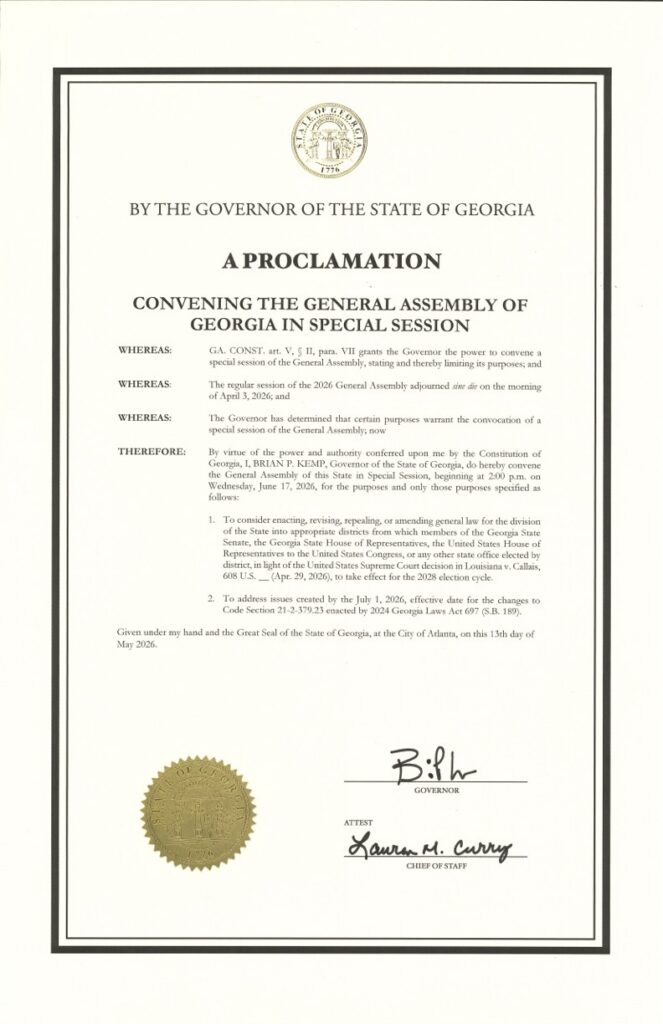
ATLANTA — Georgia lawmakers will return to the state Capitol on June 17 to contend with two election-related issues under an order signed Wednesday by Gov. Brian Kemp.
The proclamation requires the General Assembly to convene for a special session to consider redrawing legislative districts, pointing to a U.S. Supreme Court decision in April that invalidated a new majority-Black legislative district in Louisiana.
The order also calls on the Legislature to address a lingering problem with the state’s voting process.
Georgia’s current voting process will become illegal July 1 under a 2024 state law that banned the use of Quick Response barcodes, known as QR codes, for tallying votes. Despite meeting for two regular legislative sessions since passing that law, state lawmakers have neither authorized nor funded an alternative process.
The death last month of U.S. Rep. David Scott, a metro Atlanta Democrat, triggered a special election in July, leaving little time to address the issue.
Kemp’s proclamation calls lawmakers to the Gold Dome at 2 p.m. on June 17, the day after any necessary runoff elections to decide the outcome of the May 19 primary elections.
By then, some lawmakers who return to the Capitol will know that they lost and will be out of office next year.
They will be redrawing election maps without the same limitations previously imposed by the Voting Rights Act of 1965, which strengthened protections for Black and other minority voters by barring practices that diluted their votes.
In April, the U.S. Supreme Court ruled in Louisiana v. Callais that a new majority-Black legislative district was unconstitutional, raising questions about future legal interpretations of the Voting Rights Act. Lawmakers in several Southern states moved to redraw district lines after the ruling.
ATLANTA — State lawmakers passed a budget that was about $1 billion larger than what Gov. Brian Kemp expects Georgia will collect in tax revenue next fiscal year, so he took a scalpel to their spending plan.
The fiscal year 2027 budget he signed Tuesday trims $300 million from spending that the General Assembly had added.
“They may not be happy, but they also realize we’ve got a hole in the budget that we’ve got to fix,” Kemp said, before signing House Bill 974, which will govern spending starting in July.
The Legislature passed a $38.5 billion budget, but Kemp told reporters that revenue estimates for next year are only $36.6 billion. Part of the reason: income tax cuts that lawmakers passed in the waning hours of their legislative session and that Kemp signed into law Monday.
Richard Dunn, director of the Governor’s Office of Planning and Budget, said Georgia now has a $1.3 billion “structural deficit.”
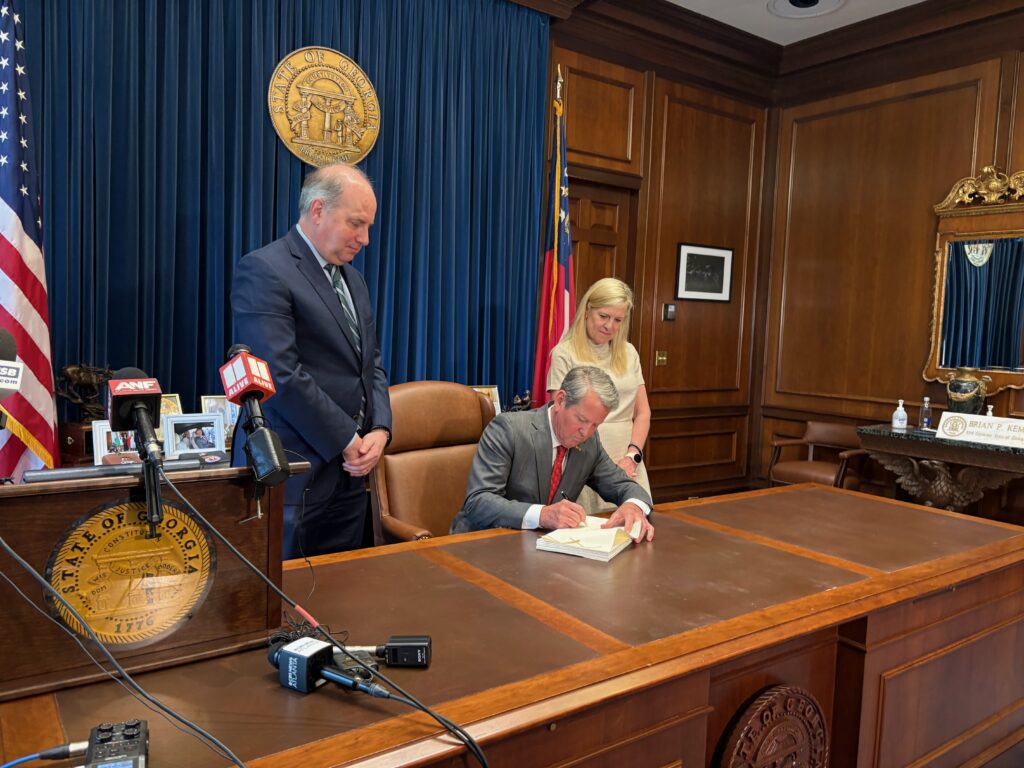
Gov. Brian Kemp signs the fiscal year 2027 budget (House Bill 974) in his office at the Georgia Capitol in Atlanta on Tuesday, May 12, 2026, as his wife Marty and Richard Dunn, director of the Governor’s Office of Planning and Budget, watch.
He said Kemp’s cutbacks will address $300 million of the excess spending and that growth in revenue should take care of much of the rest. The state will likely have to dip into its surplus to fill whatever gap remains, he added.
That amount can change depending on the rate of economic growth.
“The state must now address a reduction in revenue for the coming fiscal year of nearly $1 billion,” Kemp said, “and that’s assuming we don’t have an economic downturn.”
The income tax cuts, which Kemp embraced, tipped his budget off balance.
On Monday, Kemp signed House Bill 463, which rolled back the income tax rate to 4.99% from 5.19% for the current year.
It also waived income tax on the first $1,750 of overtime pay and cash tips, retroactive to the beginning of the year, and it increased by $5,000 the amount of excluded retirement income for those 65 and older.
But that new law is designed to continue cutting the tax rate if state revenues remain strong, reducing the rate by another percentage point over eight years, to 3.99%. The rate is scheduled to fall 0.125 percentage points (an eighth of a point) next year.
HB 463 also increased the dependent and standard deductions by 25% this year and calls for gradually increasing both by that same amount over eight years, depending on the same revenue triggers as the tax rate cuts.
The standard deduction for single filers rose to $15,000 from $12,000 when Kemp signed HB 463. It is scheduled to go up another $375 next year, ultimately reaching $18,000. The amounts are doubled for couples filing jointly. The dependent deduction rose to $5,000 from $4,000 and would top out at $6,000 after eight years of steady increases.
ATLANTA — More taxpayers will be able to contribute to a private school scholarship fund while receiving a state tax credit for the full amount after Gov. Brian Kemp signed House Bill 328 Monday.
The measure increases the aggregate cap on tax-credited contributions to organizations that distribute scholarships to attend private K-12 schools or to pay for homeschool costs.
The annual cap was $120 million. It rises to $150 million.
Kemp signed the measure at the Capitol along with other tax measures Monday.
HB 328 also relaxes requirements for to obtain the scholarships, which are generally available only to those who attend a low-performing public school.
Now, students from military families and those with intellectual or developmental disabilities can obtain a scholarship without enrolling in a low-performing public school.
ATLANTA — Next fall, Georgia students attending one of the state’s public colleges and universities will have a chance at financial aid if they come from a low-income family.
Gov. Brian Kemp on Monday signed legislation that establishes a need-based financial aid program.
The amended budget for fiscal year 2026 already included $325 million for the DREAMS Scholarship. Senate Bill 556 establishes the rules for spending it, placing the program under the Georgia Student Finance Commission, which oversees the HOPE scholarships.
Kemp had pledged to create the scholarship during his State of the State address in January.
He said his signature on SB 556 will “endow the largest investment in a need-based scholarship the state has ever seen.”
Gov. Brian Kemp speaks at the Georgia Capitol in Atlanta on Monday, May 11, 2026, before signing Senate Bill 556 to create the DREAMS Scholarship, a need-based college aid program funded by $325 million in the amended Fiscal Year 2026 budget. (Ty Tagami/Capitol Beat)
Georgia was, until now, one of only two states in the nation without such a program to help students in need. Critics have contended that the lack of support drove some of Georgia’s best students to other states for college, producing a long-term drag on the economy.
DREAMS builds on a much smaller program launched by the University System of Georgia last year under the watch of Chancellor Sonny Perdue, who attended the bill signing ceremony.
He announced in March, after the $325 million was included in the budget, that $25 million would be available for scholarships this fall. The rest of the money will serve as the foundation of an endowment for future students.
House Speaker Jon Burns, R-Newington, said the bill, along with other measures Kemp signed Monday and an early grades literacymeasure from last week, would help Georgia’s economy grow.
“This work will make our state a national leader in workforce development for years to come and, more importantly, ensure hard-working Georgians have opportunities to succeed statewide,” he said.
DREAMS recipients can receive up to $3,000 a year for up to eight semesters or 12 quarters. Students must work or volunteer at least part-time to be eligible. Unlike HOPE however, grades are not a factor.
SB 556 also creates a scholarship for University System of Georgia medical students. They can get up to eight semesters of funding toward their attendance costs in exchange for working in the state for four years after graduation.
The new law also increases the cap on contributions to Georgia’s 529 college savings plan, a tax-advantaged savings account. Previously, families could only contribute until the account reached $235,000. The new limit is $550,000. And it allows advanced fine arts courses in high school to count toward HOPE scholarship grade point average calculations for students who graduate after June.
ATLANTA — Georgia lawmakers started the year with talk of eliminating both the state income tax and the property tax for homeowners.
The goal proved elusive, but they did compromise on a scaled-back income tax cut and on legislation to decelerate the rapid increases in local property tax costs for homeowners.
And on Monday, Gov. Brian Kemp signed those two measures into law.
“We believe it is your money, not the government’s,” Kemp said.
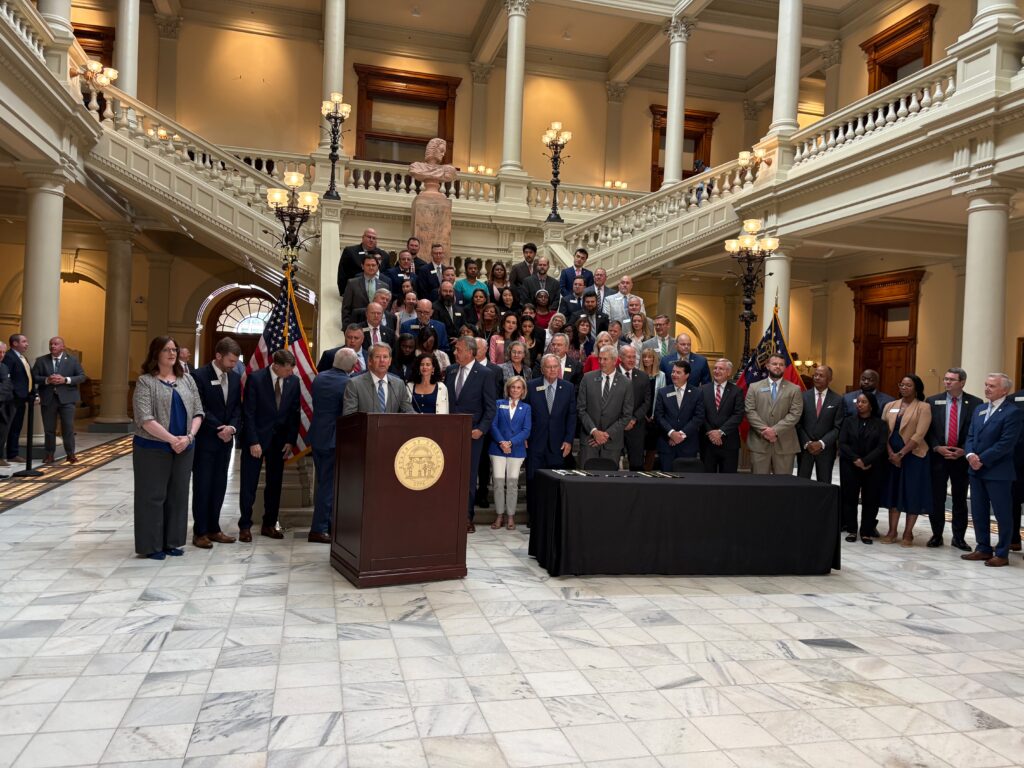
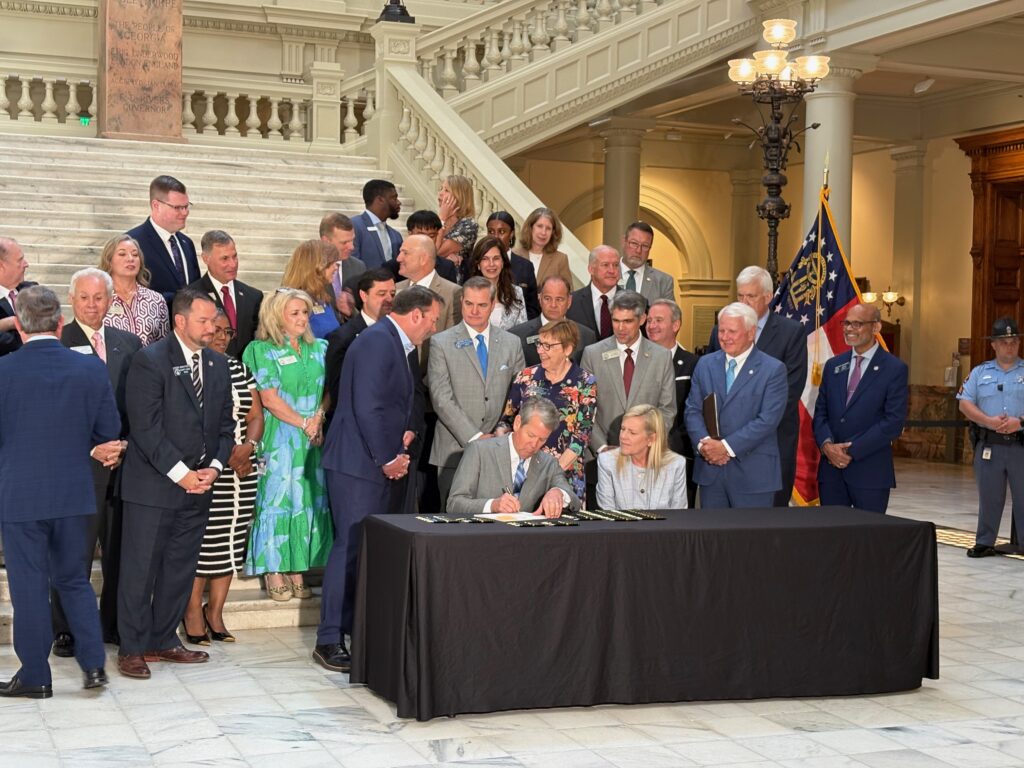
Gov. Brian Kemp selects a pen to sign tax legislation at the Georgia Capitol in Atlanta on Monday, May 11, 2026, with wife Marty by his side. House Speaker Jon Burns, R-Newington, watches to her left, as Lt. Gov. Burt Jones, a Republican candidate for governor, stands to the governor’s right. (Ty Tagami/Capitol Beat)
The Senate had at first voted to eliminate the income tax on the first $50,000 in annual earnings for individuals and the first $100,000 for married couples filing jointly. The goal was to increase the cuts for higher earners over time until the tax was abolished altogether. But the bill Kemp signed into law is more modest.
House Bill 463 will immediately reduce the income tax rate to 4.99% from the current 5.19%, then gradually reduce it by another percentage point over eight years if state revenues remain strong. Income tax deductions would also rise by 50% over that period, from the current $12,000 for single filers, to $18,000 — and double that for married couples. Dependent deductions also would rise by $2,000 over eight years from the current $4,000.
The new law also waives income tax on the first $1,750 of overtime pay and cash tips retroactive to the beginning of the year and increases the amount of excluded retirement income for those 65 and older by $5,000.
The increase in income tax cuts depends on a continual rise in state revenue estimates and collections. The governor’s annual revenue estimate must increase 3% and the prior year collections must have exceeded those in each of the three prior years. Also, the state must have enough in reserves to absorb the cost resulting from the increasing cuts.
Last week, Kemp’s office announced that revenues were continuing to rise, with April net tax collections up 5.9% over April of last year. However, nearly half of the nearly $4 billion came from the income tax. Those collections were up 10.1%.
Lt. Gov. Burt Jones said before Kemp signed the measures that it took months of negotiation between the Senate and House to reach a consensus. But Jones, a Republican candidate for governor, said they accomplished their goal on both income taxes and property taxes.
Senate Bill 33 was also a compromise. The House had hoped to eventually abolish property taxes. Instead, the measure will keep homeowner property taxes in check by restraining the increase in the official value of their homes.
The idea of eliminating the property tax altogether faced resistance from local governments and schools, which are funded in large part through that tax.
The new law will cap valuation increases at the rate of inflation.
“Property tax valuations have skyrocketed in every corner of this state,” said House Speaker Jon Burns, R-Newington. “Mileage rates have remained the same or even increased in some cases, placing a significant financial strain on families, homeowners and retirees living on fixed incomes.”
The amount paid for property taxes depends on two variables: the tax rate — called a millage rate — and property valuation. Cities, counties and schools could simply bump the tax rate part of that formula to bring in more revenue.
That might not be politically popular, but it would keep the lights on.
There is a catch for schools, though: nearly all of Georgia’s 180 school districts are limited to a maximum rate of 20 mills under the state constitution.
Most school systems are already near the maximum tax rate, with the state average at 15 mills.