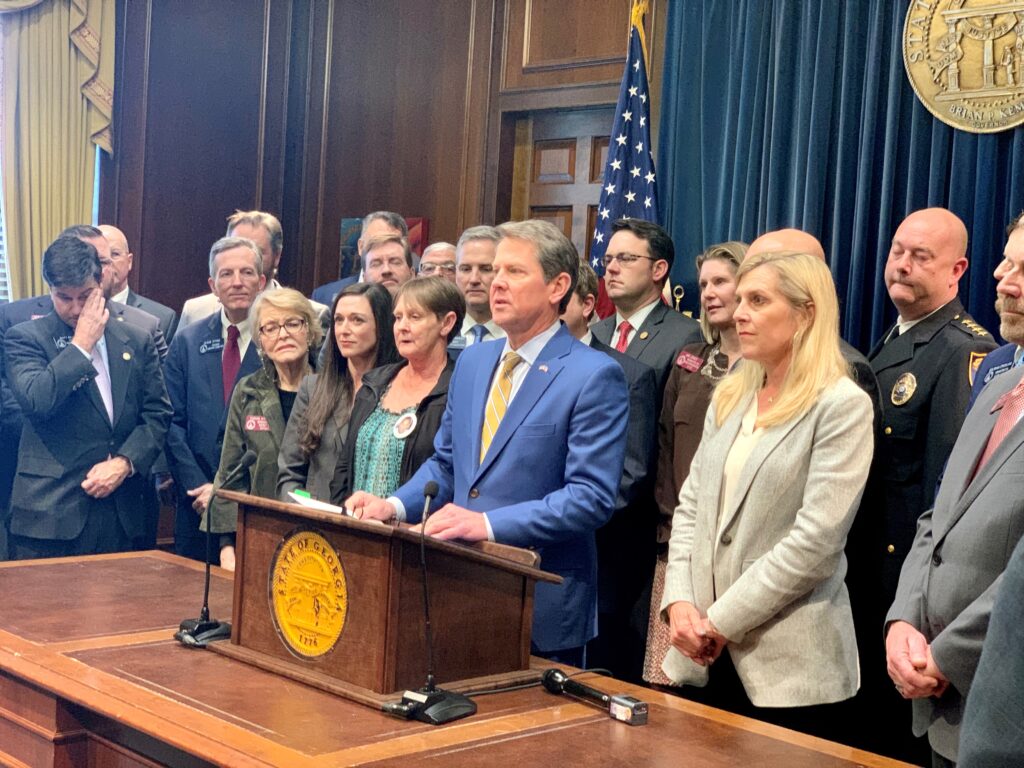
Casino backers failed in the General Assembly again this year.
ATLANTA – It
looks like proponents of legalizing gambling in Georgia are going to have to
wait yet another year before getting a crack at putting the issue before
voters.
The Georgia
House of Representatives wrapped up the annual “Crossover Day” session minutes
after midnight Friday morning without taking up a constitutional amendment to
legalize all three forms of legal gambling supporters have been pushing in
recent years: casinos, pari-mutuel betting on horse racing and sports betting.
Until the
day before Crossover Day, the deadline for bills to make it through at least
one legislative chamber to remain alive for the year, only sports betting had
gained any traction in the General Assembly.
A bill
focused solely on sports betting was introduced in the state Senate and heard
in committee. However, it wasn’t among the measures the Senate took up on
Crossover Day Thursday before adjourning at the dinner hour.
That left it
up to the House. Rep. Alan Powell, R-Hartwell, chairman of the House Regulated
Industries Committee, trotted out the constitutional amendment embracing all
three forms of legalized gambling on Wednesday. It got through his committee
and made it onto the calendar for action on Crossover Day, but the House didn’t
take it up before quitting for the night.
A host of
other bills introduced in the General Assembly this year met a similar fate.
Some made it through committees only to fall by the wayside on Crossover Day.
Others floated early in this year’s session didn’t garner enough support to get
a committee hearing.
Here is a
list of significant legislation that failed to make the Crossover Day cut:
Right to Farm Act – This
controversial measure ran into opposition from the farmers supporters said it
was intended to protect. Pitched as a way to protect farmers from nuisance
lawsuits from neighbors, environmental groups argued it would make it harder to
keep out large agricultural operations such as chicken houses and pig farms
that generate offensive smells and pollute nearby waterways.
Tort reform – While one narrowly
drawn tort reform bill related to lawsuit settlement agreements made it through
the Senate, more comprehensive legislation was shelved by a narrow margin on
Crossover Day.
Tobacco, vaping taxes – A bid to
raise Georgia’s tobacco tax, one of the nation’s lowest, went nowhere as usual
in the General Assembly. Legislation to impose an excise tax on vaping products
for the first time fared better, but it was shot down on the House floor on the
evening of Crossover Day.
Dreamers – Legislation to offer
in-state tuition to Georgia’s public colleges and universities to undocumented
Georgians protected from deportation under the federal Deferred Action for
Childhood Arrivals (DACA) program was killed in a Senate committee the day
before Crossover Day.
Adoption – A Senate bill allowing
faith-based adoption agencies to deny services in Georgia based on religious
preferences failed to get through the Senate Judiciary Committee. Opponents
argued it would discriminate against foster parents of various sexual
orientations and gender identities that don’t conform with the agencies’
religious or moral beliefs.
Title pawns – A bill capping rates charged
by Georgia’s auto-title pawn industry cleared the Senate Finance Committee but
failed to reach the Senate floor for a vote.
Seatbelts – Legislation requiring
Georgians to wear seatbelts no matter where they are sitting in a motor vehicle
– not just the front seat – was on the Senate calendar for a vote on Crossover
Day but was not taken up.
Paying college athletes – Two bills
introduced by House Democrats early in the session calling for college athletes
participating in revenue-generating sports to be paid failed to get a hearing
in the House Higher Education Committee.
It’s worth
noting that nothing is ever irrevocably dead in the General Assembly until
lawmakers adjourn for the year. If supporters are determined enough in the
session’s waning days, they often can find bills that are still alive on which to
attach their legislation.
With 11 days
remaining in the 2020 session when lawmakers return to the Capitol from the
recess forced upon them by the coronavirus, there will be plenty of time for
such gaming of the system.
ATLANTA – Three
bills imposing additional regulations on the disposal of coal ash in Georgia
cleared the state House of Representatives Thursday.
Measures
requiring Georgia Power Co. to notify local government officials when the
utility drains nearby coal ash ponds and closing a loophole in current state
law that encourages coal ash to be brought into Georgia from out of state
passed overwhelmingly.
But the
third bill requiring long-term monitoring of closed ash ponds ran into criticism
from opponents concerned that the General Assembly’s overall response to the
coal ash problem doesn’t go far enough.
Coal ash is
the residue left behind after burning coal to fuel power plants. It can contain
a number of toxic chemicals, including lead, selenium and arsenic.
Much of
Georgia’s coal ash is stored in ponds around coal-fired power plants owner by
Georgia Power. While the company is planning to excavate and close all 29 of
its coal ash ponds, it intends to leave the ash in place at 10 of the ponds,
using technology it says is safe.
Legislative
Democrats have been pushing for a bill that would require Georgia Power to install
impervious liners under every closed ash pond that will not be excavated.
On Thursday, House Minority Leader Bob Trammell complained that the Democrats’ bill isn’t moving forward and accused majority Republicans of a “missed opportunity.”
“You test to
find out if something is wrong,” said Trammell, D-Luthersville, referring to
the House bill requiring long-term monitoring of closed ash ponds. “When you
know there’s something wrong and don’t do anything about it, that’s inaction.”
Trammell
cited the community of Juliette, located in Monroe County near Georgia Power’s
Plant Scherer, whose residents came to the state Capitol last month to advocate
for lined ash ponds. Trammell said he recently bought property in Juliette a
half mile from the pond.
“I’ve come to fear for the water in my house,” he said. “Nobody should have to live with these fears.”
Rep. Vance Smith, R-Pine Mountain, sponsor of the bill requiring increased monitoring, noted that the fiscal 2021 state budget the House adopted this week provides $500,000 to add environmental engineers to the state Environmental Protection Division (EPD) to conduct the monitoring. He said the agency will inspect ash ponds annually until they are closed and every five years after that.
The House
ended up passing the monitoring bill 113-52.
The legislation
targeting out-of-state coal ash would raise the fee for disposing of coal ash
to the same rate landfills charge for other garbage.
“This bill
would deter coal ash from being dumped in landfills around our state,” said
Rep. Trey Rhodes, R-Greensboro.
Five
landfills in Georgia have taken in millions of tons of coal ash since 2017,
with much of it originating from power plants in Florida and North Carolina,
according to EPD records.
The three
coal ash bills now are headed for the state Senate.
ATLANTA – The
Georgia House of Representatives voted unanimously Thursday to prohibit the
burning of railroad ties treated with creosote used to fuel two biomass plants
in Northeast Georgia.
Neighbors of
the two plants in Madison and Franklin counties began complaining when the plants
started operating last year that the burning was fouling their air and
contaminating their water.
“The people
who lived in close proximity were highly impacted,” Rep. Alan Powell,
R-Hartwell, the creosote bill’s chief sponsor, said during a brief floor
debate. “Some of them had to move out of their homes.”
Powell said
local elected officials were told the plants were going to burn wood chips when
Birmingham, Ala.-based Georgia Renewable Power filed permit applications for
the facilities in 2015. But one year later, the U.S. Environmental Protection
Agency lifted a federal ban on burning creosote-treated railroad ties, clearing
the way for the plant operators to switch fuels.
Creosote has
been linked to cancer and some respiratory problems.
House Bill
857 includes a provision carving out of the legislation’s provisions a
manufacturing plant near Dublin operated
by WestRock. While the plant’s permit allows it to burn railroad ties
treated with creosote, an official with the state Environmental Protection
Division assured members of a state Senate committee considering a similar bill
last month that the Dublin facility is not doing so.
Powell’s
bill now heads to the Senate for consideration.
ATLANTA – The
General Assembly gave final passage Thursday to a $27.5 billion mid-year budget
suddenly made larger by the addition of $100 million for the state’s response
to coronavirus.
Gov. Brian
Kemp asked for the emergency appropriation on Wednesday. The money will come
from the state’s reserves.
“The Revenue
Shortfall Reserve is there for things like this,” House Appropriations
Committee Chairman Terry England, R-Auburn, told his legislative colleagues
before the House approved the mid-year budget 166-1. The Georgia Senate had passed
the mid-year budget earlier Thursday 53-1.
The final
version of the mid-year budget, which covers state spending through June 30, is
the product of a joint House-Senate conference committee, which met in recent
days to work out the two chambers’ relatively few disagreements over line
items.
“There were
not a whole lot of differences,” England said.
Besides the
money for the state’s coronavirus response, the conferees agreed on a $132.8
million increase in the mid-year budget to reflect enrollment growth in Georgia
public schools of 6,193 students since lawmakers adopted the original fiscal
2020 budget a year ago.
The
conference committee also added $5 million in stabilization grants to rural
hospitals, increased funding for mental health services by $8.2 million,
restored $4 million in cuts Kemp had recommended for Georgia’s public defenders
and accountability courts and put back $1.3 million in reductions to public
libraries.
The mid-year
budget now heads to the governor’s desk for his signature.
Gov. Brian Kemp addresses a news conference in January. (Photo by Beau Evans)
ATLANTA – Gov. Brian Kemp asked the General Assembly Wednesday to add $100 million to this year’s state budget to deal with the impacts of coronavirus in Georgia.
“The spread
of coronavirus represents a significant threat to our state’s health network,
financial well-being and, most importantly, the health and safety of our
citizenry,” Kemp wrote in a letter to the chairmen of the state House and
Senate Appropriations committees. “Therefore, we must be ready to respond
quickly and thoroughly to any outbreak of disease within our state.”
The governor sent a separate letter to House Speaker David Ralston and Lt. Gov. Geoff Duncan, the state Senate’s presiding officer, requesting the funds.
The money will come from the state’s budget reserves, which have been growing larger year by year since the fund was nearly depleted during the Great Recession. The fund now stands at a healthy $2.8 billion.
A spokesman for Ralston released a statement Wednesday supporting the governor’s plan.
“Speaker
Ralston is committed to ensuring adequate resources are available, and he is
confident in the federal, state and local personnel who are working tirelessly
to manage this situation,” Kaleb McMichen said.
Georgia’s
bill for coping with coronavirus is mounting day by day as the number of
confirmed cases of the virus continues to rise.
As of
Tuesday night, according to the latest update from the governor’s office, the
state Department of Public Health was awaiting testing confirmation from the federal
Centers for Disease Control and Prevention on five additional presumptive positive
cases of COVID-19. Three are in Cobb County, one in Fulton County and one in
Charlton County.
That brought
the total number of presumptive positive cases in Georgia to 16. Six cases have
been confirmed, including three in Fulton County and one each in Cobb, Floyd
and Polk counties.
Meanwhile,
the state has opened seven emergency mobile units at Hard Labor Creek Park in Morgan
County to isolate COVID-19 patients.