ATLANTA – Six working groups of educators, public health officials and representatives of state agencies and nonprofits will lead the effort to safely reopen Georgia schools closed by the coronavirus pandemic.
Gov. Brian Kemp and State School Superintendent Richard Woods formed the six K-12 Restart Working Groups Thursday to help provide guidelines for the safe reopening of schools for the 2020-21 school year.
“As we work to defeat this virus, we want to ensure Georgia’s students are safe, secure and learning,” Kemp said. “Georgians can be assured the safety of students, families and school staff is our first priority. These K-12 Restart groups will ensure we have experts at the table as we take measured steps forward.”
The 72 members will divide their responsibilities among working groups responsible for distance and professional learning; school meals; mental health and wellness; connectivity and devices; supplemental learning; and facilities, transportation and equipment.
“These working groups … will provide invaluable expertise and perspective as we ensure schools are prepared for the fall and have options to ensure learning continues, following the advice and guidance of public health officials on the national and state levels,” Woods said.
The following were named to chair the six working groups:
Caitlin Dooley, deputy superintendent of teaching and learning for the Georgia Department of Education (Distance and Professional Learning group)
Linette Dodson, school nutrition director for the Georgia Department of Education (School Meals group)
Ashley Harris, director of whole child supports and strategic partnerships for the Georgia Department of Education (Mental Health and Wellness group)
Jannine Miller, office of the governor (Connectivity and Devices group)
Shaun Owen, deputy superintendent of federal programs for the Georgia Department of Education (Supplemental Learning group)
Garry McGiboney, deputy superintendent for school safety and climate for the Georgia Department of Education (Facilities, Transportation and Equipment group)
Schools across Georgia have been practicing distance learning since mid-March, when the governor closed the schools to reduce the spread of COVID-19.
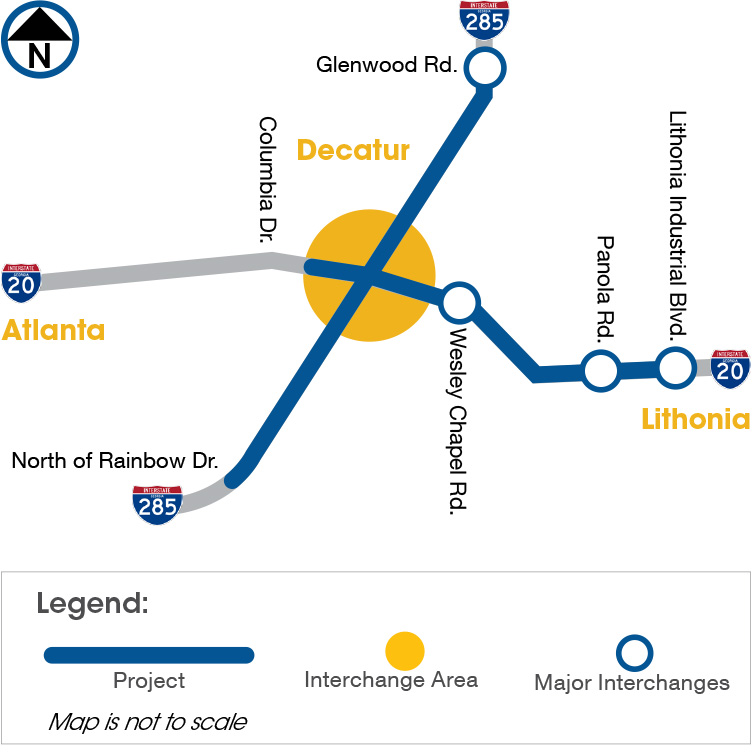
The State Transportation Board Thursday approved plans to overhaul the interchange of interstates 285 and 20. Credit: GDOT
ATLANTA – The State Transportation Board gave the green light Thursday to a planned overhaul of the interchange at interstates 285 and 20 in DeKalb County.
The project, expected to cost $350 million to $450 million, will include reconstructing three ramps, adding new collector-distributor and auxiliary lanes and replacing several bridges, Meg Pirkle, chief engineer for the Georgia Department of Transportation, told board members before Thursday’s vote authorizing the work.
The often congested interchange on the east side of metro Atlanta’s Perimeter Highway is ranked as the nation’s 25th-worst highway bottleneck, Pirkle said.
The project will be built on a design-build-finance model, the same that was used to build the Northwest Corridor toll lanes project in Cobb and Cherokee counties, and in the redesign of the I-285/Georgia 400 interchange, a project that is still under construction.
Under a resolution the State Transportation Board adopted Thursday, the DOT will manage the project. The State Road and Tollway Authority will enter into a contract with a road-building company and private-sector consultants to design, construct and finance the work.
The project timetable calls for the DOT to issue a request for qualifications this summer and select a short list of finalists in October. Two requests for proposals will follow in November and January, with the contract to be awarded during the third quarter of next year.
Construction is due to begin in 2022, and the new interchange is scheduled to open to traffic in 2025.
In other business Thursday, Georgia Commissioner of Transportation Russell McMurry reported that traffic around the state is starting to pick up after falling off dramatically during the initial weeks after the state’s economy was shut down in response to the coronavirus pandemic
At the low point early last month, traffic on the state’s highways was down 40% to 50% on average, McMurry said. It has rebounded since then and is now 25% to 30% below pre-pandemic levels, he said.
“It’s an indicator of what the economy is doing,” McMurry said.
McMurry said truck traffic in Georgia only fell off 10% to 20% at the height of the lockdown and is now back to normal.
ATLANTA – Georgia’s unemployment rate skyrocketed last month to a record high 11.9%, the state Department of Labor reported Thursday.
Coronavirus-induced joblessness rose by 7.3% during April alone, sending unemployment well past the previous record of 10.6% set at the height of the Great Recession in December 2010.
“However, the cause of this high unemployment rate differs greatly from that of the previous record,” Georgia Commissioner of Labor Mark Butler said. “I have no doubt that we will recover just as quickly and get back to our record lows once again.”
But for now, Georgia’s job outlook is not a pretty picture. The huge jump in unemployment is being reflected in unprecedented numbers of initial unemployment claims, which rose by 333% last month to reach a total of 1.35 million.
The monthly total of initial claims filed in April was higher than the number for each of the last four years combined.
The accommodations and food services sector accounted for the most unemployment claims, with more than 323,000 filed last month. The trade sector was a distant second with more than 172,000 claims, followed by health care and social assistance, which accounted for more than 151,000 claims.
April showed a decrease of 624,126 employed Georgians, bringing the total to nearly 4.3 million, the lowest number of employed residents in eight and a half years.
Jobs in Georgia were down by 492,100 over the month, the lowest number of jobs on record in six years.
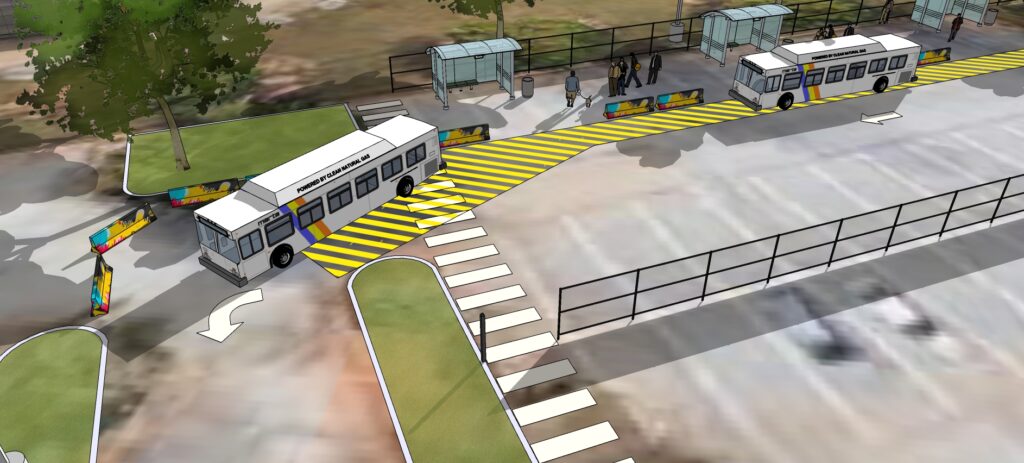
MARTA is looking for artists to design a mural on concrete barriers at a new bus transit center in Clayton County (rendering).
ATLANTA – MARTA is looking for artists to design a mural to be painted on concrete barriers at a new bus transit center in Clayton County.
As part of the first phase of planned transit improvements at the Clayton County Justice Center, MARTA will move a bus stop from Post Way to inside the center’s northwest parking lot. The concrete barriers will serve as a temporary wall between buses and bus shelters until a permanent structure can be built.
The transit hub will serve four bus routes with 800 daily riders.
Interested artists should submit 10 digital images of relevant previous work, labeled with title, dimensions and completion date.
Applications should include a statement of purpose describing the general approach and themes the artist plans to incorporate into the design. Artists also must submit a resume including community-centered work they have done, current contact information and two references.
Applications must be submitted in a single PDF document (not to exceed 10 megabytes) to artbound@itsmarta.com by May 29 at 5 p.m.
The selected artist will be notified by June 5 and must submit a final design for approval before the commission can be completed.
Designs may not represent violence, be profane or graphic in nature or contain overt political or religious messaging.
The Artbound program will pay an artist’s fee of $5,000 to cover design and creation of the stencils that will be used to paint the mural.
Democrat Joe Biden and Republican President Donald Trump are locked in a tight race in Georgia, according to a new poll.
ATLANTA – The presidential race and one of the two U.S. Senate contests in Georgia this year likely will be decided by close margins, according to a poll released Tuesday by left-leaning website DailyKos.
The survey, conducted by the online polling firm Civiqs, found Democrat Joe Biden holding a narrow lead over incumbent Republican President Donald Trump, 48% to 47%.
Likewise, Democratic challenger Jon Ossoff was slightly ahead of incumbent GOP U.S. Sen. David Perdue, 47% to 45%.
On the other hand, Republican U.S. Rep. Doug Collins was running well ahead in Georgia’s other Senate election on this year’s ballot. Incumbent GOP Sen. Kelly Loeffler was fourth in the crowded field.
The online survey of 1,339 registered voters took place from May 16-18, with results weighted by age, race, gender, education and party identification to accurately reflect the population of Georgia registered voters. The margin of error was plus-or-minus 3.1%.
The results pointed to a continuation of gains in Democratic strength in what has been a reliably Republican state for the last two decades. The pattern surfaced two years ago when Democrat Stacey Abrams lost a close race to Republican Gov. Brian Kemp and Democrats captured a congressional seat in Atlanta’s northern suburbs long in Republican hands and nearly toppled a second GOP incumbent in a U.S. House district based in Gwinnett County.
Democratic voters will go the polls June 9 to choose a nominee to oppose Perdue’s bid for a second six-year term in the Senate.
In the DailyKos poll, Ossoff was the only Democrat holding a lead over Perdue in head-to-head matchups. Perdue held a one-point lead over former Columbus Mayor Teresa Tomlinson, 45% to 44%, and a three-point advantage over Sarah Riggs Amico, the 2018 Democratic nominee for lieutenant governor, 45% to 42%.
Collins entered the other Senate race last winter after Kemp appointed Atlanta businesswoman Loeffler to succeed retiring Sen. Johnny Isakson.
In an unusual free-for-all election being held without a party primary, 21 candidates for the seat – Republicans and Democrats alike – will be on the general election ballot Nov. 3. If no one receives more than 50% of the vote, a runoff between the top-two finishers would take place in early January.
In response to a question pitting all of the candidates, Collins polled 34% of the vote. The Rev. Raphael Warnock, a Democrat and pastor at Atlanta’s Ebenezer Baptist Church, was second with 18%.
Lawyer Matt Lieberman, also a Democrat and son of former Sen. Joe Lieberman of Connecticut – the Democrats’ 2000 vice presidential nominee, was third with 14% of the vote, followed by Loeffler, with 12%. None of other candidates polled double-digit support.
When the top Republican and Democratic candidates were pitted against each other one on one, Warnock, Lieberman and former U.S. Attorney Ed Tarver outpolled Loeffler by more than 10 points.
Collins’ results against the Democrats were mixed. He defeated Tarver by three points, 45% to 42% but tied with Lieberman at 44% each and trailed Warnock by one point, 45% to 44%.