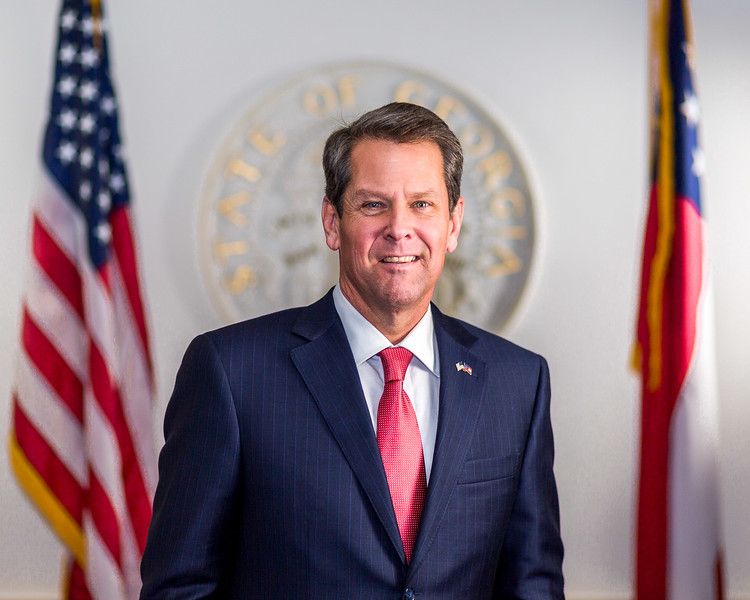
ATLANTA – A Chinese flooring company will open its first U.S. headquarters and manufacturing plant in Northwest Georgia, Gov. Brian Kemp announced Wednesday.
Huali Floors will create at least 315 jobs with an investment of $27 million at a site in Murray County.
The company is a leading manufacturer of resilient flooring, a middle ground between carpeting and hardwood or stone. Its products include vinyl tiles and stone-plastic and wood-plastic composite flooring.
“It’s a testament to Georgia’s logistics network and readily available workforce when an innovative company like Huali Floors chooses Georgia to establish their first U.S. manufacturing operations,” Kemp said. “I am confident Huali will find success in the Peach State.”
Philip Yuan, president of Huali Group, cited Northwest Georgia’s reputation as a flooring manufacturing center in the company’s decision to locate in the region. Georgia was the nation’s No.-1 exporter of floor covering products last year, with a total export value of $485.4 million.
“We want to be part of that spirit,” Yuan said. “We saw and felt the strength of the community throughout the project process.”
Huali Floors employs more than 2,000 full-time workers, with annual revenue exceeding $360 million. The company uses the Port of Savannah and plans to ship its products to the coast by rail from the Appalachian Regional Port near Chatsworth.
Jobs at the new headquarters and plant will involve administration, manufacturing and research and development. Individuals interested in employment opportunities should click on https://murraycountychamber.org/hfusa/.
The Georgia Department of Economic Development’s Global Commerce Division worked on the project in partnership with the state Department of Labor’s Quick Start program, the Georgia Ports Authority, the Murray County Industrial Development Authority, Georgia EMC and Georgia Power Co.
Georgia Rep. Chuck Efstration, R-Dacula, sponsored a hate-crimes bill the state House of Representatives passed last year.
Two business organizations with major political clout under the Gold Dome are asking the General Assembly to pass a hate-crimes bill when lawmakers return to the Capitol next month.
The heads of the Georgia Chamber of Commerce and Metro Atlanta Chamber issued a joint statement Wednesday praising last year’s bipartisan passage in the state House of Representatives of legislation sponsored by Georgia Rep. Chuck Efstration, R-Dacula, and urging the Georgia Senate to follow suit.
“Recent support from statewide leaders further demonstrates that momentum is growing for Georgia to join the 45 other states that already have these laws on the books,” wrote Chris Clark, president and CEO of the Georgia Chamber of Commerce, and Hala Moddelmog, president and CEO of the Metro Atlanta Chamber.
“When the Georgia General Assembly reconvenes in June, the Metro Atlanta Chamber and the Georgia Chamber urge swift passage of hate crimes legislation that aligns our state’s laws with our values.”
The statewide momentum for the hate-crimes bill the two chamber leaders cite stems from the widespread outrage following the arrests of a father and son in Glynn County earlier this month in the February shooting death of 25-year-old Ahmaud Arbery, who was jogging in their neighborhood. The Georgia Bureau of Investigation made a third arrest in the case last week.
The two chambers of commerce have helped lead the opposition in recent years to legislative attempts to pass a religious liberty bill in Georgia, arguing it would hurt Georgia’s image as a business-friendly state by fostering same-sex discrimination. Business leaders praised then-Gov. Nathan Deal for vetoing religious liberty legislation that made it through the General Assembly in 2016.
House Bill 426 cleared the House of Representatives last year 96-64, primarily supported by Democrats but with some Republican support, including Efstration and GOP cosponsors Ron Stephens of Savannah and Deborah Silcox of Sandy Springs.
The bill allows additional penalties for criminal defendants if it is determined the victim was selected based on his or her “race, color, religion, national origin, sexual orientation, gender, mental disability or physical disability.”
ATLANTA – The Federal Aviation Administration (FAA) has revised its review schedule for a planned commercial spaceport in southeastern Georgia that will take the process into the fall of next year.
The delayed timetable for Spaceport Camden is to allow additional time to revise an environmental impact study (EIS) to take into account a significant change in the design of the project.
Officials in Camden County submitted a revised license application to the FAA in January that calls for launching only small rockets from the site rather than the medium-to-large rockets envisioned in the original plan.
Conservation and environmental groups opposed to the spaceport sent a letter in February asking the FAA to order the revised EIS.
“The county’s decision to focus on risky, unproven small rockets requires a thorough environmental review and the opportunity for public input,” Brian Gist, senior attorney with the Southern Environmental Law Center, said Wednesday. “Camden County should recognize that this is the wrong place for a spaceport.”
Homeowners on nearby Little Cumberland Island have joined environmental critics in opposing the proposed spaceport as a threat to public safety.
Officials with the National Park Service have warned the spaceport could disrupt tourism at the popular Cumberland Island National Seashore, while the Defense Department has raised concerns over the proposed launch site’s proximity to the Kings Bay Naval Submarine Base.
The project’s backers have countered that a commercial spaceport would represent a huge economic boost for southeastern Georgia and attract aerospace engineering graduates from Georgia Tech who otherwise likely would take their skills and earning power out of state. The project has been endorsed by Gov. Brian Kemp and the state’s congressional delegation.
The FAA estimates a decision on whether to green light the spaceport won’t come until October 2021.
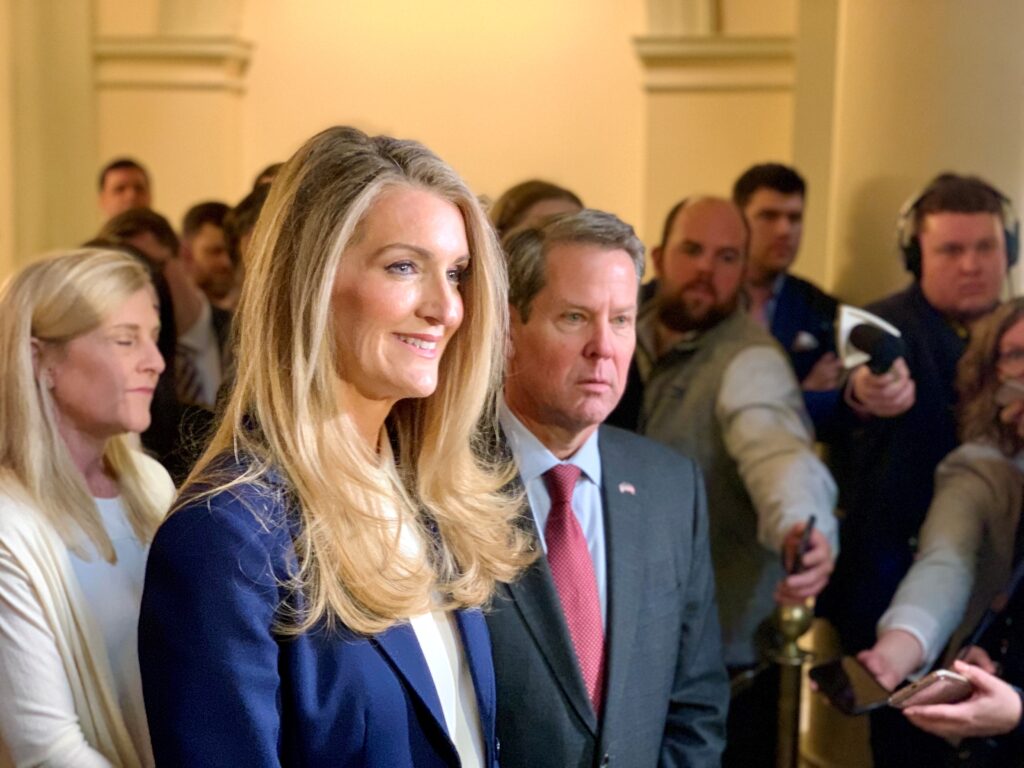
U.S. Sen. Kelly Loeffler speaks at the State Capitol after qualifying for the 2020 election on March 2, 2020. (Photo by Beau Evans)
ATLANTA – The Justice Department has dropped an investigation of stock transactions U.S. Sen. Kelly Loeffler, R-Ga., and two Senate colleagues made following a closed-door briefing in January on the looming coronavirus pandemic, Loeffler’s office confirmed Tuesday.
Loeffler, a wealthy Atlanta businesswoman, and Sens. Dianne Feinstein, D-Calif., and Jim Inhofe, R-Okla., turned over documents to investigators after political opponents and media reports called attention to the buying and selling of millions of dollars in stocks by the three senators shortly after the briefing.
A fourth senator, Republican Richard Burr of North Carolina, remains under investigation, the Wall Street Journal reported.
Loeffler has said the stock transactions were made by a third-party advisor without her input.
Last month, she liquidated her holdings in individual stocks and converted those assets into broader exchange-traded funds and mutual funds. At the time, she said she was doing so not because of any wrongdoing but to end the distraction over false allegations.
“Today’s clear exoneration by the Department of Justice affirms what Senator Loeffler has said all along – she did nothing wrong,” Loeffler campaign spokesman Stephen Lawson said Tuesday. “This was a politically motivated attack shamelessly promoted by the fake news media and her political opponents.”
Gov. Brian Kemp appointed Loeffler to the Senate last December to succeed retiring Sen. Johnny Isakson on an interim basis. To finish out Isakson’s six-term, she must win in November in a crowded “free-for-all” contest featuring 21 candidates, including both Republicans and Democrats.
The field of hopefuls includes U.S. Rep. Doug Collins, R-Gainesville, and – on the Democratic side – the Rev. Raphael Warnock, pastor at Atlanta’s Ebenezer Baptist Church; Matt Lieberman, son of 2000 Democratic vice presidential nominee Joe Lieberman of Connecticut; and former U.S. Attorney Ed Tarver of Augusta.
ATLANTA – Georgia lawmakers will get their first look next week at how deep state agencies must cut their budgets to comply with spending reductions the legislature’s leading budget writers ordered in the wake of coronavirus.
Revised fiscal 2021 budget proposals the agencies submitted this week would freeze vacant positions, furlough workers and scale back vital programs and services to achieve $3 billion to $4 billion in cuts to offset the impact of declining tax revenues resulting from the pandemic-driven lockdown of the state’s economy.
Starting on Tuesday, Georgia Senate budget subcommittees will begin examining the spending cuts state agency heads have offered. The Senate gets first crack at the revised budget because the state House of Representatives passed a pre-coronavirus version of the budget in mid-March, shortly before the pandemic forced the 2020 legislative session to be temporarily suspended.
While the targeted spending reduction in the revised budget is 14% across the board, some cuts are larger and some are smaller.
A sampling of the proposed reductions includes:
a 50% cut in state support for charter schools, for a savings of about $2.1 million.
closing six of the nine state farmers markets leaving only the markets in Atlanta, Valdosta and Moultrie, for a savings of $780,028.
reducing grant funds to county boards of health by $17.8 million.
closing 50 Division of Family and Children Services (DFCS) offices, for a savings of $1.6 million.
freezing vacant corrections officer positions in state prisons, for a savings of about $9 million.
12-day furloughs for employees throughout the Department of Public Health, the agency in the front lines of the fight against COVID-19, for a savings of about $1.8 million.
24-day furloughs for employees in the Department of Behavioral Health and Developmental Disabilities, which services the state’s mentally ill population.
eliminating 111 part-time and 41 full-time staff at the Department of Driver Services.
Such steep reductions would be counterproductive to the state’s economic recovery as well as devastating to Georgia families, said Danny Kanso, a policy analyst with the Georgia Budget and Policy Institute.
“Layoffs, furloughs and hiring freezes will only slow Georgia’s economy and exacerbate the problems underscored by COVID-19,” Kanso said.
“Based on current agency proposals, public health departments working hard to combat the virus will lose millions in funding, public schools will be underfunded by $1.5 billion, causing teachers to be furloughed and class sizes to increase, and the millions of newly unemployed Georgians seeking to enroll in necessary financial supports … will experience longer delays in receiving their benefits.”
State agencies will be able to offset the impact of some of the cuts by swapping in available federal funds for state dollars. For example, the DFCS budget proposal calls for drawing down $46.2 million in federal Temporary Assistance for Needy Families (TANF) funding left over from the last fiscal year.
In its budget submission, the Department of Community Health (DCH) notes the availability of federal stimulus funds Congress has allocated to help state Medicaid programs with their coronavirus response. However, the agency points out that money will only be available during the public health emergency declared by the U.S. Department of Health and Human Services (HHS).
“There is a risk that if the current situation improves and the [HHS] secretary declares that the emergency no longer exists, then the entire estimated savings will not be realized,” the DCH wrote.
Another limit on the federal largesse is that the stimulus funds Congress has approved for state and local governments thus far may only be spent addressing COVID-19, not to plug holes in the budget opened up by falling tax revenues.
The Democratic-controlled U.S. House of Representatives passed an additional stimulus package last week with $1 trillion earmarked for state and local governments, most of which could be put toward revenue shortfalls. But the measure looks to be a long shot in the Republican-controlled U.S. Senate.
“We have to deal with the cards we have on the table right now,” said Senate Appropriations Committee Chairman Blake Tillery, R-Vidalia.
Tillery’s committee has scheduled seven subcommittee hearings during the next two weeks to take up budget-cutting proposals from various agencies.
The full General Assembly is due to resume the legislative session in mid-June, facing a tight legal deadline of July 1 to pass next year’s budget.