Georgia Power Co. won approval Tuesday to recover $7.7 million in costs related to COVID-19.
ATLANTA – Georgia’s energy regulating board voted narrowly Tuesday to let Georgia Power Co. recover from customers $7.7 million in costs associated with its response to the coronavirus pandemic.
The state Public Service Commission signed off on the Atlanta-based utility’s request 3-2 despite a recommendation from the agency’s staff to deny the proposal.
Georgia Power submitted the request to cover expenses in March, April and May due to COVID-19, including cleaning supplies and services, personal protective equipment, employee overtime and meal vouchers for front-line workers.
“These costs are necessary to protect our workers who maintain the reliability of electric service essential to our local communities and state through this pandemic,” Georgia Power spokesman John Kraft said. “Similar to storm cost recovery, these pandemic-related costs will be deferred for consideration in the company’s 2022 base rate case.”
“Few things are more vital to society than electricity,” commission Chairman Chuck Eaton added. “The vote today ensures Georgia Power will have the medical technology and resources available for its frontline workers to prevent COVID-19 power blackouts.”
Eaton joined commissioners Tim Echols and Tricia Pridemore in supporting Georgia Power’s request.
Commissioners Lauren “Bubba” McDonald and Jason Shaw voted against it based on the PSC staff’s assertion that the utility shouldn’t be entitled to the money.
Rob Trokey, director of the commission’s Electric Unit, told commissioners Georgia Power realized some savings because of COVID-19 as well as higher costs and failed to demonstrate that its costs exceeded those savings.
He also argued that the effects of the pandemic on Georgia Power should be weighed against its impact on its residential and business customers.
“Burdening customers with additional costs that have not been adequately demonstrated, staff doesn’t believe is justified,” Trokey said.
The largest portion of Georgia Power’s costs related to coronavirus – nearly $4.1 million – came in April. The utility’s COVID-related expenses in May fell to $3.3 million.
ATLANTA – All University System of Georgia (USG) students, faculty, staff and visitors to the system’s 26 college and university campuses will be required to wear masks starting July 15.
USG officials announced the new policy Monday, basing the decision on a recent policy revision by the federal Centers for Disease Control and Prevention. The CDC no longer gives a minimum age for those at risk of contracting COVID-19.
The policy states that wearing masks is not a substitute for social distancing, which will continue to be required where possible. There are some exceptions to the policy.
“Face coverings are not required in one’s own dorm room or suite, when alone in an enclosed office or study room, or in campus outdoor settings where social distancing requirements are met,” the policy states.
“Anyone not using a face covering when required will be asked to wear one or must leave the area. Repeated refusal to comply with the requirement may result in discipline through the applicable conduct code for faculty, staff or students.”
Also, people suffering from one or more of a series of underlying documented medical conditions will be allowed to request an exemption from the mask-wearing requirement.
The list includes obesity, serious heart disease, asthma, high blood pressure, type 2 diabetes and pregnancy.
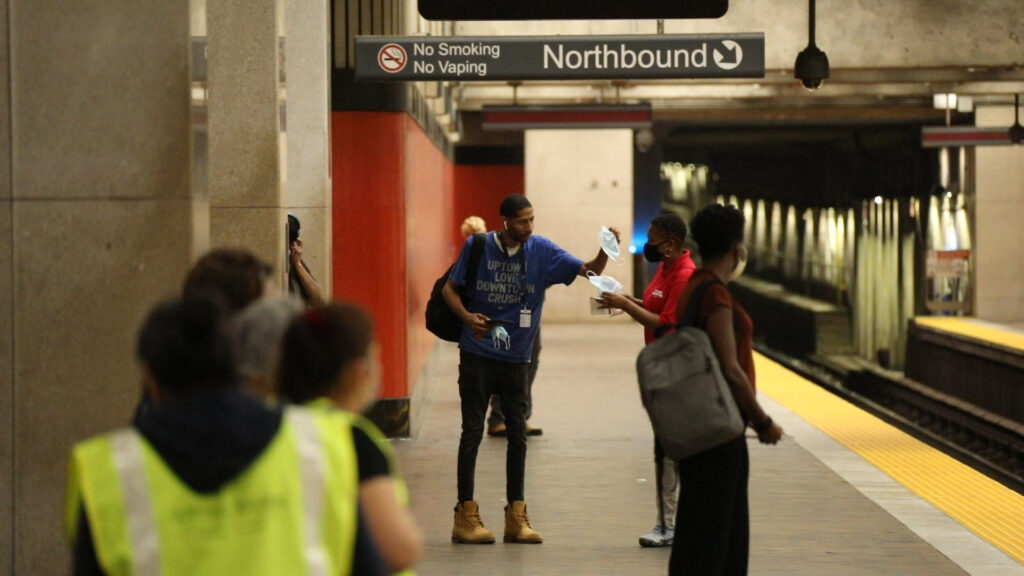
A MARTA employee (right) hands out a free mask Monday at the Five Points Station.
ATLANTA – MARTA employees and volunteers began handing out the first of up to 2 million free masks Monday at rail stations and bus stops.
The mask giveaway is part of the transit agency’s commitment to fight the spread of COVID-19. While MARTA is not requiring riders to wear masks, it is encouraging them to do so to protect themselves and those around them.
MARTA does require mask wearing of all of the system’s employees and contractors.
“Since the onset of the pandemic, we have instituted safety precautions and new cleaning protocols in order to continue providing essential transit service while protecting our customers and employees,” MARTA General Manager and CEO Jeffrey Parker said. “We are now asking our customers to join us in helping to stop the spread of this virus by wearing a mask while on MARTA.”
MARTA will be handing our free masks between 7 a.m. and 11 a.m. on weekdays, then expand the program to weeknights and weekends depending on ridership.
Customers needing a mask should look for a uniformed MARTA station agent or transit ambassador wearing a red “Team MARTA” shirt.
MARTA uses electrostatic sprayers to clean and sanitize its entire fleet of about 500 buses every night and disinfects high-touch surfaces on 200 buses each day.
Rail cars are lightly cleaned while in service and disinfected every night. The sprayers sanitize high-touch areas inside MARTA’s 38 rail stations daily.
The mask giveaway initiative will continue until further notice or until public health recommendations change.
Legalized gambling legislation fizzled again this year in the General Assembly.
ATLANTA – With state tax collections running below expectations even before the coronavirus pandemic hit, supporters of legalized gambling in Georgia were optimistic they could finally prevail during the 2020 legislative session after years of failure.
But even the glaring need for additional sources of tax revenue wasn’t enough to get casino gambling or pari-mutuel betting on horse racing over the finish line this year. A new player in the gambling debate, sports betting, also fizzled during the session’s final days.
Proponents blamed state Senate Republican leaders for blocking both a constitutional amendment asking Georgia voters to decide whether to legalize casinos, horse racing and sports betting and separate legislation embracing sports betting. Lt. Gov. Geoff Duncan, the Senate’s presiding officer, and leaders in the Senate Republican Caucus made it clear on the session’s opening day in January that legalized gambling would not be a priority for them.
“We had support in the [Georgia] House,” said Billy Linville, spokesman for a coalition of Atlanta’s pro sports teams that banded together to push the sports betting bill. “We’ve got more work to do with Senate leadership.”
But it wasn’t just external opposition that sank the legalized gambling legislation. Advocates for the standalone sports betting measure and those favoring the constitutional amendment putting casinos, horse racing and sports betting on the statewide ballot got in each other’s way, said Georgia Rep. Alan Powell, chairman of the House Regulated Industries Committee and a key supporter of the constitutional amendment.
“You had such a mixed bag of folks involved in this … the Atlanta sports teams, the casino interests,” said Powell, R-Hartwell. “They were working at diametrically different purposes.”
Both the constitutional amendment and the sports betting bill appeared to be dead back in mid-March when they failed to survive Crossover Day, the annual deadline for legislation to pass one chamber or the other to remain alive for that year’s session.
But supporters took advantage of loopholes in legislative procedure to bring them back when the coronavirus-interrupted session resumed last month by attaching them to other bills that were still eligible for passage.
Powell’s committee approved the constitutional amendment following a presentation by Rep. Ron Stephens, perennially the driving force behind efforts to get casino gambling on the ballot in Georgia.
“I don’t understand how we can sit up in Atlanta and tell folks they’re not allowed to vote for themselves,” Stephens, R-Savannah, said last week. “It’s 50,000 permanent jobs, $1 billion in new revenue, no tax incentives and local control. That’s four things that are hard to vote against.”
But state Sen. Burt Jones said his bill to legalize online sports betting in Georgia stood a better chance of passing than the constitutional amendment.
For one thing, sports betting was new to the General Assembly this year. It wasn’t until 2018 that the U.S. Supreme Court overturned a federal law prohibiting states from legalizing gambling on sports.
Also, since Jones’ bill would not change the state Constitution, it only would have required a simple majority in each legislative chamber to pass. Constitutional amendments need two-thirds majorities to clear the House and Senate.
Jones, R-Jackson, argued online sports betting doesn’t require a constitutional change because it simply would represent an expansion of the existing Georgia Lottery.
“The Georgia Lottery already has an app where you can go online and play the lottery from the comfort of your cellphone,” he said.
The Senate Special Judiciary Committee, made up entirely of minority Democrats, resurrected Jones’ bill and approved it. He said the full Senate likely would have passed it if Republican leaders had let it reach the Senate floor for a vote.
But even if the sports betting bill had made it through the Senate, it would have died in the House.
Stephens said lawmakers there weren’t going to vote for a sports betting bill that Gov. Brian Kemp would have been expected to veto.
“You don’t send him a bill knowing he’s going to veto it,” Stephens said.
The only way to bypass the governor would have been to pass the constitutional amendment, since those go directly onto the ballot.
But Powell said any momentum the constitutional change had in the House went away during the last two days of the session when Senate Republican leaders signaled they would not take up the measure even if the House could muster the two-thirds vote necessary to clear the lower chamber.
“That’s what collapsed it,” Powell said.
Linville said members of the coalition he represents plan to crisscross the state this summer and fall to educate the public on the advantages of sports betting and the estimated $60 million a year in tax revenue it would bring to the state.
With a large number of incumbent lawmakers leaving office this year, supporters of legalized gambling also can hope a more sympathetic crop of newly elected legislators will join the General Assembly next year.
However, a more likely source of momentum lies in Georgia’s ongoing budget woes. The fiscal 2021 state budget lawmakers adopted late last month reduces state spending by 10% across the board, but the cuts could go deeper next year if the recession brought on by the spread of COVID-19 drags on.
“Right now, we’re not having to lay off teachers or let prisoners go,” Stephens said. “Next year, if we come back here and have real budget problems again and the federal [stimulus] money is not coming back, we’re going to be in deep doo-doo.”
ATLANTA – Initial unemployment claims in Georgia declined again last week for the ninth week in a row, the state Department of Labor reported Thursday.
Jobless Georgians filed 117,485 initial unemployment claims during the week ending June 27, down 8,240 from the previous week.
“The claims numbers continue to improve each week,” Georgia Commissioner of Labor Mark Butler said. “The sheer volume of claims is enough to overwhelm any office, but I am proud that my staff has worked day in and day out to accomplish a 91% payment record.”
Acknowledging the unprecedented workload massive unemployment resulting from the coronavirus pandemic has forced on the labor department, the General Assembly spared the agency from spending cuts when it adopted a fiscal 2021 state budget last week with $2.2 billion in spending reductions.
On Thursday, the department reported paying out more than $7.5 billion in state and federal unemployment benefits during the 15 weeks since the pandemic prompted shelter-in-place orders that forced Georgia businesses to close and lay off workers.
Since March 21, the job sector accounting for the most initial unemployment claims is accommodations and food services with 702,127. The health-care and social-assistance sector is well below that in second place with 338,505 initial unemployment claims, followed closely by retail trade with 319,225 claims.
More than 107,000 jobs are listed online at EmployGeorgia.com for Georgians to access. The labor department offers online resources for finding a job, building a resume and helping with other reemployment needs.