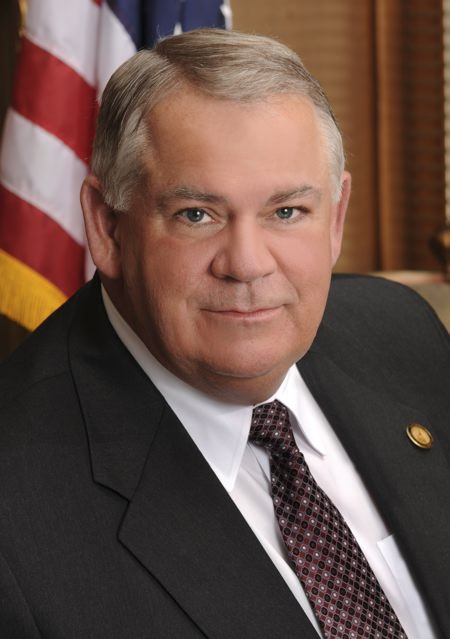
ATLANTA – Georgia House Republicans renominated Speaker David Ralston Monday to another two-year term as the chamber’s leader and reelected their entire leadership team.
Ralston, R-Blue Ridge, has served as speaker since 2010. Voters in House District 7 in Northwest Georgia reelected Ralston last week with nearly 84% of the vote over his Democratic opponent.
The House Republican Caucus also renominated Rep. Jan Jones, R-Milton, to serve as speaker pro tempore.
Both Ralston and Jones are virtually assured keeping their jobs when the full General Assembly meets in January because Republicans held onto their House majority last week, although they suffered a net loss of two seats.
Meanwhile, the caucus reelected Rep. Jon Burns, R-Newington, to continue as House majority leader. Rep. Trey Kelley, R-Cedartown, will remain majority whip.
Rep. Matt Hatchett, R-Dublin, will return as caucus chairman, with Rep. Micah Gravley, R-Douglasville, back as caucus vice chairman.
Rep. Bruce Williamson, R-Monroe, will continue serving as caucus secretary and treasurer.
The 2021 General Assembly session will begin on Jan. 11.
President-elect Joe Biden campaigned at Warm Springs, Ga., last month. (Biden campaign video)
ATLANTA – The last time a non-incumbent Democrat won a statewide race in Georgia was 1998 when Roy Barnes was elected governor.
President-elect Joe Biden was closing in Saturday on ending that 22-year record of futility. Hours after Biden clinched the presidency by carrying his birth state of Pennsylvania, the Democratic challenger was leading President Donald Trump in the Peach State by a razor-thin margin of 7,248 votes, still too close to call.
But even if Biden ends up carrying Georgia, the 2020 election results leave Republicans poised to remain a strong force in a state that was reliably red for a generation.
Biden’s successful bid for the White House helped Georgia Democrats force runoffs against incumbent Republicans in two U.S. Senate races and a third runoff for a seat on the state Public Service Commission.
Democrats also retained a congressional seat in Atlanta’s northern suburbs held by Republicans for decades until 2018 and flipped another suburban seat vacated by a GOP incumbent.
But Biden’s coattails in Georgia weren’t long enough for Democrats to make much headway in the General Assembly. While many state House and Senate races were close, Democrats only scored a net gain of two House seats and one seat in the Senate, far short of what they needed to take control of either chamber.
“Republicans actually had a very good day on Tuesday,” said Kerwin Swint, a political science professor at Kennesaw State University. “Republicans have to look at the overall picture and feel fairly good.”
Swint said down-ballot Republican candidates in Georgia generally proved more popular than Trump because of the president’s character shortcomings.
“The Republican Party’s messaging policy-wise and platform was widely embraced by voters,” Swint said. “It just didn’t translate to the top of the ticket, most likely because of [Trump’s] personal appeal, or lack thereof.”
“Some share of Republican voters just couldn’t vote for Donald Trump,” added Charles Bullock, a political science professor at the University of Georgia. “Once they voted for Joe Biden, they voted for Republicans for Congress and the state legislature.”
While the Biden-Trump contest lifted the Democrats’ statewide ticket, 2020 was only the next step in a trend that has been building in Georgia.
Democrats were outvoted in Georgia by 200,000 votes in 2016. Two years later, Democrat Stacey Abrams lost the governor’s race to Republican Brian Kemp by 55,000 votes.
“Over two election cycles, the 200,000-vote margin Republicans have enjoyed has evaporated,” Bullock said. “It’s another step in what may be another realignment in Georgia to the Democratic Party.”
That realignment has been coming during the last decade with demographic changes in the makeup of Georgia’s electorate.
“This is a different state,” Democrat Jon Ossoff told supporters Friday during his first post-election news conference after forcing Republican U.S. Sen. David Perdue into a Jan. 5 runoff. “Georgia has become younger and more diverse every day in the last decade.
“[With] the work that’s been done over the last 10 years, work done by people like Stacey Abrams … we’re now seeing change has come to Georgia.”
A dramatic example of the demographic changes occurred in Georgia’s 7th Congressional District, covering portions of Gwinnett and Forsyth counties, where Democrat Carolyn Bourdeaux narrowly won an open seat long in Republican hands. Based on the findings of one poll, Asian Americans voted 62% to 36% for Bourdeaux.
“The story of [the district] is a story about first-time Asian American and Pacific Islander (AAPI) voters and who is mobilizing them,” said Stephanie Cho, executive director of Asian Americans Advancing Justice-Atlanta. “Grassroots community-based organizing matters and it works. More and more AAPIs are excited to be part of the process. This is the future of Georgia.”
The good news for Republicans is they continue to hold a narrow 8-6 advantage in Georgia’s congressional delegation. Also, the underperformance of Democrats in legislative races leaves the GOP in charge of reapportionment and redistricting, the redrawing of congressional and legislative districts that takes place every 10 years following the U.S. Census to adjust for population shifts.
The General Assembly will hold a special session next summer to make those changes.
“They’ll be in the driver’s seat,” Swint said. “They’ll have an opportunity to draw things the way they would like to see them.”
But Bullock said the demographic changes in Georgia that favor Democrats, particularly in Atlanta’s northern suburbs, will limit what Republicans can do with new district maps. GOP leaders may decide to sacrifice some of their incumbents in Atlanta’s inner suburbs in order to draw stronger Republican districts in the outer suburbs and exurban areas, he said.
“My assumption is they’ll look around the north side of metro Atlanta and say, ‘We can’t save these folks,’ ” Bullock said. “Democrats may come out with some gains, even though they don’t control redistricting.”
ATLANTA – Georgia tax collections rose by 1.8% in October, building on a positive first quarter for the state as businesses affected by the coronavirus pandemic continued to reopen.
While the monthly revenue report for September showed a decline in tax revenues, the first quarter of fiscal 2021 overall reflected a 6.3% increase over July, August and September of last year.
The state brought in $2.02 billion in taxes last month, an increase of $35.2 million over October 2019.
On the other hand, individual income taxes declined 1.2% last month, driven in part by a 6.8% drop in tax return payments.
The reduced individual income tax collections were more than offset by a 6.3% increase in gross sales tax revenues.
Corporate income taxes fell by 28.8% in October. Contributing to the decline were a 67.6% increase in corporate tax refunds issued by the Georgia Department of Revenue and a 48% decline in tax payments to the state.
With more Georgia drivers taking to the highways with the increased reopening of offices, shops and restaurants, the state’s gasoline tax collections increased by $2.6 million over October 2019, or 1.7%.
ATLANTA – Georgia Secretary of State Brad Raffensperger defended the state’s elections system Friday, one day after President Donald Trump and his Republican supporters accused the secretary of state’s office of mishandling absentee ballots.
With more than 22,600 military and overseas absentee ballots as well as provisional ballots remaining to be counted as of late Friday, Democratic presidential nominee Joe Biden had pulled ahead of Trump in Georgia by 4,235 votes. Biden had trailed the president in the Peach State from the time vote counting began after the polls closed on Tuesday night until the wee hours of Friday morning.
Georgia was one of just a handful of states still up for grabs on Friday, with Biden holding narrow leads in most of them.
“The stakes are high and emotions are high on all sides,” Raffensperger, a Republican, said during a news conference. “We will not let that debate distract us from our work. We will get it right.”
After Trump took to the White House podium Thursday night to slam Georgia and other states still counting absentee ballots, Republican members of Georgia’s congressional delegation rushed to back the president. GOP Sen. Kelly Loeffler contributed to a defense fund raising money to mount legal challenges alleging fraud in the election.
But Gabriel Sterling, voting systems manager for the secretary of state’s office, said Friday Georgia election officials have not seen any “widespread irregularities” in the counting of votes.
“When margins are this tight, small things can make a difference,” he said. “So, everything is going to have to be investigated to ensure the integrity of this election.”
Raffensperger said the thin margin separating Biden and Trump in Georgia likely will necessitate a recount, which will come after the vote has been audited and certified.
“We’re committed to doing everything we can to maintain trust in our electoral process,” Raffensperger said.
Sterling said the secretary of state’s office is open to investigating any allegations of wrongdoing that can be supported.
“If somebody has a credible complaint and some evidence, they can give our office a call,” he said.
ATLANTA – Democratic presidential nominee Joe Biden is threatening to carry Georgia, while Democratic U.S. Senate hopeful Jon Ossoff likely will force a runoff against Republican U.S. Sen. David Perdue.
President Donald Trump’s lead over Biden in the Peach State had shriveled to just 9,426 votes by late Thursday, with 36,331 votes remaining to be counted statewide.
While Perdue held a much larger advantage over Ossoff – more than 100,000 votes – the one-term incumbent’s share of the vote had fallen to 49.95%, just below the 50%-plus-one margin required under Georgia law to avoid a runoff.
Trump held a huge lead of 372,000 votes over Biden in Georgia at midnight on Election Night. But that margin melted away on Wednesday and Thursday as elections workers continued counting mail-in ballots.
In Georgia and across the country, mail-in voting has been dominated by Democrats wary of waiting in long Election Day lines in the midst of the coronavirus pandemic. Also, Trump repeatedly cast aspersions at the integrity of the mail-in voting process during campaign rallies and urged his supporters to show up at the polls and cast their ballots in person.
A Georgia judge ruled against a lawsuit claiming elections officials in Chatham County mishandled 53 mail-in ballots.
Officials in Secretary of State Brad Raffensperger’s office stood by the integrity of the elections process across Georgia.
“We have 159 dedicated election supervisors and their staffs working to get this right,” Gabriel Sterling, voting systems manager in the secretary of state’s office, said during a mid-afternoon news conference. “They’re going to get it right. We’re going to have an audit to prove they got it right.”
With Georgia among just a handful of states still in play, its 16 electoral votes are critical to either presidential candidate’s chances.
A Biden victory in Georgia would represent a huge upset. The last Democratic presidential candidate to carry the state was Bill Clinton in 1992. Georgia has been reliably Republican in statewide contests since the early 2000s.
Meanwhile, Democratic mail-in votes also reduced Perdue’s lead over Ossoff to the point the GOP incumbent likely will face the Democrat again in a runoff. That would put both of Georgia’s Senate seats up for grabs on Jan. 5, .with Republican Sen. Kelly Loeffler defending her seat against Democrat Raphael Warnock.
That would put Georgia in the national spotlight for weeks after this week’s votes are counted. The results in Georgia could determine whether Republicans keep their majority in the Senate or Democrats wrest control.
The tightening of the presidential and Senate contests in Georgia also could result in a runoff for one or even two open seats on the state Public Service Commission (PSC).
By late Thursday, Republican Commissioner Lauren “Bubba” McDonald’s share of the statewide vote against Democrat Daniel Blackman was down to 50.11%. GOP Commissioner Jason Shaw was leading Democrat Robert Bryant with 50.32% of the vote, making it less likely but still possible a runoff might be needed to decide that race.