ATLANTA – Gov. Brian Kemp and nine other Republican governors have released a set of steps the Biden administration should take to combat the growing number of illegal immigrants flooding the nation’s southern border.
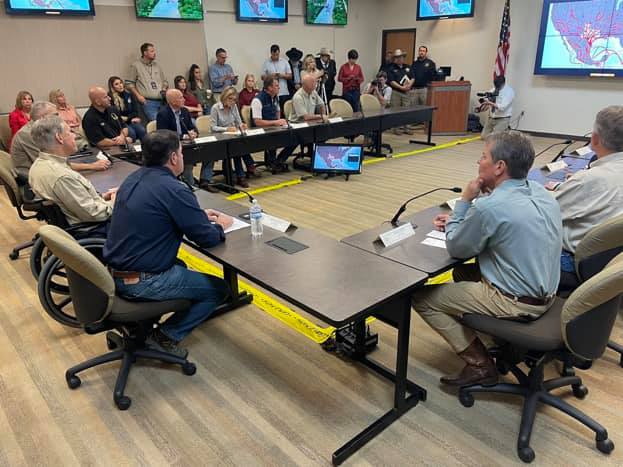
Gov. Brian Kemp (right foreground) attends a briefing on illegal immigration at the Texas border.
The GOP governors unveiled their proposals Wednesday during a trip to McAllen, Texas.
“From gangs and human trafficking to deadly drugs and crime, hardworking Georgians experience the consequences of the border crisis every day,” Kemp said. “This administration must act now.”
Kemp and his Republican colleagues complained that President Joe Biden has yet to respond to their request last month for a meeting to talk about their concerns.
Among other things, the governors are calling on the president to finish securing the border, deploy more federal law enforcement officers to that region and resume the deportation of illegal immigrants with criminal records.
The governors pointed to an almost 500% increase this year in border apprehensions, including about 9,700 detainees with prior criminal convictions.
Democrats accused Kemp of making the out-of-state trip to score political points with Republican voters ahead of next spring’s GOP gubernatorial primary.
“While Kemp spends working Georgians’ tax dollars to play political games, Democrats at every level are actually fighting for Georgia and working to move our country forward,” said Scott Hogan, executive director of the Democratic Party of Georgia.
While in Texas, Kemp received an update from officers with the Georgia National Guard, which he deployed to the border earlier this year.
Texas Gov. Greg Abbott hosted the trip, which included Kemp and the governors of Arizona, Idaho, Iowa, Montana, Ohio, Oklahoma, South Dakota and Wyoming.
This story is available through a news partnership with Capitol Beat News Service, a project of the Georgia Press Educational Foundation.
ATLANTA – U.S. Rep. Carolyn Bourdeaux and two House colleagues introduced bipartisan legislation Wednesday aimed at improving the flow of goods and materials through supply chains.
The bill would create a federal Office of Supply Chain Resiliency and Crisis Response within the Department of Commerce, with $500 million in funding authorized for each of the next five years.
“COVID-19 showed us all how critical resilient supply chains are for consumers and businesses,” said Bourdeaux, D-Suwanee. “All across my district, small business owners and manufacturers have told me about the challenges they face in accessing basic materials critical to their products. … My bill ensures we are better prepared to address these challenges.”
The new office would monitor the strength and resilience of supply chains in critical industries and encourage partnerships and collaboration between the federal government and industry, labor organizations, and state and local governments.
The office also would issue a report every four years recommending ways to improve the security and resiliency of supply chains and to support the creation of jobs through the growth of American manufacturing.
Bourdeaux’s cosponsors on the bill include Reps. Adam Kinzinger, R-Ill., and Robin Kelly, D-Ill.
This story is available through a news partnership with Capitol Beat News Service, a project of the Georgia Press Educational Foundation.
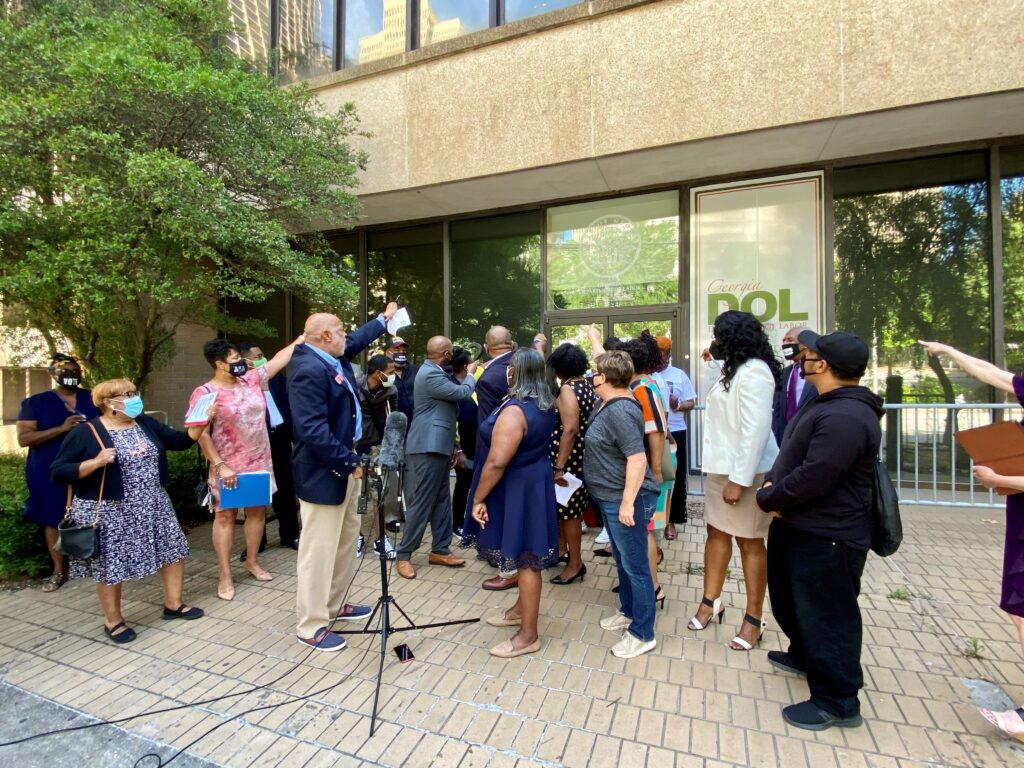
State lawmakers and worker advocates shout, “Open up these doors!” during a protest outside the Georgia Department of Labor office in Atlanta on May 19, 2021. (Photo by Beau Evans)
ATLANTA – An online portal the state Department of Labor has created to help Georgia lawmakers address constituent complaints about unemployment claims is essentially passing the buck for the program’s failures, legislative Democrats complained Tuesday.
“[Commissioner of Labor] Mark Butler is asking legislators to do something his office has not done for over a year and a half,” state Rep. Sandra Scott, D-Rex, said during a news conference at the Georgia Capitol. “Mark Butler has the legislators working for the labor department.”
The new portal is a pilot project aimed at giving members of the General Assembly access to unemployment claims filed by constituents. Lawmakers have been deluged since the coronavirus pandemic began with complaints from constituents about not receiving unemployment benefits on time and not getting a response from the labor department to their concerns.
But to get access to claims information on the portal, legislators must sign a confidentiality agreement Democrats said would expose them and their legislative staffs to legal requirements they’re not equipped to fulfill, including encrypting data. Scott and other members of the House Democratic Caucus’ Subcommittee on COVID-19 are refusing to sign the agreement.
“We’ve shifted from lawmakers to [claims] processers,” said Rep. Kim Schofield, D-Atlanta. “It is the department’s job to do this. … We should be the last resort.”
Kersha Cartright, a spokeswoman for Butler, said the confidentiality agreement lawmakers must sign to access information on individual claims complies with federal and state guidelines aimed at protecting claimant information.
Butler said the program is voluntary. He dismissed the Democrats’ criticism as politically motivated.
“We have been working with several legislators and legislative counsel during a pilot program that Representative Scott did not choose to participate in,” Butler said.
“We have welcomed feedback and implemented improvements from those participating in the program, but have yet to hear anything from Representative Scott before this political statement that fundamentally misrepresents the intent of this program.”
The Democrats also cited an audit by the U.S. Department of Labor’s Office of Inspector General of 12 states including Georgia that found antiquated computer systems and understaffing resulting in delays in paying unemployment benefits.
“A lot of these are working Georgians who lost their jobs through no fault of their own,” said Rep. Viola Davis, D-Stone Mountain.
The audit singled out Georgia’s labor department for a lack of transparency.
“There are two other states which were unable to provide data on the timeliness of claims through all three federal enhanced unemployment insurance programs,” Scott and six of her Democratic colleagues wrote in an open letter dated Oct. 4.
“There were four other states which apparently did not report the required claims volume data. Georgia is the ‘only’ state that was unable to provide data on either.”
The letter called on the inspector general to move beyond a performance audit and conduct a financial audit to determine how many valid unemployment claims filed in Georgia have not been paid in full.
This story is available through a news partnership with Capitol Beat News Service, a project of the Georgia Press Educational Foundation.
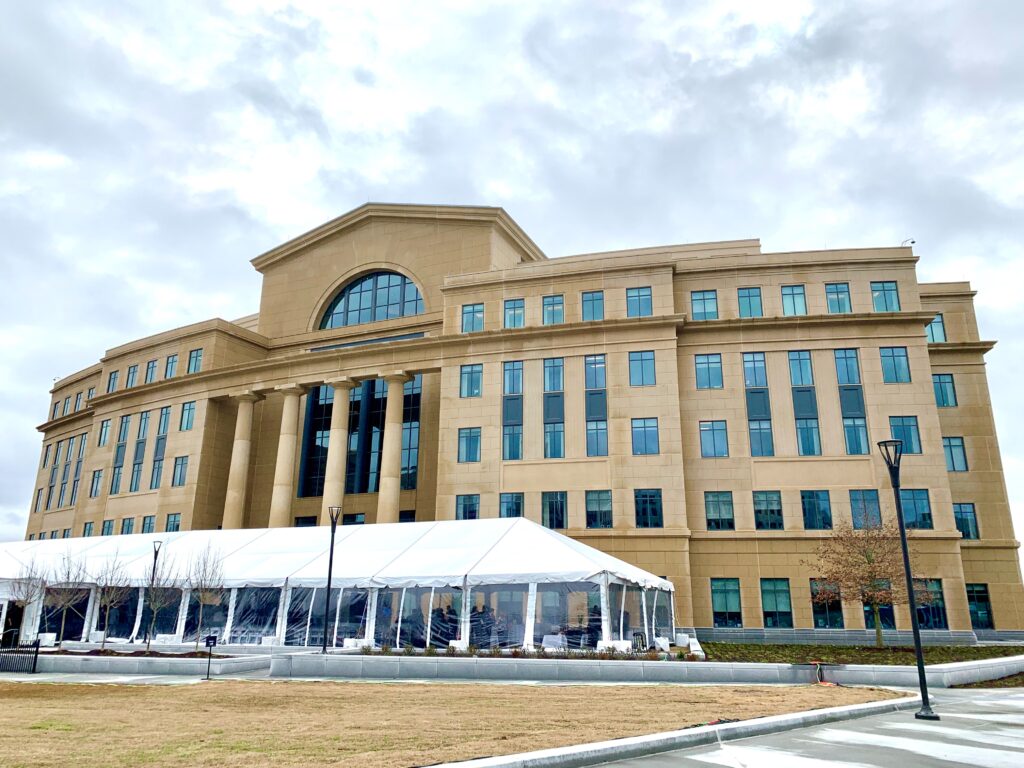
The Nathan Deal Judicial Center houses the Georgia Supreme Court. (Photo by Beau Evans)
ATLANTA – The Georgia Supreme Court upheld two lower court rulings Tuesday allowing a property owner’s lawsuit against the state to move forward.
Cathy Mixon, who owns more than 18 acres of land in Ware County, sued the Georgia Department of Transportation in 2018 claiming a road-widening project was diverting water onto her land and diminishing its value.
The suit maintained that flooding resulting from the DOT’s failure to maintain a storm-water drainage system amounted to a taking of her property without adequate compensation.
The DOT countered that the legal doctrine of sovereign immunity – which protects the government or its departments from being sued without consent— barred her claims.
Both the trial court and the Georgia Court of Appeals sided with Mixon, resulting in the DOT appealing to the state Supreme Court.
In Tuesday’s ruling, the high court declared that sovereign immunity does not protect the state from being sued in certain circumstances.
“The Georgia Constitution provides that, as a general matter, ‘private property shall not be taken or damaged for public purposes without just and adequate compensation being first paid,’ ” Justice Nels S.D. Peterson wrote in the opinion.
“There is no suggestion in the record that [the DOT] has afforded Mixon compensation for this alleged taking; indeed, her complaint seeks money damages.”
This story is available through a news partnership with Capitol Beat News Service, a project of the Georgia Press Educational Foundation.
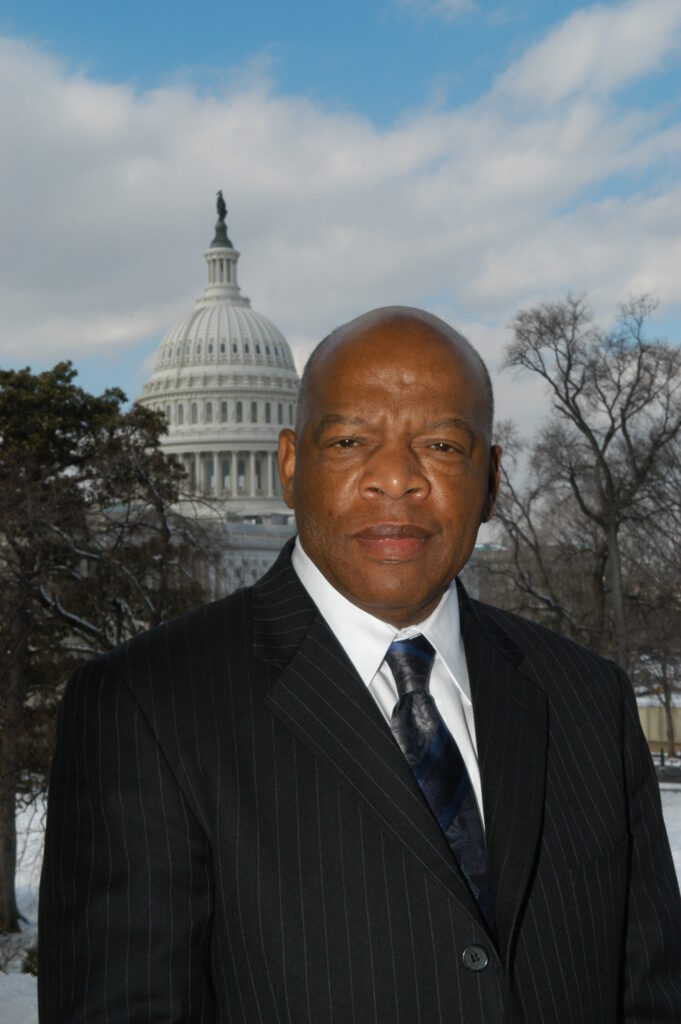
U.S. Rep. John Lewis, D-Ga., a prominent civil rights leader, served 33 years in Congress before his death on July 17, 2020. (Official U.S. House photo)
ATLANTA – U.S. Sen. Jon Ossoff, D-Ga., is leading the push for a new postage stamp honoring the late Congressman John Lewis.
Ossoff is urging the Citizens’ Stamp Advisory Committee to recommend approval of a stamp highlighting the Atlanta Democrat’s legacy as a leader and champion for civil and human rights.
“Congressman Lewis was an American hero, civil rights icon, and revered citizen of Georgia, fully deserving of this honor,” Ossoff wrote in a letter late last month. “His courage serves as an extraordinary example of civic leadership, and continues to inspire young Americans to serve their communities and build a better world.”
Lewis died in July of last year at the age of 80. He represented Georgia’s 5th Congressional District for more than 30 years after serving as a civil rights activist.
Lewis was beaten severely by Alabama state police in 1965 while on a march from Selma to Montgomery, Ala., an incident that came to be known as Bloody Sunday and was instrumental in congressional passage of the federal Voting Rights Act later that year.
In a separate move to honor Lewis, a committee in the Georgia House of Representatives approved a resolution last February calling for placing a statue of Lewis inside the U.S. Capitol. While the resolution did not get a floor vote during this year’s legislative session, it remains alive for consideration in 2022.
The Lewis nstatue would replace the statue of Confederate Vice President Alexander Stephens of Georgia inside the Capitol’s Statuary Hall.
This story is available through a news partnership with Capitol Beat News Service, a project of the Georgia Press Educational Foundation.