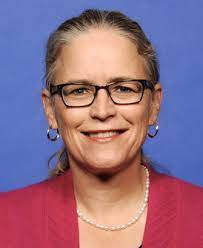
ATLANTA – U.S. Rep. Carolyn Bourdeaux raised more than $733,000 during the third quarter, the Suwanee Democrat’s campaign reported Friday.
Combined with earlier fund-raising, that brought her total to more $2 million for this election cycle and left her campaign with $1.7 million cash on hand as of Sept. 30, according to a report filed with the Federal Election Commission.
Bourdeaux, who will seek a second term representing Georgia’s 7th Congressional District next year, hasn’t taken any contributions from corporate political action committees.
“These fundraising numbers show that Carolyn is hitting the ground running, Bourdeaux spokesman Andrew Scibetta said. “We’re grateful for the enthusiasm and continued support from Georgians who are working so hard to re-elect her next November.”
Bourdeaux defeated Republican Dr. Rich McCormick for an open 7th District seat last year, winning 51.4% of the vote to 48.6%.
McCormick, a former Marine helicopter pilot and emergency medicine physician, is seeking a rematch in 2022. His campaign raised $600,000 in July, August and September, putting him past the $1.1 million mark for the election cycle.
“Dr. McCormick embraces his role as a Republican majority maker and is building a war chest and Rolodex of donors to take all challengers that stand in the way of delivering a Republican House of Representatives in 2022, said Al Chaul, McCormick’s campaign manager.
A third candidate in the race, Republican Yahanseh George, reported raising $6,755 during the third quarter.
Georgia’s 7th Congressional District takes in large portions of Gwinnett and Forsyth counties.
This story is available through a news partnership with Capitol Beat News Service, a project of the Georgia Press Educational Foundation.
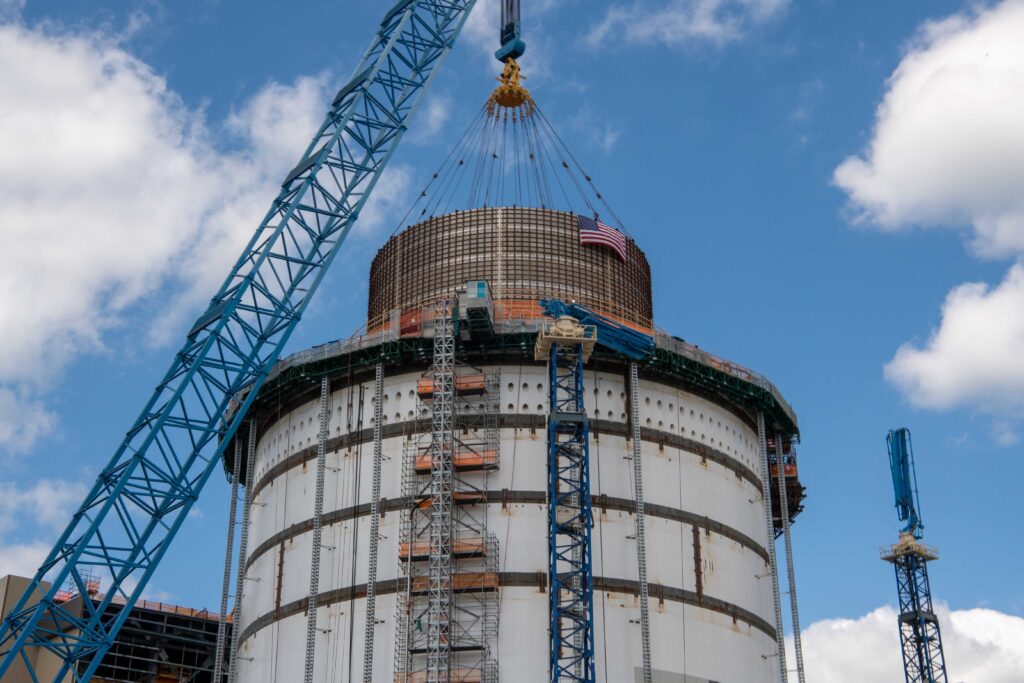
ATLANTA – Georgia Power would be allowed to pass on to customers $2.1 billion of the costs of completing the first of two new nuclear reactors at Plant Vogtle under a stipulation agreement outlined Thursday.
But the Atlanta-based utility wouldn’t be permitted to start recovering those costs until one month after the reactor unit goes into commercial operation, next June under the current completion schedule.
“Neither party to the stipulation received everything it wanted, but instead what staff believes is a fair and just compromise,” Steven Roetger, an analyst with the Georgia Public Service Commission’s (PSC) Public Interest Advocacy (PIA) Staff, told commissioners during a hearing on the agreement.
The PSC voted in August to stop approving incremental cost increases incurred at the long-delayed, over-budget nuclear expansion at the plant south of Augusta. Instead, commissioners have opted to postpone deciding how much of the cost overruns Georgia Power customers will have to bear until after Unit 3, the first of the two new reactors, is completed.
The project, originally projected to cost $14 billion, has ballooned to at least $26 billion.
At the same time, the completion dates have been postponed from 2016 for the first unit and 2017 for the second until 2022 and 2023, due in part to the bankruptcy of prime contractor Westinghouse and, more recently, to workforce shortages arising from the coronavirus pandemic.
Representatives of Georgia Power and the PIA Staff signed off on the stipulation agreement on Wednesday.
Under a key provision in the agreement, Georgia Power will not be allowed to pass on to customers any of the nearly $1.5 billion guarantee Japan-based Toshiba – the parent company of Westinghouse – committed to the project until after the commission decides how much of that guarantee has been spent prudently.
The agreement also for the first time gives the PSC the right to review all operating and maintenance expenses associated with Unit 3 following its completion if the reactor is not performing up to expectations.
In that case, Georgia Power would have to prove that any electrical production that falls below the expected 1,102 megawatts of generating capacity was not the result of “unreasonable or imprudent” construction.
“One of the major concerns we had was performance reliability,” Roetger testified Thursday. “We felt it was necessary to provide this commission an opportunity to review … all of the costs.”
During cross-examination of Roetger and two Georgia Power executives, lawyers for big industrial customers and environmental and consumer advocacy groups complained the agreement would let Georgia Power raise customer rates following the completion of Unit 3 next summer at the same time the utility already is scheduled to file its next regular rate case with the PSC.
“Predictability in budgeting … can be essential for businesses trying to navigate a challenging economy,” said Clay Jones, a lawyer representing the Georgia Association of Manufacturers.
Residential customers under the stipulation agreement would see a net increase of $3.78 a month starting next July, based on the typical usage of 1,000 kilowatt-hours of electricity.
Liz Coyle, executive director of the consumer advocacy group Georgia Watch, said that’s too much to pay beginning just one month after Unit 3 goes into commercial operation when there’s no guarantee the new reactor will perform properly. She cited an example where an AP1000 reactor in China – the same technology Plant Vogtle is using – did not perform reliably for a year.
“Many Georgians, especially those living on fixed incomes, are already having difficulty paying their power bills,” Coyle said. “Even $4 more a month can be problematic in terms of making ends meet.”
Roetger said the agreement strikes a necessary balance between the interests of customers and Georgia Power.
“I understand there are people who are struggling,” he said. “But we have to look at the entire state … and make sure we have a utility that can provide safe and reliable power and is financially sound.”
The commission is scheduled to vote on the agreement Nov. 2.
This story is available through a news partnership with Capitol Beat News Service, a project of the Georgia Press Educational Foundation.
ATLANTA – Republican Jake Evans raised more than $907,000 during the third quarter of this year in his bid to unseat Democratic U.S. Rep. Lucy McBath, Evans’ campaign reported Thursday.
Evans, former chairman of the Georgia Government Transparency & Campaign Finance Commission, is among four Republicans looking to recapture the 6th Congressional District seat in Atlanta’s northern suburbs. The GOP held the seat for decades before McBath won it in 2018.
Most of the money Evans brought in – $500,000 – came in the form of a personal loan. But he also received more than $400,000 in contributions.
“This report shows we have a deep well of support, and we’re generating excitement,” Evans said.
Another candidate in the race, former state Rep. Meagan Hanson, reported Thursday that she raised more than $300,000 during the third quarter. Hanson, who is not relying on any personal loans, received more than 1,000 donations from individual contributors, including more than 500 small-dollar donations of $25 or less.
“I’m especially proud that our effort is bolstered by small-dollar donations from families across Georgia’s 6th District,” Hanson said.
The other two candidates vying for the Republican nomination – U.S. Army veteran Harold Earls and activist Suzi Voyles – had not filed third-quarter campaign fundraising reports as of Thursday.
However, an earlier report from the Earls campaign showed he had raised more than $331,000 through the end of June.
McBath also has yet to file a third-quarter report. But the Democratic incumbent reported back in July that her reelection campaign had raised more than $1.5 million through the second quarter.
The deadline for congressional candidates to file third-quarter fundraising reports with the Federal Election Commission is Friday.
Georgia’s 6th Congressional District includes East Cobb County, Fulton County from Sandy Springs north and northern DeKalb County.
This story is available through a news partnership with Capitol Beat News Service, a project of the Georgia Press Educational Foundation.
Secretary of State Brad Raffensperger discussed absentee voting in Georgia on May 28, 2020. (Photo by Beau Evans)
ATLANTA – A Henry County Superior Court judge dismissed a lawsuit Wednesday seeking to inspect 147,000 Fulton County absentee ballots from last November’s election for signs of fraud claimed by supporters of former President Donald Trump.
Judge Brian Amero ruled that activist Garland Favorito of the group VoterGA and eight co-plaintiffs lacked standing to file the suit because they failed to claim a specific injury suffered as a result of alleged fake ballots counted among the Fulton absentees.
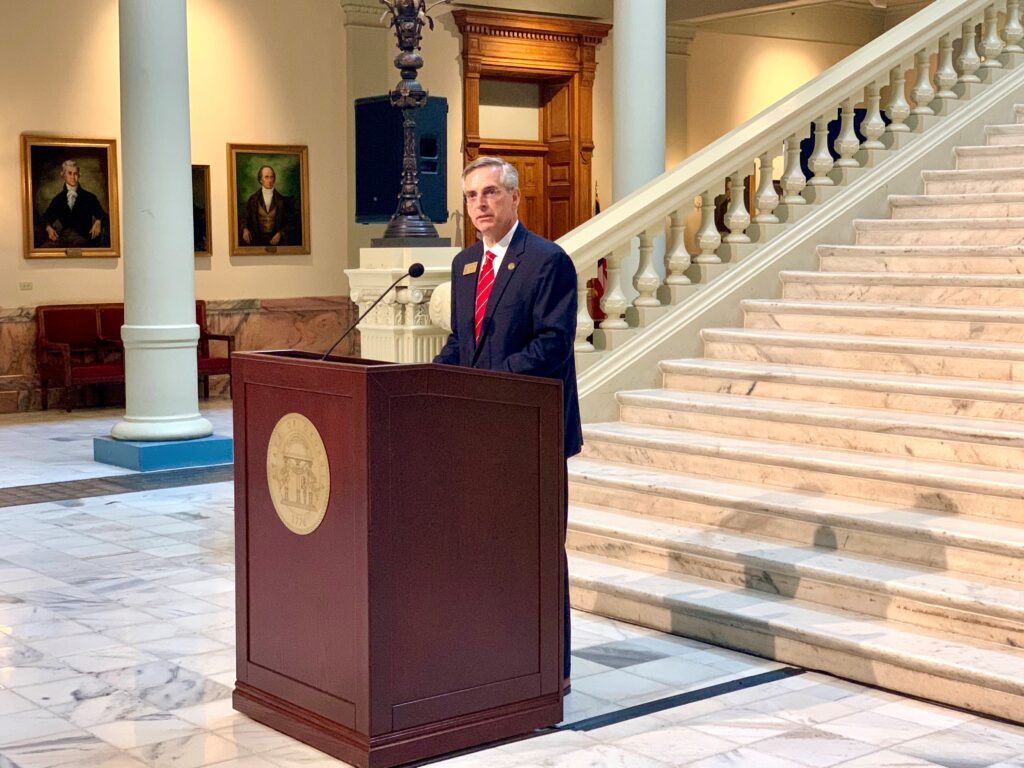
The court decision came a day after Secretary of State Brad Raffensperger’s office filed a brief concluding no evidence had been found to substantiate claims of fraud.
“There was no widespread fraud or illegal voting enough to overturn the election,” Raffensperger said Wednesday. “We’ve been saying since Day One the truth is on our side.”
Raffensperger’s office has been bombarded with a series of legal challenges since Democrat Joe Biden carried Georgia last November by nearly 12,000 votes.
During the aftermath of the election, then-President Trump urged Raffensperger in a phone call to “find” the 11,780 votes Trump needed to prevail in Georgia, a key state Biden flipped into the Democrats’ column on his way to victory.
“Today was a win for democracy,” Fulton County Commission Chairman Robb Pitts, a Democrat, declared following Amero’s ruling.
“This lawsuit was the result of the Big Lie, which is nothing more than a meritless conspiracy theory being spread by people who simply cannot accept that their side lost. Its defeat here today should echo throughout the nation.”
This story is available through a news partnership with Capitol Beat News Service, a project of the Georgia Press Educational Foundation.
ATLANTA – The multinational technology company Cisco will expand its metro Atlanta presence with a $41 million talent and collaboration center in the city’s Midtown that will create up to 700 jobs, Gov. Brian Kemp announced Wednesday.
Cisco, which already employs more than 1,000 Georgians, will set up shop in the Coda building in Midtown’s Tech Square.
“Cisco’s investment in the Peach State is a testament to the strong pipeline of talent our colleges and universities produce here,” Kemp said. “For the last two years, our capital city has ranked as the No. 1 Tech Hub by Business Facilities [magazine], and we continue to outpace the national average in both attracting and educating tech talent.”
The new talent and collaboration center is expected to open next year.
The company will be hiring in a variety of areas and skill sets, including engineering, customer experience and finance. Career opportunities will be available to students, those early in their careers and to more experienced professionals.
Individuals interested in opportunities with Cisco are encouraged to visit the company’s website for more information.
“We’re delighted to welcome Cisco to our neighborhood,” said Angel Cabrera, Georgia Tech’s president. “Tech Square has emerged as one of the most exciting innovation hubs in America — a meeting point for large tech companies and a thriving ecosystem of startups. … As a global leader, Cisco will not only benefit from this environment of innovation but will soon be a major contributor to it.”
The Georgia Department of Economic Development’s Global Commerce Division partnered with Fulton County, Invest Atlanta, the Metro Atlanta Chamber, the University System of Georgia, Georgia Tech, and Georgia Power to secure the Cisco expansion.
This story is available through a news partnership with Capitol Beat News Service, a project of the Georgia Press Educational Foundation.