ATLANTA – A state Senate committee voted Monday to double the length of time Georgia property owners would have to file nuisance lawsuits against neighboring farms.
Under the Right to Farm Act the Georgia House of Representatives passed early this month, property owners bothered by dust, noise or offensive odors emanating from a nearby farm would have one year to file a nuisance suit. A substitute bill the Senate Agriculture and Consumer Affairs Committee approved Monday would double that statute of limitations to two years.
“Two years is a fair balance to protect the private property rights of both existing landowners and a new [farm] coming in,” committee Chairman Larry Walker III, R-Perry, said before the vote.
Walker’s counterpart, House Agriculture Committee Chairman Robert Dickey, the bill’s chief sponsor, supported the change.
“I think [two years] is the right number,” said Dickey, R-Musella. “Any kind of work on a farm that could possibly be considered a nuisance, by two years, that work would be apparent.”
The bill’s supporters have been pushing off and on for several years for legislation making it harder for neighbors to file nuisance lawsuits against neighboring farms. They argued the bill is needed because of increasing encroachment by residential subdivisions on agricultural areas around the state.
“We’ve lost a lot of agricultural land in the last 20 years to development,” said Rep. Tyler Harper, R-Ocilla. “That’s why it’s important that we continue to protect our state’s No.-1 industry.”
The bill’s opponents, including environmental advocates and legislative Democrats, have argued a one-year statute of limitations for nuisance suits is inadequate. Even with the two-year leeway for suits, they continue to maintain property owners already are well protected by the 1989 law the new bill would replace.
Harper, who is running for state commissioner of agriculture, said Monday he would prefer keeping the statute of limitations at one year.
“In all the states where this [law] was found constitutional, there was a one-year clock,” he said.
The bill likely will reach the full Senate for a vote later this week.
This story is available through a news partnership with Capitol Beat News Service, a project of the Georgia Press Educational Foundation.
ATLANTA – The Georgia House of Representatives gave final passage Monday to legislation prohibiting companies owned or operated by the governments of Russia or Belarus from bidding on state contracts.
The bill, which the state Senate passed unanimously earlier this month, also sailed through the House unanimously with little discussion.
The House also passed a resolution in early March condemning the Russian invasion of Ukraine. Some of the troops Russia has used to wage the war have entered Ukraine from staging areas in neighboring Belarus.
The U.S. and its NATO allies have responded to the invasion by imposing economic sanctions on Russia.
“Senate Bill 562 is Georgia’s chance to implement our own embargo,” Rep. Martin Momtahan, R-Dallas, who carried the bill in the House, said Monday. “This is an opportunity to support Ukraine in the best possible way.”
House Democrats joined the vote to make the legislation bipartisan.
“What the Russians are doing is unconscionable,” said House Minority Leader James Beverly, D-Macon. “We stand united as Americans right now in this moment.”
The bill now heads to Gov. Brian Kemp for his signature.
This story is available through a news partnership with Capitol Beat News Service, a project of the Georgia Press Educational Foundation.
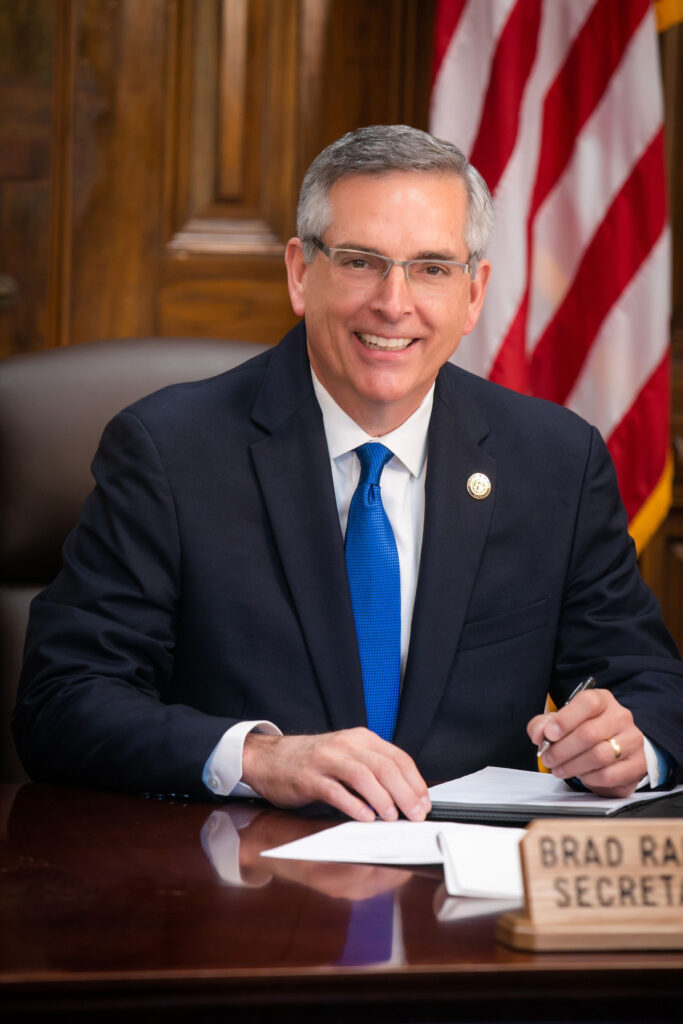
ATLANTA – The first citizenship audit of voter rolls in Georgia history has turned up 1,634 people who tried to register to vote but could not be verified as U.S. citizens.
The noncitizens identified in the audit conducted by the secretary of state’s office were placed into “pending citizenship” status and not allowed to vote.
“Ensuring that only citizens are voting in Georgia’s elections is key to upholding the integrity of the vote in Georgia,” Secretary of State Brad Raffensperger said Monday. “As liberal states and cities around the country are changing their laws to allow noncitizen voting, I will continue to take steps to ensure Georgia’s elections are executed with integrity. Leading the state’s first citizenship audit of the voter rolls is an important part of that effort.”
Fifteen U.S. cities – including New York City and San Francisco – allow noncitizens to vote in local elections. Most of those cities are in Maryland.
The audit consisted of gathering data from the state Department of Driver Services and the U.S. Citizenship and Immigration Services through the federal agency’s Systematic Alien Verification for Entitlements (SAVE) program.
In all, 2,258 voter registration applications are currently in “pending citizenship” status. The difference between the two numbers is because the secretary of state’s office was unable to obtain the required information on 624 noncitizens who were flagged by the DDS. Those 624 remain in “pending citizenship” status.
None of these individuals have cast ballots in Georgia elections.
This story is available through a news partnership with Capitol Beat News Service, a project of the Georgia Press Educational Foundation.
ATLANTA – Georgia school officials will not be allowed to require a student to wear a mask if his or her parents object under legislation that gained final passage in the state House of Representatives Friday.
The bill, which cleared the Republican-controlled chamber 93-52 along party lines, was introduced on behalf of Gov. Brian Kemp, who has fought against mask mandates imposed by local governments and school systems since the coronavirus pandemic struck Georgia two years ago.
“Parents are the best decision-makers when it comes to the health and education of their children,” said Rep. Lauren McDonald, R-Cumming, one of Kemp’s floor leaders in the House and the bill’s chief sponsor. “We need to begin to return to normal. This is the first step toward doing so.”
But House Democrats argued the COVID-19 pandemic is not over, and now is not the time to loosen restrictions on mask wearing.
“The virus is here. It’s deadly,” said Rep. Roger Bruce, D-Atlanta. “People are still getting sick and having to go to the hospital.”
The “Unmask Georgia Students Act” passed the state Senate 32-19 on March 1, also along party lines. It now heads to Kemp’s desk for his signature.
This story is available through a news partnership with Capitol Beat News Service, a project of the Georgia Press Educational Foundation.
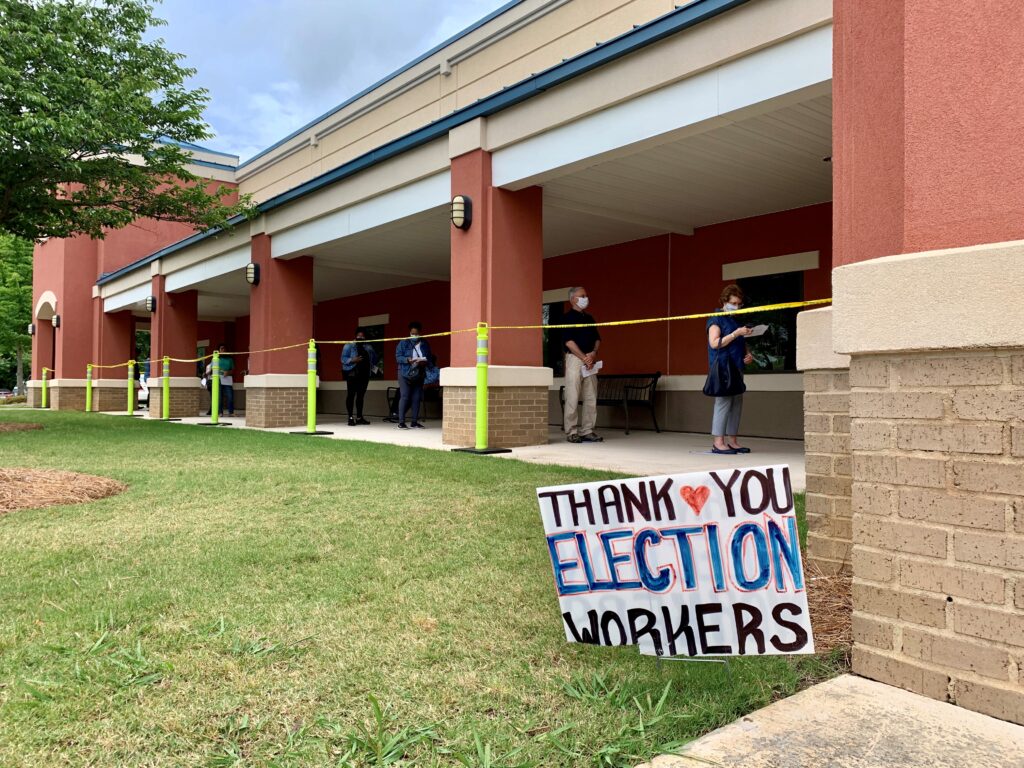
Voters wait in line at a precinct in Cobb County (Photo by Beau Evans)
ATLANTA – Last year, Republicans pushing an election reform bill through the General Assembly argued they were restoring public trust in elections following allegations of voter fraud in Georgia in 2020.
Democrats charged the 2021 legislation amounted to voter suppression by Republicans determined to reverse Democratic gains, particularly the capture of the Peach State’s two U.S. Senate seats.
Now, the two sides are fighting the same battle over a follow-up bill the Republican-controlled Georgia House of Representatives passed along party lines earlier this month and sent to the state Senate.
“It’s ‘deja vu all over again,’ ” said Aunna Dennis, executive director of Common Cause Georgia, one of the fair-elections advocacy groups working with Democrats to oppose the measure.
House Bill 1464 has some provisions Common Cause Georgia and others have praised, including a provision requiring employers to give their workers time off to cast their ballots during the early voting period prior to elections. Current law limits the time-off mandate to voting on Election Day.
But legislative Democrats can’t get past what they see is the motivation behind the bill: allegations of widespread voter fraud lodged by then-President Donald Trump following the 2020 election and his attempts to overturn the results in Georgia and elsewhere.
“We’re continuing to enact laws based on the lies that led to the violent insurrection at the U.S. Capitol,” state Rep. David Dreyer, D-Atlanta, said March 15 during the House debate on the legislation.
Republicans have defended the bill as an effort to restore trust in elections by increasing security surrounding the voting process, including tightening up requirements for sealing and transferring custody of ballots.
“In our society, the election process should be the most secure thing we have,” said Sen. Jeff Mullis, R-Chickamauga.
But Democrats say that added security would come at the expense of a centralization of the elections process to the detriment of local elections offices.
“This bill will devastate local election administration,” said Rep. Miriam Paris, D-Macon. “The State Election Board will have the centralized power to decide what all 159 counties in Georgia need.”
The bill’s most contentious provision would give the Georgia Bureau of Investigation (GBI) “original jurisdiction” to investigate election complaints, meaning the agency wouldn’t have to wait to be called into a case by the State Election Board or the attorney general’s office.
“If they get tipped off that something’s going on, they could step right in,” Rep. Stan Gunter, R-Blairsville, chairman of the House Special Committee on Election Integrity, told members of the Senate Ethics Committee March 23.
Democrats argued involving the GBI likely would lead to a flurry of arrests, even in cases where the alleged offender is doing something he or she isn’t aware is a crime, such as collecting absentee ballots from friends or relatives to take to a drop box.
“When you consult a surgeon, you’re probably going to get surgery,” said Sen. Sally Harrell, D-Atlanta. “If you consult the GBI, you’re probably going to get a crime.”
“The GBI conducting voter fraud investigations will be used to intimidate Georgia voters and election workers,” added Rep. Derek Mallow, D-Savannah. “This is another attack on the right to vote.”
But Republicans said voters have nothing to fear from the GBI, which has been investigating election complaints for years when their help is requested.
“This would not be SWAT teams parachuting onto the grounds of the courthouse,” Gunter said. “They’re not going to be standing over voters. … I’m sure they will exercise discretion.”
“If you break the law, there will be due process before you could get arrested,” added Rep. James Burchett, R-Waycross, the bill’s chief sponsor.
The Senate Ethics Committee will hold a second hearing on the bill on Monday and likely vote on it later in the week.
This story is available through a news partnership with Capitol Beat News Service, a project of the Georgia Press Educational Foundation.