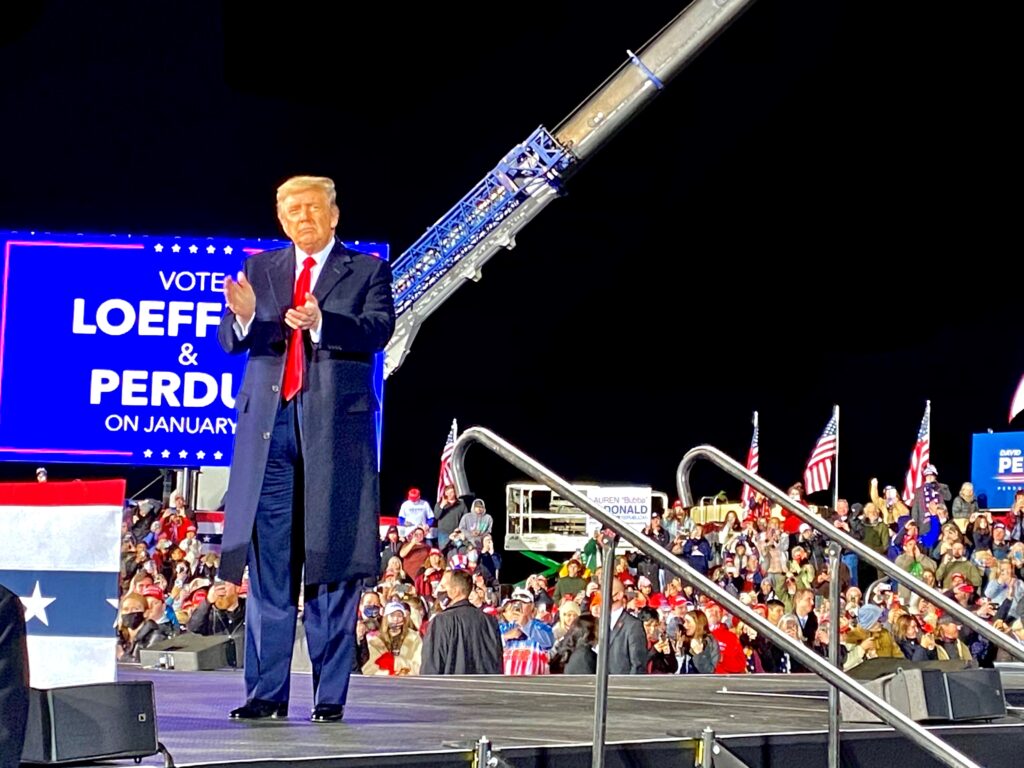
President Donald Trump rallied for then-Republican U.S. Sens. David Perdue and Kelly Loeffler ahead of the Senate runoff elections in Dalton, Georgia, on Jan. 4, 2021. (Photo by Beau Evans)
ATLANTA – Donald Trump’s endorsement doesn’t seem to mean much in Georgia’s Republican primary race for governor.
But the former president’s blessing apparently makes a big difference further down the GOP primary ballot.
Those are the findings of an unusual poll conducted March 20 through April 8 by the University of Georgia’s School of Public and International Affairs Survey Research Center.
Some of the 736 likely Republican primary voters interviewed by phone simply were asked which candidate they preferred for various races, while others were informed which candidate in each contest have been endorsed by Trump.
In the gubernatorial race, GOP Gov. Brian Kemp led former U.S. Sen. David Perdue 47.9% to 37.2% among voters who weren’t told that Trump had endorsed Perdue. When given that information, voters still preferred Kemp but by the slightly narrower margin of 46.2% to 39.2%.
Trump’s support made a much larger difference in the U.S. Senate Republican primary. Trump endorsee Herschel Walker held a huge lead in both polls, but he drew the support of 76% of voters who were told he had Trump’s backing. Walker’s support among voters who weren’t told of the endorsement fell to 64.3%, still well ahead of several opponents.
It was in the down-ballot races where Trump’s endorsement made the most difference. State Sen. Burt Jones, R-Jackson, who is running for lieutenant governor with Trump’s endorsement against Senate President Pro Tempore Butch Miller, R-Gainesville, saw his support in the poll soar from 29.7% to 58.9% among voters told Trump was backing his candidacy. Miller’s support dropped slightly from 10.6% to 8.2% when voters were told he was not Trump’s pick.
The large contingent of undecided voters in the lieutenant governor’s race – 54.2% – fell significantly to 29.8% among voters who were told Trump was backing Jones.
Incumbent Lt. Gov. Geoff Duncan, who refused to go along with Trump’s attempts to overturn the presidential election results in Georgia in 2020, decided not to seek reelection.
U.S. Rep. Jody Hice, R-Greensboro, who Trump is backing for secretary of state against incumbent Brad Raffensperger, doubled his support in the poll – from 30.3% to 60.3% – when voters were told of the former president’s endorsement.
Conversely, support for Raffensperger dropped from 22.7% among voters who weren’t told of the endorsement, to 16.3%. It was Raffensperger who stood up to Trump when the then-president called in January of last year asking him to “find” the 11,780 votes Trump would need to overturn Democrat Joe Biden’s victory in Georgia.
Trump’s endorsement even carried weight in a race that doesn’t directly involve anyone who has riled the former president. Little-known Patrick Witt, who is challenging incumbent Insurance Commissioner John King, saw his support skyrocket from just 8.3% when voters weren’t told Trump had endorsed Witt, to 51.8% among voters who were made aware of the endorsement.
King’s support slipped by a much smaller margin, from 10.6% to 7.2%. A third candidate in the race, Ben Cowart, also dropped from 9.6% to 4.5% when voters were told Trump had endorsed Witt.
UGA political science professor M.V. Hood III wrote in an analysis of the poll that Trump’s endorsement made less difference at the top of the ballot because most voters had made up their minds in the high-profile gubernatorial primary. While Trump’s endorsement of Walker moved more voters to support him, it made little difference because the UGA football icon already had a huge lead in the Senate race, Hood wrote.
However, the huge swing of support toward Trump-endorsed candidates further down the ballot could have an impact, Hood wrote.
“In the absence of other information, many may rely on Trump’s endorsement in determining their votes in these races,” he wrote. “Of course, it should be noted that they will need to seek out this information ahead of time as Trump’s endorsement will not appear on the Republican primary ballot.”
The poll’s overall margin of error was plus-or-minus 3.6%.
This story is available through a news partnership with Capitol Beat News Service, a project of the Georgia Press Educational Foundation.
ATLANTA – Georgia’s unemployment rate fell to an all-time low of 3.1% last month, creating a tight labor market that drove up wages.
The jobless rate in Georgia was five-tenths of a percent lower than the national average for March of 3.6%.
“We are now seeing the highest number of Georgians ever employed and participating in the workforce,” state Commissioner of Labor Mark Butler said Thursday. “And with a record number of jobs being created, we have a situation where this will continue to be the case for the immediate future.”
The average wage difference from February 2020 to February 2022 was more than 9%. Some of the industries hardest hit during the pandemic showed wage increases of more than 10%, led by the leisure and hospitality sector, where wages have risen 20.4% in two years.
“Many of the sectors that weathered significant hardships during the pandemic are now having to offer higher wages and better benefit packages to get employees into open positions enabling them to do business,” Butler said. “The cost of labor is being recouped by rising costs for consumers, which is one of the major drivers causing our current increase in inflation.”
The state set records in March with nearly 5.1 million employed Georgians and more than 4.7 million jobs. The sectors with the most over-the-month job gains included professional, scientific, and technical services with a gain of 4,500 jobs; and administrative and support services, which gained 2,000.
First-time unemployment claims were down 14% last month compared to February, while over-the-year claims dropped 87%.
More than 212,000 jobs are listed online at EmployGeorgia.com, resulting in a minimum of more than 310,000 unfilled positions. Industries with more than 10,000 job postings included health care with 33,000 job openings posted, manufacturing with 20,000, and retail trade with 19,000.
This story is available through a news partnership with Capitol Beat News Service, a project of the Georgia Press Educational Foundation.
ATLANTA – Georgia tax collections soared 45.5% last month compared to March of last year, an anomaly the state Department of Revenue attributed to different tax filing deadlines this year compared to fiscal 2021 and fiscal 2020.
The state brought in $2.76 billion in tax revenue in March, up $862.9 million over March of 2021.
Individual income tax collections rose 70.6%, driven in part by a 54.7% decline in refunds issued by the revenue agency. Net sales tax receipts also were up by a more modest 19.4%.
Corporate income tax collections increased 53.1%, as refunds plummeted 67.2%.
Motor fuels taxes rose by $12.6 million last month over March of last year, an 8.8% increase, despite the temporary suspension of the tax to curb rising prices at the pump.
State tax receipts for the first nine months of fiscal 2022 were up 18.9% over the same period last year.
This story is available through a news partnership with Capitol Beat News Service, a project of the Georgia Press Educational Foundation.
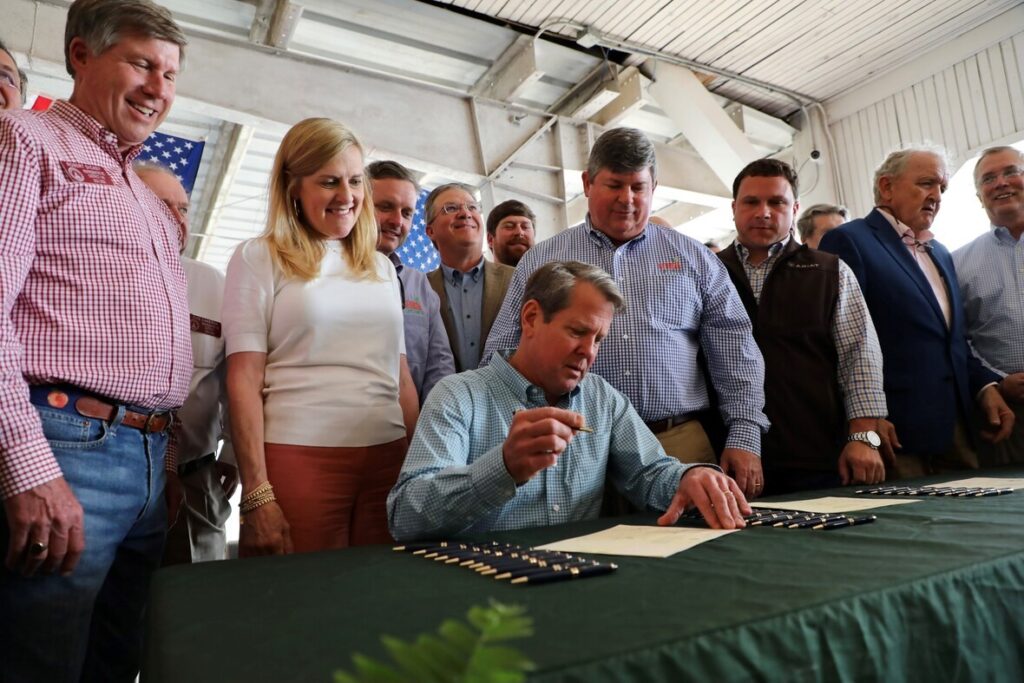
Gov. Brian Kemp signs the Freedom to Farm Act Wednesday in Musella.
ATLANTA – Gov. Brian Kemp traveled to the South Georgia Farm Belt Wednesday to sign three agricultural bills, including legislation making it harder to file nuisance lawsuits against farmers.
The General Assembly passed the Freedom to Farm Act earlier this month, mostly along party lines, after minority Democrats argued it offers less protection to farmers than the current state law governing nuisance suits.
The bill gives neighbors bothered by bad smells, dust or noise emanating from a nearby farm two years to file a nuisance suit. Once that statute of limitations expired, any farm operating legally will be protected.
Kemp said protecting farming is more important than ever with war raging in Ukraine, Europe’s breadbasket.
“This legislation increases and clearly defines protection for both farmers and property owners while still addressing bad actors,” the governor said during a ceremony at the farm of House Agriculture Committee Chairman Robert Dickey, R-Musella, the bill’s chief sponsor.
The measure’s opponents said a law passed during the 1980s protects existing farmers indefinitely from nuisances that occur after a new farm begins operating nearby. But under the new law, those existing farms are only protected for two years.
The Freedom to Farm Act was endorsed by the Georgia Farm Bureau, the Georgia Agribusiness Council, the Georgia Poultry Federation and the Georgia Forestry Association.
Kemp also signed legislation expanding Georgia’s elementary agricultural education program and providing Georgia food banks access to grants through the state’s Georgia Grown Farm to Food Bank program.
This story is available through a news partnership with Capitol Beat News Service, a project of the Georgia Press Educational Foundation.
ATLANTA – The head of three state transportation agencies is leaving next month for the private sector.
Chris Tomlinson has served as executive director of the State Road and Tollway Authority, the Georgia Regional Transportation Authority and the Atlanta-Region Transit Link Authority for the last nine years. In all, he has been in state government for the last 24 years.
Tomlinson played a key role in launching a network of toll lanes on metro Atlanta’s interstate highway system, which has helped ease some of the region’s notorious traffic congestion by providing commuters an alternative to clogged general-purpose lanes.
He also has been involved in efforts to share the cost of expensive highway projects with the private sector through public-private partnerships and has been a leading advocate for increasing funding for transit systems.
“Serving as executive director for the state of Georgia’s mobility authorities has been the most challenging and fulfilling experience of my professional career,” Tomlinson said.
“Chris has been a valued member of the team and a key leader in the transportation sector within Georgia and nationally,” Gov. Brian Kemp added. “Not many leaders can say they started a state agency from the ground up while leading two other state agencies.”
The agencies did not announce Tomlinson’s next job destination.
This story isavailable through a news partnership with Capitol Beat News Service, a project of the Georgia Press Educational Foundation.