ATLANTA — Georgia lawmakers started the year with talk of eliminating both the state income tax and the property tax for homeowners.
The goal proved elusive, but they did compromise on a scaled-back income tax cut and on legislation to decelerate the rapid increases in local property tax costs for homeowners.
And on Monday, Gov. Brian Kemp signed those two measures into law.
“We believe it is your money, not the government’s,” Kemp said.
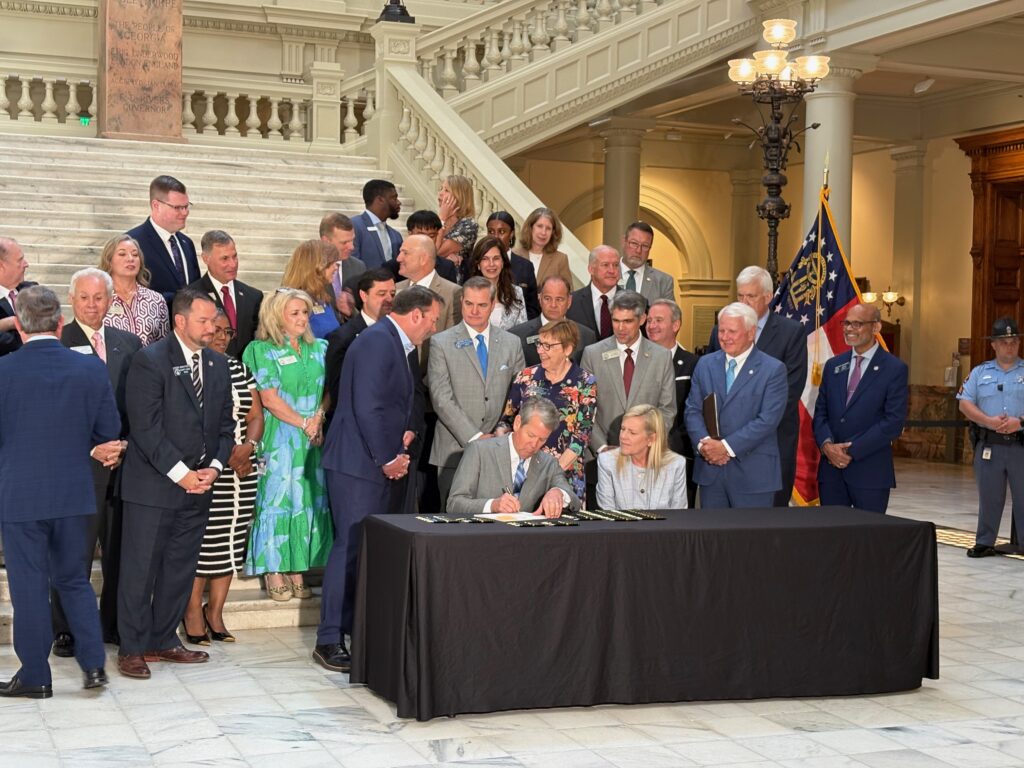
Gov. Brian Kemp selects a pen to sign tax legislation at the Georgia Capitol in Atlanta on Monday, May 11, 2026, with wife Marty by his side. House Speaker Jon Burns, R-Newington, watches to her left, as Lt. Gov. Burt Jones, a Republican candidate for governor, stands to the governor’s right. (Ty Tagami/Capitol Beat)
The Senate had at first voted to eliminate the income tax on the first $50,000 in annual earnings for individuals and the first $100,000 for married couples filing jointly. The goal was to increase the cuts for higher earners over time until the tax was abolished altogether. But the bill Kemp signed into law is more modest.
House Bill 463 will immediately reduce the income tax rate to 4.99% from the current 5.19%, then gradually reduce it by another percentage point over eight years if state revenues remain strong. Income tax deductions would also rise by 50% over that period, from the current $12,000 for single filers, to $18,000 — and double that for married couples. Dependent deductions also would rise by $2,000 over eight years from the current $4,000.
The new law also waives income tax on the first $1,750 of overtime pay and cash tips retroactive to the beginning of the year and increases the amount of excluded retirement income for those 65 and older by $5,000.
The increase in income tax cuts depends on a continual rise in state revenue estimates and collections. The governor’s annual revenue estimate must increase 3% and the prior year collections must have exceeded those in each of the three prior years. Also, the state must have enough in reserves to absorb the cost resulting from the increasing cuts.
Last week, Kemp’s office announced that revenues were continuing to rise, with April net tax collections up 5.9% over April of last year. However, nearly half of the nearly $4 billion came from the income tax. Those collections were up 10.1%.
Lt. Gov. Burt Jones said before Kemp signed the measures that it took months of negotiation between the Senate and House to reach a consensus. But Jones, a Republican candidate for governor, said they accomplished their goal on both income taxes and property taxes.
Senate Bill 33 was also a compromise. The House had hoped to eventually abolish property taxes. Instead, the measure will keep homeowner property taxes in check by restraining the increase in the official value of their homes.
The idea of eliminating the property tax altogether faced resistance from local governments and schools, which are funded in large part through that tax.
The new law will cap valuation increases at the rate of inflation.
“Property tax valuations have skyrocketed in every corner of this state,” said House Speaker Jon Burns, R-Newington. “Mileage rates have remained the same or even increased in some cases, placing a significant financial strain on families, homeowners and retirees living on fixed incomes.”
The amount paid for property taxes depends on two variables: the tax rate — called a millage rate — and property valuation. Cities, counties and schools could simply bump the tax rate part of that formula to bring in more revenue.
That might not be politically popular, but it would keep the lights on.
There is a catch for schools, though: nearly all of Georgia’s 180 school districts are limited to a maximum rate of 20 mills under the state constitution.
Most school systems are already near the maximum tax rate, with the state average at 15 mills.
ATLANTA — People who raise chickens in their backyards won’t have to “candle” their eggs. Restaurants that serve shrimp will have to let diners know if it is from abroad. And forest products manufacturers will get a tax break.
Those are among the effects of 10 bills that Gov. Brian Kemp signed into law this week.
The state’s agricultural industry has been hammered by wildfires, hurricanes and trade wars. Lawmakers reacted by passing numerous bills to help farmers, timber owners and others in the industry.
“Georgia’s farming and foresting families are some of the toughest people in our state who, despite the challenges of the past several years, have persevered and continue to put food on our tables, clothes on our backs, and provide the material for structures like our very homes,” Kemp said in a statement after signing the bills at the Georgia Forestry Association’s headquarters in Forsyth Wednesday.
The association was most pleased with House Bill 134, which makes the state’s existing Jobs and Investment Tax Credits transferable for forestry manufacturers over a five-year period.
That will allow companies more flexibility when they invest their capital, which the association said would in turn lead to more jobs and economic returns for rural areas.
The association also highlighted House Bill 983, which clarifies when prescribed burning is exempt from notice and permit requirements for forest management. Landowners use these burns to clear vegetation that can cause big wildfires like those that have raged in South Georgia.
Senate Bill 306 amends a tax incentive program that allows owners of agricultural land, timberland, or environmentally sensitive property to reduce their property taxes if they pledge to keep their land undeveloped for a decade. The bill confirms that landowners with a Conservation Use Valuation Assessment can enroll in carbon credit programs and earn revenue on the open private market without breaching their covenant.
House Resolution 1008 revises membership rules and interagency agreements for the Regional Water Planning Councils. It ratifies amendments to Georgia’s statewide water management plan in a way that ensures representation from the state’s major water-use sectors, including forestry and agriculture, according to the state forestry association.
“From new investment in forestry manufacturing to critical protections for the landowners and land managers who do the work on the ground, this is a package built around what our industry needs to grow,” Tim Lowrimore, president and CEO of the association, said in a statement.
HR 1008 was a priority for Kemp, as was House Bill 1159, which exempts from state income tax any payments received from the U.S. Department of Agriculture’s Farmer Bridge Assistance Program and Specialty Crop Farmers Program.
Kemp also signed a handful of bills for targeted industries, including those in backyards.
Senate Bill 551 deletes the egg “candling” section of Georgia law, which requires those with backyard flocks to inspect egg yolks in a dark room with a bright light.
Coastal shrimpers will appreciate House Bill 117, which requires restaurants that serve shrimp from foreign countries to notify diners with notices on menus or signs.
House Bill 1310 settles a question that has apparently lingered for hundreds of years: it designates that cotton is, indeed, the official state fabric.
ATLANTA — Four Democrats in Georgia’s congressional delegation sent a letter to the U.S. Department of Justice Friday protesting the agency’s demand for personal information about Fulton County workers and volunteers involved with the 2020 election when President Donald Trump was defeated by Joe Biden.
“Fulton County election workers have already endured years of threats and harassment from false claims about the 2020 election,” said the letter to Todd Blanche, the acting U.S. attorney general. “The Department’s subpoena risks compounding that harm by demanding the residential addresses and personal contact information of thousands of people who served in election administration.”
The New York Times reported Monday that the Justice Department had demanded the identities of every worker who staffed that election, noting that Fulton County Commission Chairman Robb Pitts had described the subpoena as “harassment” and an attempt to “punish” Trump’s perceived political opponents.
The Fulton County Board of Registration and Elections filed a motion Monday to block the subpoena, which, according to Fox 5 Atlanta, sought personal data of nearly 3,000 people.
Separately on Wednesday, Fulton County lost a demand for the return of 600 boxes of election records the FBI seized in January. U.S. District Judge J.P. Boulee for the Northern District of Georgia ruled that flaws in the Justice Department’s search warrants and the execution of the search did not merit the return of the documents. The decision enabled investigators to continue their probe of an election that Trump has continued to protest, according to Politico.
The Democrats’ letter Friday, signed by Sens. Raphael Warnock and Jon Ossoff, and Reps. Nikema Williams and Lucy McBath, said the subpoena for election workers’ personal information was “untethered to any reasonable need.”
The letter, released by Warnock’s office, asks Blanche to answer 13 questions, from why the personal information request was so broad, to why a North Carolina prosecutor was involved in investigating Georgia’s election. The subpoena was issued by a federal grand jury for the U.S. attorneys office in the Middle District of North Carolina.
ATLANTA — A shadowy group that claims to have hacked a popular educational platform is reportedly trying to extort money from colleges and schools across the country, including in Georgia.
The group, which calls itself “ShinyHunters,” claims to have hacked the Canvas platform, a popular digital hub for submitting assignments, taking quizzes, checking grades and communicating with instructors.
The product was developed by Instructure, a global education technology company with a U.S. headquarters in Salt Lake City.
Instructure told users Thursday that it was investigating problems they were experiencing when they tried to log into their online portfolios. The company also said it had placed its platform in “maintenance mode,” although a recent update said the platform was available for “most” users.
The outage affected students at all levels, including at the Georgia Institute of Technology, where students were alerted by email Thursday of a “major cybersecurity breach” affecting Instructure.
The student newspapers at universities across the country reported on the hack.
The Daily Pennsylvanian at the University of Pennsylvania reported Thursday that ShinyHunters had claimed to have stolen emails and private messages, student names and ID numbers, and course enrollments. At Duke University, The Chronicle reported Thursday that the group was threatening to release the data if it wasn’t paid a ransom.
By Friday, Georgia Tech was telling students that Canvas access had been partially restored and that students should communicate directly with instructors about affected assignments and exams.
Thursday was the last day of classes at Tech, but some or many K-12 school systems use Canvas and are weeks away from summer break.
“We understand that there is a worldwide Canvas/Instructure outage impacting over 9,000 institutions,” a spokeswoman for the Georgia Department of Education said by email Friday. She said Instructure had not provided information yet about the full scope of the incident.
The state agency oversees, but does not directly operate, Georgia’s 180 school districts. However, it does directly operate a handful of specialty schools, including Georgia Virtual School.
“Out of an abundance of caution, GaDOE has implemented security protocols and directed Georgia Virtual School students and staff not to use the platform until further notice,” the spokeswoman wrote. “We continue to coordinate with the Georgia Technology Authority and the Georgia Emergency Management and Homeland Security Agency on this matter.”
The education agency encouraged school districts that contract with Instructure to monitor the company’s user information page. The spokeswoman said the education department would offer support as the situation evolves.
It is unclear how many school systems rely on Canvas as their main learning management system. The Fulton County School System in metro Atlanta does and announced Thursday that Canvas “is completely down and inoperable for students, parents, and teachers.”
Fulton said on a web page about the outage that Instructure said student passwords, Social Security Numbers, and financial information were not involved but that names, email addresses, school assignments, and internal Canvas messages might have been.
The district said it was collaborating with law enforcement and was trying to identify workarounds for the remainder of the school year.
The disruption could make it difficult to report grade point averages for college scholarships, even for schools that do not use Canvas.
That is because many districts have students who turn to the Georgia Virtual School for Advanced Placement classes that are unavailable locally. Without Canvas, the systems cannot access their official grades.
“They’re going to have trouble calculating salutatorians and valedictorians unless they find another way around that,” said John Zauner, executive director of the Georgia School Superintendents Association. “They’ve got two weeks to get it resolved.”
ATLANTA — When Georgia voters complete their ballots this year, one of the people they select will be the next person in charge of overseeing elections.
The Georgia Secretary of State handles business registration, professional licensing and regulation of charities and securities, all essential to the economy.
But that elected official also serves a role that is vital to the operation of democracy: voter registration, ballot preparation and certification of election results.
The upheaval that followed President Donald Trump’s assertion that he won the 2020 election is the main wedge between candidates running for secretary of state this year.
All but one Republican said at a debate last week that the 2020 outcome was still in question and that the electronic voting system in use in Georgia then and now is deeply flawed.
“I think 2020 is still in question to be frank with you,” said Kelvin King, whose wife, Janelle King, is a Republican appointee to the State Election Board. “The things that I’ve learned studying our elections have been just startling. The bottom line is this: we haven’t had a clean election over the last several elections.”
Ted Metz, who described himself as an inventor, said “it is clear to anyone that has a brain” that the voting system is plagued by “irregularities” in vote counting and in administrative and procedural functions. “There are so many botched things,” he said.
Former DeKalb County CEO Vernon Jones, who was a Democrat but switched to the Republican Party, said defenders of the current system say there was no “widespread” fraud. “Well, people want to know how wide was the wide,” he said.
Only Gabe Sterling, a former chief operating officer for Secretary of State Brad Raffensperger, said voters trust the outcomes produced by the current system. He pointed to record turnout for early voting for the May 19 primary, which had started by the time of the April 28 debate. “We have the best and safest elections in America,” he said.
The tone among Democrats, who debated later that afternoon, indicated faith in election integrity and wariness of naysayers.
Penny Brown Reynolds, a former Fulton County State Court judge, lashed out at Republican state lawmakers for stripping Raffensperger, also a Republican, of his voting powers on the State Election Board. Lawmakers did that after Raffensperger clashed with Trump over the outcome of the 2020 election.
Courts found no fraud, and Gov. Brian Kemp, also a Republican, backed the outcome, she noted, yet Raffensperger was still sidelined by “the MAGA, Donald Trump and others,” she said. “They want to do everything they can to try to control our elections.”
Dana Barrett, a Fulton County commissioner, pointed to the FBI seizure of Fulton ballots from 2020, saying the January raid “was aimed at setting us up for a state takeover of our elections, which is extremely dangerous.” She said the Republican-majority state election board “is completely MAGA-controlled and they pose the biggest threat to our votes in the state of Georgia. If the state elections board tries to take over the elections in Fulton County, the largest county with the largest concentration of Democrats, we will be in bad shape,” she said.
Adrian Consonery Jr. said Georgia could increase confidence by explaining to the public how its system of voting works “in the form of a Schoolhouse Rock video or something of that nature,” adding, “We definitely need a way to educate our Georgians on how the process works to avoid any McCarthyism in the future.”
It was a reference to U.S. Sen. Joseph McCarthy, the Wisconsin senator who led a campaign in the 1950s against Americans he accused of being communists or communist sympathizers.
Cam Ashling, a financial planner, suggested making election day a state holiday to increase voter turnout.
The Republican candidates, except for Sterling, advocated for a swift shift to hand-marked paper ballots.
That appears unlikely after the election board on Friday rejected a petition to require regular use of the backup voting system. The backup system uses pre-printed and hand-marked paper ballots that are fed into a scanner for tabulation. It is intended for power outages and other emergencies, and local election officials have been testifying at hearings for months that they do not have time to implement the system at scale.
The Georgia General Assembly banned the use of machine code to tabulate results effective July 1. Georgia’s current system uses touchscreens in kiosks that print voter choices on paper, along with a “Quick Response,” or QR code, used to tabulate votes.
Despite passing the ban in 2024, state lawmakers have neither authorized nor paid for a new system. They blame Raffensperger, and he blames them.
State Rep. Tim Fleming, R-Covington, a Republican candidate for secretary of state, led a legislative study committee of the voting system last year. The committee recommended hand-counting ballots with QR codes this November before buying a new voting system in fiscal year 2027. Fleming did not appear for the GOP debate.