ATLANTA – The Georgia House of Representatives overwhelmingly passed a $32.6 billion mid-year budget Thursday that includes a $1 billion property tax rebate worth $500 to the average homeowner.
The mid-year budget, which covers state spending through June 30, sailed through the House 170-1 and now moves to the Georgia Senate. With the state sitting atop a $6.6 billion revenue surplus, the mid-year budget would increase spending by 7.8% over the fiscal 2023 budget the General Assembly adopted last spring.
“This budget and $2 million in new revenue go a long way toward meeting the needs of Georgians,” House Appropriations Committee Chairman Matt Hatchett, R-Dublin, told his legislative colleagues shortly before Thursday’s vote.
House budget writers found other uses for the surplus besides property tax relief. The mid-year budget also includes $1.1 billion to fill the revenue gap caused by the temporary suspension of the state’s gasoline tax Gov. Brian Kemp ordered last March, which wasn’t lifted until last month.
House lawmakers also approved Kemp’s request to fully fund Georgia’s Quality Basic Education k-12 student formula (QBE), at $12.4 billion the largest single expenditure in the budget. After years of falling short of the mark, the state has been able to afford full funding of the QBE for the last several years.
The mid-year budget also includes $128.2 million to account for student enrollment growth in Georgia public schools since last year.
The spending plan provides $73.1 million to the Technical College System of Georgia’s Quick Start program to build training facilities in Bryan and Newton counties to train workers for two electric-vehicle manufacturing plants being built near Covington and Savannah.
The state Department of Human Services would receive $137.4 million for the additional staffing that will be necessary to accomplish “the great unwinding” of Medicaid in April, when the federal government will relax pandemic-era regulations that prevented states from disenrolling people from Medicaid. Georgia will need to re-examine the eligibility of more than 2 million current Medicaid enrollees.
The House also added $23 million to the governor’s funding request for school security grants, enough to raise the grants from $50,000 for every school in the state to $60,000.
The mid-year budget also would provide $2.4 million to improve security at the state’s 48 domestic violence shelters.
A couple of House lawmakers questioned how the $1 billion property tax rebate would affect the coffers of local governments, which rely heavily on property taxes.
Hatchett said the tax relief would be funded out of state surplus revenue.
“The state is funding that discount,” he said. “There is no effect on cities and counties.”
This story is available through a news partnership with Capitol Beat News Service, a project of the Georgia Press Educational Foundation.
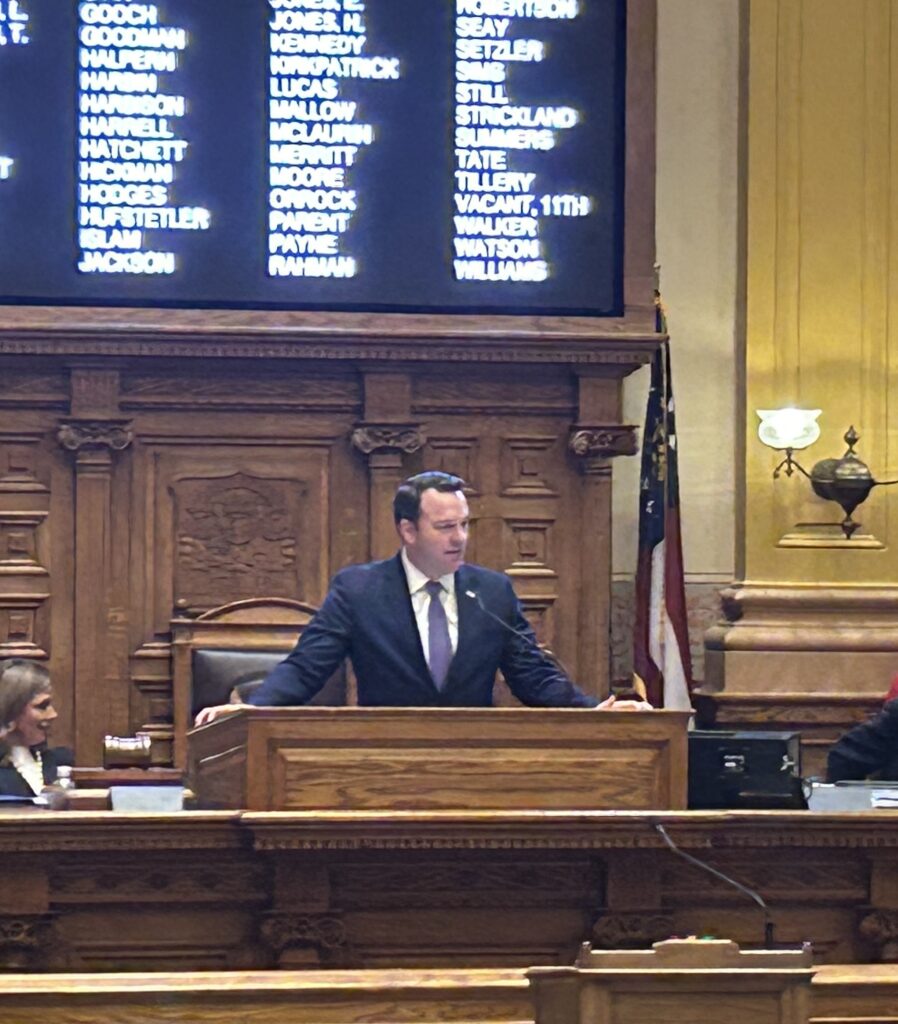
Newly elected Lt. Gov. Burt Jones in front of the Georgia Senate in January. (Photo credit: Rebecca Grapevine)
ATLANTA – Newly elected Lt. Gov. Burt Jones says he is “laser focused” on the well-being of Georgians.
The Jackson Republican and businessman ran for lieutenant governor after a decade as a state senator because he wanted a new challenge and thought he could help ordinary Georgians, Jones told Capitol Beat this week.
“I have always been of the mindset that you shouldn’t stay put for too long,” he said. “You either move up or move on.
“I saw an opportunity to lower our state income tax to put more money back into the pockets of hardworking Georgians, empower parents and teachers, and to make our communities safer.”
Jones beat out then-Senate President Pro Tempore Butch Miller in last May’s Republican primary and went on to defeat Democrat Charlie Bailey by 5 percentage points as part of the GOP’s November sweep of statewide constitutional offices.
Jones’ campaign was helped along by loans from his personal fortune. His father founded Jones Petroleum Company, a wholesale fuel distributor that also owns retail and fast-food outlets.
Besides being a businessman and lawyer, Jones’ father, William “Bill” Jones, served in the Georgia House of Representatives for four terms beginning in 1976 – as a Democrat.
The younger Jones, who was born in 1979, attended the University of Georgia, where he majored in history and served as captain of the 2002 SEC championship-winning football team after initially joining as a walk-on.
Jones went on to found J.P. Capital & Insurance, an insurance agency in Jackson, and won his first run for the Senate in 2012.
Now that Jones is firmly ensconced as head of Georgia’s upper chamber, he is concentrating on workaday issues such as public safety and growing the state’s workforce.
He called addressing gang violence in Georgia “a top priority for my office.” This week, he announced his strong support for a bill that would institute mandatory minimum sentences for those convicted of gang recruitment.
Jones also wants to fix Georgia’s workforce challenges. He is backing a Senate bill that would make it easier for state agencies to hire people who do not hold college degrees.
“I want to increase Georgia’s workforce by taking a holistic approach to increase the number of Georgians all types of business can hire, immediately and long term,” he said.
Jones wants to make Georgia “the most affordable place to adopt a child.” And he supported the creation of the new Senate Committee on Children and Families, which has already held an in-depth hearing on problems in the foster-care system.
Two issues likely to draw heated debate this session are abortion rights and whether the state can pre-empt local control of housing regulations.
When it comes to abortion, Jones said he stands by the abortion regulations outlined in the “heartbeat law.” Passed in 2019, the law prohibits abortions in most cases after about six weeks of pregnancy, although it allows exceptions for rape, incest and to protect the life of the mother. The law is currently in effect in Georgia but faces a legal challenge, with the state Supreme Court expected to hear arguments on the matter next month.
“We’re going to have a wait-and-see mode on that front as [the law] moves through the court system,” Jones said.
Local governments’ control over housing regulations is also likely to draw controversy this session as lawmakers consider how to increase the supply of affordable housing around the state.
“I am not against local control,” Jones told Capitol Beat. “Like any other issue, I think it deserves to be heard and go through the legislative process. I look forward to seeing how this shapes up.”
One of the lieutenant governor’s main responsibilities is managing the day-to-day workings of the Senate. Jones said he is committed to allowing debate in the Senate chamber.
“I believe in allowing … robust and open debate,” Jones said. “I’m not going to shut down the conversation if a senator brings an issue forward because they have legitimate issues that may address the needs of their district or constituency.”
Jones’ past support for former President Donald Trump drew criticism during his election campaign.
Jones was the sole Trump-endorsed statewide candidate to win both primary and general elections last year. The endorsement came after years of support for Trump, which culminated in Jones’ participation in efforts to form an alternate slate of Georgia electors in an attempt to reverse the former president’s loss in the November 2020 election.
Now that he has taken office, Jones is distancing himself from the maelstrom of national political controversy.
“Right now, I’m solely focused on being a really good lieutenant governor for the people of Georgia,” Jones said. “I am laser focused on the future and doing all that I can to ensure our state continues to move in the right direction.”
This story is available through a news partnership with Capitol Beat News Service, a project of the Georgia Press Educational Foundation.
ATLANTA – The state Senate Wednesday passed a bill that would allow the Georgia Bureau Investigation (GBI) to independently investigate a wide range of terrorism cases.
The first bill to make it to the Senate floor this session – the “Georgia Fights Terrorism Act”— passed handily, with 49 senators voting for the bill and only three voting against it.
The bill would allow the GBI to open investigations of terrorism independently instead of solely at the request of government agencies or officials, as is typically the case now.
“This bill simply allows the Georgia Bureau of Investigation the ability to proactively, either independently or with our other agencies, both local and federal, go after and investigate crimes related to terrorism, nuclear, biological, chemical, cyber and domestic,” said Sen. John Albers, R-Roswell, the bill’s chief sponsor.
Under the bill, the GBI could open such investigations if the agency’s director finds that doing so “would not compromise the successful completion of cases.”
The GBI provides a number of services to the state, including forensic analysis, autopsies, investigations of serious crimes and tracking of crime statistics.
Though the bill breezed through the Senate, some advocates say the bill is unnecessary.
“Our main concern …. is that a lot of the conversations around protesting, around some of the complaints and issues that communities have … are starting to slowly be called things like domestic terrorism,” said Isabel Otero, Georgia policy director for the Southern Poverty Law Center Action Fund.
“We’re seeing this trend of trying to push the law in ways that make it a little bit easier to go after communities when they disagree with what it is that leaders have come up with,” Otero added. “I don’t think there’s been an issue with the GBI being left out of an important investigation … and so this seems like a sort of superfluous additional bill.”
The bill will now be taken up by the state House of Representatives.
This story is available through a news partnership with Capitol Beat News Service, a project of the Georgia Press Educational Foundation.
ATLANTA – Georgia House budget writers approved a $32.6 billion mid-year state budget Wednesday that takes advantage of a $6.6 billion revenue surplus to increase spending 7.8% above the record fiscal 2023 budget lawmakers adopted last spring.
“It is putting the focus on the people of this state and our state employees,” House Appropriations Committee Chairman Matt Hatchett, R-Dublin, said of the mid-year budget, which covers state spending through June. “We’ve got the money right now to do that.”
The mid-year spending plan, which the full House will take up Thursday, supports most of the mid-year budget recommendations Gov. Brian Kemp outlined last month. Big-ticket items in the governor’s plan include $166.7 million in grants to help the state land large economic development projects, $105 million for a new electronic medical records system at the Medical College of Georgia, and $92 million for a state reinsurance plan launching this month that aims to hold down health coverage premiums.
House appropriators also endorsed Kemp’s request for $51.4 million for emergency maintenance and repairs to state prisons and $35.7 million to establish a Rural Workforce Housing Fund.
The House committee also kicked in additional funds beyond the governor’s recommendations in a number of areas.
The panel put an extra $1 million toward completing an expansion of the Savannah Convention Center, an amount to be matched later by the Senate. Kemp also is seeking $8 million in bond funding for the project in his fiscal 2024 budget package.
House appropriators added $23 million to the school security grants the governor is requesting in his mid-year budget plan, for a total of $138.8 million.
The committee also earmarked $5 million for the Georgia Department of Human Services to help find housing for foster children. A lack of space is forcing the “hoteling” of foster kids in hotels or state offices, a problem that was highlighted during a legislative hearing last week.
The House panel also is looking to provide an additional $7.8 million in state aid to airports and $5.7 million for additional aircraft and hangars at the School of Aviation on Middle Georgia State University’s Eastman campus.
This story is available through a news partnership with Capitol Beat News Service, a project of the Georgia Press Educational Foundation.