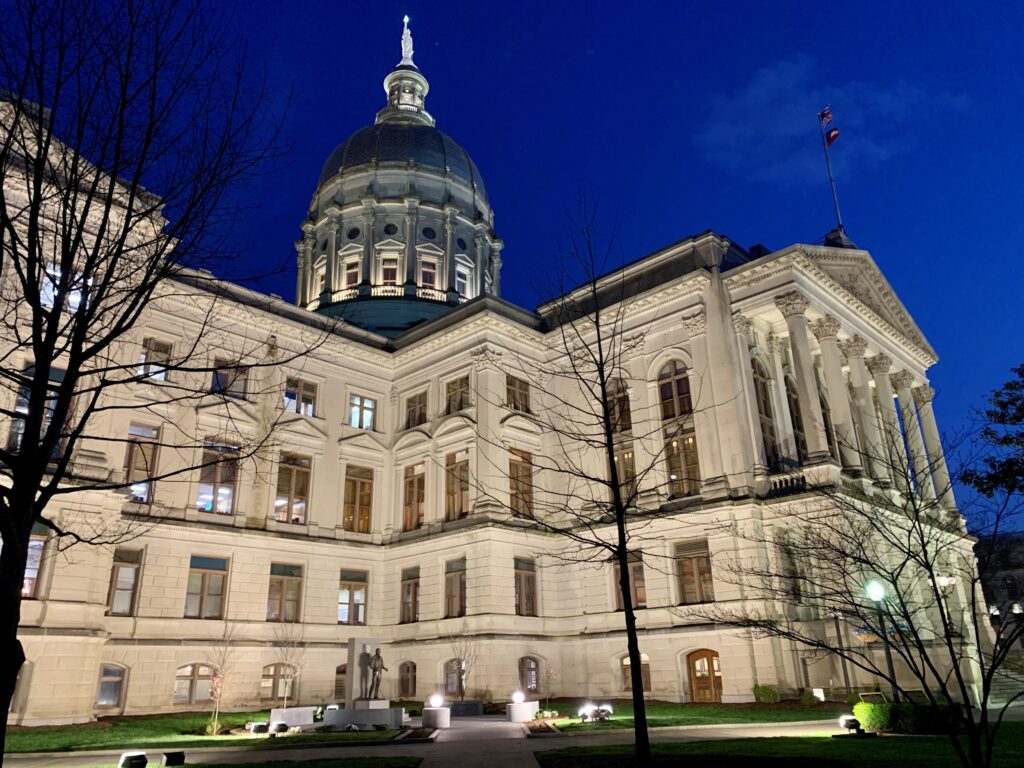
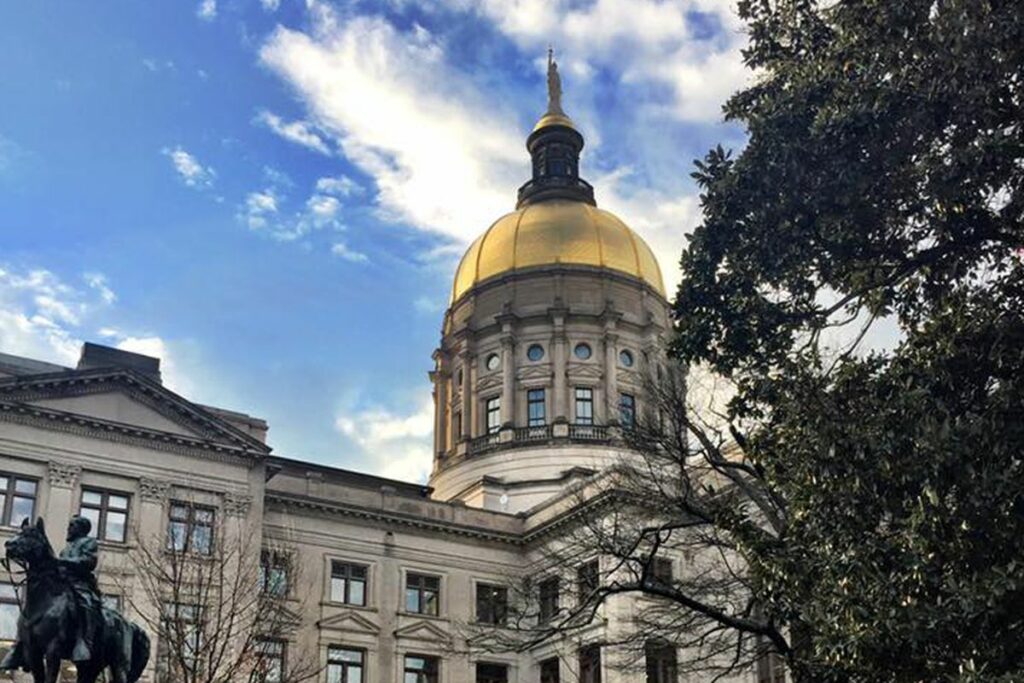
The Georgia Capitol building in Atlanta (Photo by Beau Evans)
ATLANTA – While high-profile races in Georgia remained uncertain on the morning after Election Day, voters have overwhelmingly approved two constitutional amendments and one statute on this year’s statewide ballot.
A constitutional change requiring that state fees and taxes collected for a specific purpose are spent as intended passed with 81.4% of the vote.
A second constitutional amendment prohibiting the state and local governments from using the legal doctrine of “sovereign immunity” to avoid citizen lawsuits won approval from 74.3% of the voters.
Georgia voters also authorized a tax exemption for property owned by charitable organizations for the purpose of building or repairing single-family homes. House Bill 344 was endorsed with 73% of the vote.
The General Assembly put Amendment 1 on the ballot in honor of the late state Rep. Jay Powell, R-Camilla, a longtime leader of the effort to ensure that fees collected for Georgia’s Hazardous Waste and Solid Waste Trust funds are spent cleaning up hazardous waste sites and tire dumps.
Georgia governors and legislatures have a history of redirecting the revenue those dedicated fees collect into the general fund during tight economic times.
The sovereign immunity amendment stems from a 2014 Georgia Supreme Court decision that essentially granted the state blanket immunity from citizen lawsuits in a case brought by the Center for a Sustainable Coast. The group had filed suit alleging the state Department of Natural Resources was illegally allowing alterations to private property in fragile coastal wetland areas protected by state law.
To discourage the filing of frivolous lawsuits, the amendment prohibits plaintiffs from recovering monetary damages or attorney fees.
Supporters pushed House Bill 244 as a way to help grow the stock of affordable housing in Georgia, particularly in small cities and rural communities.
ATLANTA – Georgians heading to the polls next month will decide the fate of two amendments to the state Constitution supporters have been pushing for years.
A third ballot question is being pitched as a way to increase Georgia’s stock of affordable housing.
Here is a description of the three statewide referendum measures in the order they will appear on the Nov. 3 ballot:
Amendment 1
House Resolution 164 requires that state fees and taxes collected for a specific purpose be used as intended in most circumstances.
Supporters point to a history of Georgia governors and lawmakers raiding the state’s Hazardous Waste and Solid Waste Trust funds when money is tight.
Between 2009 and 2019, only $56.4 million of $153.8 million paid into the Hazardous Waste Trust Fund was actually used to clean up waste sites. During the same decade, $72.7 million went into the Solid Waste Trust Fund, but only $22.5 million was spent getting rid of tire dumps and other waste management programs including recycling.
Governors and the General Assembly redirected the rest of that money into the state’s general fund budget for a variety of needs, particularly during years when income and sales tax revenues fell off.
“It really got bad during the Great Recession,” said Mark Woodall, chairman of the Georgia Sierra Club’s legislative committee. “But they’ll grab that money even in a good year.”
Kathleen Bowen, associate legislative director at the Association County Commissioners of Georgia, said of the two state trust funds, the Hazardous Waste Trust Fund has the greater need.
The Georgia Environmental Protection Division has done a good job bringing funds from its budget to bear to clean up tire dumps when money from the Solid Waste Trust Fund wasn’t available, she said.
But there’s not nearly enough money to clean up the 503 hazardous waste sites scattered across Georgia, Bowen said.
“The state has only been able to fund a couple of sites per budget cycle,” she said. “It costs a lot of money.”
The Georgia House of Representatives has passed the amendment to dedicate the two trust funds to their intended purposes repeatedly, a tribute to the work of the late Rep. Jay Powell, R-Camilla, who died last November.
But the state Senate has blocked the proposal just as many times. The late Senate Appropriations Committee Chairman Jack Hill, R-Reidsville, who died last April, was concerned that requiring the trust fund money to stay put would leave the state without budget flexibility during economic downturns.
Sen. Blake Tillery, R-Vidalia, Hill’s successor on the budget-writing committee, said he shares his predecessor’s reservations. But he said he comes down on the side of truth in advertising.
“The citizens of Georgia deserve honesty and transparency in fees,” Tillery said. “It does hamper flexibility, but transparency is worth it.”
Georgia Rep. Andrew Welch, R-McDonough, who picked up sponsorship of the constitutional amendment from Powell, said the measure contains several safeguards to protect the state when money is tight.
Under the proposal, the governor can temporarily suspend the requirement to dedicate all fees to a trust fund in a financial emergency. It also prohibits designating 1% or more of total state revenues during a given year to trust funds, and any fee or tax intended to fund a specific purpose automatically expires after 10 years.
“I worked with Jack on that, trying to address his and other members’ concerns about what you do when you have a contraction of the economy,” Welch said.
“There are adequate safeguards, which we support,” Woodall added. “You do have to keep the government running.”
Amendment 2
Welch also played a major role in Amendment 2 as chief sponsor of House Resolution 1023. It prohibits the state and local governments from using the legal doctrine of “sovereign immunity” to keep citizens from suing them when government officials commit unconstitutional actions.
The amendment stems from a 2014 Georgia Supreme Court decision that virtually gave the state blanket immunity from citizen lawsuits in a case brought by the Center for a Sustainable Coast. The group had filed suit alleging the state Department of Natural Resources was illegally allowing alterations to private property in fragile coastal wetland areas protected by state law.
The court doubled down two years later, citing sovereign immunity in refusing to consider a legal challenge to a University System of Georgia policy requiring students who are illegal immigrants to pay out-of-state tuition rates.
“Historically, citizens were able to sue their government, state or local, in state court to seek an injunction or declaration that their rights were being violated,” Welch said. “With those decisions, the citizens of this state were not able to get into the courthouse.”
Supporters put the measure into the form of a constitutional amendment after two governors vetoed previous bills passed by the General Assembly. Unlike statutes, constitutional amendments bypass the governor and go directly to Georgia voters.
Both Gov. Brian Kemp and Nathan Deal, Kemp’s immediate predecessor, argued that denying the state the defense of sovereign immunity would allow “unprecedented judicial intervention into daily management decisions entrusted to the executive branch of government,” as Deal put it in a 2016 veto message.
Welch said the proposed amendment includes provisions to limit the scope of citizen lawsuits. It prohibits plaintiffs from recovering monetary damages or attorney fees.
“We don’t want people just filing frivolous lawsuits to try to generate attorney fees,” Welch said. “This is about upholding legal rights.”
Referendum A
House Bill 344 authorizes a tax exemption for property owned by charitable organizations for the purpose of building or repairing single-family homes to be sold to individuals through no-interest loans.
If passed, the measure would help grow the stock of affordable housing in Georgia, particularly in small cities and rural communities, said Ryan Willoughby, executive director of Columbus-based Habitat for Humanity of Georgia.
“Every dollar we can save makes a difference in terms of completing a project in a timely manner,” he said.
Willoughby said helping Georgians forced to rent move into their own home is a quality-of-life issue. He cited a 2017 Georgia Tech study that found children who live in owner-occupied homes do better in school.
Offering tax breaks to encourage single-family home construction also pays off in the long run for a local community’s tax base, Willoughby said.
“Our lots are usually vacant in undeveloped areas that don’t tend to have large property tax bases,” he said. “The smaller municipalities will really benefit in a big way.”
BY THE NUMBERS
Most of the fees paid into Georgia’s Hazardous Waste and Solid Waste Trust funds from 2009 through 2019 were redirected to other uses:
Hazardous Waste Fund Solid Waste Fund
Collected $153.8 million $72.7 million
Appropriated $56.4 million $22.5 million
Redirected $97.4 million $50.2 million
Source: Association County Commissioners of Georgia
ATLANTA – Manufacturers that use the cancer-causing chemical ethylene oxide face new restrictions in Georgia under legislation Gov. Brian Kemp has signed into law.
Senate Bill 426 was among a flurry of 40 bills Kemp signed on Wednesday, the legal deadline for the governor to sign or veto measures the General Assembly passed during this year’s session.
Ethylene oxide is used primarily to sterilize medical equipment, a need that has garnered a great deal of attention during the coronavirus pandemic.
The bill, which was introduced by Sen. Brian Strickland, R-McDonough, requires manufacturers that use ethylene oxide to report any waste spills or gas releases to the Georgia Environmental Protection Division (EPD) within 24 hours. The director of the EPD then must post the information on the agency’s website.
The need for tighter regulation of ethylene oxide became apparent last winter after public concerns were raised over unreported releases of the chemical at a Sterigenics plant in Smyrna and a facility in Covington operated by BD Bard.
The bill passed overwhelmingly in both the state Senate and House of Representatives, with strong support from the Cobb and Newton county legislative delegations.
Also on Wednesday, Kemp signed a constitutional amendment calling for a statewide referendum in November on whether to require that dedicated state funds be spent on their intended purpose.
Committing dedicated state money such as Georgia’s Solid Waste and Hazardous Waste trust funds to their intended use was a longstanding priority of the late state Rep. Jay Powell, R-Camilla, who died unexpectedly last November.
Another measure Kemp signed on the final day for bill signing will reserve a permanent slot in annual state budgets for the funding of freight rail improvements.
Opponents had urged the governor to veto the bill, sponsored by Sen. Steve Gooch, R-Dahlonega, because it could be used to put state funding toward privately owned “short-line” freight railroads, not just those owned by the state.
While the legislation authorizes the Georgia Department of Transportation to fund freight rail projects, this year’s tight state budget doesn’t contain any money for that purpose.
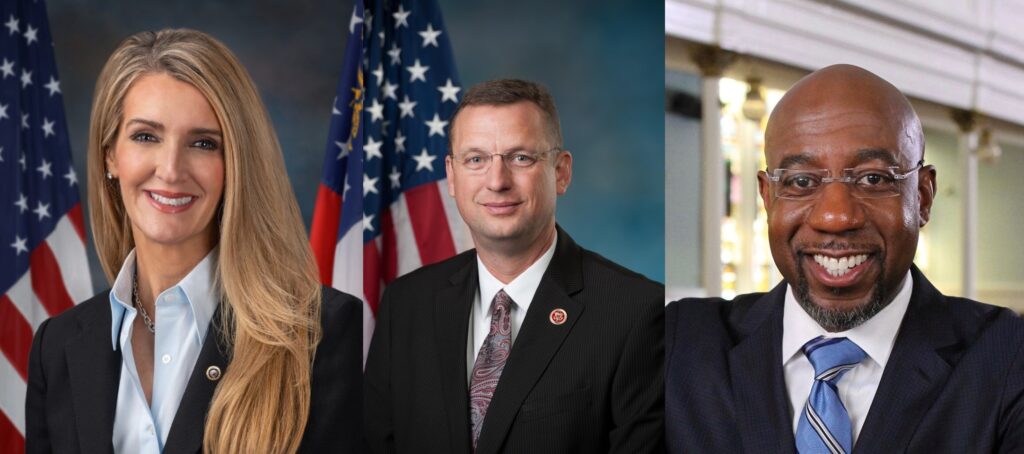
U.S. Sen. Kelly Loeffler (left), U.S. Rep. Doug Collins (center) and Rev. Raphael Warnock (right) are competing in the Nov. 3 special election.
Battle lines are being drawn in the race to fill the remaining two years of retired U.S. Sen. Johnny Isakson’s Senate term with less than 100 days left until Election Day in November.
U.S. Sen. Kelly Loeffler, R-Ga., who was appointed to hold the seat in December, has squared off with Republican challenger U.S. Rep. Doug Collins, R-Ga., over criminal justice issues and their personal backgrounds.
Meanwhile, Democratic candidate Rev. Raphael Warnock has homed in on health care and voting rights issues, both figuring as major policy areas for Democrats across the country.
Above all looms the coronavirus pandemic, which has prompted tough debate on how to keep Georgians safe without wrecking the economy.
Nearly two dozen candidates have thrown their hats in the ring for the Senate special election on Nov. 3, a free-for-all contest in which candidates from all parties will be on the same ballot.
On the Republican side, candidates Loeffler and Collins are hustling to scoop up marquee endorsements from conservative groups and political leaders as they jab each other with campaign attacks.
Loeffler, an Atlanta businesswoman running her first political campaign, has cast herself as an outsider candidate compared to the four-term Congressman Collins – though both have grounded their campaigns in supporting gun ownership, opposing abortion and backing President Donald Trump.
“With significant advantages in resources, infrastructure and grassroots support, our campaign is continuing to build momentum toward a big win,” said Loeffler’s communications director, Stephen Lawson.
Collins, a U.S. Air Force Reserve chaplain who served in the Georgia House before joining Congress, has embraced his legislative experience while lobbing criticism at Loeffler’s use of her wealth in the campaign and fending off attacks on his record as a former criminal defense attorney.
“I’ve stood for the Constitution as a military officer,” Collins said Thursday. “I’ve stood for the Constitution as an attorney representing the values of this community and representing the values of this state.”
Warnock, the senior pastor of Atlanta’s Ebenezer Baptist Church, quickly drew endorsements from a slate of top Democratic state and national lawmakers and party favorites like former Georgia gubernatorial candidate Stacey Abrams.
He has sought to emphasize popular Democratic stances on expanding health-care coverage and voting-rights protections in recent weeks as COVID-19 continues battering Georgia and months of protests over police brutality and racial injustice carry on.
“It’s not about the personalities who are running,” Warnock said recently. “We’re seeing a moment unlike anything we’ve ever seen in our lifetime that whoever you decide to vote for can literally decide who lives and who dies.”
As the race steams ahead, differences have emerged between the candidates on how to best tackle the health and economic burdens of the COVID-19 pandemic.
Among the most pressing issues amid the pandemic is what to do about the $600 weekly federal unemployment benefit millions of out-of-work Americans have received since March, which is set to expire this weekend.
Loeffler and Collins have echoed congressional Republican leaders who oppose keeping the $600 benefit as is, arguing many businesses have struggled to bring employees back to work amid unemployment benefits that may be higher than their regular paychecks.
And both candidates have said they would prioritize sending more federal aid to schools, hospitals and businesses struggling to rebound and purchase protective equipment.
But while Loeffler has not said whether she would support a reduced weekly benefit, Collins has been unequivocal.
“If the unemployment insurance is something that is still there, make it as small as possible and make it end as quickly as possible,” Collins said at a recent campaign stop.
For her part, Loeffler has said she wants to weigh proposals on benefit amounts before taking a position and emphasized the need to bolster state unemployment trust funds.
“That’s the first thing, how do we help states make sure that they can meet the need at that level,” Loeffler said on Monday. “And then I think we’d have to look at what that additional federal level of funding would be needed.”
Warnock has urged extending the $600 benefit going forward and called for helping prop up unemployed workers via expanded health-care coverage, particularly for Medicaid in Georgia.
He has also tied the issue to bids by Republican lawmakers to trim federal spending and shrink taxes, framing those moves as “an effort to renegotiate the social contract to starve the government to death” that he argues has hamstrung the long-term pandemic response.
“This idea that you wouldn’t have resources, a social safety network, to respond in a crisis like this is the logical outcome of that kind of move,” Warnock said recently. “And so I will absolutely stand up as United States senator and argue that working people, middle-class people, deserve their fair shake.”
The race looks to intensify in the coming weeks as the candidates begin pouring campaign funds into television ads and social-media spots.
Loeffler will have the largest bank by far to pay for ads and other marketing, having already loaned her campaign $15 million from her own personal money. Warnock raised around $4.4 million through June, while Collins reeled in roughly $3.8 million.
In mid-July, Loeffler unloaded a campaign ad criticizing Collins’ stint as a defense attorney in Gainesville, noting his firm took on several clients facing gang, drug trafficking and assault charges.
Collins dismissed the ad, stressing his firm was appointed by the courts to defend the indigent clients shown in the ad.
A week later, Collins released his own ad highlighting controversial stock transactions Loeffler made following a closed-door briefing on the coronavirus in January.
Loeffler has said those trades were done by a third-party advisor without her input and noted the U.S. Justice Department did not produce evidence of insider trading before closing an investigation into her transactions.
And Warnock, who has held off so far on in-person campaigning due to the virus, has leaned on social media to air his views on voting rights and health care.
In recent videos, Warnock has pressed both Loeffler and Collins to state their positions on restoring certain election oversight rules to the Voting Rights Act taken away by the U.S. Supreme Court in a 2013 ruling, and on proposals to repeal a key coverage requirement in the Affordable Care Act.
The weeks ahead may also settle whether any of the 17 other candidates in the race drop out to help boost chances for Loeffler, Collins or Warnock to nab more than 50% of votes in the Nov. 3 election.
Among prominent Democratic candidates still in the race are Ed Tarver, a former U.S. attorney and state senator from Augusta, and Matt Lieberman, son of former U.S. senator and 2000 Democratic vice presidential nominee Joe Lieberman.
Lieberman turned heads by polling higher than Warnock by 5 percentage points in a poll released Wednesday by Monmouth University.
If no candidate wins more than 50% of the vote in November, a runoff will be held in January between the top two vote-getters.
ATLANTA – A proposed constitutional amendment calling for a statewide referendum on whether to legalize sports betting in Georgia cleared the state Senate Tuesday.
Senate Resolution 579 passed 41-12, garnering three more votes than the minimum two-thirds majority required to approve constitutional amendments in the General Assembly. Combined with an enabling bill specifying how sports betting would operate that the Senate passed earlier this month, Tuesday’s vote marked the most progress legalized gambling has made in a years-long effort in the legislature.
Under the legislation, sports betting would be overseen by the Georgia Lottery Corporation through a newly created gaming commission.
The enabling bill calls for the awarding of 16 licenses to online sports betting providers. Five would go to Atlanta’s professional sports teams: the Braves, Falcons, Hawks, Dream, and Atlanta United. The Augusta National Golf Club, the Professional Golf Association (PGA), and the Atlanta Motor Speedway would receive one license each.
Seven licenses would be open to sports betting providers through an application process overseen by lottery officials. The lottery corporation also would receive one license.
The vast majority of the tax revenue derived from sports betting – 80% – would go toward education with an emphasis on Georgia’s pre-kindergarten program. Another 15% would fund an education program on the dangers of problem gambling, and the final 5% would be used to promote major sporting events in Georgia.
During years of debate in the General Assembly over legalized gambling, a key issue of contention has been whether a constitutional amendment is necessary or whether it can be done through general law.
Georgia voters deserve the right to decide whether to bring sports betting to the Peach State, Sen. Bill Cowsert, R-Athens, Senate Resolution 579’s chief sponsor, said during Tuesday’s floor debate.
“It’s politically appropriate to let the people vote,” he said.
“I trust the people of Georgia to make the right decision,” added Sen. Carden Summers, R-Cordele, one of the resolution’s cosponsors.
After some senators questioned the proposed sports marketing fund Tuesday, Sen. Brandon Beach, R-Alpharetta, said the state should contribute to a promotional effort that now is largely handled by the private sector.
“We’ve depended on the business community. … (But) you can only go to that well so much,” said Beach, another of the resolution’s cosponsors. “We need those funds if we want to be competitive.”
Sen. Marty Harbin, R-Tyrone, who has consistently opposed legalized gambling, said the projected $125 million sports betting would generate for Georgia’s economy each year is minuscule compared to the $16 billion budget surplus the state has built up during the last three years.
“We have the money,” Harbin said. “We don’t need this.”
Both the enabling bill and the constitutional amendment are now in the Georgia House of Representatives’ court. Since the Senate has been leading the legalized gambling push in recent years, the fate of sports betting remains uncertain as the General Assembly heads into the final weeks of the 2024 session.