ATLANTA – When the dust settled from this year’s General Assembly session, environmental advocates were looking at some success but mostly disappointments.
Lawmakers finally voted to protect state trust funds for environmental cleanup activities after years of failed efforts.
But two bills that passed the General Assembly would prohibit local governments from regulating poultry plant processing wastes or adopting building codes based on the source of energy to be used.
The trust fund legislation follows a constitutional amendment Georgia voters ratified overwhelmingly last November requiring all revenues the state’s dedicated trust funds collect to remain inside those programs rather than be diverted into the general fund budget.
The late Georgia Rep. Jay Powell, R-Camilla, who died in November 2019, championed the constitutional amendment for years to prevent Georgia governors and legislative leaders from raiding the state’s Solid Waste and Hazardous Waste trust funds during economic downturns when money is tight.
While Powell had those two environmental trust funds in mind, the final version of House Bill 511 added other trust funds to the protected list, including the
State Children’s Trust Fund, which goes to the Georgia Division of Family and Children Services.
Wildlife Endowment Trust Fund, a tax on hunting and fishing licenses that supports state wildlife programs.
Georgia Trauma Care Network, which funds trauma care services through a fine on “super speeders.”
Transportation Trust Fund, which supports road projects through the state’s motor fuels tax.
Georgia Agricultural Trust Fund, which goes toward marketing the state’s farm products and state-run farmers’ markets.
Fireworks Trust Fund, a sales tax on fireworks that goes toward trauma care and firefighter training.
Georgia Transit Trust Fund, a per-ride tax on ride-sharing services that helps fund public transit improvements.
“When we in this General Assembly create and pass a dedicated fee to go to a certain purpose … it should go to the purpose it was intended for,” Rep. Bert Reeves, R-Marietta, the bill’s chief sponsor, said during a committee hearing on the measure.
The constitutional amendment ratified last fall includes a 10-year sunset date to give lawmakers a chance to make sure the services each trust fund pays for are still needed.
It allows governors and legislatures to suspend the dedication of trust fund revenues during economic emergencies to free up those funds for general spending needs.
Also, the total amount dedicated to the trust funds during a given fiscal year may not exceed 1% of the state’s budget from the previous fiscal year.
While celebrating the win on trust funds, environmental groups and minority Democrats criticized two “preemption” bills the Republican-controlled General Assembly passed during the last two days of this year’s legislative session.
One of the measures prohibits local governments from regulating poultry processing plant wastes farmers spread on their fields as fertilizer.
The legislation was spurred by complaints from residents in several Northeast Georgia counties of foul odors emanating from farm fields.
Rep. Mary Frances Williams, D-Marietta, said waste being spread on the fields that is supposed to be limited to liquid but sometimes contains byproducts, including chicken carcasses.
“The smell is awful,” she said. “It’s been a problem people have really complained about.”
But Sen. Tyler Harper, R-Ocilla, the bill’s chief sponsor, said a late change the Georgia House of Representatives added to the measure requiring farmers to submit a nutrient management plan should give the state the tools to go after violators.
“It ensures those that are bad actors get their act together and do it right,” he said.
The other preemption bill stems from actions a handful of cities in other states have taken requiring builders to use only renewable sources of energy to power new commercial and residential buildings.
Republicans pitched the legislation as giving home- and business owners freedom to choose how they want to power their properties without government interference.
“Many homes in my district are warmed by petroleum gas,” Rep. Beth Camp, R-Concord, said during a committee debate on the bill. “If a municipality makes a decision to terminate a form of energy, they’re telling people what they can and can’t do in their homes.”
But opponents said the bill essentially was a solution looking for a problem. While Georgia cities including Atlanta, Athens and Savannah, have set goals for reducing reliance on fossil fuels, none have banned gas.
“Nobody’s going to prohibit a gas hookup,” said Neill Herring, a lobbyist for the Georgia chapter of the Sierra Club. “The bill was just a showboat.”
Environmental advocates also were disappointed with the lack of progress on addressing the 29 ash ponds Georgia Power is working to close at 11 of the utility’s coal-burning power plants.
For the second year in a row, Republican legislative leaders wouldn’t give a hearing to Democrats’ bills requiring the installation of liners for the 10 ponds being closed in place to prevent groundwater contamination.
The only legislation that did get a hearing, a proposal to tighten monitoring requirements for coal ash, passed the House but wasn’t taken up in the Senate.
“Toxic coal ash is sitting in groundwater around the state, and yet the Georgia legislature failed to pass legislation addressing this problem,” said Jennette Gayer, director of Atlanta-based Environment Georgia.
But Rep. Vance Smith, R-Pine Mountain, chief sponsor of the monitoring bill, said the solution environmentalists are seeking for coal ash is problematic.
“Liners are good if they never, ever have a default or deterioration,” he said. “But one small pinhole or a crack and you lose what you’re supposed to be doing.”
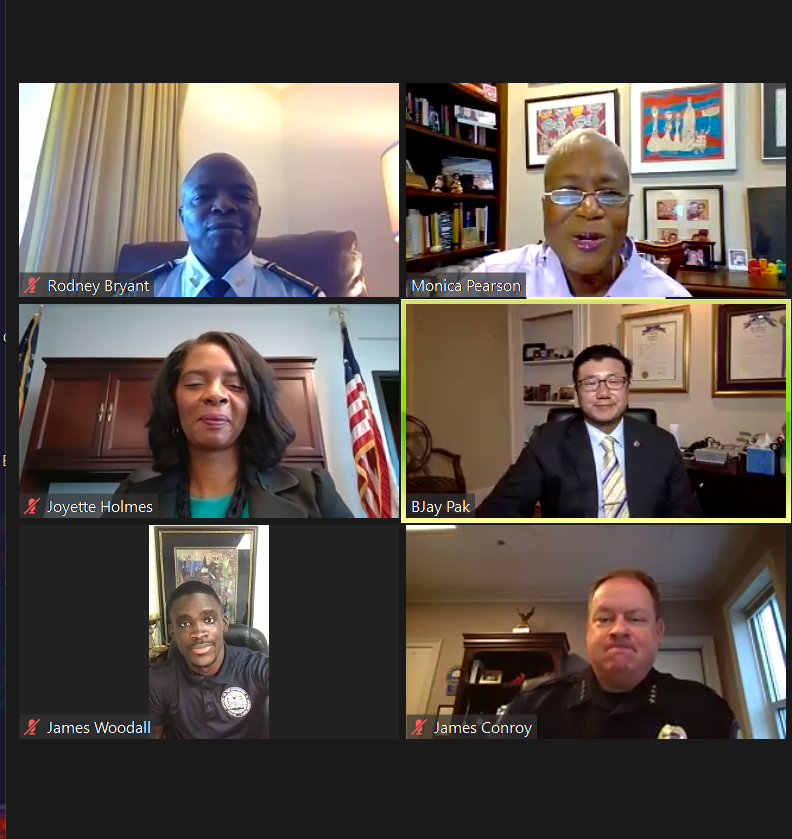
Panelists in a virtual talk led by U.S. Attorney BJay Pak discussed criminal justice issues in Georgia on Aug. 25, 2020. (Screenshot of event)
How to rebuild trust in Georgia communities between police officers and local residents was a focus of talks Tuesday between representatives from metro Atlanta law enforcement agencies, the U.S. Attorney’s Office and the state chapter of the NAACP.
Spearheaded by U.S. Attorney BJay Pak of the Northern District of Georgia, the virtual town hall-style talk touched on how officer-involved shootings are investigated, what can be done to improve officer training and the impact of calls for reduced police funding in local communities across the country.
“We have to acknowledge that right now we’re hurting,” Pak said. “We have to show some empathy and some patience, condemn the violence and talk to each other to find a common solution that all of us can agree with and buy into.”
The talk was held amid a backdrop of continuing protests against police brutality and racial injustice sparked by the officer-caused killing of George Floyd in Minnesota in late May and the local arrests of two men involved in the February shooting death of Ahmaud Arbery near Brunswick.
Protesters have also decried the fatal shooting of Rayshard Brooks by an Atlanta police officer in June shortly after nationwide protests gained steam. His killing prompted the resignation of Atlanta’s police chief at the time.
And new protests broke out in Kenosha, Wis., Sunday night after 29-year-old Jacob Blake was shot in the back by police while trying to get into his SUV as his three children inside the vehicle looked on.
Several communities nationwide have pressed for reducing funds for local police departments in recent months, marking a policy that has drawn sharp denouncement from many politicians including President Donald Trump.
James Woodall, president of the National Association for the Advancement of Colored People’s Georgia chapter, said the conversation around police funding requires more nuance than a wholesale call for fewer law enforcement dollars.
He said funding should be driven by local decisions based on the needs of individual communities, not by political talking points on either side of the partisan divide.
“We have to be having these conversations about what’s happening on the ground and not listen to the national voices and the national movements that are trying to underwrite what’s actually happening at the grassroots level,” Woodall said.
Chief Rodney Bryant, who now heads the Atlanta Police Department in an interim capacity, said he disagrees with efforts to reduce police funding given the increased resources departments like his will need to improve training. But he agreed funding decisions should be kept strictly at the local level.
“I think it’s important to recognize that it should lie with the community itself to make that determination,” Bryant said.
Bryant added he aims to have Atlanta officers evaluated more regularly to identify potential training shortcomings and to incorporate peer intervention in training programs so that it is ingrained in officers to report misconduct from their colleagues, rather than turn a blind eye for fear of being ostracized.
“You will have to do it,” Bryant said of peer intervention. “And if you don’t, you will be held accountable.”
Bryant also backed efforts by state lawmakers to evaluate whether Georgia’s citizen’s arrest law should be changed, calling it “a very dangerous situation for both parties, especially when it goes wrong.”
Chief James Conroy, who heads up the Roswell Police Department, echoed remarks from others during Tuesday’s talk that local jurisdictions need more recourse to assist persons with mental health issues via professional services, rather than by calling police.
To that end, Conroy also highlighted the importance for citizens to involve themselves more in community engagement in order to better partner with law enforcement agencies and identify specific, local points of improvement for police to make.
“Relationships are the key to successful and effective law enforcement,” Conroy said. “If we don’t have strong relationships with our community built on trust and transparency, we’re going to fail.”
Cobb County District Attorney Joyette Holmes, whose office is prosecuting the two men arrested in the Arbery fatal shooting, noted communication between law enforcement and many different community groups is critical to build trust between officers and residents.
“It really takes all of us recognizing what our blind spots are,” Holmes said.
ATLANTA – Georgia
voters will decide this fall whether to require that dedicated state funds be
spent on their intended purpose.
The state
Senate voted unanimously Monday to put the proposed constitutional amendment on
the statewide November ballot, giving final passage to a measure that
originated in the Georgia House of Representatives.
Committing
dedicated state money such as Georgia’s Solid Waste and Hazardous Waste trust
funds to their intended use was a longstanding priority of the late state Rep.
Jay Powell, R-Camilla, who died unexpectedly last November. As chairman of the
House Ways and Means Committee and later the Rules Committee, Powell opposed
the legislative practice of diverting those monies into the state’s general
fund budget absent a financial emergency.
“It would
bring a level of accountability to these fees and truth in taxation back to the
dedication of these fees,” Rep. Andrew Welch, R-McDonough, said on the House
floor last week.
Although the
Senate at one point in this year’s session favored limiting the legislation to
the Solid Waste and Hazardous Waste trust funds, senators on Monday agreed to a
House proposal applying the constitutional amendment to all dedicated revenues
derived from state fees or taxes.
The
legislation includes substantial limits to make sure dedicated funds don’t grow
too large and can be put to general use in emergencies.
Under the
constitutional amendment, dedicated funds could not exceed 1% of total state
revenues from the previous year. In a financial emergency, the governor and
General Assembly would have the authority to temporarily suspend the dedication
of funds.
“This is
true middle ground in the appropriations process,” Welch said.
As a
constitutional amendment, the legislation does not go to the governor to be signed
into law. Its passage Monday guarantees its placement on the general election
ballot Nov. 3.
ATLANTA – The controversial election bill the Republican-controlled General Assembly passed in March garnered the most publicity by far of anything lawmakers did during this year’s session.
But the legislature approved a host of other bills during 40 days under the Gold Dome covering a variety of issues that, like the election measure, take effect on Thursday.
July 1 will see the implementation of a state tax cut and a series of new tax breaks for Georgia businesses. Local police departments will get new protections from budget cuts, and a new crime applicable to a type of theft popularized during the pandemic will go on the books.
The tax cut will increase the standard deduction for married couples who file joint state income tax returns by $1,100. Single taxpayers can deduct an extra $800, while Georgians ages 65 and older can deduct another $1,300. Married couples filing separately will be able to deduct an additional $550.
House Bill 593 is a follow-up to legislation the General Assembly adopted in 2019 lowering Georgia’s income-tax rate from 6% to 5.75%.
Mostly lower- and middle-income families will benefit from the higher standard deduction, said Georgia House Speaker David Ralston.
“Today marks another chapter in Georgia’s continuing commitment to provide sustainable, meaningful tax relief to Georgians to let them keep more of their hard-earned money,” Ralston, R-Blue Ridge, said after the mid-March vote passing the bill.
Separate legislation also taking effect Thursday serves up a smorgasbord of new tax breaks aimed at spurring business investment in Georgia. It offers tax credits to medical equipment and pharmaceutical manufacturers, aerospace defense projects, performing arts venues, short-line railroads and developers of corporate “mega-sites.”
While most of the bill doles out more largesse in the form of tax credits, Senate Bill 6 also seeks to rein in tax breaks that don’t give enough bang for the buck. It requires independent audits of up to five tax credit programs each year to determine whether their economic impact justifies the loss of state tax revenue.
“This is a large bill,” state Sen. John Albers, R-Roswell, said as the multi-faceted measure was being debated on the Senate floor during the final day of the 2021 legislative session. “It brings checks and balances. It has us measure the return on investment, and it keeps Georgia the No.-1 place to do business.”
Republican legislative leaders focused much of their attention this year on crafting friendly tax policies to help Georgians and Georgia businesses cope with the economic damage wreaked by the pandemic.
But another thread that ran through the 2021 session stemmed from last year’s murder of George Floyd, a Black man, by a white police officer in Minneapolis, which sent demonstrators into the streets of America to protest racism and police brutality.
An offshoot of those protests was the “defund the police” movement, as some on the left called for slashing police budgets and redirecting those funds to social programs aimed at the causes of a nationwide surge in violent crime.
Georgia lawmakers reacted by passing legislation limiting local government from reducing funds for police more than 5% during a 10-year span.
“This legislation sends a strong message that we support our law enforcement officers and we will never defund police here in Georgia,” said Rep. Houston Gaines, R-Athens, chief sponsor of House Bill 286.
Legislative Democrats overwhelmingly opposed the bill as a power grab by the state over local governments. Critics also argued it would stall efforts to fund other areas like mental health, housing and education that aim to keep people from landing in jail.
Lawmakers also were divided over a bill criminalizing “porch piracy,” a form of theft that hadn’t been given much thought before the pandemic prompted shoppers hunkered down in their homes to do most of their buying online.
House Bill 94 makes it a felony to be caught in possession of at least 10 different pieces of stolen mail that is addressed to three or more separate recipients – even if it is unclear who exactly stole the mail.
The bill also makes it a felony to steal three or more envelopes, bags, packages or other mailed items from the porch, front or back entrance of a residence.
“This was a problem before the pandemic,” Rep. Bonnie Rich, R-Suwanee, the measure’s chief sponsor, said during a committee hearing on the bill. “It has become even more of a problem now.”
While the legislation drew some support from Democrats, others questioned the severity of the bill’s penalties, noting porch pirates could face more jail time and a worse criminal record than those who commit petty theft at a retail store.
Other bills the General Assembly passed this year that take effect July 1 include:
House Bill 112 – extends COVID-19 liability protections for Georgia businesses and hospitals into the summer of 2022.
House Bill 317 – extends the state tax on hotel and motel rooms to “marketplace facilitators” including Airbnb and Vrbo.
House Bill 511 – prohibits spending money deposited in nine state dedicated trust funds on any other purpose.
House Bill 617 – lets student-athletes at Georgia colleges, universities and technical colleges receive compensation for their name, image and likeness.
Senate Bill 34 – allows victims of human trafficking to petition to change their name without public disclosure.
ATLANTA – The Georgia Water Coalition’s annual Dirty Dozen report highlights a combination of broad concerns over pollution of the state’s rivers, streams and groundwater and threats posed by specific projects.
The report, released Tuesday, also includes items that have appeared previously on the list and remain unaddressed as well as newly identified issues.
Topping the seven returning concerns are a coal ash pond at Georgia Power’s Plant Scherer that residents of nearby Juliette say is polluting their drinking water, pollution of the Altamaha River from the Rayonier Advanced Materials chemical pulp mill in Jesup, a proposed titanium mine adjacent to the Okefenokee Swamp and Spaceport Camden, a proposed rocket launching facility in Camden County opposed by property owners on nearby Little Cumberland Island as a safety hazard.
Another issue back on the coalition’s list not tied to a specific project is the Right to Farm Act, which drew opposition in the General Assembly this year from environmental advocates who argued it would make it easier for large animal-waste generating livestock operations to locate in Georgia. While the bill failed to make it through the legislature this year, supporters are vowing to reintroduce it in 2021.
New items that made the list include the discharge of untreated sewage in the Chattahoochee River in Columbus within a popular whitewater paddling run, a proposed landfill that has drawn opposition in Brantley County and a proposed $20 million development within the floodplain of Little Lotts Creek near downtown Statesboro.
One past item from the list was addressed this month when Georgia voters overwhelmingly approved a constitutional amendment prohibiting the diversion of tax money from environmental trust funds that are supposed to be used to clean up hazardous waste sites and illegal tire dumps.
“That amendment is the first step in keeping millions of dollars dedicated to their intended purposes, and we hope we never spend ink on that issue in this report again,” said Jesse Demonbreun-Chapman, executive director of the Coosa River Basin Initiative in Rome.
“This is our tenth annual report, and the goal each year is to correct these issues so that they’ll never be considered for the Dirty Dozen again.”