ATLANTA – The Georgia House of Representatives will resume a 2020 legislative session interrupted by the coronavirus pandemic on Thursday, June 11, Speaker David Ralston announced Tuesday.
In a memo to House members and staff, Ralston, R-Blue Ridge, reiterated a starting date he had previously announced late last month.
However, the speaker also delayed the resumption of in-person committee meetings at the Georgia Capitol. Under the new schedule, the House staff will return to their offices on June 1, instead of May 18, and in-person committee meetings will begin on June 2 instead of May 19.
Until then, committee meetings will be held online.
When lawmakers reconvene under the Gold Dome, it will be under safety guidelines recommended by the Georgia Building Authority and a bipartisan committee of House leaders the speaker formed to develop plans for reopening the Capitol.
“As you can imagine, the nature of the legislative session which, by design, is meant to bring together hundreds of people from across the state under one roof to craft legislation and debate policy poses some unique challenges with regard to preventing the spread of the virus,” Ralston wrote.
“I support these [guidelines] and will ensure that sound policies and procedures are put in place in order to protect members, staff and public participants in the legislative process.”
When the Senate will gavel back into session remains uncertain. Lt. Gov. Geoff Duncan, the Senate’s presiding officer, has previously expressed a preference for returning at some point in May.
The General Assembly suspended the 2020 session indefinitely in mid-March as the pandemic was taking hold in Georgia. When lawmakers return to the Capitol, it will be for Day 30 of their annual 40-day session.
ATLANTA – The coronavirus pandemic isn’t stopping the Georgia Lottery.
In fact, the lottery posted its highest sales week of the year from April 26 through May 2, Brad Bohannon, the Georgia Lottery Corp.’s vice president for government relations, told members of the Georgia House of Representatives’ Higher Education Committee Tuesday.
Sales for the month of April were up $7.4 million, or 1.8%, over April of last year, Bohannon said.
“We’re seeing increases for all product lines,” he said.
Bohannon attributed the strong numbers despite the COVID-19 outbreak to lottery customers adapting well to online sales and to most lottery retailers remaining open while adhering to the new social distancing requirements.
With the fourth quarter of the current fiscal year looking good, Bohannon predicted the lottery will end fiscal 2020 on June 30 by transferring $1.113 billion in profits to Georgia’s HOPE Scholarships and pre-kindergarten programs.
“We feel very confident we’ll be able to show another increase in May,” Bohannon said.
Bohannon said the lottery corporation soon will reopen its offices around the state by appointment only to distribute prizes to winners.
ATLANTA – Georgia Gwinnett College in Lawrenceville (GGC) is launching a new “nexus” degree program in professional sound design for film and television.
The University System of Georgia Board of Regents unanimously approved the new program Tuesday.
Gwinnett is home to both Eagle Rock Studios in Norcross and the forthcoming Atlanta Media Campus and Studios, located on the former OFS plant site along the Jimmy Carter Boulevard Corridor.
GGC boasts a diverse student population, with 59.8% of its students identified as minority students. Women make up 56.2% of the student body.
The college already features film courses as part of its curriculum. It began offering a bachelor of arts in cinema and media arts production in 2017, growing the program quickly from just two students initially to 288 in 2018 t0 483 last year.
The university system created nexus degrees several years ago to emphasize the connection between traditional college instruction, hands-on experience and training from professionals in specific careers.
The new nexus degree in professional sound design for film and television will require 42 hours of general education and 18 credit hours in highly specialized courses, including 12 upper division credit hours. GGC will will use program content built by the Georgia Film Academy.
ATLANTA – Marietta-based C.W. Matthews Contracting has been named the “apparent” winner of a state contract for the second phase of the widening of Interstate 85 from Braselton northeast into Jackson County.
The project, which will widen the highway in both directions from two lanes to three, is part of the ambitious $11 billion Major Mobility Investment Program (MMIP) then-Gov. Nathan Deal announced in 2016 shortly after the General Assembly passed legislation earmarking $950 million a year for transportation improvements across Georgia.
The first phase of the widening project, stretching from Hamilton Mill Road in Gwinnett County to Braselton, is on target to open to traffic this summer.
C.W. Matthews got the nod on the second phase of the project after submitting a bid of $94.6 million. The DOT selected C.W. Matthews over two competitors using a “best-value” procurement method, which takes into account both the price and technical proposals.
“C.W. Matthews has developed a strong history of working with the department,” said Andrew Hoenig, the DOT’s design-build program manager. “We are looking forward to working with them on the delivery of the I-85 widening Phase 2 project.”
Final design of the project is expected to begin late this year, with construction due to begin next year. The project is expected to open to traffic in 2025, four years ahead of the original schedule.
The DOT decided last year to speed up the timetable for the I-85 widening and another MMIP project to build truck-only lanes along northbound I-75 from north of Macon to McDonough to allow for better competition among construction bidders and permit better maintenance of traffic during construction.
At the same time, the agency delayed the scheduled addition of toll lanes along the Top End of I-285 and Georgia 400.
The I-85 phase two contract will be officially awarded after the DOT verifies the bid is in order.
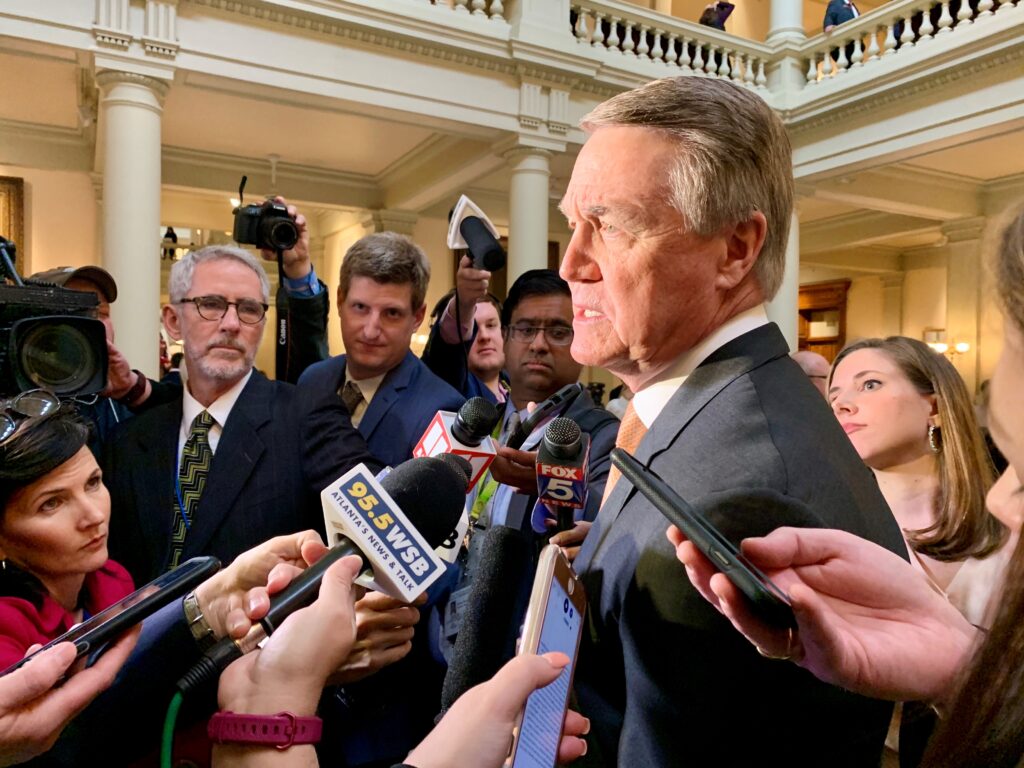
U.S. Sen. David Perdue speaks at the State Capitol after qualifying for the 2020 election on March 2, 2020. (Photo by Beau Evans)
ATLANTA — U.S. Sen. David Perdue, R-Ga., has restructured his retirement savings to eliminate individual stock trades.
In a financial disclosure statement filed last month, Perdue reported that he and his wife, Bonnie, sold shares in dozens of companies and bought shares in exchange-traded funds. The couple already was invested in mutual funds and bonds.
Perdue’s announcement came one month after Georgia’s other senator, fellow Republican Kelly Loeffler, announced in an op-ed in The Wall Street Journal that she is liquidating her family’s holdings in stocks in individual companies and moving those investments into exchange-traded funds and mutual funds.
Loeffler – and, to a lesser extent, Perdue – had been caught up in media reports that they sold a large number of stock shares following a briefing by health officials about the coronavirus pandemic.
Perdue spokeswoman Cherie Gillan pointed out that he did not attend that briefing and said he has never shared or acted on any “nonpublic” information. She also noted there was no major selloff since more purchases were made at that time, reinforcing did not profit from the COVID-19 crisis.
In a statement issued late last week, Perdue said he and his wife have retained independent advisors including Goldman Sachs and fund managers to handle most of their stock investments since 2005, almost a decade before he was elected to the Senate.
“Goldman Sachs or these independent fund managers bought and sold individual stocks without consulting with us,” he said.
Perdue said the couple continues to own three specific stocks he earned as compensation for serving on corporate boards before entering the Senate.
“Right now, I remain focused on helping Georgians recover from the devastating impact of the COVID-19 pandemic and getting America back to work,” the senator said.
“This was a personal decision Senator Perdue and his wife made to avoid any confusion about their retirement savings,” Gillan added. “They did so voluntarily.”