ATLANTA – First-time unemployment claims fell again in Georgia last week, mirroring a decline in jobless claims nationwide as more and more businesses shut down by the coronavirus pandemic reopen.
Georgians filed 25,447 initial unemployment claims last week, a decrease of 1,085 from the previous week, the state Department of Labor reported Thursday.
As the number of claims in the Peach State continued trending down, Georgia Commissioner of Labor Mark Butler said his agency is processing claims at rates above the national average. Georgia reports releasing first payments to 75.5% of claimants with initial claims within 21 days, outpacing the national average of 66.4%.
“No state has processed and paid as many claims as we have at a faster pace,” Butler said. “We have received some tough scrutiny lately for the small percentage of claims not paid that may not even be eligible for payment.”
Still, the General Assembly is looking to give the labor department more help processing claims. The fiscal 2021 mid-year budget Gov. Brian Kemp signed last week includes $49,729 to hire a chief labor officer to oversee unemployment insurance requests, including financial audits.
Legislation authorizing the position is now before the Georgia Senate Industry and Labor Committee.
Since the outbreak of COVID-19 in Georgia, more than $18.7 billion in state and federal benefits have been paid out to more than 4.4 million jobless Georgians, more than during the entire nine years before the virus struck.
The job sector accounting for the most unemployment claims last week was accommodation and food services with 5,520 claims. The administrative and support services sector was next with 3,045 claims, followed by manufacturing with 2,226.
More than 186,000 jobs are listed online at https://bit.ly/36EA2vk for Georgians to access. The labor department offers online resources for finding a job, building a resume, and assisting with other reemployment needs.
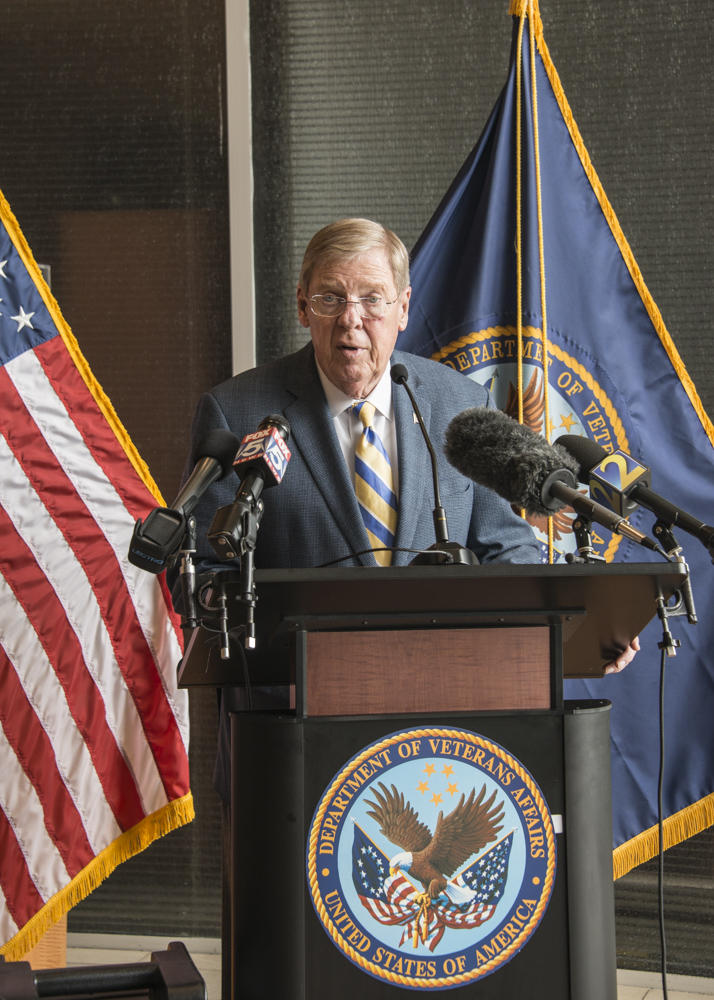
ATLANTA – A bridge over a portion of the Port of Savannah would be named in honor of former U.S. Sen. Johnny Isakson, R-Ga., under a resolution the Georgia House of Representatives passed unanimously Thursday.
The bridge on Georgia 307 crosses over the Mason Mega Rail Yard, a $215 million project that, when completed, will give the port enough additional capacity to ship goods to cities in the nation’s Mid-South and Midwest regions.
Isakson helped land federal funding for that project as well as the $1 billion deepening of Savannah Harbor to make room for a new generation of giant containerized cargo ships now calling at the Port of Savannah. Both projects will be key contributors to one of the nation’s fastest-growing ports.
“Johnny Isakson was and is a champion for economic development and job creation,” said House Speaker David Ralston, R-Blue Ridge, the resolution’s chief sponsor, who made a rare appearance in the well of the House chamber to present it. “Senator Isakson believes the best way to help lift our state up is to expand economic opportunity for everyone.”
Isakson, who hails from Cobb County, was elected to the U.S. House of Representatives in 1999 and moved up to the Senate in 2004. He retired at the end of 2019 for health reasons.
Ralston praised the former senator Thursday for serving as a model of civility, which he said has become an increasingly rare quality in Washington, D.C.
“Senator Isakson only knows people as friends or future friends,” the speaker said. “His example is one we would do well to follow.”
Rep. Steven Meeks, R-Screven, told his House colleagues he got to know Isakson while working as a congressional staffer on Capitol Hill. He said Isakson treated everyone the same, regardless of their status.
“To him, everyone in a room was important,” Meeks said.
The resolution’s cosponsors include House Majority Leader Jon Burns, R-Newington, and Reps. Bill Hitchens, R-Rincon; Ron Stephens, R-Savannah; Jesse Petrea, R-Savannah; and Carl Gilliard, D-Garden City.
ATLANTA – The General Assembly is considering giving Georgians trying to cope with the financial impact of the coronavirus pandemic some tax relief.
Legislation raising the standard deduction allowed state income taxpayers passed unanimously Wednesday in a House Ways and Means subcommittee.
Under House Bill 593, married taxpayers filing jointly would be able to add $1,100 to the state’s standard deduction, which would increase from $6,000 to $7,100. Single taxpayers would be allowed to deduct an additional $800, and married couples filing separately would get an additional deduction of $550.
The state House of Representatives approved a bill last year setting Georgia’s income tax rate at a flat 5.375%. But the Georgia Senate didn’t take up the measure after lawmakers returned to the Gold Dome from a three-month hiatus prompted by COVID-19.
“So much of this was talked about last session,” Ways and Committee Chairman Shaw Blackmon, R-Bonaire, the bill’s chief sponsor, told members of the subcommittee Wednesday. “This is an opportunity to ease back into giving folks some of that relief. … It hits the most Georgians we could get with a tax relief package.”
Blackmon said the annual fiscal impact of the tax cut on the state’s coffers would be around $150 million at most.
The bill is cosponsored by Rep. Bruce Williamson, R-Monroe, the subcommittee’s chairman; and Reps. Chuck Martin, R-Alpharetta; Ron Stephens, R-Savannah; David Knight, R-Griffin; and Jason Ridley, R-Chatsworth.
The legislation now heads to the full Ways and Means Committee.
ATLANTA – The Georgia Senate unanimously passed bipartisan legislation Wednesday calling for the most thorough review of the state’s tax laws in more than a decade.
The 2021 Special Council on Tax Reform and Fairness for Georgians would be modeled after an advisory council of the same name the General Assembly created in 2010.
That iteration of the council led to tax reforms that eliminated Georgia’s “birthday” tax on motor vehicles, phased out the state sales tax on energy used in manufacturing and expanded an income tax exemption for married couples filing jointly.
“Georgia did something that worked really well back in 2010,” Senate Finance Committee Chairman Chuck Hufstetler, R-Rome, told his Senate colleagues Wednesday. “It’s time to do that again.”
Under Hufstetler’s bill, the council would include Gov. Brian Kemp, three economists, a fiscal expert chosen by minority Democrats, the 2021 chairman of the Georgia Chamber of Commerce, the 2021 director of the state chapter of the National Federation of Independent Business, two members appointed by the lieutenant governor and two members appointed by the speaker of the Georgia House of Representatives.
The council will study Georgia’s tax structure during the course of this year and report its findings and recommendations to the speaker and lieutenant governor no later than Jan. 10, 2022.
The Special Joint Committee on Georgia Revenue Structure, a panel Hufstetler’s bill also would create, would then develop the council’s recommendations into one or more bills to be introduced into the House during next year’s legislative session.
Anything that emerges from the joint committee would move directly to the floor of the House for an up-or-down vote with no amendments. The same process then would be followed in the Senate.
The 2010 council expressed interest in a similar up-or-down voting process as a way to prevent its tax reform recommendations from being watered down, but the General Assembly wouldn’t go along. As a result, the final legislation that came out of the council’s work was not as far-reaching as council members intended.
Like the council, the joint committee would guarantee representation to legislative Democrats, including the minority leaders of the House and Senate. Unlike the council, the joint committee would be limited to members of the General Assembly.
Hufstetler said Georgia was ranked as the sixth-best state in the nation in which to do business by Site Selection magazine at the time lawmakers created the council. Since then, Georgia has improved to the point that the state’s business climate has been No.-1 on the magazine’s list for eight years running.
“This is an attempt to replicate what we did 11 years ago,” Hufstetler said. “Are we going to stand still and let others pass us, or are we going to be more economically competitive?”
Senate Bill 148 now heads to the House of Representative.
ATLANTA – The Georgia Senate passed legislation Wednesday that would put the Peach State on standard time all year.
The bill, which senators approved 46-7, would do away with switching back and forth twice a year between standard and daylight time, a system studies have shown disrupts sleep patterns.
Interfering with sleep during the two weeks following time changes every March and November impacts Georgians’ health and causes mood swings, said Sen. Ben Watson, R-Savannah, the bill’s chief sponsor.
“There’s a significantly higher percentage of heart attacks during the spring-forward time,” he said. “We have grumpy judges due to sleep deprivation giving harsher sentences.”
While Watson’s bill would move Georgia to standard time all year, it also calls for the state to move to daylight saving time if and when Congress allows states to make that switch. Current federal law permits states to go on standard time but not daylight saving time.
Watson said surrounding states including Florida, South Carolina and Tennessee are considering similar legislation.
Sen. Kim Jackson, D-Stone Mountain, questioned the wisdom of Georgia acting now rather than waiting for Congress to let states switch to daylight time permanently. She said businesses including restaurants and concert venues prefer daylight time because it allows additional evening daylight hours.
“People like having more evening light,” Jackson said.
But Watson said observing daylight time during the winter would lead to dark mornings. The sun wouldn’t come up until almost 8:30 a.m. in December, prompting concerns for the safety of children going to school, he said.
Senate Bill 100 is cosponsored by Senate President Pro Tempore Butch Miller, R-Gainesville; Senate Majority Leader Mike Dugan, R-Carrollton; Republican Sens. John Kennedy of Macon and Dean Burke of Bainbridge; and Democratic Sen. Michelle Au of Johns Creek.
The bill now moves to the Georgia House of Representatives.