ATLANTA – Gov. Brian Kemp defended Atlanta-based The Home Depot Inc. Tuesday after a group of Black Georgia faith leaders called for a nationwide boycott of the company over its position on the state’s controversial election law.
“They did not ask to be in this political fight,” Kemp told reporters during a news conference. “It’s unfair to them, their families and their livelihoods to be targeted.”
Home Depot released a statement after Kemp signed Senate Bill 202 late last month that “all elections should be fair, accessible and secure.”
But the bill’s opponents criticized the statement as not strong enough, particularly when other Atlanta-based companies including Delta Air Lines Inc. and Coca-Cola Co. have forcefully condemned the legislation.
“A boycott is not something we wanted to do, but now it is something that we must do,” Bishop Reginald T. Jackson, who oversees Georgia’s African Methodist Episcopal churches, said Tuesday.
“Blacks and people of color, like others, are also [Home Depot] customers and they benefit from our dollars. … We believe they should oppose any effort to suppress our votes.”
While faith leaders were on the front lines Tuesday in calling for a boycott, Kemp said the effort is being led by Democrats intent on pressuring businesses to get behind congressional passage of sweeping voting rights legislation.
“This is not about Georgia’s election law,” he said. “This is about a movement at the national level to nationalize elections and have an unconstitutional takeover of state elections.”
The bill, which cleared the Republican-controlled General Assembly last month along party lines, replaces the signature-match verification process for mail-in ballots with an ID requirement. It also restricts the location of drop boxes and prohibits non-poll workers from handing out food and drinks within 150 feet of voters standing in line.
But it also expands weekend early voting hours in most Georgia counties and authorizes the use of drop boxes in state law for the first time.
By comparison, Kemp said voting laws in Democratic states including New York, New Jersey and President Joe Biden’s home state of Delaware are more restrictive than Georgia’s new law.
That message has been lost in the rush to boycott Georgia-based companies and in Major League Baseball’s recent decision to pull the All-Star Game out of Georgia, the governor said.
“We have to stand up and tell people the truth about Senate Bill 202,” Kemp said. “It makes it easy to vote and hard to cheat in Georgia.”
Home Depot has 90 facilities, 15 distribution centers and accounts for 30,000 jobs in Georgia, Kemp said.
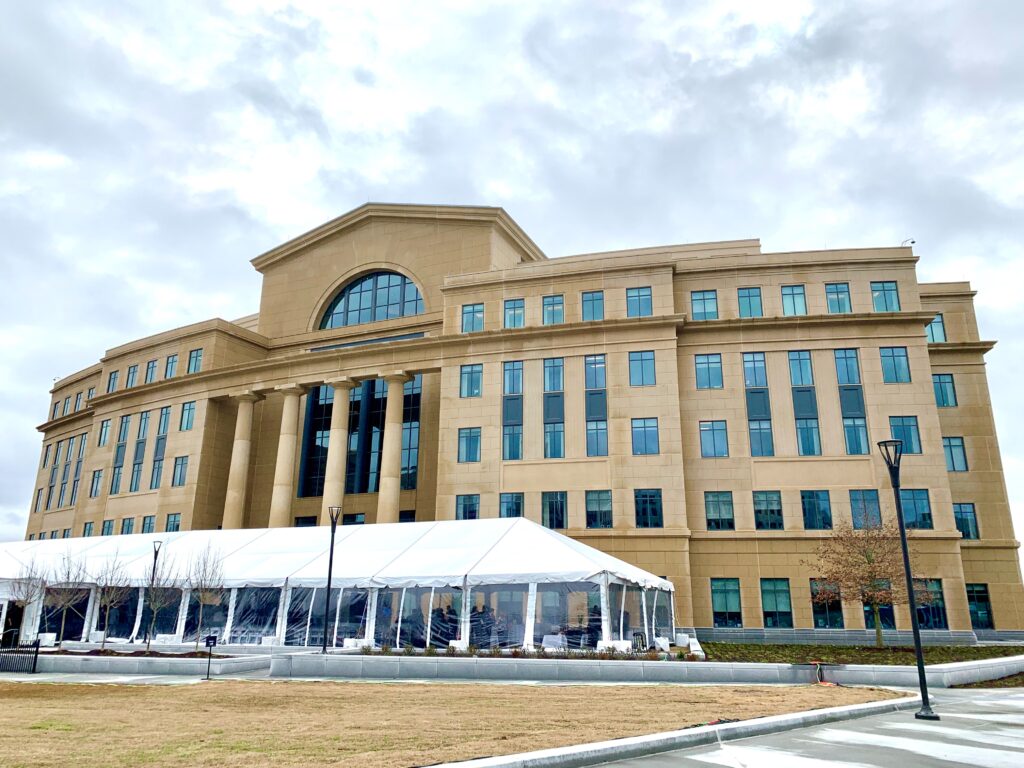
The Nathan Deal Judicial Center in downtown Atlanta is home to the Georgia Supreme Court. (Photo by Beau Evans)
ATLANTA – Whether a landowner whose property is damaged by the state can sue to stop the activity causing the damage was debated in the Georgia Supreme Court Tuesday.
Ware County landowner Cathy Mixon sued the state Department of Transportation (DOT) in 2018 claiming the widening of a road adjacent to her property has caused repeated serious flooding, diminishing the land’s value.
The lawsuit seeks damages and an injunction to prevent “future nuisance and continual trespass” based on the Takings Clause of the Georgia Constitution.
The DOT asked the trial court to dismiss the case based on the doctrine of “sovereign immunity,” which protects the state from being sued without its consent or a waiver approved by the General Assembly.
The agency lost before both the trial court and the Georgia Court of Appeals, leading it to take the case to the state Supreme Court.
On Tuesday, Senior Assistant Attorney General Loretta Pinkston-Pope argued an 1877 amendment to the Georgia Constitution permits property owners to sue for damages if their land has been damaged by the state. However, the so-called Takings Clause does not allow plaintiffs to seek injunctive relief that could prevent a public project from going forward, she said.
“Later cases clearly followed this line of reasoning,” Pinkston-Pope said.
But Douglas Gibson, Mixon’s lawyer, said Georgia cases going back to 1885 do allow property owners to seek injunctive relief.
While the lawsuit also seeks monetary compensation, Gibson argued an injunction is needed to stop a “continuing nuisance” on his client’s land.
“Water is being dumped on us because [the DOT] stopped up a ditch,” he said. “We want them to stop water backing up on us by fixing the drainage.”
Gibson said the Takings Clause waives sovereign immunity for claims for injunctive relief.
But several justices seemed skeptical. Justice Charlie Bethel pointed out that the highway widening project at issue in the case has been completed.
“How do I get an injunction at this point with a finished project?” Bethel asked Gibson.
Bethel went on to suggest Mixon’s claim should be limited to seeking damages.
The 2018 lawsuit predates a recent change in Georgia law governing sovereign immunity. Voters approved a constitutional amendment last November that prohibits the state and local governments from citing sovereign immunity to keep citizens from suing them when government officials commit unconstitutional actions.
ATLANTA – The vital national role Georgia played during the 2020 elections is leading to some high-volume political fund-raising in the Peach State early on in the 2022 election cycle.
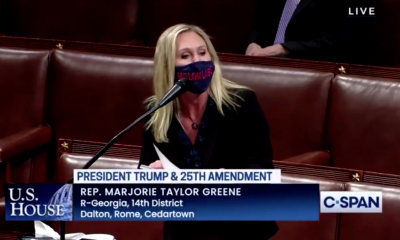
U.S. Rep. Marjorie Taylor Greene, R-Rome, raised nearly $5.9 million through the first three months of this year, a stunning first-quarter total for a House freshman.
On the other side of the aisle, U.S. Sen. Raphael Warnock, D-Ga., another newly elected member of Georgia’s congressional delegation, brought in more than $5.7 million during January, February and March.
Both Greene and Warnock drew national attention during their successful campaigns for different reasons.
Greene became a lightning rod for controversy when she embraced far-right conspiracy theories in social media postings to the point that the House voted in February to strip her committee assignments.
“I have been the most attacked freshman member of Congress in history,” Greene told CNN in a statement earlier this month. “I stood my ground and never wavered in my belief.”
Greene’s fund-raising prowess in the first quarter by comparison dwarfed the total progressive icon Rep. Alexandria Ocasio-Cortez, D-N.Y., hauled in during the same period two years ago as a freshman member of Congress.
The publicity “AOC” received in left-wing circles during and after her election victory in 2020 is comparable to the attention Greene is getting now.
“She has become a national figure, a celebrity on the far right,” said Kerwin Swint, a political science professor at Kennesaw State University. “I think she’ll continue to get attention and money from around the country.”
Greene likely doesn’t need so much money to win re-election in Georgia’s staunchly conservative 14th Congressional District, where Democrats generally fare poorly.
Warnock, on the other hand, already is starting to draw Republican opposition for next year’s Senate contest. While U.S. senators normally serve six-year terms, the Democrat will have to run again next year to complete the last two years of retired Sen. Johnny Isakson’s term.
Warnock and fellow Democrat Jon Ossoff captured Georgia’s two Senate seats in January runoffs over Republican incumbents, pulling Democrats into a 50-50 split with Republicans, just enough to gain control of the chamber because Vice President Kamala Harris is in position to break tie votes.
“That’s looked at as a nationally important Senate seat,” Swint said. “It’s going to yield a lot of money on both sides.”
More than a year and a half out from the 2022 general election, Atlanta banking executive Latham Saddler and Kelvin King, an Atlanta small-business owner, have declared their candidacies for Warnock’s Senate seat. U.S. Rep. Buddy Carter, R-Savannah, is considering running for the Senate.
Meanwhile, two Democratic House incumbents occupying competitive seats have gotten off to fast fundraising starts.
Rep. Lucy McBath of Roswell reported raising $918,550 during the first quarter, and the campaign of Rep. Carolyn Bourdeaux of Suwanee brought in $743,066 in January, February and March.
ATLANTA – First-time unemployment claims in Georgia rose last week even as initial claims nationwide fell dramatically.
However, longer-term figures on unemployment reported Thursday by the state Department of Labor weren’t nearly so dismal.
Jobless Georgians filed 38,382 first-time unemployment claims last week, up 4,759 from the week before.
That contrasted sharply with a nationwide drop in claims of 193,000 during the week. Initial unemployment claims for the U.S. stood at 576,000 as of April 10, the lowest since mid-March of last year when the nation’s economy first began feeling the impact of the coronavirus pandemic.
Georgia’s numbers for the month of March gave more reason for optimism. The state’s unemployment rate declined by 0.3% last month to 4.5%.
“March is yet another month where we have seen job growth throughout the state,” Georgia Commissioner of Labor Mark Butler said. “Georgia has gained a vast majority of the jobs that were lost since March of last year, and we continue to remain strong in economic growth and business development.”
Jobs in Georgia increased by 21,800 last month, reaching a total of nearly 4.5 million. But that’s down 151,000 compared to March of last year.
The job sectors experiencing the most month-over-month job gains were administration and support services with an increase of 3,500 jobs. Next was health care, which added 2,400 jobs in March, followed by local government with 1,800.
Notably absent from the list was the accommodation and food services job sector, which week after week and month after month has led the way in job losses in Georgia leading to the filing of unemployment claims.
Last week, 11,906 Georgians previously working in that sector of the economy filed initial unemployment claims, far ahead of the administrative and support services sector, which accounted for 4,043 claims. Manufacturing was next with 3,160 claims.
The labor department has paid out nearly $20.6 billion in state and federal unemployment benefits since the beginning of the pandemic. The agency has processed more than 4.6 million initial unemployment claims during that time, more than during the last nine years combined before COVID-19 struck.
More than 223,000 job openings are currently listed on the EmployGeorgia website, triple the number that were listed in March 2020.
ATLANTA – The Port of Savannah set an all-time record last month, handling nearly 500,000 twenty-foot equivalent units (TEUs) of containerized cargo.
That represented an increase of 48% over March of last year, when the coronavirus pandemic was starting to slow the movement of freight.
The March showing put the port at 3.9 million TEUs for the first three quarters of fiscal 2021, putting Savannah on track to top 5 million for the first time ever in a single fiscal year.
“The port and the entire logistics community continue to serve as an economic engine for coastal Georgia and the entire state as we accelerate our economic recovery in the aftermath of the COVID-19 pandemic,” Gov. Brian Kemp said Thursday. “This record-setting month proves that Georgia is open for business!”
“Last month’s performance constitutes a massive turnaround from the same period a year ago,” added Will McKnight, chairman of the Georgia Ports Authority board.
“The board’s decision to invest more than $100 million per year over the next three years will not only make Savannah better able to handle this new level of trade, but to take on additional business as our customers grow.”
Rail played a major role in Savannah’s growth, with volumes at the port’s Mason Mega Rail Terminal increasing by 29.7% in March. Only half of the project’s 18 tracks are operational, with the rest scheduled to open later this year.
Another freight rail project, the Appalachian Regional Port near Chatsworth, saw an increase of 37.7% in lifts last month, moving an additional 761 containers compared to March 2020.
Meanwhile, the authority plans to break ground in September on the first phase of a project that will add 650,000 TEUs of capacity at Savannah’s Garden City Terminal. A separate project adding 750,000 TEUs of space is due for completion in 2023.