ATLANTA – Gov. Brian Kemp is transferring two members of his staff to the Georgia Department of Community Health (DCH).
Kemp’s deputy chief of staff for operations, Caylee Noggle, will take over July 1 as the agency’s commissioner, succeeding the retiring Frank Berry.
Ryan Loke, now deputy chief operating officer in the governor’s office, also will join the DCH as deputy commissioner and chief health policy officer.
Noggle is a veteran of state government, having served as an interim chief of staff in the Kemp administration and, before that, as interim chief of staff for the Georgia Department of Public Health and chief management officer for the Governor’s Office of Planning and Budget.
Before joining the administration early last year, she held several management roles with the Georgia Student Finance Commission.
“Caylee Noggle has done a remarkable job throughout her service in state government – including in her integral role throughout the state’s response to the COVID-19 pandemic,” Kemp said.
“Caylee brings years of in-depth knowledge and management expertise to a complex state agency that will greatly benefit from her diverse experience and leadership. Georgians will be well-served by having her at the helm of DCH as the agency continues to deliver critical services to the people of our state.”
Loke is currently deputy chief operating officer in the governor’s office. Before that, he served as the governor’s health policy advisor.
Prior to joining the Kemp administration, Loke worked in the private sector advising several Georgia-based companies on legislative strategy.
Berry is retiring after 26 years in state government in various roles.
The DCH serves nearly three million Georgians with an annual budget of $17 billion, including state and federal dollars.
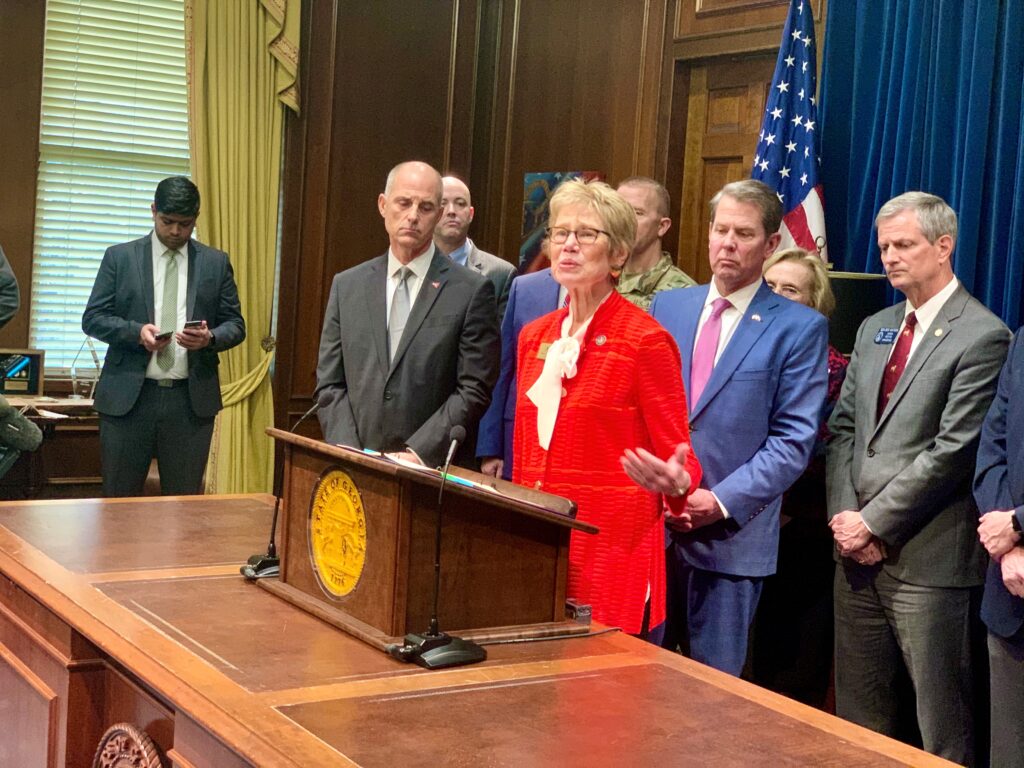
Georgia Public Health Commissioner Kathleen Toomey talks about coronavirus testing at a news conference on March 5, 2020. (Photo by Beau Evans)
ATLANTA – Gov. Brian Kemp Tuesday issued what is expected to be the last statewide public health emergency of the coronavirus pandemic era.
The order will expire on Thursday, July 1, at 12 a.m.
“I appreciate the General Assembly granting my office this authority in order to swiftly and appropriately respond to the coronavirus pandemic,” Kemp said. “We worked together – along with the Department of Public Health, dozens of state agencies, local leaders, private sector partners, and countless others – to protect both lives and livelihoods.
“Thanks to those efforts, more Georgians are getting vaccinated, our economic momentum is strong, and people are getting back to normal.”
Kemp issued the first of a long series of public health emergency orders in March of last year as COVID-19 took hold in Georgia. The restrictions included in those orders have varied depending on the severity of the threat posed by the virus.
Early on, many businesses shut down and laid off their workers, while restaurants stopped serving customers inside their establishments and provided only pickup and delivery service.
More recently, companies have brought employees back to their offices at least part of the time, but those who can work at home have gotten used to the convenience and are continuing to do so if allowed by their bosses.
As of Tuesday, the state Department of Public Health has reported 901,472 confirmed cases of COVID-19 and 64,697 hospitalizations. The virus has killed 18,407 Georgians.
In Georgia, the virus hit an early peak last July, then hit a second higher peak in January before tapering off substantially.
More than 3.8 million Georgians have been fully vaccinated against COVID-19, 37% of the state’s population, a vaccination rate that continues to lag the national average.
While there will be no more public health emergency declarations, Kemp said he plans to issue an executive order next week that will continue aiding the state and Georgia job creators as they fully recover from the pandemic. The order will include the suspension of various state rules and regulations, the governor said.
ATLANTA – The Southern Poverty Law Center and an Atlanta-based law firm filed a class-action lawsuit Tuesday against the Georgia Department of Labor over unprocessed and unpaid unemployment claims.
The suit, filed in Fulton County, charges extreme delays in the handling of claims throughout the coronavirus pandemic in violation of state and federal law.
Four plaintiffs represented by the Montgomery, Ala.-based center and Bondurant, Mixon & Elmore LLP are seeking relief for delays suffered by unemployed Georgians in initial determinations of eligibility for benefits, in payments of benefits and in appeals of adverse decisions.
“The pandemic created the largest unemployment crisis in generations, and throughout this trying time [the labor department] has refused to follow the law in providing help to people who desperately need it,” said Emily Early, senior supervising staff attorney for the center’s Economic Justice Project.
“State and federal law guarantee promptness and due process rights and [the department] has ignored those rights. … This catastrophe cannot continue.”
State lawmakers besieged by complaints from unemployed constituents also have criticized the department’s handling of unemployment claims since COVID-19 took hold in Georgia in March of last year.
The General Assembly responded by passing legislation this year creating the position of chief labor officer to work with Commissioner of Labor Mark Butler in expediting the handling of unemployment claims.
However, Gov. Brian Kemp vetoed the bill, arguing the new position would have conflicted with the constitutional authority of Georgia’s elected labor commissioner without providing any legal mechanism to resolve disputes between the two.
In opposing the chief labor officer bill before a legislative committee, Butler pointed to the unprecedented nature of the pandemic, which saddled his agency with more unemployed claims in months than it had been called on to handle during the previous decade.
He said he has sought more funding for the department for years to no avail.
On Tuesday, Butler said the lawsuit is politically motivated and without merit.
“These groups believe that unemployment insurance should be paid to everyone who applies, regardless of their qualifications,” he said. “The same groups should be more concerned with helping people go back to work in one of the hundreds of thousands of jobs currently available across the state of Georgia.”
The lawsuit seeks an injunction forcing the labor department to comply with state law and to enforce the plaintiffs’ federal due process rights. It also asks for monetary damages.
Georgia Commissioner of Economic Development Pat Wilson
ATLANTA – Fresh-prepared meal delivery service Freshly Inc. is expanding its presence in Georgia.
The company announced Tuesday plans to open a distribution operation in Clayton County. The $52 million investment will create 665 jobs.
“It’s great to see Freshly continue to find success in Georgia and expand their presence in the Southeast,” Gov. Brian Kemp said.
New York-based Freshly opened its first Southeastern distribution center in Cobb County earlier this year. The new facility in Ellenwood will help the fast-growing company meet increasing demand sparked by customers’ desire during the coronavirus pandemic to eat their meals at home.
“Over the past year, Freshly has experience substantial growth as consumer demand continues to grow for convenient and nutritious meal options,” said Mike Wystrach, Freshly’s founder and CEO. “Tapping into Clayton County’s tremendous pool of talent, the second facility will allow us to increase capacity for efficient assembly and distribution of our chef-prepared meals.”
Freshly plans to begin hiring at the new center for positions in warehousing, operations and maintenance. Interested applicants should visit Freshly’s careers page for more information.
Director Hank Evans of the Georgia Department of Economic Development’s Global Commerce Division worked with the Metro Atlanta Chamber, Clayton County Office of Economic Development, Electric Cities of Georgia and the state Department of Labor’s Quick Start program on the project.
“Just four months after announcing Freshly’s initial investment in Georgia, it is exciting to see them continue to expand here and create hundreds of jobs in Georgia, state Commissioner of Economic Development Pat Wilson said. “Freshly’s growth in the state is a testament to how well companies have adapted to rapidly changing consumer behavior and to Georgia, with our strong logistics infrastructure, being the ideal place for companies within this growing sector to locate and expand.”
ATLANTA – American manufacturers of solar panels would benefit from a new federal tax credit under legislation introduced by U.S. Sen. Jon Ossoff, D-Ga.
“This legislation will bring more clean energy Jobs to Georgia while creating tens of thousands of clean energy jobs across the country,” Ossoff said Tuesday during a news conference. “It will help make America energy independent and allow American manufacturers to compete with Chinese solar manufacturers, and it will accelerate our transition to clean and renewable energy sources.”
Ossoff said he campaigned for the Senate last year on a pledge to make Georgia a national leader in solar manufacturing. The state already is home to Q Cells USA in Dalton, the largest solar panel manufacturer in the Western Hemisphere.
The proposed tax credit is aimed at boosting the production of solar panels at every stage of a supply chain currently dominated by Chinese manufacturers.
“We don’t want to rely upon Chinese monopolies to produce this technology,” Ossoff said.
Ossoff said he is working with Senate Finance Committee Chairman Ron Wyden, D-Ore., to include the tax credit as part of broader infrastructure legislation.
The bill could play a major role in transitioning the United States toward a clean-energy future, he said.
“We’ve got to wean ourselves off of fossil fuels,” he said. “American companies and American workers should produce the technology that will allow us to generate clean, renewable energy at scale.”
The bill’s cosponsors include Democratic Sens. Raphael Warnock of Georgia, Michael Bennet of Colorado and Debbie Stabenow of Michigan.