ATLANTA – The General Assembly is taking another look at legislation that would raise the mandatory school attendance age in Georgia from 16 to 17.
A state Senate study committee created to take up a bill introduced this year by Sen. Lester Jackson, D-Savannah, held its first hearing Thursday and heard endorsements of the measure from both the Georgia Association of Educators (GAE) and the Georgia School Boards Association.
Grace Kim of the school boards group said only 16 states allow students to drop out of high school when they turn 16. The rest make them wait until they turn 17, 18 or even 19 to make that life-changing decision, she said.
“Students do not understand the consequences of going through life without the benefit of a high school education,” Kim said.
Joe Fleming, the GAE’s chief lobbyist, said students who drop out of school are more likely to end up in prison or in need of taxpayer-funded support services than those who stay in school.
“This is an investment in that in the long term would save millions and millions of dollars in Georgia,” he said.
Kerry Pritchard of the state Department of Education raised some concerns about the legislation. She said mandating that students stay in school an extra year would require hiring more teachers and counselors as well as other resources that might be better spent on support services for students of all ages.
But Sen. Gail Davenport, D-Jonesboro, said choosing between raising the mandatory school attendance age and providing “wraparound” support services to students shouldn’t be an either-or proposition.
“Students need to stay in school as long as they can and learn as much as they can,” she said. “They’re better off staying in school.”
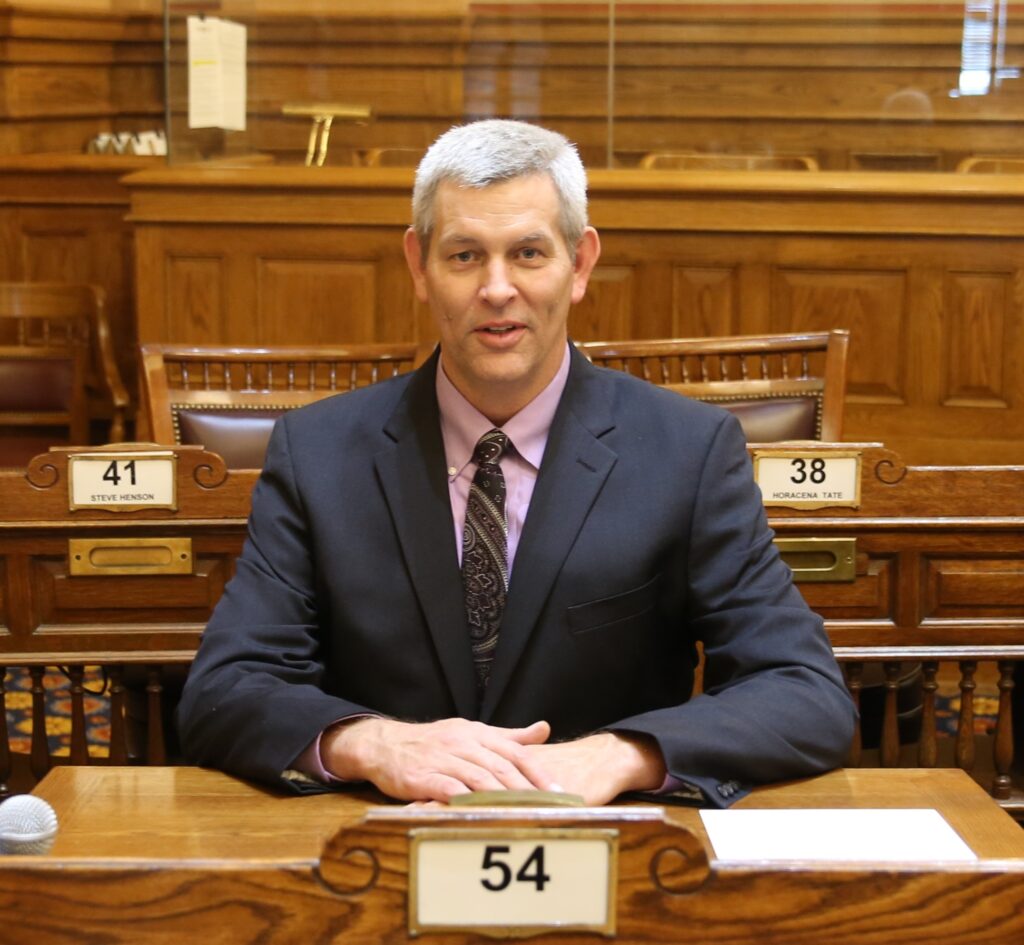
Sen. Chuck Payne, R-Dalton, the study committee’s chairman, said the panel will hold at least one more meeting, preferably in one of the committee members’ Senate districts, before recommending whether the bill should move forward.
“It’s very important that we get this right,” said Payne, who spent 30 years as a juvenile probation officer. “There’s no kid who, to me, is disposable.”
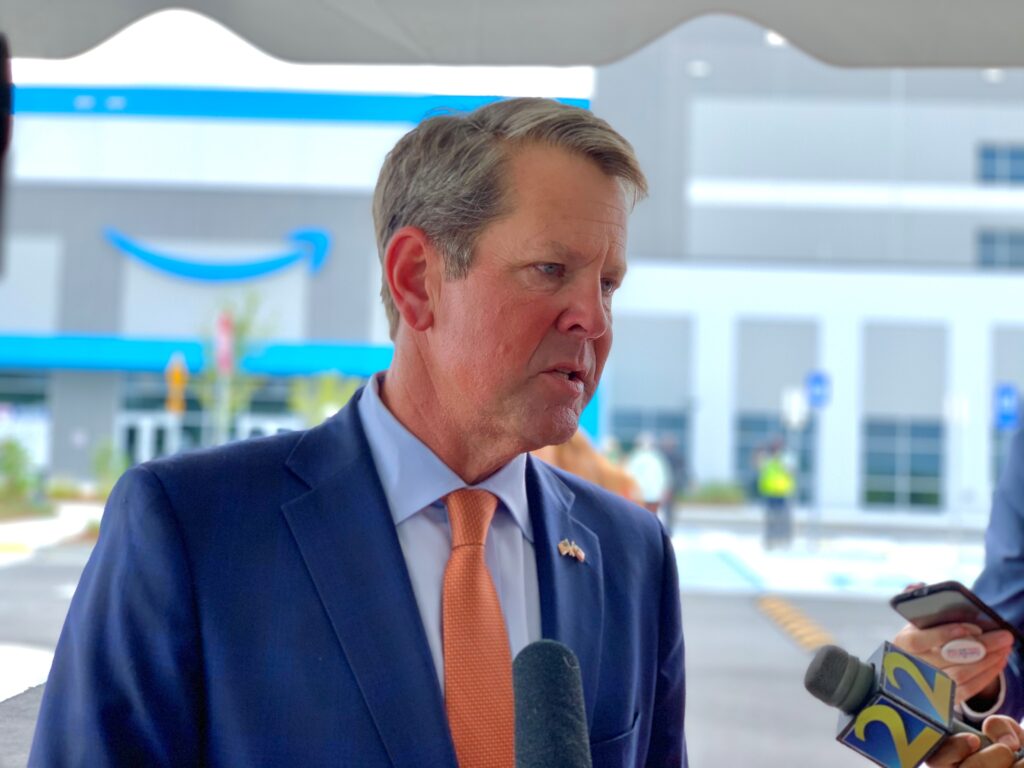
Gov. Brian Kemp speaks with reporters outside Amazon’s new warehouse in Gwinnett County on Sept. 1, 2020. (Photo by Beau Evans)
ATLANTA – Georgia set records for jobs and economic development investments during the last fiscal year despite the coronavirus pandemic, Gov. Brian Kemp announced Wednesday.
Nearly $11 billion in new investments during fiscal 2021, which ended June 30, represented a 46% increase over the last fiscal year, while 33,439 jobs created across the state beat the previous record by 5%.
“Setting new economic development records during a global pandemic is further evidence that Georgia remains the No. 1 state for business,” Kemp said. “By remaining open for business and working alongside local economic development partners and private sector business leaders, we’ve been able to create greater opportunities for hardworking Georgians and prioritize attracting key industries that bring quality jobs and investments to every corner of the Peach State.”
Kemp said 74% of new project locations and expansions came outside of the 10-county Atlanta region, along with more than two-thirds of total investments and about one-third of new jobs. He pledged on the campaign trail three years ago to focus economic development efforts on rural Georgia.
“We are making good on that promise,” Kemp said Tuesday during remarks at the annual Congressional Luncheon sponsored by the Georgia Chamber of Commerce.
Georgia’s international partnerships accounted for the creation of nearly $2 billion in foreign direct investment in the state.
Nineteen projects from South Korea represented the highest job creation from a single country, while Swiss-based projects led in total investment. Businesses from Germany created the second-highest number of jobs during fiscal 2021.
“The pandemic reminded us of how critical our existing industry and international relationships are to Georgia’s economic success, Georgia Commissioner of Economic Development Pat Wilson said. “We have had to think creatively and react innovatively in order to help businesses successfully locate and expand while continuing to attract key industries to the state.”
Leading industries investing in Georgia included automotive, advanced manufacturing, software/technology, logistics and distribution, and food processing. Additional strong gains in jobs and investments came from financial technology and digital media.
Investments in headquarters reached nearly $93 million, an increase of 94% from fiscal 2020, and jobs created by headquarters projects were up 281% over the previous year.
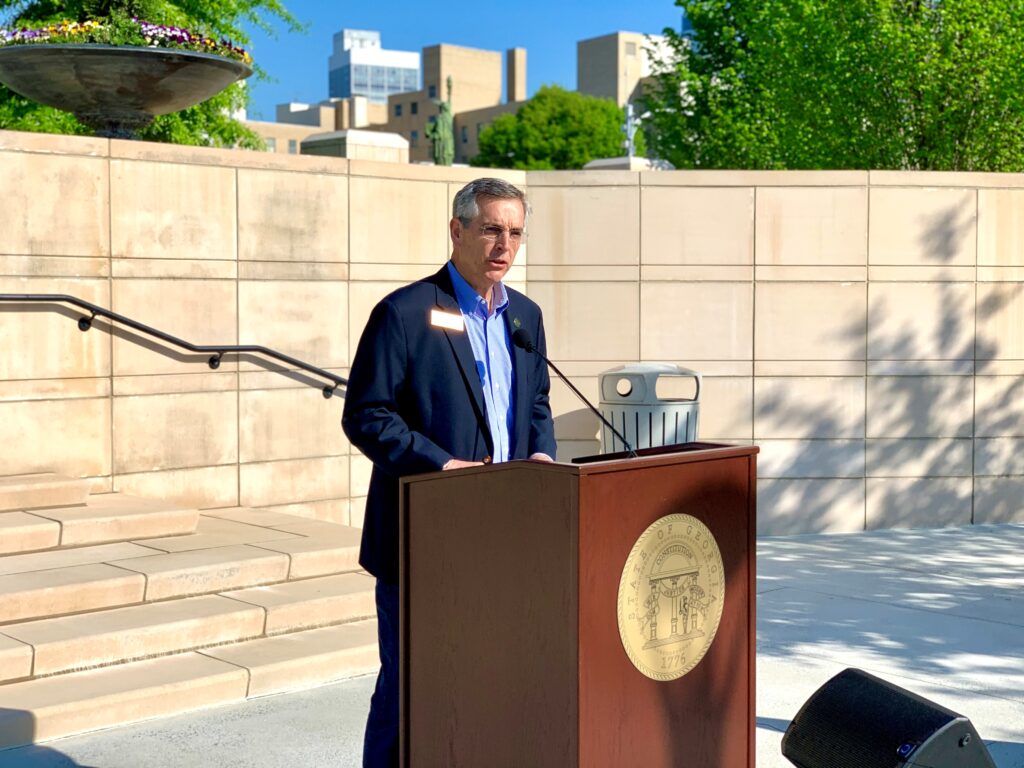
ATLANTA – Georgia Secretary of State Brad Raffensperger called on the General Assembly Wednesday to pass a constitutional amendment prohibiting non-U.S. citizens from voting in state elections.
While such a prohibition already exists in Georgia law, Raffensperger pointed to several other states that are allowing noncitizens to vote.
The Vermont legislature overrode a veto by Gov. Phil Scott last year that paved the way for noncitizens to vote in two cities’ municipal elections. Noncitizens already can vote in municipal elections in San Francisco and nine Maryland cities.
Two cities in Massachusetts have passed resolutions calling for noncitizens to vote there, and proposals for noncitizen voting were introduced recently in New York City and in the states of Washington and Illinois.
“Only American citizens should be voting in our elections,” Raffensperger said Wednesday. “That’s why I’m calling on the General Assembly to act and pass a constitutional amendment ensuring this is the standard for generations to come.”
A constitutional amendment aimed at keeping noncitizens from voting likely would gain strong support from Republican voters in Georgia.
Raffensperger alienated many of those voters last year when he refused to go along with efforts by former President Donald Trump to overturn Democrat Joe Biden’s narrow victory in Georgia. Trump urged Raffensperger in a telephone call to “find” him the votes necessary to carry the Peach State.
Since then, Trump has endorsed U.S. Rep. Jody Hice’s Republican primary challenge of Raffensperger in next year’s race for secretary of state. Former Alpharetta Mayor David Belle Isle also is seeking the GOP nomination.
A constitutional amendment similar to Raffensperger’s proposal failed in the state Senate in March of last year amid opposition from minority Democrats. Constitutional amendments require two-thirds votes to pass the Georgia House and Senate.
ATLANTA – Georgia-based businesses that have taken advantage of the state’s decade-old Invest Georgia Exemption (IGE) will take part in an investment and business fair later this month inside the state Capitol.
Secretary of State Brad Raffensperger is hosting the fair to highlight the exemption, which allows Georgia companies to raise capital from Georgia investors without being subject to the regulatory costs and burdens of registering with the U.S. Securities and Exchange Commission.
More than 100 companies have used the exemption to grow their businesses in Georgia since it was created in 2011, Raffensperger said Wednesday.
“As a small-business owner myself, I know how important it is for the government to support rather than get in the way of business and investment,” he said. “I am proud to bring more attention to this important tool to help Georgia small businesses and entrepreneurs.”
The fair will take place on Aug. 26 from 10 a.m. until noon in the lobby of the Capitol. Participating companies will set up tables displaying what they do and how they have used the exemption to grow their businesses.
Business groups and government agencies, including representatives of the secretary of state’s office, also will be on hand to provide information and tips to entrepreneurs interested in starting a business or owners of existing small businesses looking to grow.
“IGE is an example of good public policy,” said Larry Williams, president and CEO of the Technology Association of Georgia. “By making it easier to raise capital, IGE helps our members develop new technologies and create value. With help from effective programs like IGE, capital investment in Georgia is growing and deal flow is strong.”
The IGE fair is sponsored by the Investors Protection Trust, a nonprofit organization that provides independent, objective information consumers need to make informed investment decisions.
ATLANTA – The U.S. Senate passed a bipartisan infrastructure spending bill Tuesday that would steer more than $11 billion toward highways, transit, airports and electric vehicle charging stations in Georgia.
The $1 trillion legislation, which cleared the Senate 69-30 and now moves to the U.S. House of Representatives, includes $8.9 billion for highway projects in the Peach State, $1.3 billion for transit expansion, $225 million to repair bridges, $619 million for airport improvements and $135 million to build EV charging stations.
It also contains at least $100 million to expand broadband connectivity in Georgia.
“Today’s historic bipartisan vote to upgrade our infrastructure, promote clean energy, and create good-paying jobs will benefit Georgians for generations to come,” said Sen. Jon Ossoff, D-Ga., who voted for the bill along with fellow Georgia Democratic Sen. Raphael Warnock.
“The investments we make now will set us forward on a path toward sustainability, innovation, and world-class transit and transportation across our state. And we have proven that America’s elected leaders can rise above partisanship to serve the national interest.”
The vast majority of the transit funding earmarked for Georgia – $923 million – would go to transit systems in metro Atlanta. However, 15 other transit agencies across the state would receive allocations ranging from $5.8 million to $33 million, including systems serving Augusta, Savannah, Athens, Macon, Columbus, Brunswick and Rome.
Georgia also would share in funding for repairs and upgrades of public schools, port improvements, flood mitigation and replacement of lead pipes.
While 19 Republicans voted for the infrastructure bill in the Senate, it’s unclear whether it will pass in the House. Progressive Democrats in the House have vowed not to support the legislation unless the Senate passes a $3.5 trillion bill aimed at funding investments in “human” infrastructure including free community college tuition, subsidized child care, housing and health care.
Senate Republicans who opposed the infrastructure bill argued it would further increase an already huge federal deficit.