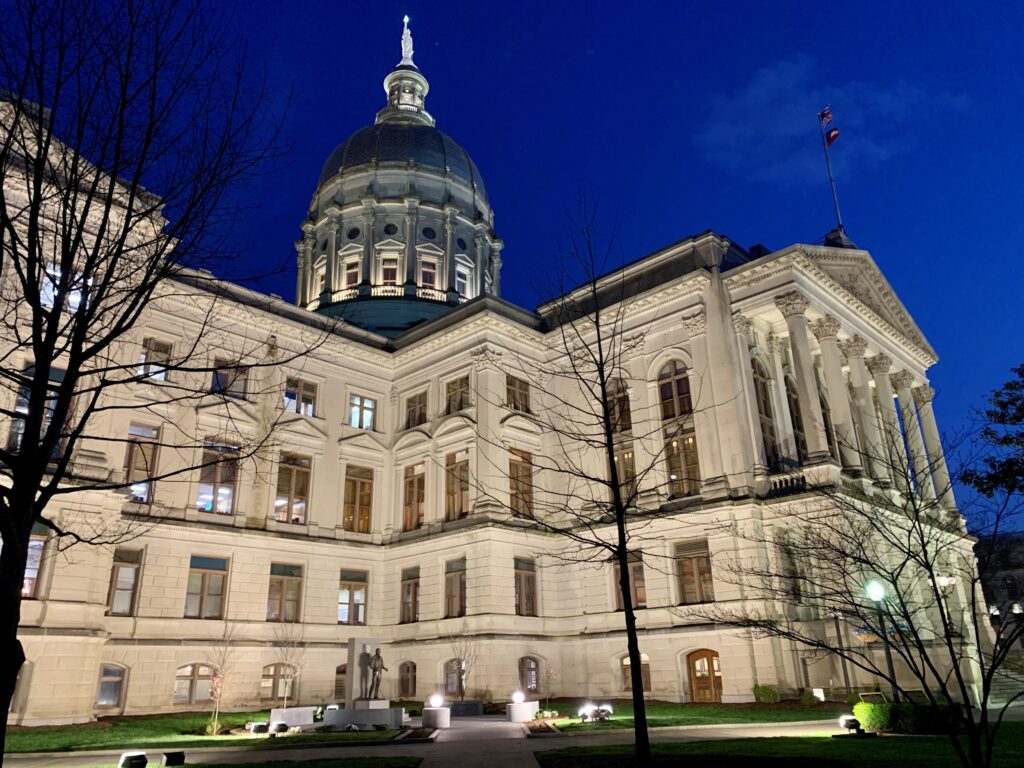
The Capitol building in Atlanta looms on “crossover” eve on March 12, 2020. (Photo by Beau Evans)
ATLANTA – Democrats on the Georgia House Higher Education Committee urged Gov. Brian Kemp Monday to drop his opposition to mask mandates and leave the decision to administrators at the state’s public colleges and universities.
The lawmakers’ plea came as University System of Georgia professors and students launched a weeklong series of demonstrations on campuses across the state demanding mask mandates to prevent the spread of COVID-19.
“We need our leaders to fight against the virus, not against our students and faculty,” said Rep. Jasmine Clark, D-Lilburn.
“A leader makes decisions,” added Rep. Rhonda Burnough, D-Riverdale. “Georgia needs a leader, not a follower.”
Kemp has held firm against imposing statewide mask mandates on either college campuses or K-12 classrooms in Georgia, criticizing such requirements as divisive.
He and other Republican governors also have strongly objected to an executive order President Joe Biden issued late last week requiring all federal employees to get vaccinated against COVID-19 and any employers with 100 or more employees to make sure they get the shots or are tested regularly for the virus.
GOP opponents have argued the U.S. Occupational Safety and Health Administration lacks the legal authority to enforce such workplace mandates, and a legal challenge is expected.
Last week, university system Acting Chancellor Teresa MacCartney defended Kemp’s position on mask mandates. She said campus administrators have worked hard to put all necessary health and safety protocols in place for students returning for in-person classes this semester.
The system is encouraging but not requiring students and professors to wear masks and get vaccinated.
But Clark, who holds a doctorate in microbiology from Emory University, said nothing works to prevent the spread of COVID-19 better than making mask wearing and vaccinations mandatory.
“We have data [showing] that mask mandates work. We also know vaccines work,” she said. “The more people we have vaccinated on our campuses, the better we’re able to stop the virus.”
This story available through a news partnership with Capitol Beat News Service, a project of the Georgia Press Educational Foundation.
ATLANTA – The Georgia Department of Agriculture should play a role in the state’s fledgling medical marijuana program, a member of a legislative oversight committee said Monday.
“This is an agricultural product. We’re an agricultural state,” Georgia Rep. Micah Gravley, R-Douglasville, said during the inaugural meeting of the Medical Cannabis Commission Oversight Committee. “Having them involved going forward is a good thing.”
Gravley was chief sponsor of legislation the General Assembly passed two years ago creating a state commission to award licenses to companies to grow marijuana and convert the leaf crop into low-THC cannabis oil.
The oil is intended to treat patients with a variety of diseases including cancer, seizure disorders, multiple sclerosis, amyotrophic lateral sclerosis (ALS), Crohn’s disease, Parkinson’s disease, mitochondrial disease and sickle-cell anemia.
The 2019 law also established a legislative oversight committee to monitor the program. But the oversight panel didn’t meet for the first time until Monday due to delays the seven-member state commission has encountered getting the program off the ground.
The commission took until this summer to award cannabis oil production licenses to six companies.
Two “Class 1” licensees will be authorized to grow marijuana under close supervision in up to 100,000 square feet of space. Four other companies received “Class 2” licenses limiting them to no more than 50,000 square feet of growing space.
While Georgia Agriculture Commissioner Gary Black has been a strong supporter of the state’s hemp farming program, he has been cool toward the Peach State getting into the cannabis oil business.
However, with Black now seeking next year’s Republican nomination for the U.S. Senate, Georgia likely will have a new agriculture chief after the 2022 elections.
Rep. Sam Watson, R-Moultrie, said Utah’s agriculture department is playing an active role in that state’s cannabis oil program, which Georgia is looking to as a model.
Both states permit only low-THC in cannabis oil, far below a level that would make a user “high,” and neither permit recreational use of marijuana.
Watson said getting the agriculture department involved in Georgia’s program is “definitely a conversation to be had.”
The commission, meanwhile, has been working on responses to seven protests filed by companies whose bids for Class 1 licenses were rejected and 14 protests filed by bidders rejected for Class 2 licenses.
While that process continues, Gravley said the oversight committee should move as quickly as possible to identify labs that can test the licensees’ cannabis oil for quality and compliance with the low-THC requirement.
“Having a variety of labs available to cultivators would be a good thing,” he said. “There are those who are in need of this oil.”
This story available through a news partnership with Capitol Beat News Service, a project of the Georgia Press Educational Foundation.
A passenger disembarks from a MARTA train at the Buckhead Station in Atlanta.
ATLANTA – Public transit projects for the first time would receive federal funding based on their connectivity to affordable housing under legislation proposed Friday by several members of Georgia’s congressional delegation.
The Public Transportation Expansion Act is sponsored in the Senate by Georgia Democrats Jon Ossoff and Raphael Warnock. Sponsors in the U.S. House of Representatives include Democratic Reps. Nikema Williams of Atlanta, Carolyn Bourdeax of Suwanee and Hank Johnson of Stone Mountain.
The bill would establish a federal grant program to fund public transportation expansion to serve low-income communities and connect affordable housing with transit networks.
It also, for the first time in decades, would let large transit systems use federal funds for operating expenses.
The legislation was added to the massive budget reconciliation bill now making its way through Congress.
“I am championing historic transit investments in the reconciliation bill because mobility is essential for opportunity, health, and quality of life — especially in communities that have been historically neglected,” Ossoff said.
“This legislation will build public transportation to serve residents in Georgia’s low-income neighborhoods, connecting affordable housing with health care, education, and employment centers while protecting our environment by reducing air pollution.”
“Connected communities are thriving communities,” added Williams, a member of the House Transportation & Infrastructure Committee. “For too long, Black, Brown, and low-income communities have been left behind in transit expansion. … This legislation is a direct line to economic opportunity for everyone, no matter your ZIP Code or your bank account.”
The budget reconciliation bill faces an uncertain future in Congress. Because of the process being used to consider the legislation, it must receive support from all 50 Democrats in the Senate – with the tie-breaking vote of Vice President Kamala Harris – in order to pass.
Sen. Joe Manchin, D-W.Va., has expressed concerns that the nation can’t afford the legislation’s $3.5 trillion price tag, while progressive Democrats are seeking an even larger spending measure.
This story available through a news partnership with Capitol Beat News Service, a project of the Georgia Press Educational Foundation.
ATLANTA – Last week’s meeting of a legislative committee looking for ways to improve rural Georgia’s economy was full of discouraging statistics depicting losses in population, failing schools and inadequate health care.
But in the midst of that gloom and doom, members of the Georgia House Rural Development Council got a glimpse of fledgling efforts by a nonprofit that is helping farmers find new markets for their products and could help reinvigorate Georgia’s textile industry.
The Georgia Rural Hospital Food Collaborative was launched last May to provide fresh fruits and vegetables, pork and beef, and even medical scrubs to rural hospitals and nursing homes.
“Not only is it good for hospitals. It’s good for nursing homes,” said Jimmy Lewis, CEO of HomeTown Health Care, which represents rural hospitals in Georgia. “It’s good economic development.”
The food collaborative is a byproduct of the coronavirus pandemic, which has disrupted supply chains Georgia fruit and vegetable farmers rely on to get their highly perishable crops to market.
HomeTown Health Care has partnered with Healthcare Services Group, which manages hospital dining and nutritional services, to cut out the middleman and supply fruits and vegetables directly to hospitals and nursing homes.
Sixteen rural hospitals and nursing home are participating in the program, David Bridges, interim director of the Georgia Center for Rural Prosperity, told members of the Rural Development Council Sept. 1.
Offering fruits and vegetables at reasonable prices boosts the bottom lines of rural facilities often operating on thin margins, said Bridges, who also serves as president of Abraham Baldwin Agricultural College in Tlfton.
“If they have to choose between paying for food or nurses, we want them to pay the nurses,” he said.
“The patients in the hospitals love it,” Lewis added. “It’s doing really well.”
The same supply chain issues face Georgia beef and pork producers, making it difficult to ship cattle and pigs raised here to out-of-state processers in a timely manner.
Lewis said the Miller County Development Authority provided the solution, offering to purchase a local slaughterhouse and lease it to the food collaborative.
“We’ve got farms lined up to have their beef processed,” Lewis said.
Another project HomeTown Health and the Georgia Center for Rural Prosperity are involved in holds potential for reviving a textile industry that has lost thousands of jobs to overseas outsourcing for decades.
Working with Swainsboro-based textile manufacturer America Knits, the two have launched Field to Closet, an initiative to provide 100% cotton medical scrubs to Georgia hospitals at no cost. Thus far, 16 rural hospitals have signed on.
The project spins Georgia-grown cotton into yarn at Parkdale Mills in Rabun Gap, weaves the yarn into fabric in North Carolina, and arrives at the America Knits plant for final production. As an additional benefit, the fabric is treated with an antimicrobial chemical that inhibits the growth of bacteria and has been shown in lab tests to destroy viruses.
“There was a time when an end-to-end U.S. supply chain for cotton garments would have been considered a pipedream,” said Steve Hawkins, CEO of America Knits.
“Working on this project aligns perfectly with our focus on providing prosperity for rural smaller communities and creating quality, environmentally sustainable products in the United States.”
Lewis envisions expanding the medical scrubs project to all sorts of cotton clothing as a way to “reshore” cotton production back from overseas. He said several major companies are interested in investing, including Ralph Lauren and Nike.
“If we could track [cotton] from the point of the seed all the way to a new cotton product … we can bring cotton back to the United States,” Lewis said. “We’ve got every part of the cluster to make re-shoring a reality.”
This story available through a news partnership with Capitol Beat News Service, a project of the Georgia Press Educational Foundation.
ATLANTA – University System of Georgia (USG) students, faculty and staff plan to launch daily protests of the system’s lack of a mask mandate at campuses across the state starting Monday.
The plan was announced in an email to Acting Chancellor Teresa MacCartney this week.
Matthew Boedy, president of the Georgia Conference of the American Association of University Professors, complained that without a mask mandate to discourage the spread of COVID-19, many students, professors and staff are not following the system policy encouraging mask wearing.
“The USG and its Regents have ignored the [federal Centers for Disease Control and Prevention], the state’s large cadre of public health professors, and what I am sure have been many private pleas from university administrators,” wrote Boedy, an associate professor at the University of North Georgia.
“Many of the state’s k-12 schools where our children attend have mandated masks. And yet even after pleas from the officials charged with the safety of those in that system, still the USG refuses.
“So cases skyrocket, hospitals fill, and deaths climb.
“We will not sit idly by and watch this hellscape anymore.”
Protests have been scheduled on university system campuses in Atlanta, Albany, Augusta, Athens, Savannah, Columbus and other locations. Demonstrators will gather at different times each day.
“This is not a strike, work stoppage or ‘teach-out,’ ” Boedy wrote. “Classes will continue at their appointed time, and education will not cease.”
MacCartney defended the university system’s stand against mask mandates on Thursday during a meeting of the Board of Regents. She said the system’s colleges and universities spent months preparing to hold classes safely, including distributing masks, gloves, hand sanitizer and COVID-19 tests.
“The health and safety protocols are in place,” she said.
Gov. Brian Kemp has opposed mask mandates on university campuses or in the workplace as divisive at a time Georgians need to work together to fight the spread of the virus.
This story available through a news partnership with Capitol Beat News Service, a project of the Georgia Press Educational Foundation.