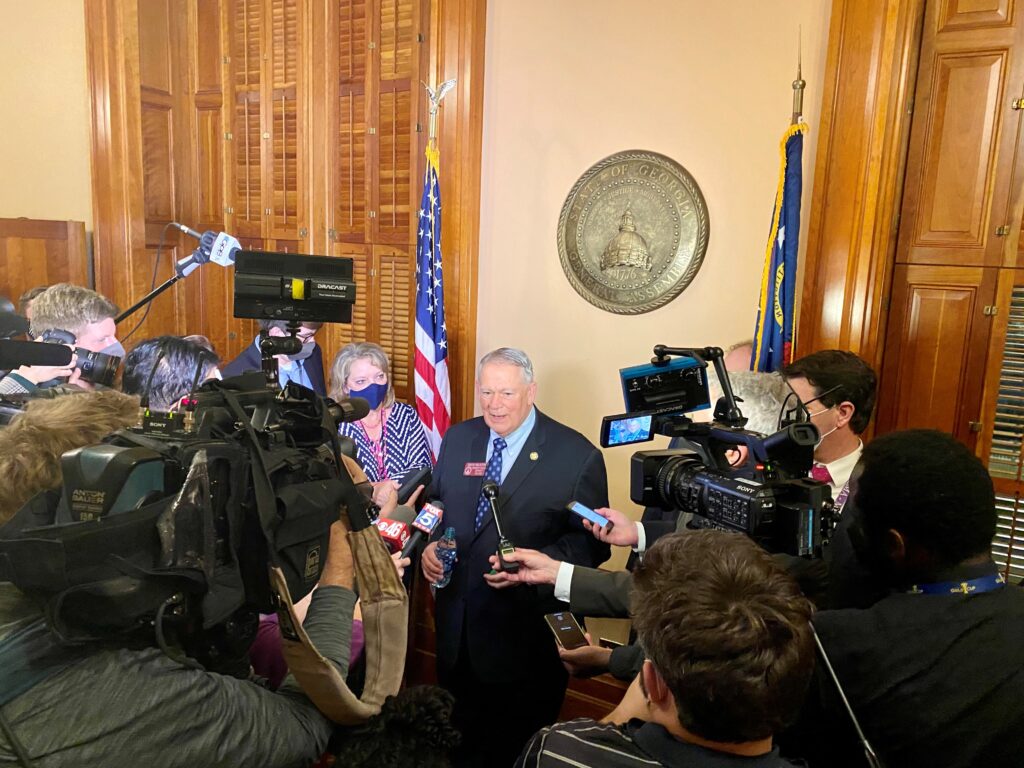
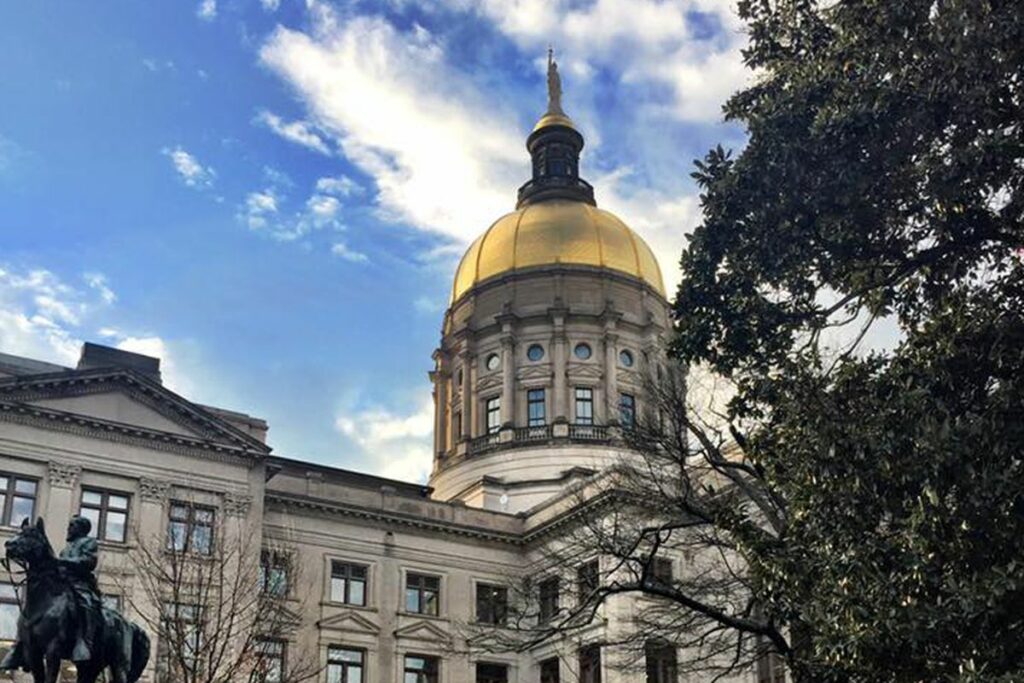
ATLANTA – A constitutional amendment asking Georgia voters whether to legalize pari-mutuel betting on horse racing cleared a state Senate committee Wednesday.
But some lawmakers worried the horse racing industry could be set up for failure in the Peach State if racetracks are limited to live or simulcast horse racing.
The constitutional amendment would prohibit casinos from setting up slot machines and table games at racetracks. Other tracks around the nation have come to rely on income from casino operations for a major portion of their businesses.
“I’m very fearful they would not generate enough income without the other forms of gambling,” said Sen. Bill Cowsert, R-Athens, chairman of the Senate Regulated Industries and Utilities Committee.
An “enabling” bill accompanying the constitutional amendment calls for the construction of up to five horse racing tracks in Georgia, to be overseen by a five-member state commission whose members would be appointed by the governor.
Applicants for licenses to operate a racetrack would pay a $500,000 non-refundable fee and a $250,000 renewal fee each year.
If Georgia voters approve horse racing in a statewide referendum, local city councils or county commissions would have to vote by ordinance to allow a racetrack to be built in their community.
A portion of the revenue generated by racetracks would go to education, health care and rural economic development.
Bringing horse racing to Georgia – including the breeding and racing of thoroughbreds – would generate $1.28 billion in annual economic impact and create 15,800 jobs in its first decade, according to a recent study by Georgia Southern University.
“This is a huge industry that’s already here but not at the level it could be,” Sen. Billy Hickman, R-Statesboro, told members of the committee. Unlike Georgia’s heavily subsidized film industry, horse racing would not involve taxpayer-funded incentives to attract interest, he said.
But Mike Griffin, public affairs director for the Georgia Baptist Mission Board, said racetracks wouldn’t be able to stick with horse racing and turn a profit without adding casinos.
“Forty tracks have closed since 2000,” he said. “[They] can’t make it without machines.”
Cowsert said Senate leadership will not support horse racing without making sure the constitutional amendment prohibits tracks from adding casinos.
The committee is expected to vote Thursday on the underlying enabling bill specifying how the horse racing industry would operate in Georgia.
This story is available through a news partnership with Capitol Beat News Service, a project of the Georgia Press Educational Foundation.
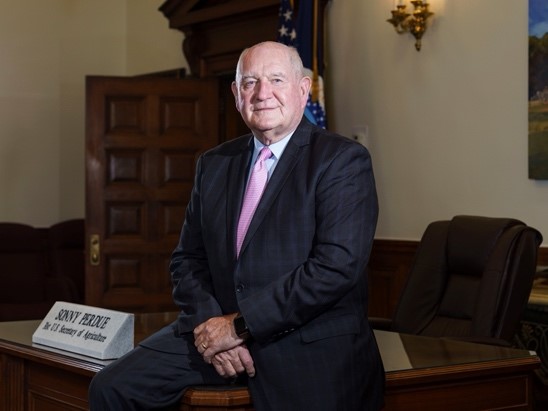
ATLANTA – Former Gov. Sonny Perdue will become the 14th chancellor of the University System of Georgia.
The system’s Board of Regents voted unanimously Tuesday to hire Perdue to lead the state’s 26 public colleges and universities, their more than 300,000 students and more than 40,000 faculty and staff.
Perdue, 75, of Houston County, was selected sole finalist for the post two weeks ago after a nationwide search following the retirement of former Chancellor Steve Wrigley last summer.
The Republican served two terms as governor in the 2000s, then was secretary of agriculture in former President Donald Trump’s administration from 2017 until early last year.
Before being elected statewide, Perdue served in the state Senate, where he chaired the chamber’s Higher Education Committee.
Student and faculty groups criticized Perdue’s appointment because of his lack of experience in education administration.
But Regent Don Waters of Savannah said management and leadership are more important to the chancellor’s role than an academic pedigree.
“Sonny Perdue is extraordinarily well equipped to lead the University System of Georgia,” he said. “His skills make him the right person at the right time.”
Regent Barbara Rivera-Holmes of Albany said Perdue will take on his new role with the university system at an important time for higher education in Georgia.
“We’re facing a national and global labor crisis … a workforce challenge,” she said. “Our institutions are our biggest economic development drivers. … Sonny will do a phenomenal job.”
Perdue’s appointment is effective April 1.
“I appreciate the board’s confidence in me and look forward to working together with them, our campus leadership and faculties, our elected representatives and most importantly, our students, to provide opportunities for students, faculty and staff to be successful and to produce even more outstanding results,” Perdue, who did not attend Tuesday’s board meeting, said in a statement.
“This may be the most important job yet. I can’t think of a better way to make a difference than to help prepare the next generation – educating them for prosperity, themselves, their families and ultimately our state. I’m excited to get started.”
Teresa MacCartney, who has served as acting chancellor since Wrigley left, will remain with the university system as executive vice chancellor of administration.
“She’s been an incredible leader,” Regent Harold Reynolds, the board’s chairman, said before Tuesday’s vote. “We’re grateful for her steady hand.”
This story is available through a news partnership with Capitol Beat News Service, a project of the Georgia Press Educational Foundation.
Georgia House Speaker David Ralston (Photo by Beau Evans)
ATLANTA – Republicans in the Georgia House of Representatives are proposing the third state tax cut in the last five years.
Legislation introduced in the House Tuesday calls for lowering Georgia’s income tax rate from 5.75% to 5.25%, returning $1 billion to state taxpayers.
“We believe as a core principle that government must live within its means, that there is no such thing as government money,” House Speaker David Ralston, R-Blue Ridge, told reporters during a news conference unveiling the bill. “It belongs to Georgia taxpayers.”
The Republican-controlled General Assembly rolled back the state income tax rate from 6% to 5.75% in 2018, then followed that up last year by raising the standard deduction for single taxpayers and couples filing jointly.
In proposing a third tax cut, Ralston cited the highest inflation rate in the last 40 years – 7% statewide last year and 9.8% in Atlanta – leaving Georgians in need of tax relief.
“Everything is costing more, food, gas, the things Georgians buy every day,” he said.
Rep. Shaw Blackmon, R-Bonaire, chairman of the House Ways and Means Committee, said the tax cut would mean Georgia families with incomes of $30,000 a year would pay no state income taxes, while those with incomes of $50,000 annually would owe only $400. The cuts would take effect with the 2024 tax year.
House Appropriations Committee Chairman Terry England, R-Auburn, said strong growth in tax revenues despite the impact of the pandemic means the state can afford an additional tax cut.
“The growth we’ve seen in revenues … is outpacing what the needs are,” he said.
But Ralston cautioned against completing eliminating the state income tax, an idea being pushed by state Senate President Pro Tempore Butch Miller, R-Gainesville.
“That would blow a catastrophic hole in the budget,” the speaker said. “The responsible way to do it is taken the incremental approach we’ve adopted in the House.”
Minority Democrats likely will push back against even an incremental tax cut. Democratic lawmakers have long argued the state is underfunding such critical needs as education and health care.
House Republicans rolled out the proposed income tax cut on the same day the chamber passed a one-time $1.6 billion reduction in taxes proposed by Gov. Brian Kemp. The bill passed 148-18 and now heads to the state Senate.
This story is available through a news partnership with Capitol Beat News Service, a project of the Georgia Press Educational Foundation.
ATLANTA – Women in Georgia would be prohibited from obtaining abortion-inducing drugs through the mail without seeing a doctor under legislation that cleared the state Senate Tuesday.
The bill, which passed 31-22 and now moves to the Georgia House of Representatives, targets providing such drugs through telemedicine, a practice the Biden administration authorized last year as a pandemic measure.
“Telemedicine may be appropriate in certain instances but not when it places a patient in grave danger,” said Sen. Bruce Thompson, R-White, the bill’s chief sponsor. “This bill is about assuring powerful drugs such as these are prescribed as intended.”
But Senate Democrats accused the bill’s Republican backers of trying to make abortions more difficult to get – particularly for low-income women in rural communities – rather than protecting women.
Sen. Kim Jackson, D-Stone Mountain, said telemedicine is a critical option in a state where half of the 159 counties don’t have an ob-gyn.
“This bill is really about access to health care,” she said. “Without access, there can be no equity in health care.”
Other Democrats said abortion-inducing drugs have been thoroughly studied and proven safe.
But Thompson said some women have died after taking abortion-inducing drugs without the supervision of a qualified physician.
“This bill’s about protecting women,” he said. “It’s about the health and safety of women.
This story isavailable through a news partnership with Capitol Beat News Service, a project of the Georgia Press Educational Foundation.
University of Georgia football coach Kirby Smart (Credit: Dawg Post)
ATLANTA – A General Assembly that has been sharply divided during the current legislative session came together Tuesday to honor Kirby Smart, head coach of the national champion University of Georgia Bulldogs.
Smart, who led the Dawgs to a 33-18 victory over the University of Alabama in January, brought the national championship trophy with him to the Georgia House and Senate chambers.
After being greeted with standing ovations and Dawg barks from lawmakers, Smart thanked Georgia’s political leaders for helping him do his job through their efforts to make the Peach State an attractive place to live and – for top-level high school recruits – to play college football.
“Our university wouldn’t be what it is without the people in this room,” Smart told members of the Senate from the chamber’s podium. “You’re part of this team. … The better you make the state, the better off our football team will be.”
Smart told members of the House his team already has begun spring workouts with an eye toward the 2022 season this fall.
He said the Dawgs can’t afford to dwell on the successes of last season and the championship win over Alabama and legendary coach Nick Saban.
“If you sit for too long, that guy on the other side of the border will catch up to you,” he said.
This story isavailable through a news partnership with Capitol Beat News Service, a project of the Georgia Press Educational Foundation.