ATLANTA — Drivers will soon find gas to be a little cheaper in Georgia after Gov. Brian Kemp signed a law Friday that immediately suspended the state excise tax on motor fuel to address affordability concerns.
“Today is just the latest step we’re taking and it’s one that will help all Georgians as they work to make ends meet,” Kemp said at the Capitol before signing House Bill 1199 into law. The measure passed the House on Wednesday with broad bipartisan support and cleared the Senate unanimously on Thursday.
Kemp also signed House Bill 1000, giving Georgians a one-time rebate on income taxes paid last year or the year before. Individual filers will get $250 back, heads of household $375 and married couples filing jointly $500.
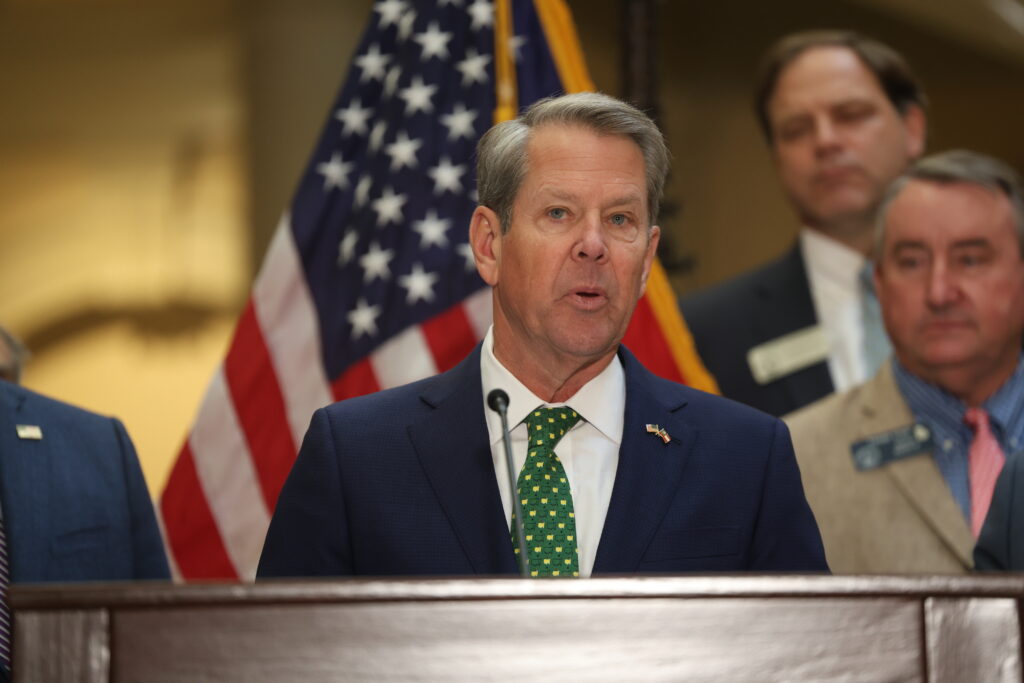
Gov. Brian Kemp speaks before signing Georgia House Bills 1199 and 1000 into law at the Georgia State Capitol on Friday, March 20, 2026. The laws suspend the state motor fuel tax for 60 days and implement one-time income tax rebates. (Ashtin Barker/Capitol Beat)
Kemp noted that lawmakers were working to help Georgians deal with affordability well ahead of the elections, when voters are expected to select candidates based on their feelings about the issue.
The fuel tax suspension, the fourth during Kemp’s tenure, will cost the state treasury an estimated $400 million during the 60 days it is in effect. The timing has the suspension in place up to the Georgia primary election on May 19.
Lt. Gov. Burt Jones, who is running for the GOP nomination for governor, applauded the collaboration between the Senate, the House and the governor’s office.
“We want to get income tax relief. We want to get property tax relief. So, we’re working together on getting this done,” Jones said.
Kemp’s signature on HB 1199 immediately suspends the state’s 33 cent per gallon excise tax on gasoline. It also suspends the 37 cent a gallon tax on diesel fuel, which affects the cost of food and other goods on store shelves.
Gas prices spiked after President Donald Trump ordered air strikes on Iran last month.
“We’re all feeling the pain at the pump as instability in the global oil markets causes the cost of fuel to rise across this country,” House Speaker Jon Burns, R-Newington said.
He said Georgia is among the first states to suspend the gas tax to suppress the recent run-up in prices. He said the state House met this week with representatives of the trucking industry, which faces a nearly $2 per gallon increase in diesel costs.
Burns said he anticipated “a quick and successful end to the conflict overseas that is causing these increases.” He also thanked American military members and their families, saying “we should all keep them in our prayers.”
Then, Kemp signed the bills that will leave more income tax money in Georgian’s pockets and reduce the cost of travel as families embark on spring break trips.
ATLANTA — Georgia drivers should soon see relief at the pump after the Georgia General Assembly sent a temporary gasoline tax suspension to Gov. Brian Kemp.
The 60-day suspension of the state excise tax would save drivers just over 33 cents a gallon for gasoline and 37 cents a gallon for diesel.
It would cost the state treasury an estimated $200 million a month.
The measure comes after the U.S. attack on Iran triggered a spike in fuel prices.
“Hopefully this will be resolved but in the meantime we’re going to do what we can to help our citizens of Georgia have the lowest cost possible,” said Sen. Chuck Hufstetler, R-Rome, who presented House Bill 1199 on the Senate floor Thursday.
The bill started out as a measure to conform Georgia law with changes in the federal tax code. It passed the House for the first time in mid-February, a week before the air strikes on Iran ordered by President Donald Trump.
The bill bounced back and forth between the House and Senate as each made changes, and then, on Wednesday, the House added the gas tax suspension and sent HB 1199 to the Senate again.
“We’re hopeful that the ongoing international conflict, which is temporarily driving up energy prices, comes to an expeditious and successful conclusion,” Hufstetler said.
He talked about affordability, noting that fuel prices ripple through the economy, driving up the price of fertilizer and food.
Democrats agreed.
“It’s a win for our constituents and hopefully will give them much needed relief while we get through this time,” said Sen. Nikki Merritt, D-Grayson, the minority caucus vice chair.
The bill then passed the Senate unanimously.
Kemp has used his authority to unilaterally order three gas tax suspensions in recent years in response to high prices, inflation and Hurricane Helene.
Kemp said Thursday on X that he applauded passage of the bill because it would provide immediate relief for families: “This is great news for all Georgians, and I look forward to signing this tomorrow!”
ATLANTA — Students in Georgia schools and colleges who face certain types of discrimination could soon have a path for redress that need not involve the federal government.
Both the state House and Senate have passed a measure that would establish a Georgia-based process for investigating complaints of discrimination involving race, ethnicity, national origin or religion.
The version of Senate Bill 523 that passed the House unanimously Wednesday had been stripped of language that would have required public schools to treat harassment or discrimination motivated by antisemitism the same as religious discrimination.
Even so, Rep. Esther Panitch, D-Sandy Springs, praised the measure, citing instances of Jewish parents who felt powerless when their children were subjected to harassment.
“These families had no real recourse short of going to the media or filing a federal complaint,” said Panitch, the only Jewish member of the Georgia General Assembly.
In its current form, the measure would require that the Georgia Department of Education employ a statewide coordinator of Title VI, the part of the federal Civil Rights Act that prohibits discrimination based on race, color or national origin.
Sen. Russ Goodman, R-Cogdell, said he was moved to introduce the bill because of a family trip to Israel. They happened to be there the day Hamas attacked in 2023.
“There are extremes on both ends of the political spectrum that in today’s climate condone antisemitism,” he said at a House committee hearing on his measure last week. “History has shown us what happens when we allow antisemitism to take root in our society.”
He referenced the slaughter of World War II unleashed by Nazi Germany and the Americans who died “before we got the genie back into the bottle.”
He left that hearing before Rep. Deborah Silcox, R-Sandy Springs, presented the measure, saying that the language targeting antisemitism had been deleted.
Several public commenters, include one representing a Muslim civil rights advocacy organization, then praised the deletion. They said the bill now treated all faiths equally.
SB 523 would require public schools and colleges to establish policies for handling discrimination complaints or risk the withholding of their state funds.
The measure returns to the Senate, which can choose to accept or reject the House changes.
ATLANTA — Georgia drivers could soon get a break on rising gas prices under a proposal moving quickly through the General Assembly.
The state House voted 163-4 on a bill Wednesday that would suspend Georgia’s gas tax to help moderate costs as they increase because of the United States war with Iran.
“Given the actions in the Middle East, this is going to be some well-received relief to our constituents and taxpayers, particularly as we head into the summer season for purchasing gasoline,” said Rep. John Carson, R-Marietta.
Gas prices in Georgia average $3.73 per gallon for regular unleaded, according to AAA. That’s an increase of more than a dollar per gallon compared to a month ago, when prices averaged $2.71 per gallon.
The proposal, House Bill 1199, would suspend Georgia gas taxes for 60 days at a cost of roughly $200 million per month to the state government.
“Today’s passage of House Bill 1199 is a direct reflection of the House’s continued leadership in addressing affordability for citizens across the state,” said House Speaker Jon Burns, R-Newington. “We are delivering meaningful, timely relief to millions of Georgia drivers and families when and where it’s needed most.”
Gov. Brian Kemp, who would have to sign off on the bill if it passes the Senate, hasn’t yet agreed to the plan.
But Kemp has used his authority to suspend gas taxes by executive order three times in recent years in response to high prices, inflation and Hurricane Helene.
“The governor is always actively working to find ways to support hardworking Georgians, including this step alongside the Legislature to keep more money in their pockets,” said a spokesperson for Kemp.
HB 1199 now advances to a final vote in the Senate.
ATLANTA — Georgia representatives abandoned a deadline to change the state’s voting technology before this November’s election, advancing a bill Tuesday that delays a switch to hand-marked paper ballots until the 2028 election year.
The amended bill wouldn’t remove computer QR codes from ballots for nearly two more years, frustrating critics of Georgia’s elections who say the state’s touchscreen voting system is untrustworthy and insecure.
Legislators had passed a state law in 2024 to remove QR codes by this year, but they said they need more time to buy new election equipment and train election workers before rolling out new technology for over 8 million registered Georgia voters.
The bill cleared the House Governmental Affairs Committee on Tuesday and could soon reach a vote in the full House of Representatives.
“This was not the original vision that we had proposed,” said House Governmental Affairs Chairman Victor Anderson, R-Cornelia. “We very quickly and very abruptly began to realize the practicality of that happening without causing a severe upset in our election.”
All in-person Georgia voters use touchscreens that print out paper ballots, which are then tabulated by scanning machines that read a QR code.
Opponents of Georgia’s voting technology say voters aren’t able to read QR codes to verify that their ballots accurately reflect their choices.
Under Senate Bill 214, the state government would buy new machines that would print out ballots on-demand when voters arrive at the polls starting in 2028. Then voters would bubble in their choices with a pen and insert their ballots into a scanner.
“We’re kicking the can down the road another two years,” said Autumn Miller, a Fulton County voter who testified to the committee Tuesday. “I don’t trust this. When can we get our election back? What can we do as a voter to get these QR codes off and have a good election?”
Election officials from counties across the state turned out at the committee meeting in support of the revised bill.
“This is something that’s setting us up for success and not for failure. The timeline was our biggest concern,” said Paulding County Election Director Deidre Holden. “It’s our duty to serve our voters and to serve them well. I don’t like confusion when it comes to our voters.”
The bill doesn’t include funding, but Anderson said he’s working to identify money in the state budget to pay for the new voting system.
When Georgia bought its touchscreen-based voting system in 2019, manufactured by Dominion Voting Systems, it cost over $100 million.
Both election security advocates and conservatives have for years opposed Georgia’s voting equipment. Republican criticisms of the technology increased after Republican President Donald Trump narrowly lost the 2020 election to Democrat Joe Biden.
“We cannot have fair and accurate elections with the Dominion machines,” said Earl Ferguson, a conservative voter, told the committee.
The Senate rejected a bill earlier this month that would have forced Georgia to make a rapid conversion to hand-marked paper ballots in time for this year’s midterms. That legislation, which called for hand-marked paper ballots and fewer early voting locations, failed amid concerns it would lead to “chaos” and voters unable to cast their ballots.
Hand-marked ballots are the main election day voting method in two-thirds of the United States, according to the election technology organization Verified Voting.
If the House passes this version of SB 214, it would return to the Senate for another vote. But if the Senate disagrees with the changes to the bill, a conference committee would need to resolve any disputes.
Without a new state law, the July 1 deadline to remove QR codes would remain in place without any plan to do so. Anderson warned that inaction by the General Assembly could lead the problem to be decided by the courts right before a major election.