In a rare bipartisan moment during this year’s legislative session in Georgia, Democrats and Republicans agreed on how to do something about what they said was a core cause of Georgia’s housing affordability problem.
The state Senate passed a bill that sought to punish institutional investors with more than 500 single-family rental homes.
Sen. Greg Dolezal, R-Cumming, accused investors of exacerbating the housing crisis by outbidding regular purchasers trying to buy a house, thus driving up prices and forcing many would-be homebuyers to rent instead.
“I have a grave fear that we are becoming a nation of renters and not homeowners,” Dolezal said at a Senate committee hearing last month. The Senate went on to pass his legislation 49-3.
Senate Bill 463 would have enforced the ownership cap by allowing lawsuits against these companies and by withdrawing their tax credits and deductions.
But Dolezal’s bill fell apart Thursday, when a committee of the state House deleted the language, replacing it with another measure.
The legislative session ends Thursday, so time is running out.
Something similar happened last year. Legislation that sought a 2,000-home cap for institutional owners failed to exit a House committee after the industry raised constitutional concerns, as happened with SB 463.
The lawmakers were pursuing a popular cause.
An Atlanta Regional Commission survey in 11 metro Atlanta counties last summer found housing affordability was the No. 1 concern. The 2025 Metro Atlanta Speaks Survey said 44% blamed developers and 35% blamed investors buying up homes to rent.
Last spring, U.S. Sen. John Ossoff announced an investigation into “large, out-of-state companies driving up home prices in Georgia.”
A news conference at the Democrat’s Atlanta office featured renters complaining about unsafe conditions. One reported dangerous debris embedded in his backyard. Another reported gas leaks that she said went unaddressed for weeks.
In a demonstration of bipartisan frustration, President Donald Trump, in January, penned an executive order titled “Stopping Wall Street from Competing with Main Street Homebuyers.”
Two weeks later, Dolezal, who is running for the GOP nomination for lieutenant governor, introduced SB 463.
A 2024 report by Georgia State University and Rutgers University found that three companies collectively owned more than 19,000 rental homes in metro Atlanta. The report said corporate landlords were drawn to the area by cheap housing and lax tenant protections.
One of them, Amherst, told Capitol Beat that the industry provides housing to families that cannot qualify for a mortgage.
“We understand that we’re easy scapegoats,” said Dagney Gomez del Campo, an Amherst spokeswoman. But she pointed to data about the service her company provides: Amherst spent over $526 million renovating more than 8,300 homes during at least 14 years of operations in Georgia when it housed about 57,000 renters.
Renters’ credit scores were typically in the 600s, below the 700s common among first-time homebuyers with a government-sponsored mortgage, according to Amherst.
Sharon Franklin, a renter through Amherst subsidiary MainStreet Renewal, described an idyllic home she and her two older sisters, both retired, are renting in Stockbridge.
It is a quiet street with wildlife roaming the property, she said, and the company has been responsive to repair requests.
At 61 and nearing retirement herself, Franklin said she had no interest in buying a house with a 30-year mortgage.
If lawmakers penalize companies like Amherst, she said, “who are we going to rent from?”
Industry fights back
Former Georgia Attorney General Sam Olens, now working for the National Home Rental Council, helped the industry attack SB 463 at a House committee hearing two weeks ago.
It was a repeat performance of his efforts against the legislation for a 2000-home cap last year.
He said Dolezal’s bill had “numerous constitutional infirmities” and was “a gift to lawyers to sue.”
The assumption of the bill — that renters would be homeowners if the investors did not already own the houses — was false, he said. The reality is that they cannot qualify for a mortgage and there is “an abject shortage” of housing, he added.
Others from the industry who spoke at the hearing contended that such a law would lead to less rehabilitation of dilapidated housing and fewer rental options.
“Good policy should be grounded in facts and data, not assumptions and misleading narratives,” said Stephen Davis, a lobbyist for Progress Residential, a multistate rental home company. “SB 463 creates serious unintended consequences: mass evictions, higher rents, lower home values, and greater school turnover.”
Jason Parker, president of rental home construction company Two Resi Build, pointed to a foundational problem. He said his company builds 100 to 150 houses a year.
“If we could build more homes, it would absolutely reduce the average house price,” he said. “Our biggest challenge is the land cost.”
Why houses got so expensive
Institutional investors bought up large swaths of housing stock when prices cratered during the Great Recession.
As of June 2022, they owned a quarter of Atlanta’s single-family rental home market, according to a 2024 report by the U.S. Government Accountability Office.
The report said these investors may have contributed to rising rents and home prices. This may have helped “stabilize” neighborhoods, the report said, adding that it was unclear whether this affected homeownership opportunities.
The rate of institutional ownership of single-family homes in Atlanta is six times the national average, said Alex Horowitz, project director of the housing policy initiative at The Pew Charitable Trusts.
But institutional investors own just 3% of all Atlanta single-family houses, he said. “Nothing that’s 3% of the market is driving the market. … And most research on single-family rentals suggests that they lower rents by adding new supply to the market overall.”
Pew’s research indicates that one main driver of housing unaffordability is the tightening of mortgage lending rules after the recession, when so many owners went into foreclosure. The standards increased while their credit ratings fell.
Another big driver is government development policy, and it is something state lawmakers could do something about, Horowitz said.
Pew released a report in mid-March that showed how Austin, Texas, reduced housing costs by implementing policies to encourage denser development, such as allowing large apartment buildings near jobs and transit and reducing minimum mandated lot sizes and parking space requirements.
Median rents fell from $1,546 in December 2021 to $1,296 by January 2026 even though Austin had added 18,000 residents.
The city added 120,000 housing units between 2015 and 2024, a 30% increase that was three times the national average, Pew reported.
Pew’s findings in Austin echoed its findings about similar policies in four other cities: Minneapolis; Portland, Or.; New Rochelle, N.Y.; and Tysons, Va.
Horowitz said Texas enacted seven laws last year that should result in a lot of new housing, such as allowing apartments on commercially zoned land and homes on smaller lots, and expanding use of manufactured housing.
A path forward for Georgia
One Georgia bill would have taken the state in the direction of Texas.
Senate Bill 508 sought to offer financial incentives to encourage Georgia communities to reduce minimum lot sizes and parking requirements and to take other steps to increase density.
Sen. Elena Parent, D-Atlanta, the main sponsor, said it is difficult for local elected officials to make such changes because existing residents tend to push back. Not in my backyard, or “NIMBYism,” is a powerful force, she said.
Lawmakers are more insulated from local pressure, she said, so if zoning is to change, the push can more easily come from the Legislature.
Her legislation probably never had a chance because all the other sponsors were Democrats, and the General Assembly is controlled by Republicans.
But Parent and every other Democrat present voted for Dolezal’s corporate homeownership cap when it reached the Senate floor. It’s a good bill, she said.
Next year, Republicans should reintroduce her bill and call it their own, said Parent, who is not running for re-election.
“I think it is something they should hop on and pass it themselves,” she said. “It isn’t really a partisan issue.”
ATLANTA — The Georgia Senate approved its version of the $38.5 billion fiscal year 2027 budget Friday, sending it to the state House for negotiations over the disagreements.
The House started the budget process, passing its version earlier this month.
Among the big differences: the Senate reduced the House’s increase in funding for the state’s public colleges and universities by just over $110 million, increased the amount for private K-12 school vouchers by $31 million and added $100 million to the state employee pension system.
“I think this is one of the most important lines in the budget,” Sen. Blake Tillery, R-Vidalia, chairman of the Senate Appropriations Committee, told senators before Friday’s unanimous vote for passage. Pensions have been eroded by decades of inflation as increases have failed to keep pace, he said. The extra money is intended to trigger regular annual cost of living increases.
The Senate agreed with the importance of the House’s focus on literacy but amended the way that new program would be funded. Instead of building money to hire 1,313 literacy coaches for K-3 classrooms into the public school funding formula, the Senate chose a $70 million grant.
The Senate made myriad smaller changes. It cut the $11 million the House had allocated to hire staff to confirm all food stamp enrollees are eligible.
Georgia has one of the highest “error” rates in the country, which can mean loss of federal funding. Lawmakers in both chambers want to reduce that rate, but the Senate chose to accept an offer from the company Equifax to do the work for free.
The House disagreed with the Senate’s changes and the Senate held fast, sending the budget to a conference committee to iron out the wrinkles.
Higher education funding could be a sticking point. Tillery said he had heard complaints about the Senate cutting the University System of Georgia’s budget. But he pointed out that the system budget would still rise under the Senate’s proposal, from $3.6 billion in state funding this year to $3.76 billion next year. It just would not rise as much as the House proposed.
“Only in government,” he said in an interview, “can you give an agency more money next year than this year and it be a cut.”
ATLANTA — A proposal for a quick switch to hand-marked paper ballots cleared the Georgia Senate on Friday, an idea that election officials say would disrupt this year’s elections.
The Senate’s 32-21 party-line vote sets up a showdown over competing bills that would change Georgia’s voting system. The Senate bill would take effect this summer, while a House proposal would delay the transition until the 2028 election year.
The measure that advanced Friday would require voters to fill out ballots by bubbling in ovals instead of making their choices on touchscreens. Millions of ballots would need to be preprinted and stored until voters fill them out.
Immediately replacing Georgia’s statewide voting system would be “irresponsible and unrealistic,” said Joseph Kirk, president of the Georgia Association of Voter Registration and Election Officials.
“It’s just not enough time” for training, testing, and implementation, Kirk said. “You don’t want to do it for the first time in a Georgia 2026 gubernatorial election, when we’re going to have lines and have a bunch of folks there. That’s a really heavy lift.”
The bill follows a state law legislators passed two years ago that set a deadline to remove computer QR codes from ballots by July 1 of this year. Critics of Georgia’s election system say voters can’t read QR codes to verify that their ballots accurately reflect their choices.
The House’s proposal would move that deadline until 2028, before voters decide on the next U.S. president.
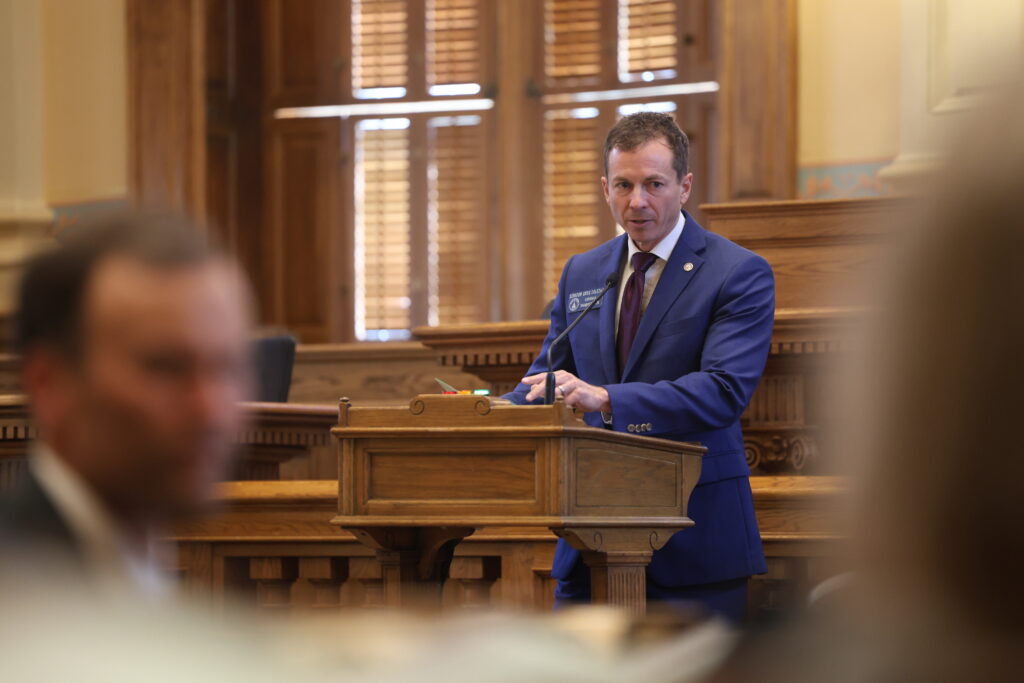
Sen. Greg Dolezal, R-Cumming, speaks in support of House Bill 960 on the Senate floor, which would move Georgia to hand-marked paper ballots before this fall’s election, in the Georgia Capitol in Atlanta on Friday, March 27, 2026. (Ashtin Barker/Capitol Beat)
Sen. Greg Dolezal, R-Cumming, said now is the time to change to hand-marked paper ballots.
Hand-marked ballots are the main election day voting method in two-thirds of the United States, according to the election technology organization Verified Voting.
“Democrats tell you on one hand we should move to paper ballots. But now that we’re trying to do it, it’s a threat to democracy: Bloody Sunday, voter suppression, Donald Trump,” Dolezal said. “All that we’re asking is for Georgians … to vote the way that the vast majority of people in America vote.”
Critics of Georgia’s elections, including election security advocates and Republicans disillusioned by Trump’s loss in 2020, say Georgia’s touchscreen voting system is untrustworthy and insecure.
But election officials and Democrats say Georgia’s elections are accurate, and allegations of widespread fraud have never been proved.
Sen. Kim Jackson, D-Stone Mountain, said the bill’s requirement to print so many ballots before elections introduces new problems.
“We have built in all kinds of opportunities for human error, let alone the major security risks and concerns that I have when you have thousands and thousands of preprinted ballots sitting in someone’s fellowship hall,” Jackson said. “Georgia is moving in a direction of changing our system because there has been so much doubt seeded into our system, even though we’ve proven that they are safe and secure.”
Under the competing bill in the House, the state would purchase new ballot-on-demand printers that would create ballots when voters arrive rather than require blank ballots in advance.
The Senate bill also includes new provisions that would fine county governments $100 for each voter registration they fail to cancel after receiving information those voters might have moved away, require election officials to post the names of all voters by midnight on election day, and mandate recounts by hand.
Senators previously voted down a similar version of their elections bill earlier this year, but Republicans mustered enough votes Friday to override Democratic opposition.
With just two business days left before this year’s legislative session ends, Georgia lawmakers will need to decide how to resolve their difference.
The House could consider the bill that passed the Senate on Friday, House Bill 960. Or the House could move forward with its legislation, Senate Bill 214, that would replace Georgia’s voting system before the 2028 election.
ATLANTA — A Republican measure to limit out-of-state support of Georgia political campaigns passed a state House committee and is nearing final passage in the final days of this year’s legislative session.
Senate Bill 423 would make it a felony punishable by up to a decade in prison for an intermediary to launder money from out-of-state donors and give it to a local campaign.
The campaigns would have to return whatever portion of non-Georgia donations exceed their total local dollars raised, or the state would take the money.
It would be the responsibility of candidate’s campaigns to source the dollars and ensure they came from people who — or companies that — pay taxes in Georgia.
“What we’re saying is you can run the ads. We just want to know who you are,” said Sen. Tim Bearden, R-Carrollton, the sponsor of the bill.
The measure passed the Senate with opposition from Democrats in early March.
Rep. Martin Momtahan, R-Dallas, member of the House committee that passed the bill out of the House committee on a party-line vote Thursday, said it was a necessary measure to protect Georgians from out-of-state interests that want access to the state’s natural resources, such as water.
Rep. Solomon Adesanya, D-Marietta, countered that wealthy candidates who can self-fund their campaigns could escape the limitations by simply giving enough of their own money to match whatever they collected from outside Georgia.
“So this is going to be unfair,” he said. “This is actually not going to be protecting Georgia. It’s going to give a certain candidate who can self-fund an … advantage.”
He didn’t name names, but two GOP candidates for Georgia governor — Lt. Gov. Burt Jones and businessman Rick Jackson — have reservoirs of personal money that they can tap for their campaigns.
When Rep. Rhonda Burnough, D-Riverdale, asked what would happen if her friends from other states wanted to give her money, Bearden responded that she’d have to raise more money locally to match the amount.
The committee made a small change that Bearden approved.
So if the House were to pass the measure, it would have to return to the Senate for agreement.
ATLANTA — Legislation that raised alarms about public access to police videos passed through a House committee Thursday with amendments that eased access for members of two Georgia media associations.
Senate Bill 482 started out as a way to restrict the free flow of mugshots online, where unscrupulous operators are reportedly violating a state law that requires removal upon request, free of charge when the person depicted was not convicted.
Along the way, the bill morphed into a broader restriction on the release of police body-worn camera footage and other law enforcement videos.
Free speech advocates worried that videos showing police misconduct could be withheld from the public if the legislation were to become law.
On Thursday, the House committee charged with vetting the bill exempted certain media organizations from many of the bill’s provisions: “bona fide credentialed” members of the Georgia Association of Broadcasters and of the Georgia Press Association, which has 139 newspaper members and operates Capitol Beat.
Everyone else, except those depicted or their next of kin, would have to go in person with a notarized document to obtain a mugshot or video.
And no one except next of kin and association members would have access to state recordings depicting death.
No one would be exempt from a core requirement: that they be able to identify either a person depicted or, in the case of a video, alternative information about the time, location or officer who recorded it.
Police would be authorized to redact images in videos of people the requester cannot identify, except for law enforcement personnel.
Sen. Brian Strickland, R-McDonough, said he introduced the legislation because of the harmful invasion of privacy by a rogue mugshot industry.
He said the video component was hastily added in a Senate committee and, in retrospect, was not properly vetted. He said he opted to include videos because police should not be compelled to release them to be exploited “for some kind of sick entertainment.”
During a hearing earlier this week, one public commenter challenged the notion of a video industry profiting from grief. That prompted Rep. Terry Cummings, D-Mableton, to describe a video of a friend’s husband, decapitated in a motorcycle crash, circulating on YouTube. She said the person who posted it demanded money to take it down.
On Thursday, Sarah Hunt-Blackwell, with the ACLU of Georgia, said the new restrictions combined with a prohibition in another bill would “completely gut” public scrutiny of police activity through video.
The other bill she referenced, Senate Bill 268, would require the observing public to remain 25 feet away from police and other first responders doing their duty.
“We understand the sensitivities around exploiting people’s most vulnerable moments,” she said, “but placing an almost impenetrable shield around observance of law enforcement actions is not the solution.”
Lobbyists for the two media associations asked for the media exemption on access to videos depicting death.
Both Cummings and Rep. Bill Werkheiser, R-Glennville, asked why those associations were singled out to decide which media organizations get access, and Strickland said it was because they are known to the state and have a credentialing process.
Their members are known entities that would be subject to enforcement of Georgia law governing use of the material, he said, adding that nothing would prevent the General Assembly amending that provision later “if these two groups are being too exclusive.”
Another amendment expanded the definition of next of kin, giving courts more latitude to decide if a familial relationship exists.
The bill then passed the committee unanimously. Should the House approve it, the Senate would have to agree to the changes before it could become law.