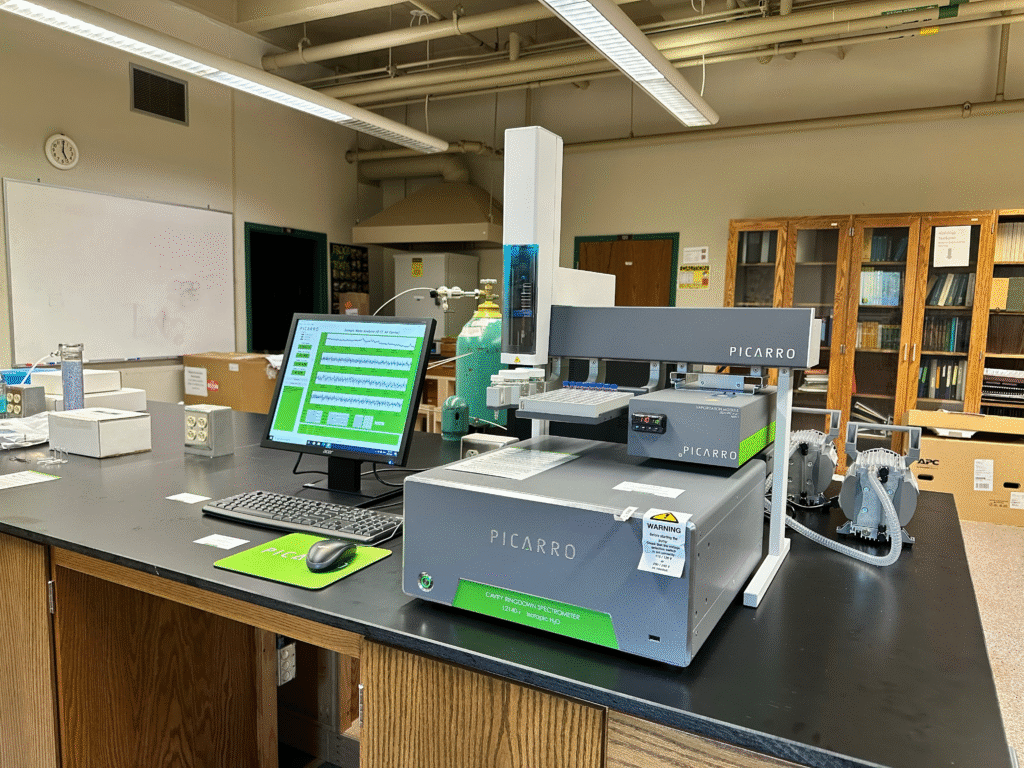
The device that Jaivime Evaristo, co-author of new research about water “fingerprints” linking the Okefenokee Swamp to an aquifer below, used to measure water isotopes. Evaristo is a University of Georgia assistant professor of hydrology and water resources. (Courtesy of Jaivime Evaristo)
ATLANTA — New scientific research has added more evidence about the risks of mining near the Okefenokee Swamp, with potential implications for future permitting applications.
Philanthropists neutralized the latest attempt to withdraw minerals near the ancient wetland by purchasing property on Trail Ridge.
Twin Pines Minerals was engaged in a years-long petition to mine titanium dioxide when the Conservation Fund announced the purchase agreement in June.
The company had argued that its plans to draw an average of 1.4 million gallons of water a day from an aquifer deep underground would not harm the swamp.
Environmentalists and scientists asserted that water withdrawal of that magnitude would lower the swamp’s water level. That in turn, they argued, would wreak havoc on a rich ecosystem that is among the best preserved blackwater wetlands in the world and home to endangered and threatened species
Now, researchers have found more evidence that the Okefenokee is linked to the aquifer and that drawing water from the aquifer would effectively draw water from the swamp.
In an article published last week in Environmental Research: Water, University of Georgia scientists report that water in the Okefenokee has the same “fingerprint” as water in nearby parts of the much larger aquifer deep underground, which means the Okefenokee is likely draining into the aquifer.
Water samples can have different atomic mass, or isotopes, depending upon the number of neutrons present. Water that has undergone significant evaporation can be a heavier isotope, and scientists used this characteristic to document similarities between what is in the Okefenokee and what they extracted from the Upper Floridian Aquifer beneath it. Water in the aquifer that was farther from the swamp was lighter.
They also found another connection: they examined decades of records and found that the swamp and aquifer water levels tracked each other. When the swamp level rose after a rainstorm, the aquifer would rise a month later.
For years, a thick intervening layer of clay known as the Hawthorne Formation was assumed by some to create an impermeable barrier between the two bodies of water.
The UGA researchers’ finding of similar isotopes in both the swamp and nearby parts of the aquifer “overturns long-held assumptions in the region’s hydrogeologic conceptual model and has implications for water budgets, ecological dynamics, and groundwater management,” they wrote.
Todd Rasmussen, emeritus professor of hydrology at UGA, was one of the three authors.
He said the evidence is strong enough to suggest at least a temporary policy against mining in Charleton, Clinch and Ware counties, where most of the swamp is located.
“There should be a moratorium on groundwater pumping in those counties until further evaluations have been conducted,” Rasmussen said.
He said the state Environmental Protection Division, which was considering the Twin Pines’ permit application, saw the Hawthorne Formation as a solid barrier despite what he considered to be inadequate data about its effectiveness as a water seal.
The agency had no comment. Spokeswoman Sara Lips said Monday that Division staff had a copy of the study but had not had sufficient time to review it.
Although Rasmussen and other scientists had already hypothesized a connection between the swamp and the aquifer, this new finding provides more solid evidence.
Jordan Clark, a University of California at Santa Barbara hydrology professor, used isotopes to trace water in the Upper Floridian Aquifer in the 1990s. He was not involved in the new study, but it cites his work.
He rated the research approach in the new study as “pretty strong” and “very valid.”
Clark said, however, that further testing to confirm that the water in the aquifer isn’t ancient would provide more solid confirmation of a connection, since some theorize that the aquifer was filled by glaciers over 10,000 years ago.
He said evidence of human influence, such as traces of atomic testing from the 1950s and 1960s that would have been present in groundwater, would be more convincing. But he also said he doubts the aquifer is still holding water from 10,000 years ago and that water recharge from the surface in the past half century is probably the easiest explanation for the aquifer’s water source.
Josh Marks, president of Georgians for the Okefenokee, heralded the findings as a “game changer” that proves a mine would harm the swamp. He said the Environmental Protection Division’s position on the issue is “yet another reminder” that the agency “is simply incapable of regulating mining at the Okefenokee” and that lawmakers should step in and ban mining there.
Megan Huynh, a senior attorney over the Southern Environmental Law Center’s wetlands and coastal protection program, said the new research will be useful if another landowner seeks permission to mine near the swamp.
“The science was out there already to say that mining next to the Okefenokee couldn’t be done safely and was a bad idea,” she said. “This is more evidence to support that.”
ATLANTA — National economic headwinds driven in part by politics will continue suppressing Georgia’s economy while raising the risk of recession, says a new economic forecast from a business think tank at the University of Georgia.
The 43rd annual prediction by the Selig Center for Economic Growth rates the risk of a recession in Georgia at pretty much a coin toss.
“In short, Georgia’s economy will struggle, and it would not take much to tip into recession,” says the report, out this week.
It places the odds of a recession in Georgia at 49%.
The forces on the state economy are largely the result of policies in Washington, as President Donald Trump’s tariff war blunts national economic growth, which the report placed at 1.3% rather than the potential 2%. Job growth will likely remain subpar, its authors predicted.
“We’re expecting another year of slow economic growth. The rate of growth will be very similar in 2026 to what we experienced in 2025, but there is a higher risk of recession,” Jeffrey M. Humphreys, the main author, said in an interview.
Given the uncertainty in the economic and political environment, fewer projects are in the pipeline, said Humphreys, the director of the Selig Center. “The biggest headwind is of course the trade war. And then the second biggest headwind is more restrictive immigration policies.”
Georgia depends more on international trade than the average state, so the tariff troubles have been taking a greater toll here.
Atlanta, with a highly diverse economy, depends less on global trade than other large metro areas, so is less exposed.
But smaller communities with economies based more on production and international trade are feeling that ill wind.
The economies of coastal Brunswick and Savannah, for instance, rely heavily on shipping through their major ports. And North Georgia industrial communities — Dalton with flooring and Gainesville with food and machinery production — are also affected, as they move product through those ports to international consumers.
The job market has been stable, if lackluster.
The unemployment rate remained at 3.4% in September, the same as in August, according to the Georgia Department of Labor. That was a percentage point below the national average, though it meant more than 180,000 without jobs.
The job market has been cooling through the year though.
Previously, employees could hop between jobs to boost their wages.
Now, employers have the upper hand, Humphreys said. And that should last into next year.
“The labor market has barely been adding any jobs at all,” he said. “We’re only expecting about a half a percent job growth next year, so basically the labor market has stalled out.”
Even so, consumers have been propping up the economy.
November tax revenues were up 0.9% last month compared to November a year ago, according to the Georgia Department of Revenue.
Income tax collections fell but were counterbalanced by rising sales tax revenue, with motor fuel tax receipts up a whopping 53%, or $70 million.
Despite the uncertain economic outlook, people who have jobs feel secure in them, the Selig Center report said.
Household finances are generally in good shape with manageable debt, due in part to a housing shortage that has buttressed home values. Houses are pretty much worth the mortgage note, so home loans are not at risk of sinking underwater like in 2008.
And many were lucky enough to lock in historically low mortgage rates a few years ago, though rising property tax and insurance rates have been nibbling away at buying power.
For those with less fortunate timing who did not find an affordable home, the report did not offer good news.
Housing costs are expected to remain out of reach next year due to a variety of factors behind an abiding shortage. The tight labor market means fewer homeowners are moving and selling. Tariffs have driven up costs for construction materials. And the Trump administration’s policies on immigration have pinched the construction industry’s labor supply.
“Since we do not expect these negative factors to change very much in 2026,” the Selig Center said, “the homebuilding and real estate industries will remain in recession.”
ATLANTA — Georgia’s freight rail line from the Port of Savannah to Murray County had a record haul last month, as seven CSX trains per week carried nearly 4,000 containers, up 35% from November 2024.
The Appalachian Regional Port opened in 2018 near Chatsworth, about an hour and a half north of Atlanta.
The Georgia Ports Authority reported Thursday that the rail traffic to and from the inland port reduces congestion and emissions in metro Atlanta by cutting back on truck mileage.
The agency also pointed to a University of Georgia study that said the port supported an increase of about 5,600 jobs in the northwest part of the state between fiscal years 2023 and 2024, for a 14% increase.
Economists at the Selig Center for Economic Growth at UGA said in a new report about the state of the economy that the Appalachian Regional Port helps the Port of Savannah tap new markets while fueling the local economies of Dalton and Rome.
Rail freight carriage is expected to grow next year as the Port Authority prepares to open its new Blue Ridge Connector in the spring.
The $127 million rail facility 50 miles from Atlanta will be served by Norfolk Southern “doublestack” trains that the Authority said would will further reduce Atlanta traffic while connecting northeast Georgia to the Port of Savannah.
ATLANTA — Georgia’s dominant electric power monopoly has a reached a tentative deal with state regulators that would allow a major expansion of energy production, mostly from natural gas.
The Public Service Commission’s public interest advocacy staff had previously advised approving only a third of Georgia Power’s request for a 10 gigawatt expansion. They had argued in November that ratepayers would face “unreasonable risk” if the company built its new power plants and no one came to use the energy.
But on Wednesday the agency revealed that the staff had negotiated a “stipulated agreement” that would authorize nearly everything Georgia Power requested, with some new guarantees for ratepayers.
The company wants more capacity so it can sell more energy as it forecasts massive growth in demand from data centers. Those server warehouses that power the internet have been sprouting across the state and devouring energy to enable the computations behind artificial intelligence.
The agreement will not be final unless the five elected commissioners, all Republicans, approve it next week.
At month’s end, two of them will be off the commission, having lost decisively in the November election to two Democrats who campaigned against a series of recent electricity price hikes.
One of the incoming commissioners, Peter Hubbard, attended a protest outside the commission offices before Wednesday’s hearing, where he said he had just learned about the new agreement revealed earlier in the morning.
He said the estimated cost of $17 billion was just the start and that it could rise to $50 billion or even $60 billion during the 45-year lifespan of the power expansion plan.
He warned that “speculative customers” might not show up if they find better deals in other states, and he said a “data center bubble” could pop, leaving ratepayers on the hook for unnecessary power plant construction.
The state can provide affordable, clean and reliable energy, said Hubbard, who takes office Jan. 1, “but we must not lock ourselves into a massively expensive mistake, with the decision made by two commissioners who are just days away from leaving office.”
The protest moved indoors for the hearing, but police escorted several back out after they caused a disruption.
“This whole meeting is a sham,” one man yelled as he exited. “They’ve already made a deal.”
Nearly 50 members of the public then got to speak. A handful, including a developer and a representative of the Clayton County Chamber of Commerce, backed the expansion, saying economic growth and jobs rely on power.
But a representative from DeKalb County read a resolution by the county commission that called on the Public Service Commission to delay its vote to ensure more time to evaluate the impact on local governments, customers, public health and the environment.
Ava Trachtenberg, an environmental science student at Emory University, spoke of the impact on the climate of burning more fossil fuel for energy. She said she was concerned that extreme heat, flooding and drought would cause crop failures and political instability.
“I don’t know about you,” she said, “but I want my future to be livable.”
Some were concerned about cost, such as Joshua Tolbert, an energy engineer, who said Georgia Power should only be authorized to build power plants for customers with executed contracts.
Satya Vatti, a nurse, said the tentative agreement would let Georgia Power profit from the expanded supply while ratepayers assumed the risk if demand didn’t materialize.
“While working people agonize over the necessities they’ll be able to afford and which they’ll have to cut each month, Georgia Power investors and executives are raking in cash,” said Vatti, who described herself as a socialist.
Records from a November hearing indicate that the commission’s public advocacy staff had misgivings about ratepayers absorbing the cost of unrealistic demand forecasts.
“Staff’s primary recommendation is that the Commission should approve the acquisition of 3,125″ megawatts, the document said.
The staff’s turnaround Wednesday to support 10 gigawatts in new capacity was due in part to a pledge by Georgia Power to calculate rates based on the forecast rather than actual revenue from “large load” customers like data centers. The pledge means a “downward pressure” for the typical residential customer’s rates, amounting to $8.50 a month, said Jeffrey R. Grubb, a director at Georgia Power who testified Wednesday.
“We want to assure the commission and our customers that certification of the requested resources will not change residential customers’ rates,” he said. “As we have stated before and reiterate here, existing customers will not pay for the cost associated with serving new large load customers.”
But that guaranty is only good from 2029 through 2031.
Tricia Pridemore, one of the five commissioners scheduled to vote Dec. 19 on Georgia Power’s expansion request, said large load ratepayers drive economic development and pump tax revenue into local government. She said she’d heard of one community that was “retiring” property taxes because of the income and of others using the proceeds to build schools or waterworks.
That is a “tremendous benefit,” she said. “So when these folks up here want to talk about affordability, that’s just one more way where that revenue is being put to use at a local level.”
ATLANTA — The Georgia Supreme Court heard oral argument Tuesday in a dispute over the extent of the Georgia General Assembly’s authority to compel testimony, but the case may become irrelevant next week now that Fulton County District Attorney Fani Willis has agreed to testify.
Willis, who has been fighting efforts by a Senate committee that wants her to appear under subpoena, has agreed to talk with them on Dec. 17, her lawyer, former Gov. Roy Barnes, said at the hearing.
The dispute stems from Willis’ decision to pursue criminal charges against Donald Trump and his allies after they disputed the outcome of the 2020 election.
Republicans in the legislature issued two subpoenas, once last year and again this year.
A lower court ordered Willis to comply, but she appealed to the state Supreme Court, prompting Tuesday’s hearing.
Republicans say they want to explore what led Willis to prosecute Trump before he became president for a second time.
Democrats have derided the Senate’s work as a political stunt, an assertion that Barnes, a Democrat, repeated outside the courthouse.
He noted that several members of the Senate Special Committee on Investigations are running for statewide office.
“They’re putting out fundraising [that] says ‘we’re going to go after Fani Willis, and you need to send me $100.’ I mean, that’s ridiculous. It is in bad faith,” he said.
Five of the committee’s members are running for higher office. The Chairman, Sen. Bill Cowsert, R-Athens, wants to be Georgia attorney general.
Four others, also Republicans, are running for lieutenant governor, although one of them, Sen. John F. Kennedy, R-Macon, announced hours before the court hearing that he was resigning immediately to focus on his campaign.
Sen. Greg Dolezal, R-Cumming, serves on the committee and is also among those running for lieutenant governor. He attended the hearing and said afterward that the Supreme Court would not have had to listen to the lawyers argue about subpoena power if it were not for Willis’ “stonewalling” the committee.
“I think the question for her is how much of this is political,” Dolezal said. He said Willis benefitted politically from the media coverage.
“The case was unfounded from the very beginning,” he said. “It was rooted in its core in a scheme of prosecution for personal profit and we need to ensure that lady justice indeed keeps her blindfold on.”
Willis indicted Trump and 18 co-defendants.
Four took plea deals, but the rest were cleared last month when a special prosector dismissed the case after Willis was sidelined due to an ethical issue.
The courts removed her from the case because she had employed a romantic partner to help prosecute it.
Barnes downplayed that.
“If they disqualify every member of the General Assembly that has a romantic relationship with a secretary or a lobbyist,” he said, “you’re not going to be able to have a quorum next session.”
Lawmakers return to the Capitol to conduct another round of state business on Jan. 12, though some will be back next week to hear Willis testify.