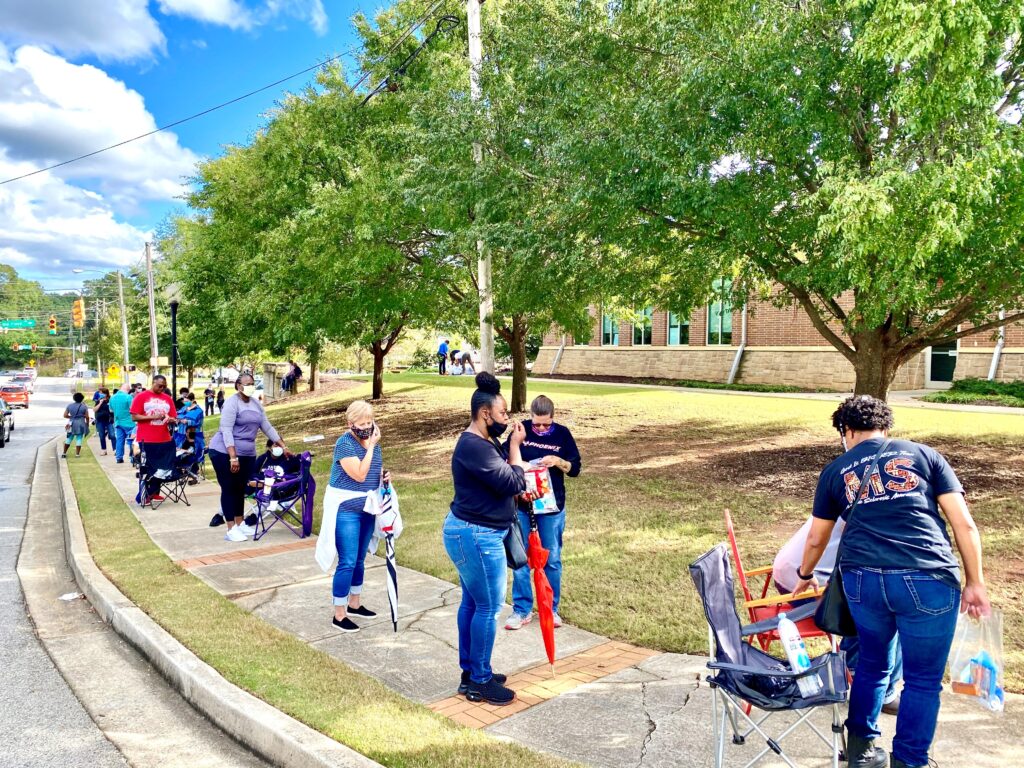
A long line outside South Cobb Regional Library in Mableton stretched around the block on the first day of early voting for the Nov. 3, 2020, elections. (Photo by Beau Evans)
ATLANTA – A federal judge has denied motions to temporarily block several provisions of controversial election reform legislation the General Assembly’s Republican majorities passed two years ago.
Several civil rights groups challenged restrictions in Senate Bill 202 on absentee voting and the placement of absentee ballot drop boxes, claiming the new law will make it harder for Black voters in Georgia to cast their ballots next year.
But U.S. District Judge J.P. Boulee ruled against the motions for a preliminary injunction Wednesday, declaring that the plaintiffs failed to prove the legislation was intended to discriminate against voters based on their race.
The provisions at issue included limits on the number of absentee drop boxes, an ID requirement for voters casting absentee ballots, and a ban on volunteers providing food and water to voters waiting in line at the polls.
“We are disappointed that the challenged provisions of SB202 will remain in effect during the 2024 election cycle,” said Rahul Garabadu, senior voting rights attorney with the American Civil Liberties Union’s Georgia chapter. “But our legal challenge is far from over. … We will never stop advocating on behalf of our clients and voters across the state.”
Georgia Secretary of State Brad Raffensperger, Republican, praised the decision.
“Today, the court confirmed what we’ve been saying all along,” he said. “SB202 strengthens election integrity while increasing the opportunity for Georgia voters to cast a ballot.”
The plaintiffs had brought the lawsuit before last year’s elections. But the judge declined to issue a ruling at the time, contending that changing voting laws close to an election would confuse voters.
The General Assembly passed SB202 after Democrats had scored major gains in Georgia in the 2020 election cycle, including Joe Biden’s victory over incumbent GOP President Donald Trump and the capture of both of the state’s U.S. Senate seats.
Absentee voting played a major role in the pandemic-era 2020 elections, with drop boxes being used for the first time. Critics said many drop box locations lacked adequate security measures.
ATLANTA – Georgia’s Class of 2023 scored slightly lower on the ACT than last year’s cohort but exceeded the national average for the seventh year in a row.
Georgia students recorded an average composite score of 21.3 on the ACT, down slightly from 21.6 in 2022 but above the national average of 19.6.
“As I’ve had the occasion to say often lately – I’m incredibly proud of the class of 2023,” State School Superintendent Richard Woods said Wednesday. “These students were high-school freshmen when the pandemic closed schools in 2020. Their education was severely impacted by the national crisis, but they have risen above.”
The ACT results came just two weeks after the state Department of Education announced Georgia’s Class of 2023 also bested the national average on the SAT.
Georgia students taking the ACT scored highest in reading, with an average of 22.2. That was followed by an average of 21.2 in science, 20.7 in English, and 20.6 in math. Georgia’s ACT scores in every subject were higher than the national average.
ATLANTA – A U.S. solar cell manufacturer that went bankrupt six years ago amid competition from a glut of cheap Asian solar panels announced Wednesday it is restarting its manufacturing plant in Norcross.
Suniva, which began as a Georgia Tech spinoff, secured a $110 million commitment earlier this year from Orion Infrastructure Capital (OIC) to finance the upgrading, expansion, and restarting of the Gwinnett County plant. The first phase of the expansion will create up to 240 jobs and increase the plant’s manufacturing capacity to 1 gigawatt, enough to power 750,000 homes.
Production is expected to begin by next spring, to be followed by a second phase of expansion that will further increase capacity to 2.5 gigawatts.
“The solar cell is the essential component in solar energy generation,” Matt Card, Suniva’s president and chief operating officer, said Wednesday. “Today’s announcement is the first step in rebuilding solar cell manufacturing in the United States, which will bolster our country’s energy independence and security.”
Besides the financial boost from OIC, Suniva executives cited new federal tax credits provided through the Inflation Reduction Act Congress passed last year for allowing the company to restart cell manufacturing operations.
“This announcement shows the Inflation Reduction Act’s power in writing a new chapter for the American solar industry,” said John Podesta, senior advisor to the president for clean energy innovation and implementation.
“After closing during the last administration, Bidenomics is bringing this plant back to life. It’s part of President Biden’s Investing in America agenda to renew manufacturing, create good-paying jobs, and ensure America wins our competition with countries like China.”
ATLANTA – Georgia lawmakers should simplify the state’s dual enrollment program for high-school students wishing to get a jump on post-secondary education, do more to publicize the program and provide more funding, a legislative study committee recommended Wednesday.
The joint House-Senate panel unanimously approved a report following several meetings around the state this summer and fall exploring ways to make the dual enrollment program financially sustainable while speeding up the progression of students earning credit for taking college courses into high-demand careers.
Among other things, the committee recommended doing away with a three-year sunset provision on the program.
“When it comes to a time frame, we want continuity,” said Georgia Rep. Matt Dubnik, R-Gainesville, one of the committee’s co-chairmen.
The study committee also recommended clarifying state law by providing a legal definition for the term “high-demand careers.” Currently, the list includes 18 careers ranging from welding to criminal justice, but there’s no specific criteria for either adding to or subtracting from the list to keep up with workforce requirements.
“It needs to be based on data we can track and monitor,” Dubnik said.
The panel also suggested the state look to increase the number of “articulated agreements” between the University System of Georgia and the state’s technical colleges, which allow technical college students to transfer after two years to complete their degrees at a four-year state college or university without losing credits.
“A lot of these arrangements are done locally or regionally,” said state Sen. Matt Brass, R-Newnan, the study committee’s other co-chairman. “It would be in the best interests of our students if there were more uniformity throughout the state.”
Beyond steps to simplify the dual enrollment program, the committee also recommended the state take steps to make information about the program more accessible to students and parents and boost funding to hire more high-school counselors and technical college instructors.
Brass said how many of the panel’s recommendations would require legislation and how many could be implemented through policy changes remains to be seen.
“This report doesn’t lock the legislature into anything,” he said. “We’re only making recommendations.”
The committee’s report will now be forwarded to the full General Assembly to take up during the 2024 legislative session beginning in January.
ATLANTA – The Okefenokee Swamp Park has landed $497,000 in federal funding for a research project aimed at telling the story of a group of young Black Americans who worked to develop the park during the Great Depression.
The Civilian Conservation Corps (CCC) was a nationwide New Deal program formed to provide employment and vocational training to young Americans ages 18 through 25. CCC Company 1433, a group of nearly 200 Black Americans from Georgia, Florida, and Alabama, worked on conservation projects in the Okefenokee, building bridges and roads, planting trees and developing recreational facilities.
The federal funds will go toward a project dedicated to collecting, preserving, and digitizing historical records and manuscripts pertaining to Company 1433’s efforts. The database the project produces will be made accessible to the public to promote an awareness of the historical and cultural significance of the CCC to both the swamp and surrounding communities.
“The Okefenokee region was a crucial safe haven for many Black Americans in the New Deal era,” said U.S. Sen. Raphael Warnock, D-Ga., who requested the federal funding for the project. “This all-Black Civilian Conservation Corps revitalized the broader region, which is important and often overlooked in our state’s history.”
The federal funds will be used to hire an archivist to work with project leaders to complete the work within three years. Collected material will be made available online through the University of Georgia’s Digital Library.
Also, park officials will work with teachers in nine counties surrounding the swamp to incorporate findings from the project into existing eighth-grade social studies curricula.
“These funds will help us preserve an untold yet critically important piece of history … encouraging a deeper appreciation and understanding of the swamp’s intrinsic, economic, and cultural value,” said Kim Bednarek, the park’s executive director.
The Okefenokee Swamp is the largest blackwater swamp in North America, encompassing roughly 700 square miles. The Okefenokee National Wildlife Refuge, renowned worldwide for exceptional habitat and species diversity, is preparing a bid to become a UNESCO World Heritage Site.
The Okefenokee Swamp Park was founded in 1946 at the northern entrance to the swamp near Waycross to provide visitor access and interpretive education aimed at developing an appreciation of the swamp’s wildlife, cultural and natural beauty.