ATLANTA – The state Senate passed legislation Tuesday that would prohibit government agencies from requiring proof of COVID-19 vaccination to access government facilities or services.
The bill continues a long debate about what role COVID vaccinations should play in public life in Georgia after they first began to be administered in December 2020.
Last year, the General Assembly enacted a measure barring the use of a person’s COVID vaccine status to prevent access to government facilities, services or licenses. The law included an automatic repeal date of June 30, 2023.
The new Senate bill would remove the repeal date, making the provision a permanent part of Georgia law. The bill passed the Republican-controlled chamber by a 31-21 party line vote.
“The fundamental question that this bill addresses … is whether or not the government should deny services to its citizens based on their COVID-19 vaccination status,” said Sen. Greg Dolezal, R-Cumming, the bill’s main sponsor.
“Ultimately, by voting ‘no’ for this [bill], you’re not voting for public health. You’re voting to allow government to deny a license to someone because they don’t have the COVID-19 vaccine.”
Senate Democrats opposed the measure, arguing the bill politicizes what should be a public health matter.
Sen. Nan Orrock, D-Atlanta, said vaccines have driven the decline in the severity of the COVID-19 virus.
“Newsflash: That [decline is] because we developed a vaccine,” Orrock said. “This nation should take public health measures to protect the population from a dread disease.”
“A permanent ban sets a dangerous precedent, which may lead to erosion of vaccine requirements for school attendance,” added Senate Minority Leader Gloria Butler, D-Stone Mountain.
The Georgia chapter of the American Academy of Pediatrics and the American College of Physicians oppose the bill, Butler said.
Georgia has had more than 3 million confirmed COVID-19 cases and more than 42,000 deaths, according to the Johns Hopkins University Coronavirus Resource Center. About 58% of the state is fully vaccinated.
The bill now moves to the state House of Representatives.
This story is available through a news partnership with Capitol Beat News Service, a project of the Georgia Press Educational Foundation.
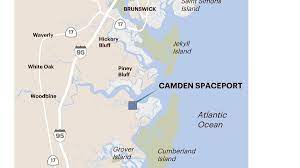
ATLANTA – The Georgia Supreme Court Tuesday upheld a lower court ruling verifying the validity of a voter referendum in Camden County last March that rejected plans to build a commercial spaceport.
In the referendum, Camden voters soundly defeated the county’s plan to purchase land for the proposed Spaceport Camden. The county, which had gone to probate court before the referendum to try to block it, appealed to the state Supreme Court after the vote.
In oral arguments before the justices last October, lawyers for Camden County argued the Georgia Constitution’s Home Rule Paragraph does not allow local voters to veto a county commission’s resolution after the fact.
Lawyers for the project’s opponents, registered voters who gathered petition signatures to force the referendum, countered that the vote was valid under a plain reading of Home Rule.
In Tuesday’s unanimous ruling, the state Supreme Court agreed with Spaceport Camden’s opponents, declaring that the county had no legal authority to try to block the referendum.
“The Home Rule Paragraph makes no provision authorizing a county, or any other party, to file a caveat, or any other form of opposition, to an electors’ petition,” Justice Carla Wong McMillian wrote for the court.
“With respect to challenging an election, the statute governing contests to elections … limits the right to contest elections to ‘electors.’ Because the county is not an elector, it would not be authorized to contest the outcome of the special election.”
Camden County’s political leaders have sought to build a spaceport for years, claiming it would bring jobs and economic development to southeast Georgia. The county has spent $12 million pursuing the project.
Opponents say firing small rockets from Spaceport Camden over populated areas of Little Cumberland Island, just off the coast, would pose a major safety risk.
The National Park Service – which operates the Cumberland Island National Seashore – and environmental organizations worried about the spaceport’s impact on a fragile coastal ecosystem have also expressed reservations about the project.
Tuesday’s ruling didn’t bring to an end to the litigation surrounding Spaceport Camden. A federal lawsuit challenging the Federal Aviation Administration’s issuance of a launch permit in December 2021 remains pending.
Opponents of Spaceport Camden also have filed a lawsuit in Camden County Court seeking the release of public records concerning the project.
This story is available through a news partnership with Capitol Beat News Service, a project of the Georgia Press Educational Foundation.
ATLANTA – Georgia Secretary of State Brad Raffensperger urged the General Assembly Monday to pass legislation aimed at preventing the financial exploitation of Georgia seniors.
Senate Bill 84, sponsored by Senate Finance Committee Chairman Chuck Hufstetler, R-Rome, would authorize financial advisors to delay transactions involving their elderly or disabled clients if they suspect fraud.
Financial exploitation of seniors has been on the rise since the pandemic struck nearly three years ago, Raffensperger said Monday during a news conference at the state Capitol.
“The COVID pandemic helped [drive] that rapid increase as you saw many people isolated from their support systems and under tremendous financial strain and worry,” he said.
Raffensperger said the rate of financial exploitation of seniors has doubled across the country since the start of the pandemic, with COVID-related scams accounting for more than $100 million in losses.
He cited a federal study that found U.S. financial institutions lost more than $3.4 billion to fraudulent criminal activity in 2020 alone.
The Securities Division in the secretary of state’s office handles complaints of financial exploitation. But those complaints often come too late, Raffensperger said.
“The money is usually gone well before we are notified,” he said. “Recovery is difficult.”
Senate Bill 84 is designed to avoid financial exploitation by letting financial advisors who spot something amiss in a pending transaction head it off.
“This bill will give financial institutions the tools to be preemptive instead of waiting until after the fact when the money may be gone,” Hufstetler said. “There’s many horror stories of that out there, and we want to take care of them.”
The bill’s cosponsors include Republican Sens. Mike Dugan of Carrollton, Kay Kirkpatrick of Marietta, Ben Watson of Savannah, and Rick Williams of Milledgeville, and Democratic Sen. Jason Esteves of Atlanta.
This story is available through a news partnership with Capitol Beat News Service, a project of the Georgia Press Educational Foundation.
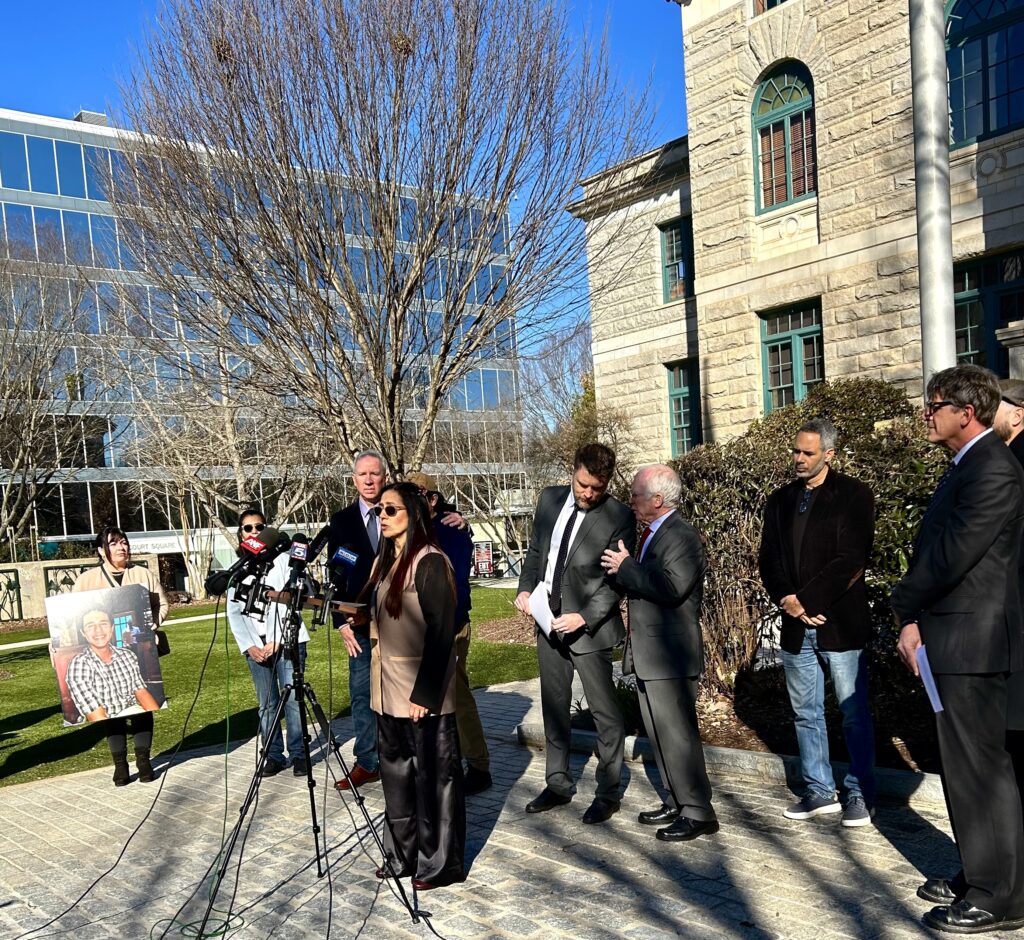
Belkis Teran, mother of Manuel Esteban Paez Teran, describes the slain activist’s love for the environment at a Monday press conference. (Photo credit: Rebecca Grapevine)
ATLANTA – The parents of slain activist Manuel Esteban Paez Teran called on the Georgia Bureau of Investigation (GBI) Monday to provide answers about the events leading up to the activist’s death last month.
Paez Teran – who went by “Tortuguita” – along with other activists was protesting the proposed building of a large police training center in a forest in southern DeKalb County. Groups critical of the police and environmentalists have opposed the building of the Atlanta Public Safety Training Center, or “Cop City,” since 2021 by setting up encampments in the 85-acre forest.
On Jan. 18, a law enforcement “clearing operation” turned violent. A Georgia State Patrol officer was shot and seriously wounded and Paez Teran was shot and killed.
A private autopsy commissioned by the family indicated that 26-year-old Paez Teran was shot at least 12 times by several different firearms, attorney Brian Spears said Monday.
“Multiple officers riddled his body with bullets,” Spears said.
There is no camera footage of the event because none of the officers present were wearing body cameras, GBI spokeswoman Nelly Miles said last month. Bodycam footage of the aftermath does exist.
The attorneys called on the GBI and other law enforcement agencies to release any and all audio and video footage – including drone and helicopter footage – of the events of Jan. 18.
“Manuel is dead. You cannot charge a dead person with a crime,” Spears said. “There is no reason to withhold this information and there is no reason to not be transparent.
“There needs to be an independent and unbiased investigation into the entire circumstances that should focus not only on whatever shooting may have been done by our young deceased, but also by the officers. We’re here today because we need facts.”
“We are not releasing any videos currently because agents are continuing to conduct key interviews and want to maintain the integrity of the investigation,” GBI’s Miles said on Monday.
Once the investigation is complete, the case file will be handed off to a special prosecutor, Miles added. Officer-involved shooting investigations typically take 60 days to 90 days to complete.
The legal team had hand-delivered a letter to the GBI asking a representative to meet with the family but received no response, attorney Jeff Filipovits said.
“When we began our case, we contacted and spoke with Teran’s family,” Miles said. “We intend to follow up with the family as the investigation progresses.”
Paez Terán’s family said the activist was drawn to the Atlanta forest by a long history of environmental activism and love for the natural world.
“We are horrified by all that has happened,” said his mother, Belkis Teran.
Paez Teran graduated with honors from Florida State University and frequently organized beach and park clean-ups and recycling events, she said.
Daniel Paez, brother of the slain activist, said he missed his best friend and issued a fiery denunciation of how law enforcement agencies have handled the matter.
“I don’t see integrity in the police,” Paez said. “Calling protesters only charged with trespassing misdemeanors ‘terrorists’ is not absolute honesty and trustworthiness.”
“My call to action goes to the police officers: Find your moral courage and place your nation over loyalty to individuals,” added Paez, who described how he learned the meaning of integrity while serving in the U.S. Navy.
The GBI has said Paez Teran legally purchased a 9 mm handgun in 2020 and used that gun to shoot the state trooper last month.
However, the family’s lawyers contended that the gun purchase is not conclusive.
“It’s a single fact without context that tells us nothing of the narrative of what happened and how things unfolded on that day,” Filipovits said. “And we’re not in a position to respond further because we have no further information from the GBI.”
The lawyers said other activists who were in the forest at the time are reluctant to come forward with information because they fear repercussions. Other activists at the site have been arrested and charged with domestic terrorism.
DeKalb County District Attorney Sherry Boston recused herself from the investigation last month because her office has been involved in a task force related to the training facility.
A multi-agency law-enforcement task force carried out another clearing operation at the forest on Monday, GBI spokeswoman Miles said. No arrests were made.
This story is available through a news partnership with Capitol Beat News Service, a project of the Georgia Press Educational Foundation.
ATLANTA – Legislation introduced into the state House of Representatives Monday would establish the crime of “interference with critical infrastructure” in Georgia.
House Bill 227, sponsored by Rep. Rob Leverett, R-Elberton, was prompted by a rash of attacks in recent months by gunmen on utility substations. The most widely publicized was an attack on two Duke Energy substations in Moore County, N.C., in December that left about 45,000 customers without power for days.
Under the legislation, critical infrastructure includes electricity, water, sewers, telecommunications, internet, public transportation and public transit systems, hospitals, ambulances, emergency medical and rescue services, the military, police, Coast Guard, and prison and fire services.
The bill is being endorsed by Georgia EMC, the umbrella organization representing 41 electric membership corporations across the state, as a way to protect customers from service disruptions.
“People need electricity — and other critical infrastructure — in their jobs, schools and homes for cooking, heating, communicating and even supporting medical treatments,” Georgia EMC spokesman Walter Jones said. “Would-be bad actors need to know that Georgia protects its citizens.”
The measure provides penalties of up to 20 years in prison for the most serious offenders, those who intentionally damage a form of critical infrastructure with the intention of disrupting service.
Intentionally interfering with the “proper operation” of a form of critical infrastructure is a lesser offense punishable by up to 10 years in prison.
In either case, the bill requires the offender to pay restitution for the damage.
Tampering with any form of critical infrastructure, such as preventing an electric meter from registering how much electricity a customer has used, would be a misdemeanor.
The bill’s cosponsors include House Majority Whip James Burchett, R-Waycross, and House Majority Caucus Chairman Bruce Williamson, R-Monroe.
This story is available through a news partnership with Capitol Beat News Service, a project of the Georgia Press Educational Foundation.