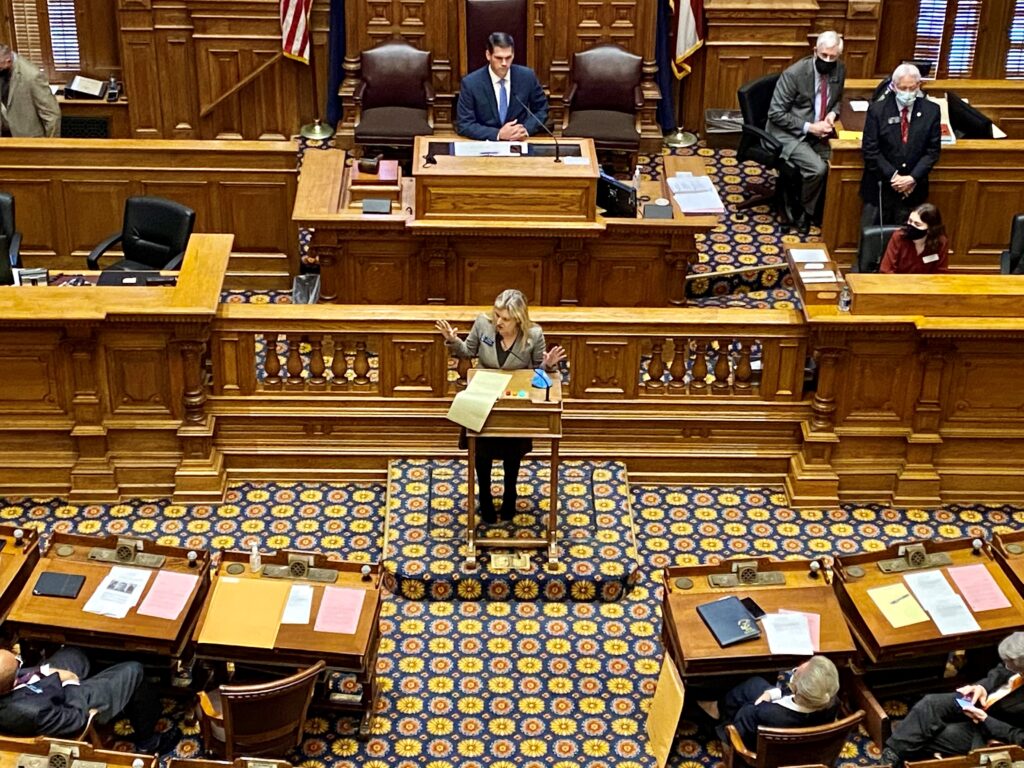
State Sen. Jen Jordan (D-Atlanta) slammed Republican-held election fraud hearings during the legislative session on Jan. 12, 2021. (Photo by Beau Evans)
Democratic lawmakers in the Georgia Senate have kicked off the 2021 legislative session with a resolution condemning the riot by supporters of President Donald Trump at the U.S. Capitol last week.
Sponsored by five Democratic senators, the resolution slams “the disgraceful actions of right-wing violence and sedition” that saw Trump supporters break into and vandalize the Capitol building. The riots disrupted Congress’ vote to certify President-elect Joe Biden’s win in the Nov. 3 general election.
The resolution also criticized several Republican state senators for holding “sham hearings” in December that gave a platform to election fraud claims spread by Trump and his allies, “delegitimizing the Senate and giving credibility to these conspiracy theories,” the resolution said.
State Sen. Jen Jordan, D-Atlanta, Tuesday called for those Senate Republicans to be held accountable for acting to agitate Trump’s supporters, saying on the Senate floor they “aided and abetted the spread of disinformation.”
“They gave oxygen to a lie,” said Jordan, who faced death threats for challenging the fraud claims at a Senate hearing last month. “To pretend like nothing happened, that this is just another day … that can’t be an option.”
The rioting and resolution came after Republican state lawmakers on the Senate Judiciary Subcommittee released a report last month calling the Nov. 3 election “chaotic” and that “any reported results must be viewed as untrustworthy.”
Georgia election officials including Secretary of State Brad Raffensperger repeatedly dismissed the Nov. 3 fraud claims as unfounded while federal courts tossed several lawsuits seeking to reverse the election results.
Proposals to change Georgia election laws including tighter voter ID requirements and limits on who can cast mail-in ballots look to feature prominently in this year’s session after Biden became the first Democrat to carry Georgia since 1992 and Democrats flipped the state’s two Republican-held U.S. Senate seats last week.
Republican senators who attended the subcommittee hearings and voiced belief in the fraud claims included state Sens. Burt Jones, R-Jackson; Brandon Beach, R-Alpharetta; Greg Dolezal, R-Cumming; Steve Gooch, R-Dahlonega; John Kennedy, R-Macon; Blake Tillery, R-Vidalia; and Carden Summers, R-Cordele. Former state Sens. William Ligon, R-Brunswick, and Bill Health, R-Bremen, also attended.
Jones, Beach, Dolezal and Ligon also circulated a failed petition in December urging General Assembly members to convene a special session aimed at blocking Georgia’s presidential election results. Gov. Brian Kemp opposed calling a special session.
On Tuesday, Jones and Beach were stripped of their Senate committee chairmanships by Lt. Gov. Geoff Duncan, who repeatedly pushed Republicans to drop their focus on fraud claims and instead look ahead to bolstering Georgia GOP candidates in future elections.
The Senate resolution was co-sponsored by Georgia Senate Minority Leader Gloria Butler, D-Stone Mountain; state Sens. Harold Jones II, D-Augusta; Elena Parent, D-Atlanta; Lester Jackson, D-Savannah; and Jordan.
The trial of a man accused of murdering South Georgia beauty queen Tara Grinstead moved forward Tuesday as Georgia Supreme Court justices heard arguments for why the state should pay for his expert witnesses.
Court appeals over witness funds have delayed for nearly two years the trial of Ryan Duke, who authorities say confessed to breaking into Grinstead’s home in Ocilla in 2005 and strangling her to death before hiding her body in a pecan orchard.
Duke was set to stand trial in April 2019 before attorneys representing him pro bono appealed an Irwin County Superior Court judge’s decision denying him state funds for expert witnesses since he is indigent.
Grinstead, a high school teacher and winner of a South Georgia beauty pageant, was missing for more than a decade before Duke was arrested in connection with her murder in 2017, shortly after a friend helped him burn Grinstead’s body in a pine orchard then came clean to investigators.
Duke faces a host of felony charges murder, assault and burglary in connection with Grinstead’s killing. His friend, Bo Dukes, was convicted of making false statements, hindering an arrest and concealing a death, and given a 25-year prison sentence in 2019.
Attorneys who have represented Duke for free since August 2018 have argued he should be entitled to state funds for expert witnesses under the state’s indigent-defense law, despite the fact he is represented by private lawyers instead of public defenders.
Justices gave little indication which way they may rule at a hearing on Duke’s motion for expert-witness funding. His case will be sent back to the Irwin County court following their ruling to schedule a new date for trial.
The Supreme Court has held virtual hearings in Georgia since March 2020 due to safety concerns with the ongoing COVID-19 pandemic.
Gordon State College will offer a nexus degree in film production.
ATLANTA – Two institutions in the University System of Georgia are launching degree programs focused on two of the state’s top industries.
The system’s Board of Regents voted Tuesday to offer a new nexus degree in film production at Gordon State College and a new master’s degree program in epidemiology at Augusta University.
Gordon State College is located in Barnesville, 40 miles from the Georgia Film Academy’s flagship instructional site at Trilith Studios in Fayetteville. With six major film studios located in metro Atlanta, Georgia is now the third-largest state in film production.
Film production was the first area of study to offer nexus degrees in Georgia, an initiative that grew out of the College 2025 program system Chancellor Steve Wrigley introduced in 2017 to better tailor course offerings to the state’s 21st century workforce needs.
Columbus State University graduated the university system’s first two nexus degree holders last month, both in film production.
Gordon State is expected to draw many of its film production students from nearby Southern Crescent Technical College, which offers an associate’s degree in film.
Georgia is the third-highest employer of epidemiologists in the country.
The University of Georgia already offers an epidemiology masters degree, while Georgia State University and Georgia Southern University offer master’s in public health with a concentration on epidemiology. Still, many of the state’s undergraduates with epidemiology majors leave Georgia to attend the University of Alabama at Birmingham.
Georgia students who graduate with a master’s in epidemiology can be recruited to work in a variety of governmental institutions within the state, the most prominent being with the federal Centers for Disease Control and Prevention.
The cooling tower of Plant Vogtle’s Unit 3 is under construction in the background.
ATLANTA – Georgia Power is putting off some of this year’s milestones in the construction schedule for the nuclear expansion at Plant Vogtle, citing the COVID-19 pandemic.
The Atlanta-based utility expects to adjust the dates for fuel loading at Unit 3, one of two nuclear reactors being added at the plant south of Augusta, and for the start of “hot functional testing,” which measures the safety and operability of the reactors, Georgia Power announced Monday.
Georgia Power has made significant changes to work practices at the project since the coronavirus pandemic struck Georgia last March. The company laid off 20% of the project workforce last April, and the site has seen a significant increase in cases of the virus since October consistent with the broader national and regional increase.
However, Georgia Power still expects to bring Unit 3 into service this November, followed a year later by Unit 4, the second reactor.
The state Public Service Commission approved the project back in 2009 at an estimated cost of $14 billion and a schedule that called for completing the work in 2016 and 2017. However, the project has been plagued by a series of cost overruns and scheduling delays brought on in part by the bankruptcy of Westinghouse Electric, the original prime contractor.
The project’s critics are predicting that further delays and overruns will occur, based on testimony last fall from engineers monitoring the work.
Georgia Power expects to provide additional updates next month during parent Southern Co.’s quarterly earnings call.
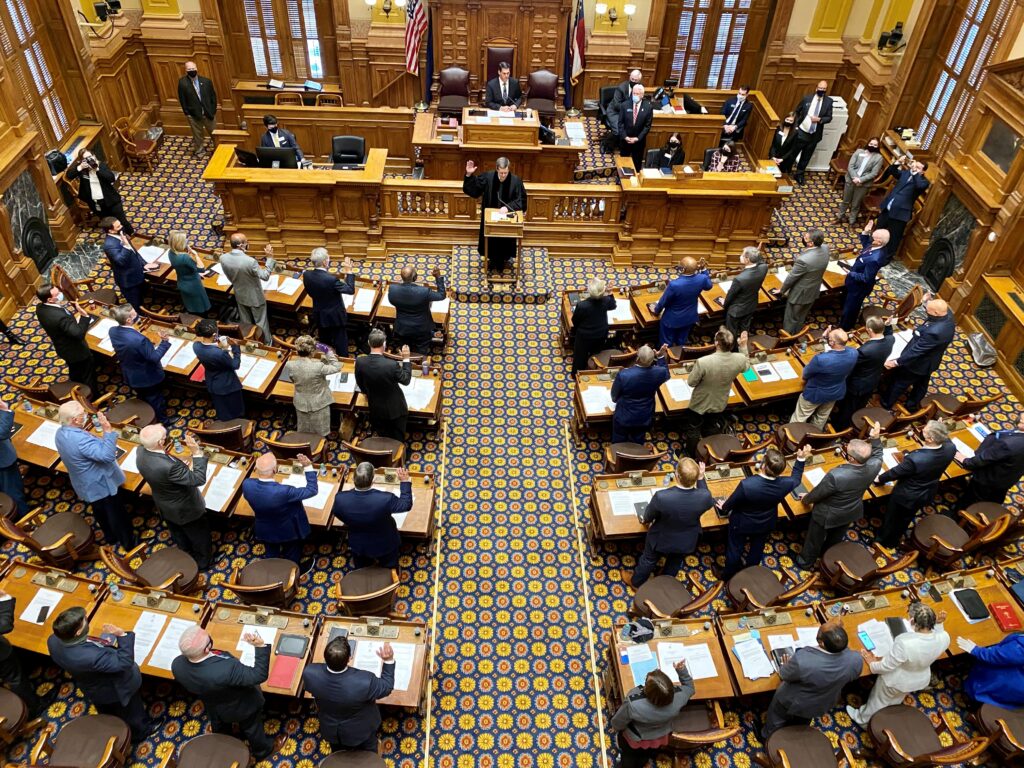
Georgia Senate members take the oath of office on the first day of the 2021 legislative session on Jan. 11, 2021. (Photo by Beau Evans)
ATLANTA – COVID-19 and last week’s storming of the U.S. Capitol loomed large in the Georgia General Assembly Monday as lawmakers were sworn in to begin the 2021 legislative session.
Eleven new senators and 20 new House members took the oath of office, as the two chambers – still controlled by Republicans following the November elections – elected their leaders for the next two years.
Besides a requirement that lawmakers wear masks on the House and Senate floors, they will be tested twice a week to discourage the spread of the virus, which has sickened hundreds of thousands of Georgians and prompted the General Assembly to shut down for three months during last year’s session.
At least one lawmaker recently tested positive for COVID-19 and was absent Monday, prompting state Sen. Nan Orrock, D-Atlanta, to criticize the slow rollout of Georgia’s vaccine program. Just one-third of the 555,800 vaccines shipped to Georgia so far have been administered, according to state Department of Public Health data.
“We must call on the leadership in the state … to step up,” Orrock said. “What we cannot do is tolerate this current level of being at the bottom in the nation for the levels of vaccine we’re getting out.”
The House overwhelmingly re-elected Speaker David Ralston, R-Blue Ridge, to head that chamber for the next two years. In his acceptance speech, he condemned last week’s violet assault on the U.S. Capitol building by supporters of President Donald Trump that killed five people, including a Capitol police officer.
“Last week was a dark day in the history of our nation … to see American citizens storming our revered Capitol,” Ralston said. “There is no possible justification for this loss of life, bloodshed and damage. America is better than this.”
State Sen. Elena Parent, D-Atlanta, criticized Republican state senators who held hearings on Trump’s election fraud claims under the Gold Dome, which she said helped spark the riot in Washington.
“This, my colleagues, was a reckless decision,” Parent said. “We should not sow doubt, anger and faithlessness in the citizens who elect us.”
Proposals to change Georgia election laws including tighter voter ID requirements and limits on who can cast mail-in ballots look to feature prominently in this year’s session after President-elect Joe Biden became the first Democrat to carry Georgia since 1992 and Democrats flipped the state’s two Republican-held U.S. Senate seats last week.
“Our elections must be free, fair, free from fraud, secure and accessible,” Ralston said. “We must always tell our citizens the truth.”
Senate President Pro Tempore Butch Miller, R-Gainesville, who was re-elected to that leadership post on Monday, urged collaboration between both parties and highlighted the tough challenges ahead on voting laws and COVID-19 bills.
“We’ve got to keep things in perspective,” Miller said. “This is a part-time job but with immense responsibility.”
Meanwhile, House members re-elected Rep. Jan Jones, R-Milton, speaker pro tempore, the chamber’s No.-2 leadership position. Like Ralston, she has served in House leadership since 2010.