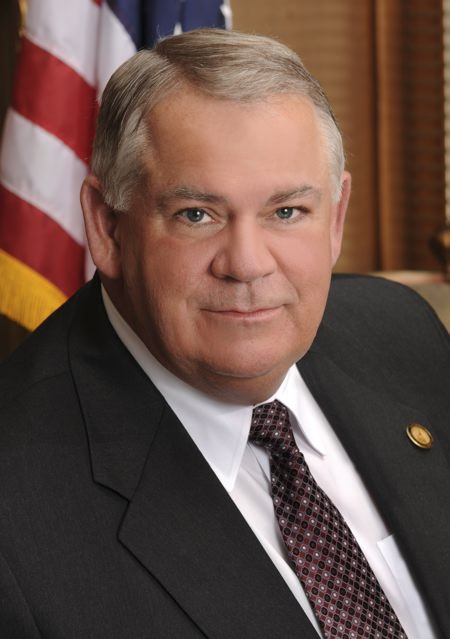
ATLANTA – Georgia House Speaker David Ralston is asking Congress for $500 billion in aid to state governments suffering the economic fallout of the coronavirus pandemic.
In a letter to U.S. Sen. David Perdue, R-Ga., this week, Ralston called for assistance to the states to be included in the latest federal COVID-19 relief legislation, which is stuck in Congress amid sharp disagreements between congressional Democrats and Republicans and the Trump administration.
The state is doing its part to respond to plummeting tax revenues resulting from the economic downturn brought on by the pandemic, Ralston wrote. He pointed to the 10% across-the-board spending cuts the General Assembly imposed in the fiscal 2021 budget lawmakers adopted in late June.
“In addition to reductions that include hiring freezes, new programs slated to begin in [fiscal] 2020 were rescinded,” he wrote. “The only significantly new service approved is to address Georgia’s unacceptable maternal mortality rates.”
The state also has reduced its budget reserves by more than half since the start of fiscal 2020 just more than a year ago, from $2.7 billion to about $1.3 billion, Ralston wrote.
The Democratic-controlled U.S. House of Representatives passed a bill in May earmarking more than $1 trillion for state and local governments. Thus far, however, the White House has offered $150 billion, the same amount states and cities received from a coronavirus relief package Congress passed back in March.
“Georgia’s economy is typically a strong network of diverse revenue streams, but the pandemic has affected all of them, even those like motor fuels that typically resist downturns,” Ralston wrote. “The lagging effect on our largest revenue sources, income and sales taxes, is presenting us with additional challenges for months to come.”
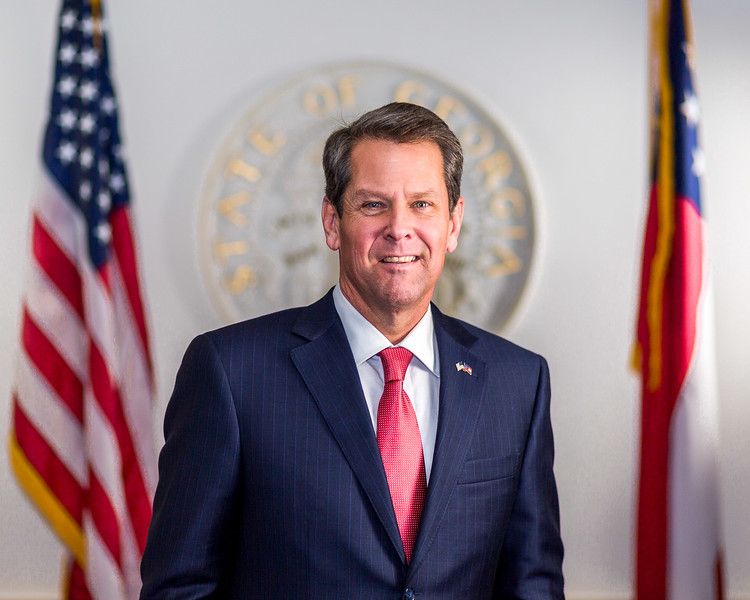
Without significant congressional assistance, more spending reductions could be in the offing. Gov. Brian Kemp announced Wednesday he intends to call the General Assembly back to the Capitol for a special session later this year in part to take up adjustments to the budget.
ATLANTA – Gov. Brian Kemp Wednesday vetoed four bills the General Assembly passed during the 2020 session, signed a fifth bill reluctantly and hinted he will call a special session of the legislature later this year.
The most significant of the vetoed bills called for the creation of an oversight committee to review the performance and conduct of all contractors and subcontractors working for the insurance plan that covers Georgia teachers and state employees.
In a veto message issued late Wednesday, Kemp argued the committee would violate the separation of powers provision of the Georgia Constitution.
“Two-thirds of the proposed committee’s members would be members of the General Assembly,” the governor wrote. “Further, the powers prescribed to the proposed committee largely supplant the planning, policy making, and oversight powers exercised by the [state] Board of Public Health.
“Since such boards are considered creatures of the executive branch of state government, it is possible that service by members of the General Assembly on the Healthcare Transparency and Accountability Oversight Committee could violate the separation of powers.”
Kemp also vetoed legislation calling for a nonbinding referendum asking voters in Glynn County whether the local police department should be abolished and its functions transferred to the Glynn County Sheriff. He pointed out that the General Assembly also passed legislation this year providing a binding referendum on that issue, and there can’t be two laws on the books on the same subject.
A third vetoed bill would have authorized Georgia to enter into a compact with other states to regulate the audiology and speech-language pathology professions. Kemp wrote the measure was not put before a state council that reviews occupational regulations.
Finally, Kemp nixed a local bill for Gwinnett County at the request of its sponsor, Rep. Chuck Efstration, R-Dacula, that would have added senior judges to the county Recorder’s Court.
Kemp also issued a statement explaining that he signed House Bill 105 only because it will provide a critical income tax exemption for Georgia farmers who received state and/or federal disaster relief to help offset losses from Hurricane Michael, which ripped through South Georgia in October 2018.
The governor pointed to a technicality in a late amendment to the bill unrelated to the tax exemption that could render the entire measure open to a legal challenge.
“If the bill is ever challenged, the measure may not withstand judicial scrutiny, resulting in the unraveling of the tax structures it created,” Kemp wrote. “Our farmers, especially, cannot afford further economic hardship.”
As a result, Kemp indicated he plans to call lawmakers back to the Gold Dome for a special session to pass the tax exemption as a separate measure to make sure farmers are protected.
Importantly, he also hinted the special session might include adjustments to the $25.9 billion fiscal 2021 state budget the General Assembly passed in late June. As the economic impact from the coronavirus pandemic stretches on, more business closures and job losses could drive state tax revenues even lower, which might force Kemp and the legislature to make additional spending cuts.
Gov. Brian Kemp signed legislation Wednesday tightening rules on third-party companies that play a role in negotiating pharmaceutical drug prices between insurers and local pharmacies in Georgia.
The bill Kemp signed into law requires companies called pharmacy benefits managers (PBMs) to set drug prices within a national average, a move aimed at reining in excessively high prescription prices.
PBMs act as go-betweens for prescribers and insurance companies that contract with health insurers to negotiate lower drug prices for patients. But critics have long accused them of muddying the process, prompting increases in drug prices and unnecessary delays in filling prescriptions.
Senate Bill 313, by state Sen. Dean Burke, R-Bainbridge, also forces PBMs to offer up full rebates to health plans that are typically given by drugmakers, rather than pocketing a portion.
And PBMs will need to submit to new audits by the state Department of Community Health as well as requirements for publishing data on prescription prices online.
The bill mirrored a separate measure introduced during the 2020 legislative session by state Rep. David Knight, R-Griffin, who called the drug-price rules a compromise between PBMs, insurers, pharmacies and state officials.
“[This] will be the toughest PBM legislation in the nation,” Knight said in June. “We can finally bring transparency to drug pricing and give choice to our patients.”
PBM representatives were less enthused by the bill’s signing Wednesday. The Pharmaceutical Care Management Association, representing PBMs, argued the new rules could increase drug prices and hamstring negotiating powers PBMs use to drive down costs.
“[The bill] takes a step in the wrong direction by undermining the tools that pharmacy benefit managers, PBMs, use to reduce drug costs,” said spokesman Greg Lopes.
Burke’s bill was among the top priorities for Georgia Senate Republican leaders in this year’s session, along with measures to curb the practice of surprise hospital charges.
It followed legislation signed last year aimed at preventing PBMs from steering patients to associated pharmacies with potentially higher costs.
This week, Kemp also signed legislation by state Rep. Sharon Cooper, R-Marietta, that seeks to bolster those rules on steering and relax some penalties for pharmacies that are audited by PBMs.
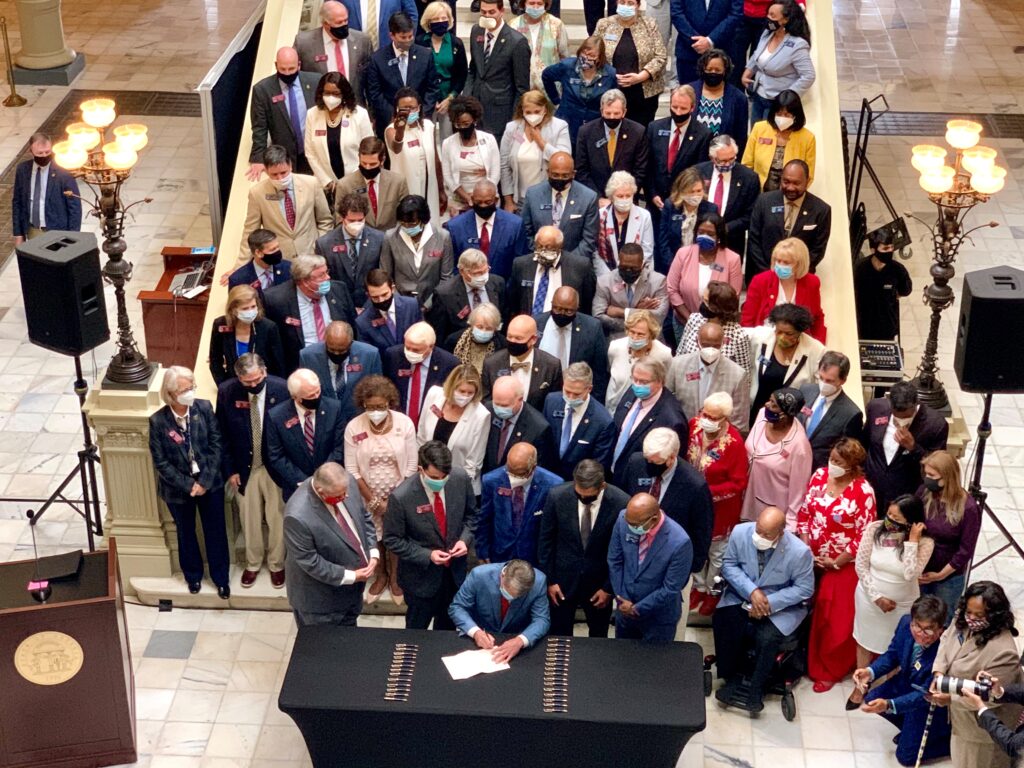
Flanked by state lawmakers, Gov. Brian Kemp signs Georgia’s hate-crimes bill into law on June 26, 2020. (Photo by Beau Evans)
Gov. Brian Kemp signed legislation Wednesday aimed at protecting police and other first responders from bias-motivated crimes in Georgia, capping a series of controversial moves by state Republican leaders that nearly derailed passage of a separate bill outlawing hate crimes.
The bill Kemp signed into law sets out punishments for those who commit crimes against police officers, firefighters and medics because of their “actual or perceived employment as a first responder.” Crimes would have to involve serious physical injury or property damage.
Backers of the legislation have highlighted it as a show of support for police and other first-responders amid nationwide protests against police brutality and racial injustice that have prompted tense and at times violent encounters between officers and protesters.
Late Wednesday, Kemp said he had “attended the funerals of far too many law enforcement officers who were killed in the line of duty,” and that the bill aims to help “those who are risking their lives to protect us.”
“While some vilify, target, and attack our men and women in uniform for personal or political gain, this legislation is a clear reminder that Georgia is a state that unapologetically backs the blue,” Kemp said in a statement.
The bill’s critics immediately lashed out at the governor Wednesday, noting Georgia law already has enhanced penalties for crimes committed against police and arguing its intent is to dampen the recent protests that have rocked the country and Georgia cities since June.
“This terrible bill was drafted as a direct swipe at Georgians participating in the Black Lives Matter protests who are asserting for their constitutional rights,” said Andrea Young, executive director of the American Civil Liberties Union’s Georgia chapter.
The first-responder protections stirred passions on both sides in the waning days of the 2020 legislative session when they were tacked onto a separate hate-crimes bill in June.
The hate-crimes measure, House Bill 426, created enhanced penalties for crimes committed based on a victim’s race, gender, sex and other identifiers. The landmark legislation gained bipartisan support in the General Assembly.
Kemp signed the hate-crimes bill after the first-responder protections were pulled and added to House Bill 838, by state Rep. Bill Hitchens, R-Rincon, which originally dealt with peer counseling for police officers.
The maneuvering, largely led by Georgia Senate Republican leaders, angered Democratic lawmakers and social justice advocates who viewed it as a slap in the face for black communities and other groups that have historically faced hateful and discriminatory crimes, including from police officers themselves.
The bill’s opponents urged Kemp to issue a veto during the weeks since the police-protections bill cleared the General Assembly by largely party-line votes in late June.
In particular, the ACLU has argued the bill could inadvertently water down existing penalties for crimes committed against police, noting prison time could be limited to a maximum of five years for crimes as severe as murdering an officer.
“In their haste to silence Georgians’ demand for police accountability, the state legislature has produced a severely flawed bill that may substantially reduce penalties for deliberately killing a police officer,” Young of the ACLU said in June.
Supporters, meanwhile, have pointed out the bill also creates statewide rules on investigating complaints made against police officers and allows officers to sue those who file false complaints.
“It’s disappointing that supporting law enforcement has become a partisan issue,” House Speaker David Ralston, R-Blue Ridge, said Wednesday. “We value and stand with the men and women who wear the badge in Georgia, and House Bill 838 demonstrates that unequivocally.”
Shortly after the bill’s passage in June, Lt. Gov. Geoff Duncan called it necessary to help distinguish between officers who have violated the public’s trust on the job from those who have carried out their duties properly.
“At a time when officers feel under siege, when police fear politically motivated prosecution, when extreme voices are calling to ‘defund the police,’ our state must stand up for those who put their lives on the line for us,” Duncan said.
ATLANTA – Georgia’s electric membership corporations (EMCs) will play a major role in expanding broadband service in rural Georgia under legislation Gov. Brian Kemp has signed into law.
Under House Bill 244, the state Public Service Commission will decide how much EMCs can charge telecommunications providers for broadband attachments to their utility poles.
High pole attachment fees have been a key obstacle to extending broadband technology into underserved rural communities in Georgia.
The goal of the Georgia Broadband Opportunity Act is to lower those fees to encourage telecoms to invest in delivering the service in rural counties while not making them so low they force EMCs to raise electric rates for their existing customers.
“The EMCs eagerly look forward to working with the Public Service Commission as an integral partner to expand access to broadband in rural Georgia, while keeping our neediest and most vulnerable citizens from shouldering the burden of that progress,” Dennis Chastain, president and CEO of Georgia EMC said Wednesday.
“The EMCs are fully invested with staff and technical resources dedicated to one goal: working with PSC commissioners and staff to help solve the digital divide while simultaneously protecting rural Georgians, our EMC members, from unfair subsidies and increasing energy costs. This is even more critical now, as entire communities of EMC consumers struggle from the financial fallout of COVID-19.”
Despite arguments from opponents that the bill would hurt the pocketbooks of EMC customers and give the PSC unprecedented power, the measure cleared the Georgia House of Representatives on Crossover Day in March, the deadline by which bills must pass at least one legislative chamber.
The Senate then passed it during the final week of the 2020 General Assembly session in June.
The bill was sponsored by Rep. Ron Stephens, R-Savannah.