University System of Georgia Chancellor Steve Wrigley
ATLANTA – The University System of Georgia Board of Regents signed off Wednesday on a fiscal 2021 budget that includes $2.3 billion in state funds.
The regents got their marching orders last week when the General Assembly adopted a $25.9 billion state budget that cuts spending across the board by 10%. For the university system, that represents a reduction of $278 million from last year’s spending plan.
The damage could have been worse. When the coronavirus pandemic hit Georgia in March, prompting shelter-in-place orders that forced businesses to close and lay off employees, Gov. Brian Kemp and legislative leaders told state agency heads to prepare to cut their budgets by 14%.
But that was revised downward subsequently to 11% and then 10% when reports from the Georgia Department of Revenue showed the downturn in the economy was not affecting state tax revenues as much as had been anticipated.
“That gives us a little more flexibility … going into fiscal ’21,” university system Chancellor Steve Wrigley told the regents before Wednesday’s vote.
As a result of the lowering of the spending reduction target, the legislature restored $78 million to the system’s budget, enough to avoid furloughing any of the system’s 55,000 employees. In May, the regents authorized either four or eight furlough days for most employees, depending on their salary level.
Lawmakers also appropriated $3.2 million to fully fund the Georgia Public Library System’s materials grants program. The grants allow the state’s libraries, particularly in rural communities, to buy books, technology and other resources.
The university system budget also is being supported with more than $157 million in federal coronavirus relief funds.
The fiscal 2021 state budget took effect on Wednesday.
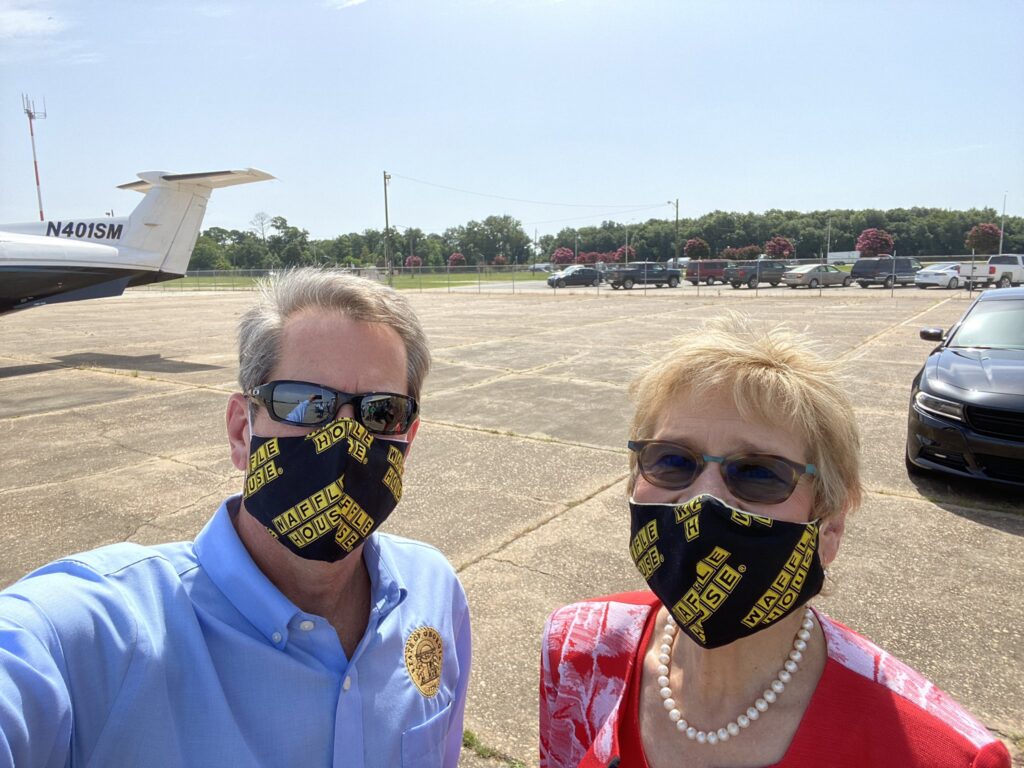
Gov. Brian Kemp (left) and Georgia Public Health Commissioner Dr. Kathleen Toomey (right) embarked on a statewide tour to promote mask use on July 1, 2020. (Gov. Kemp official Twitter account)
Gov. Brian Kemp is holding off on ordering a statewide mandate to wear masks in Georgia as positive cases of coronavirus and hospitalizations are on the rise.
The governor embarked on a six-city tour Wednesday morning to urge Georgians to wear masks, wash hands and keep their distance from each other in public.
But so far, Kemp is not following the lead of several other states and the city of Savannah in ordering people to wear masks, saying Georgians should don facial coverings to protect themselves and others regardless of any official requirements.
“We shouldn’t need a mask mandate for people to do the right thing,” Kemp said at a news conference Wednesday.
Meanwhile, doctors at Emory University and its affiliated hospital pressed for more people to wear masks as the virus gains steam, particularly ahead of the upcoming Fourth of July weekend.
They noted hospitalizations have doubled at Atlanta-based Emory Healthcare over the past week as concerns have soared that local health-care facilities in Georgia could be overwhelmed in the near future without better mask use, personal sanitizing and social distancing.
“I think the best way to show compassion is to wear a mask. If I care, I wear a mask,” said Dr. Carlos Del Rio, executive associate dean of the Emory University School of Medicine at Grady Health System.
As of Tuesday afternoon, more than 81,000 people had tested positive in Georgia for COVID-19, the disease caused by the novel strain of coronavirus that sparked a global pandemic. It had killed 2,805 Georgians.
Dr. Kathleen Toomey, the state’s public health commissioner, acknowledged the recent increases in positive COVID-19 cases and hospitalizations as she joined the governor on his “Wear A Mask” tour this week.
She urged Georgians who have tested positive to participate in the state’s contact-tracing efforts amid lackluster interest in some communities for the program, which aims to quickly pinpoint and curb local outbreaks.
“We’re concerned about the upticks,” Toomey said Wednesday. “But we can work together to stop this.”
Kemp also acknowledged the number of hospitalizations – a key marker in assessing the virus’ spread – has crept up in recent weeks following the Memorial Day holiday late last month.
He stressed local hospitals are largely prepared for an influx of hospitalizations due to COVID-19 but that some facilities have sought staffing support from the state.
“Thankfully, [hospitalizations] are not going up exponentially,” Kemp said Wednesday. “It’s worrisome but not alarming at this point. And we don’t want it to get alarming.”
The governor also highlighted a slowdown in deaths caused by the virus, marking an encouraging downward trend that comes even as case counts continue rising.
But Dr. Jonathan Lewin, Emory Healthcare’s chief executive officer, tempered that optimism by cautioning hospitals will likely see deaths go up in the next few weeks as more patients receive treatment.
He also noted hospitals are facing increased numbers of patients who are younger and have slacked off on social distancing measures over the past month.
Lewin, like his Emory colleague Del Rio, urged local leaders Wednesday “to be more forceful” in compelling people to wear masks, highlighting evidence that shows states and cities in the U.S. that require mask-wearing have seen transmission rates decrease.
“From a scientific basis, we feel strongly about that,” Lewin said Wednesday. “If everyone wears a face mask, we can stop the spread of this virus.”
On Wednesday, Savannah became the first major city in Georgia to require that people wear masks in public. Other states including New York, California and Kentucky have also implemented mask mandates.
Kemp said Wednesday he had not talked yet with his legal team about whether to consider overturning Savannah’s mask mandate under his emergency executive powers, which supersede any local rules imposed during the pandemic.
He criticized the outcry from some elected officials and leaders for mask mandates as political distractions.
“The whole mask issue right now, in my opinion, is being over-politicized,” Kemp said. “And that’s not what we should be doing.”
Lewin, of Emory, also dismissed any partisanship involved with masks. He argued universal mask-wearing would bolster both public health and the state’s economic recovery.
“Whatever our elected leaders can do to increase the compliance with masking, whatever our elected leaders can do to decrease the partisanship that’s currently seen around masking, the more likely we are to get through this without seeing more economic damage,” Lewin said.
ATLANTA – U.S. Senate Democratic nominee Jon Ossoff raised more than $3.45 million during the last three months in his bid to unseat incumbent Republican Sen. David Perdue, the Ossoff campaign reported Wednesday.
More than $2.35 million of that amount came during the three weeks since Ossoff captured his party’s nomination, avoiding a runoff by winning nearly 53% of the vote in a crowded Democratic primary field.
Democrats have grown increasingly confident that they can compete this year with the long-dominant GOP in Georgia. Besides Ossoff’s fund-raising prowess, they point to a $457,000 ad buy in the Peach State by President Donald Trump’s re-election campaign as evidence Republicans believe they need to shore up their support in Georgia.
“Georgia is the premier battleground state in 2020, and we are building a grassroots movement to defeat Senator Perdue and deliver a government that works for the people,” said Ellen Foster, Ossoff’s campaign manager. “Jon’s message of ensuring every Georgian has health care, passing a new Civil Rights Act and new Voting Rights Act, and reforming our corrupt campaign-finance system is clearly resonating with Georgia voters, and our unstoppable momentum will lead us to victory in November.”
Ossoff’s average contribution during the second quarter was about $20. The investigative journalist is not accepting donations from corporate political action committees.
Despite Ossoff’s strong fund-raising since his June 9 primary victory, he still has a long way to go to match Perdue.
The first-term senator had raised more than $13.4 million through May 20, according to the pre-primary campaign-finance disclosure report he filed with the Federal Election Commission (FEC). Perdue had almost $9.4 million on hand at that time.
The deadline for filing second-quarter reports with the FEC is July 15.