Legislation allowing undocumented students to pay in-state tuition for Georgia public colleges and universities cleared a major hurdle in the General Assembly on Thursday.
The House Higher Education Committee passed a measure brought by Rep. Kasey Carpenter, R-Dalton, that would extend lower-cost tuition rates to thousands of so-called “Dreamers” in Georgia who are protected from deportation under the federal Deferred Action for Childhood Arrivals (DACA) program.
Carpenter’s bill stalled in the same committee last year amid uncertainty over then-President Donald Trump’s moves to scrap the DACA protections that were created during former President Barack Obama’s administration.
The bill now heads to the full House of Representatives where it could face stiff opposition from Republican lawmakers fearful of incentivizing undocumented immigrants to reside in Georgia illegally for the benefit of their children.
However, some Georgia Republicans have praised Carpenter for bringing the bill in the face of attacks from immigration hardliners in the state legislature and outside advocacy groups.
“This took a lot of courage and a lot of guts,” said Rep. Bert Reeves, R-Marietta. “This measure makes a tremendous amount of sense.”
The bill would cover DACA recipients who have lived continuously in Georgia since 2013 and are younger than 30, estimated by Carpenter at about 9,000 potential students who would be newly eligible for in-state tuition.
State law currently bars many non-citizen residents like DACA recipients from qualifying for in-state college tuition, which tends to be much lower than what students arriving from outside Georgia pay.
Carpenter’s bill would ease financial pain for DACA recipients who consider Georgia their home but tend to pay double or more to attend public colleges. It would let schools set the rates for DACA recipients at in-state tuition levels or up to 10% higher.
The bill would not allow in-state tuition to attend Georgia’s research schools including the University of Georgia, Georgia Tech, Georgia State University and Augusta University.
Supporters say lowering tuition rates would bolster Georgia’s workforce with better-educated and higher-skilled workers in Georgia while giving longtime residents a reprieve as they navigate paths to citizenship.
Opponents have criticized the measure as a slap in the face for Georgia citizens that could attract more undocumented persons and take college spots away from U.S. citizen students from other states.
Carpenter’s bill still needs to clear the House Rules Committee and pass out of the full House no later than Monday for it to remain alive in the current legislative session.
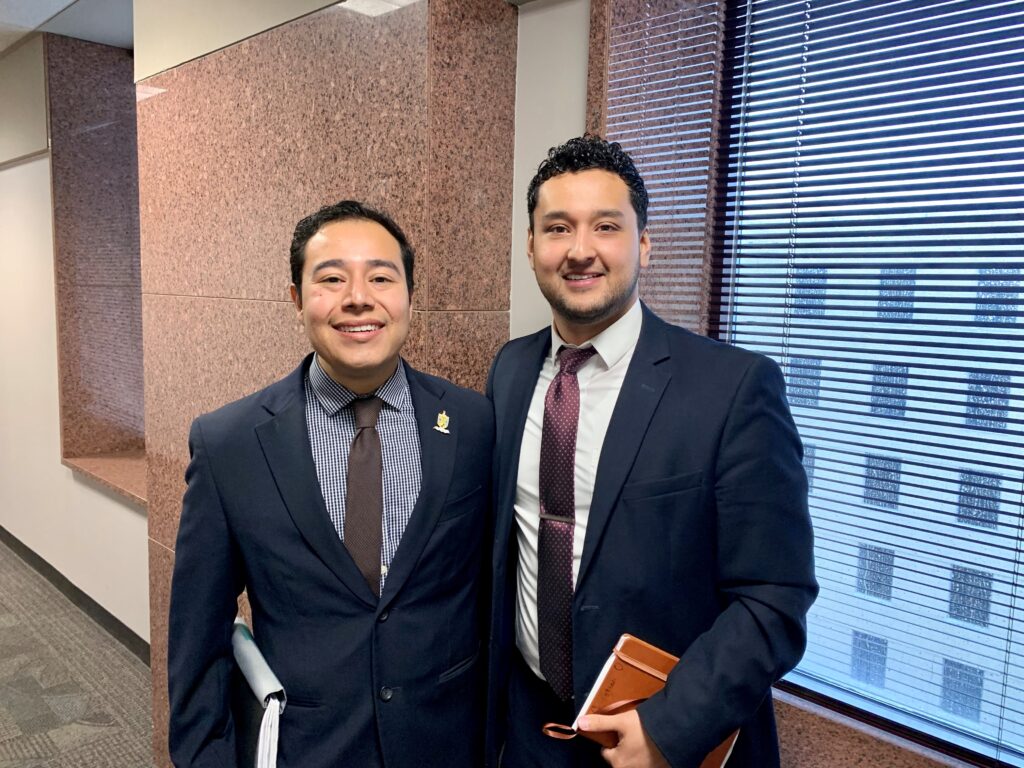
Christian Olvera (right) and Israel Arce (left), both DACA-beneficiary students, pose outside the House Higher Education Committee on March 11, 2020. (Photo by Beau Evans)
ATLANTA – A push to let undocumented students pay in-state tuition for publicly funded colleges in Georgia hit a roadblock Wednesday as House lawmakers shelved a hoped-for bill in the legislative session.
In a hearing Wednesday afternoon, House
Higher Education Committee Chairman Chuck Martin declined to call a vote on a
measure that would extend in-state tuition to undocumented Georgia residents
protected from deportation under the federal Deferred Action for Childhood
Arrivals (DACA) policy.
The decision effectively ended a bid this year by DACA advocates to ease college tuition hurdles ahead of a ruling from the U.S. Supreme Court in the coming months that could decide the residency fate of DACA recipients in the U.S.
Martin, R-Alpharetta, said he wanted to
wait until after the court’s ruling before tampering with Georgia law on
undocumented students.
“You’re here now. You’re just as much a
Georgia guy as I am and I mean that,” Martin said. “That said, the folks in
Washington need to get together and figure this out.”
The measure up for consideration, House Bill 997, called for granting in-state tuition to non-U.S. citizens like DACA recipients to most public colleges so long as they had lived in the country since age 12, were under 30 years old, had lived in Georgia for four years before enrolling in college and obtained a high school or GED diploma here.
It would have applied for most of the 26
schools in the University System of Georgia except for the University of Georgia,
Georgia Tech and Georgia State University, which do not grant admissions to
DACA recipients.
Sponsored by Rep. Kasey Carpenter, the
bill was one of a handful filed in the House this year but was viewed by DACA
advocates as having the best shot at moving forward. Carpenter, R-Dalton, said
DACA recipients in his heavily Latino district and elsewhere already working
toward college degrees ought to get a fairer shake financially before federal
policy on the issue is settled.
“Sometimes, the federal government
doesn’t take care of business and leaves us with no avenue,” Carpenter said.
DACA recipients, called “Dreamers”, were
brought to the U.S. as children with their parents and possess temporary work
authorization permits but are not legal permanent residents. There were about
21,000 Dreamers in Georgia as of June 2019, according to the nonprofit
Migration Policy Institute.
Students who are not U.S. citizens have
been largely barred from qualifying for in-state tuition in Georgia since 2008
— though state law does give universities leeway to allow in-state tuition for
green-card holders, refugees and asylum seekers. In-state tuition tends to be
much lower than out-of-state rates.
Many DACA recipients who grew up in Georgia attend state colleges but must pay out-of-state tuition, which can be triple the cost of in-state tuition. Christian Olvera said he pays about $6,000 per semester currently to attend Dalton State College as a DACA recipient, three times more than the roughly $2,000 he said he would for in-state tuition.
Olvera, whose parents migrated from
Mexico, said he was buoyed by the fact House lawmakers gave Carpenter’s bill a
hearing instead of leaving it to languish in the legislative dustbin. But the
largely symbolic victory was bittersweet.
“Eyes on the prize,” Olvera said after
the hearing. “It’s only right to do that for the sacrifices of the people who
came before us.”
ATLANTA – Undocumented students could pay in-state college tuition in Georgia under a bill Democratic lawmakers filed this week that aims to overturn longstanding state law prohibiting those students from paying lower school costs.
Sponsored by House Minority Leader Bob Trammell, D-Luthersville, House Bill 896 would let non-citizen students pay in-state tuition if they attended high school in Georgia for three or more years, earned a diploma and are applying for legal immigration status.
Trammell said the measure would help
Georgia retain more students who would pick up jobs in the state after
graduating.
“It’s cost-prohibitive for students to
advance their education in Georgia,” Trammell said. “As a consequence, we’re
losing talent in Georgia to other states.”
Students who are not U.S. citizens have been largely barred from qualifying for in-state tuition in Georgia since 2008 — though state law does give universities leeway to allow in-state tuition for green-card holders, refugees and asylum seekers. In-state tuition tends to be much lower than out-of-state rates.
A spokesman for the University System of
Georgia, which oversees 26 colleges in the state, declined to comment Thursday
on pending legislation.
Christian Olvera, a student at Dalton
State College whose parents migrated from Mexico, has had to pause his studies
for long stretches of time to work so that he could pay his out-of-state
tuition. Olvera pays about $6,000 per semester currently, three times more than
the roughly $2,000 he said he would for in-state tuition.
He said allowing in-state tuition would
keep droves of students in Georgia who otherwise cannot pay for college.
“It’s a dream crusher, really,” Olvera
said. “In order to keep Georgia the No.-1 business state, we’d love to keep
those students coming out of high schools with good GPAs and bright futures.”
The bill would cover so-called “Dreamers” like Olvera who are protected from deportation under the federal Deferred Action for Childhood Arrivals (DACA) policy but are not legal permanent residents. They arrived in the U.S. as children with their parents and possess temporary work authorization permits.
There were about 21,000 Dreamers in
Georgia as of June 2019, according to the nonprofit Migration Policy Institute.
Georgia is one of five states that either
deny in-state tuition for undocumented students or prohibit them from enrolling
in college entirely, according to the National Conference of State
Legislatures.
Trammell’s bill would not tamper with a policy held by three prominent schools – the University of Georgia, Georgia Tech and Georgia College and State University – that bars DACA students from admission.
The bill was filed Wednesday around the same time state Rep. Philip Singleton, R-Sharpsburg, introduced legislation that would toughen state law requiring city and county law enforcement agencies to cooperate with federal immigration authorities.
This story was updated to clarify Georgia law that note that universities have discretion to allow in-state tuition for some green-card holders, refugees and asylum seekers.
Rep. Philip Singleton has filed legislation to tighten coordination between local police agencies and U.S. Immigration and Customs Enforcement. (Official House photo)
Legislation taking aim at so-called
“sanctuary cities” in Georgia was filed in the 2020 legislative session
Wednesday.
Sponsored by Rep. Philip Singleton, R-Sharpsburg, House Bill 915 would force city and county law enforcement agencies to hand over detained undocumented persons to federal immigration authorities.
Local agencies would also have to notify federal officials when a detained person is being released from custody on bail.
Singleton credited President Donald
Trump’s hardline stance on immigration as inspiration for the bill.
“Radical efforts to protect criminal
illegal immigrants, which burden our state and federal government, and put our
citizens in danger, will not be unchecked in our great state,” Singleton said
in a statement.
Local Latino advocates panned the bill
Wednesday, calling it a threat Georgia’s huge immigrant workforce that drives
the state’s poultry, carpet and hospitality industries.
Jerry Gonzalez, executive director of the
nonprofit Georgia Association of Latino Elected Officials, said the measure
would make Georgia less safe.
“Georgia does not need this legislation,
and it is simply aimed as a distraction and fear mongering during an election
year,” Gonzalez said.
Singleton’s bill would broaden a Georgia
law enacted in 2016 that allows state officials to withhold funding to cities
and counties that have adopted policies of limiting information shared between
local police agencies and U.S. Immigration and Customs Enforcement.
Several local governments in Georgia have
adopted such policies in recent years including Atlanta, Clarkston and DeKalb
County.
Beyond tightening coordination,
Singleton’s bill would allow the Georgia attorney general’s office to act on
formal complaints filed by anyone – including the federal government – against
those policies. The attorney general could bring suit to have the policies
overturned.
The bill would also require county and
city jails and state prisons to sign agreements with the federal government
“for temporarily housing persons” facing deportation and “for the payment of
the costs of housing and detaining those persons.”
Singleton has already brought a handful
of contentious bills since winning a special election in October. In December,
he filed House Bill 747, which opponents say would prohibit transgender
children from competing in same-sex sporting events on public property.