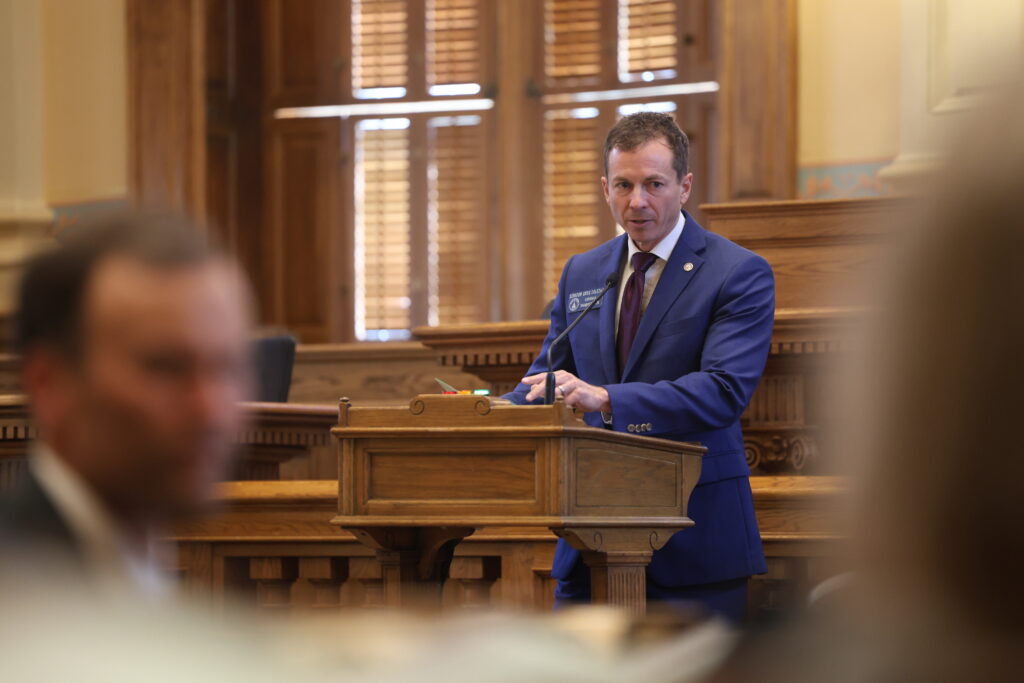
ATLANTA — A bill that honors conservative activist Charlie Kirk and protects students’ political speech won final approval from the Georgia General Assembly on Tuesday.
The Republican-controlled Georgia House voted 95-68 to pass the bill Tuesday over Democrats’ objections to Kirk, who co-founded the conservative student organization Turning Point USA. Kirk was assassinated last year during a Turning Point USA event at Utah Valley University.
The Senate later voted 42-7 on the bill. It now heads to Gov. Brian Kemp.
The legislation, Senate Bill 552, would make it illegal for public schools to deny access to school facilities for student meetings based on political or ideological content.
“They can’t discriminate based on the content of the subject or viewpoint of the group,” said Rep. Rob Leverett, R-Elberton.
Schools would still be able to restrict conduct that could disrupt education or infringe on other students’ rights, Leverett said.
The bill is named the “True Patriotism and Universal Student Access Act,” giving it the same acronym as Turning Point USA.
Democrats said they support student speech but opposed Kirk’s criticism of gay people, immigrants, and Black people.
“The title excludes some of the groups it purportedly seeks to include on our campuses,” said Rep. Jasmine Clark, D-Lilburn. “It breaks my heart that we are doing this bill in a way that only gives a nod to one political ideology and one specific organization.”
ATLANTA — Georgia voters will decide this year on a constitutional amendment that would dedicate their 911 fees to a statewide fund for improving emergency services.
The Senate voted unanimously Tuesday to put the 911 referendum on the ballot in November. The House previously approved the proposal.
The 911 fund could pay for cellphone technology that would allow Georgians to contact emergency services using voice, text, and data.
“Imagine you’re a first responder being able to see videos of what you’re rolling into, whether it be a terrible situation of an active shooter scene or a crime that just happened, or a firefighter rolling up on a hot fire situation,” said Rep. Chuck Martin, R-Alpharetta. “It makes the first responders safer and gives them the ability to react to the situation and get to the people that need help.”
If approved by voters, the 911 fee will remain the same as it is today, at $1.50 per month.
But instead of a local fee, the money would be used exclusively for expansion, maintenance, and operation of 911 services across Georgia, according to House Resolution 1243.
Senate Minority Leader Harold Jones, D-Augusta, said the fee could help improve emergency response times.
“We hear many stories: They call 911, a person may not answer. It’s not quite up to the quality level. This is what we’re hoping to actually change,” Jones said.
ATLANTA — A proposal for a quick switch to hand-marked paper ballots cleared the Georgia Senate on Friday, an idea that election officials say would disrupt this year’s elections.
The Senate’s 32-21 party-line vote sets up a showdown over competing bills that would change Georgia’s voting system. The Senate bill would take effect this summer, while a House proposal would delay the transition until the 2028 election year.
The measure that advanced Friday would require voters to fill out ballots by bubbling in ovals instead of making their choices on touchscreens. Millions of ballots would need to be preprinted and stored until voters fill them out.
Immediately replacing Georgia’s statewide voting system would be “irresponsible and unrealistic,” said Joseph Kirk, president of the Georgia Association of Voter Registration and Election Officials.
“It’s just not enough time” for training, testing, and implementation, Kirk said. “You don’t want to do it for the first time in a Georgia 2026 gubernatorial election, when we’re going to have lines and have a bunch of folks there. That’s a really heavy lift.”
The bill follows a state law legislators passed two years ago that set a deadline to remove computer QR codes from ballots by July 1 of this year. Critics of Georgia’s election system say voters can’t read QR codes to verify that their ballots accurately reflect their choices.
The House’s proposal would move that deadline until 2028, before voters decide on the next U.S. president.
Sen. Greg Dolezal, R-Cumming, speaks in support of House Bill 960 on the Senate floor, which would move Georgia to hand-marked paper ballots before this fall’s election, in the Georgia Capitol in Atlanta on Friday, March 27, 2026. (Ashtin Barker/Capitol Beat)
Sen. Greg Dolezal, R-Cumming, said now is the time to change to hand-marked paper ballots.
Hand-marked ballots are the main election day voting method in two-thirds of the United States, according to the election technology organization Verified Voting.
“Democrats tell you on one hand we should move to paper ballots. But now that we’re trying to do it, it’s a threat to democracy: Bloody Sunday, voter suppression, Donald Trump,” Dolezal said. “All that we’re asking is for Georgians … to vote the way that the vast majority of people in America vote.”
Critics of Georgia’s elections, including election security advocates and Republicans disillusioned by Trump’s loss in 2020, say Georgia’s touchscreen voting system is untrustworthy and insecure.
But election officials and Democrats say Georgia’s elections are accurate, and allegations of widespread fraud have never been proved.
Sen. Kim Jackson, D-Stone Mountain, said the bill’s requirement to print so many ballots before elections introduces new problems.
“We have built in all kinds of opportunities for human error, let alone the major security risks and concerns that I have when you have thousands and thousands of preprinted ballots sitting in someone’s fellowship hall,” Jackson said. “Georgia is moving in a direction of changing our system because there has been so much doubt seeded into our system, even though we’ve proven that they are safe and secure.”
Under the competing bill in the House, the state would purchase new ballot-on-demand printers that would create ballots when voters arrive rather than require blank ballots in advance.
The Senate bill also includes new provisions that would fine county governments $100 for each voter registration they fail to cancel after receiving information those voters might have moved away, require election officials to post the names of all voters by midnight on election day, and mandate recounts by hand.
Senators previously voted down a similar version of their elections bill earlier this year, but Republicans mustered enough votes Friday to override Democratic opposition.
With just two business days left before this year’s legislative session ends, Georgia lawmakers will need to decide how to resolve their difference.
The House could consider the bill that passed the Senate on Friday, House Bill 960. Or the House could move forward with its legislation, Senate Bill 214, that would replace Georgia’s voting system before the 2028 election.
ATLANTA — Now that the government isn’t making pennies anymore, Georgia lawmakers are planning to round cash transactions to the nearest nickel.
The penny proposal makes sense, said Sen. Chuck Hufstetler, R-Rome.
“It’s pretty simple,” Hufstetler said. “You round up or down to the nearest 5 or 10. It all evens out.”
The Georgia Senate voted 50-0 to approve the legislation Wednesday, sending it to the House for a potential final vote.
If the bill passes, Georgia businesses would be required to round down transactions that end in a 1, 2, 6, or 7. Prices that end in a 3, 4, 8, or 9 would be rounded up. And items with costs that end exactly in a 0 or 5 would stay the same.
The proposal applies to in-person purchases made with cash. Transactions with credit cards wouldn’t need to be rounded.
The debate prompted senators to crack a few jokes.
“Is a penny earned a penny saved still valid?” asked Sen. Carden Summers, R-Cordele.
“Is it not true that this legislation isn’t worth a dime?” asked Sen. Max Burns, R-Sylvania.
The Trump administration decided last year to stop producing new pennies, which are worth less than they cost to make.
With pennies gradually disappearing from circulation, Georgia is one of several states across the country considering legislation to round transactions, according to the National Conference of State Legislatures.
Customers would still be able to pay with exact change if they wish, according to House Bill 1112.
The House previously passed a different version of the bill that rounded transactions differently. Now the House needs to decide whether to agree to the Senate’s proposal or seek further revisions.
ATLANTA — When police pull over someone with autism, those stops can quickly escalate into confrontations because of miscommunications and stress.
The General Assembly gave final approval Wednesday to a bill designed to alert police so they handle those situations better.
The legislation, which is now heading to Gov. Brian Kemp’s desk, would create a specialty license plate for people with autism or developmental disabilities. It also calls for police to receive training in effective communication and using alternatives to handcuffs.
A star of the Netflix show “Love on the Spectrum,” Connor Tomlinson, urged representatives to support the bill before they voted unanimously to approve it.
“Today … we usher in a new beginning for Georgia as we try to make this state safer for the autistic and neurodiverse,” Tomlinson said in the House.
The bill is called “Rio’s Law,” named after a boy with autism whose mother, Layla Luna, advocated for a similar law that passed in South Carolina after a difficult traffic stop.
“This is a tool for law enforcement. It allows responders to approach a vehicle with situational awareness before escalation into a sensory overload with an individual with autism,” said Rep. Eddie Lumsden, R-Armuchee.
Under Senate Bill 433, the autism license plate would include a symbol to represent autism. It would be issued only to Georgians whom medical practitioners swear have autism or a developmental disability.